The Bureau That Sank the Moskva Is Now the Partner Europe Wants
Live from Ukraine 🇺🇦
The Bureau That Sank the Moskva Is Now the Partner Europe Wants
Live from Ukraine 🇺🇦
Thanks to the support of generous and determined, true friends like you, we will keep reporting on this terrible war with our boots on the ground.
We are grateful to those who support the message that must and can go on from a free Ukraine.
Kyiv — There was a time, early in this war, when danger could be measured. You stayed four or five kilometers back from what we still called a line, and the arithmetic held: artillery had a reach, a beaten zone, and an edge you could plot on a map and respect. The front was a line, and a line has two sides. We were observers in the middle.
That geometry is gone. The front first took depth, then height, and once it had both, it stopped being a line at all. It became a volume — a column of lethal air standing over everything, twenty, fifty, two hundred kilometers deep, watching with patience and striking with selective precision. The rear dissolved into it. Roads that were safe by daylight became suicidal. Assembly areas, field hospitals, the slow business of evacuating a wounded man — all of it now sits within the kill zone. The danger to us is the drone, almost to the exclusion of all else. We who came here to observe, by the simple physics of the thing, become prey.
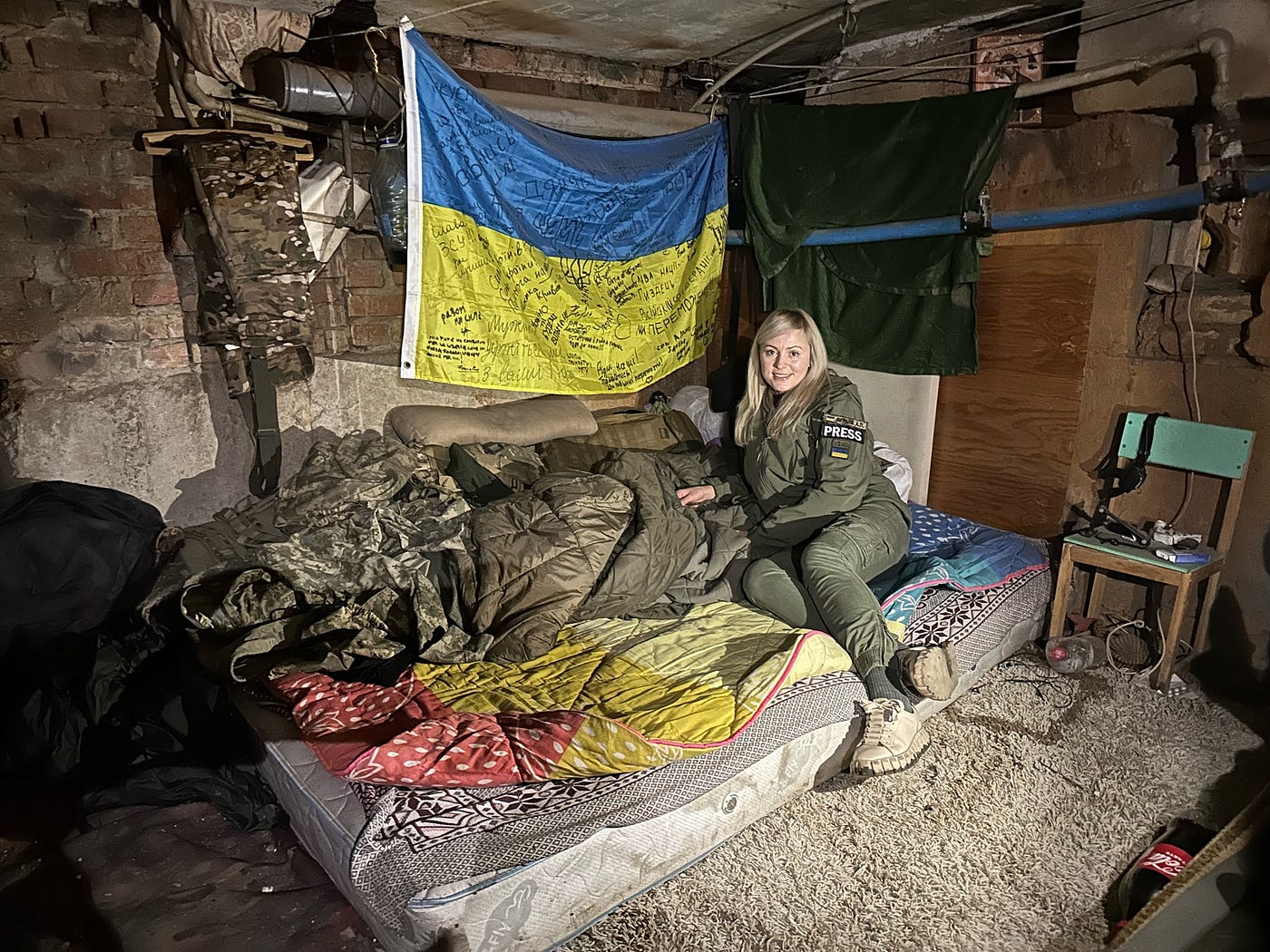
[embed]Alla and I recorded this footage in Pavlohrad, Ukraine — copyrighted media content Giorgio Provinciali
Drones do more than watch. They can dive as kamikaze. They hover and drop munitions of every kind, including mines sown one by one onto a road. They now fire from the air on their own. The eye and the trigger have fused into a single cheap object, and that fusion is the whole story of the modern battlefield.
The numbers say it plainly. Ukraine logged 819,737 video-confirmed drone hits across 2025, and by official accounting, unmanned systems now account for more than 80% of all targets destroyed. UN human rights monitors have also reported that up to 95% of civilian casualties from short-range drones occur in frontline territory under Ukrainian control, warning that more than a year ago, short-range FPV drones had already become the single deadliest weapon for civilians, killing them in their cars, on buses, in the street. By the count that matters where we work, the share of the actual killing runs higher still — closer to nineteen in twenty. The artillery duel that defined the first years has been demoted to a supporting act.
Yesterday in these pages we showed you the sea side of that revolution: images of Ukrainian naval drones, the Sea Baby and the Magura, among the machines that today keep Crimea and the temporarily occupied Black Sea coasts of the southern regions under permanent threat. Today’s photographs, alongside this dispatch, show you several more of these technological prodigies — the ones that carried Ukraine from a beggar to a world leader in the span of forty-eight months.
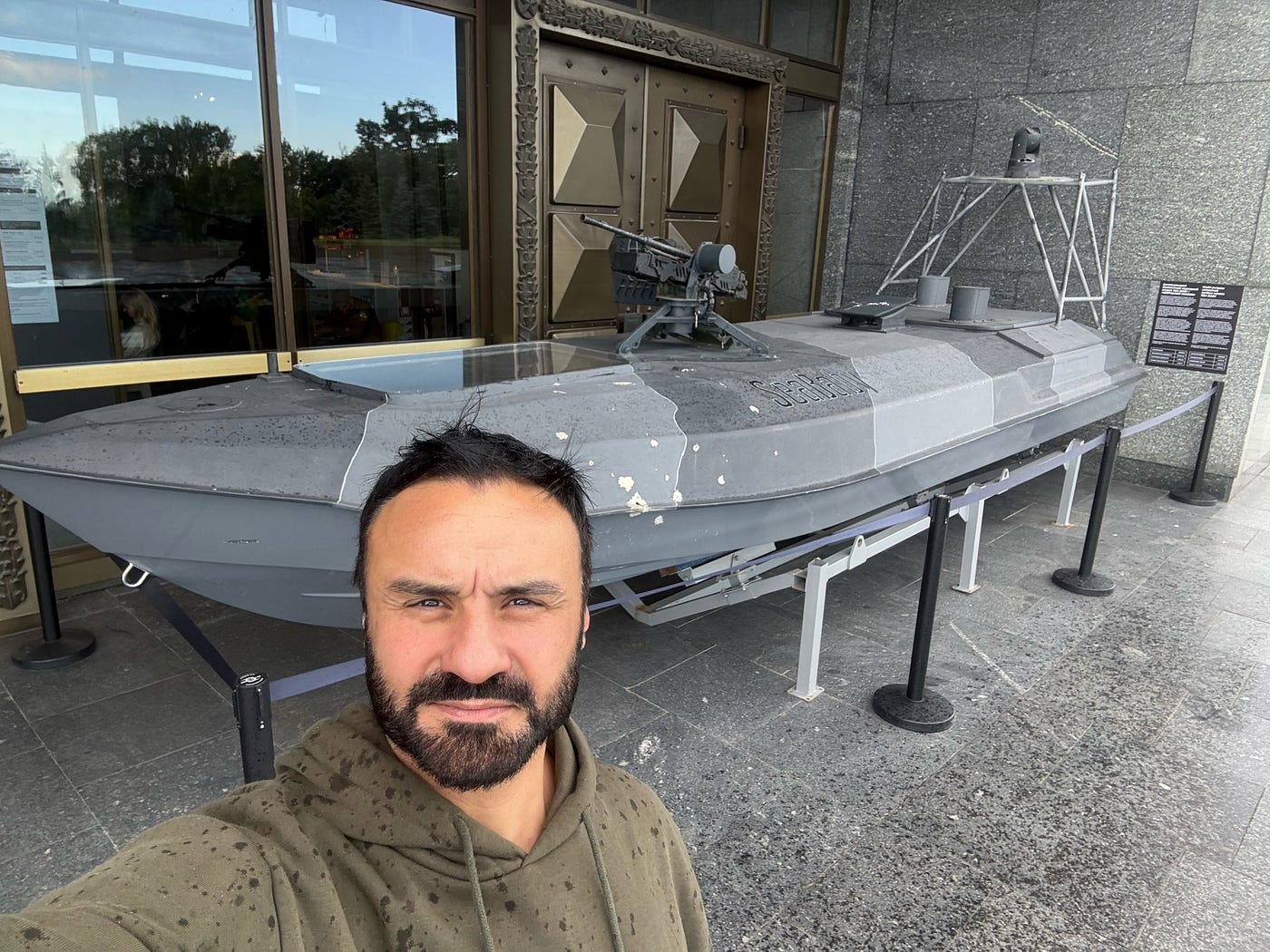

A “Sea Baby” and a “Magura” marine drone used by the Ukrainian Armed Forces — copyrighted photo Giorgio Provinciali
Four years ago, this country was importing weapons in desperation, taking whatever its Western allies would part with. Much of it was warehouse surplus, some of it more than half a century old. None of that mattered; anything that fired was vital. Today Ukraine builds more new weapons systems than any nation on earth. Its Ministry of Defence certified 175 new systems in the single month of May, nearly ninety-three percent of them designed and manufactured inside the country — six new systems every day.
Set that against the rest of the alliance, and the gap turns into an indictment of peacetime procurement itself. As Verity Bowman reported in The Telegraph, Germany cleared fewer than twenty new systems in the whole of 2024 — and that was its record year. The United States fields between two and five genuinely new platforms a year, on procurement cycles that average a decade.
Ukraine compresses into a Tuesday what Berlin manages in a calendar year.
The workshops scattered across the country have built a war machine while NATO’s heaviest members stood still.

Alla stares at the ruins of the Dolyna Monastery in Donetsk, Ukraine’s Donbas — copyrighted photo Giorgio Provinciali
What follows is a walk through the latest of those machines, because each one carries an argument about where this war is going.
The most consequential change of the past year is that the drone has acquired a predator. Ukrainian engineers have presented a new generation of SkyFall interceptors, the P1-SUN Long, which carry onboard artificial intelligence and are already credited with dozens of successful kills against incoming Shahed drones. An interceptor that thinks for itself is the beginning of a drone-versus-drone equilibrium, and the side that closes that loop fastest will own the sky.
That same logic of autonomy runs through the strike fleet. Among May’s newly certified drones sits the Lupynis, built by a startup whose founder once made remote pet cameras; for most of its flight, a human flies it, and in the final five hundred meters — exactly where Russian electronic warfare is thickest and the link most likely to be cut — its onboard brain takes the target and finishes the job alone. Range matters less than that last half-kilometer of independence.

A Ukrainian P1-Sun drone — copyrighted photo Giorgio Provinciali
The enemy understands the equilibrium too, and answers with cheapness. Ukrainian monitors, among them Serhij “Flesh” Beskrestnov, have logged a crude new Russian jet drone on the front — primitive, analog video, a warhead of up to four kilograms, and a speed near 300 km/h. Its only purpose is to run down the small, slow interceptors that Ukrainian fire teams send up against Shahed swarms. The counter-drone is itself being countered.
On the ground, the picture is the same and strange. In an interview with RBC-Ucraina, the head of Ratel Robotics described a battlefield where logistics robots now make up seventy to eighty percent of all ground drones, hauling supplies, evacuating the wounded, and occasionally taking Russian soldiers prisoner. They stay small because anything large dies fast. They run on three nervous systems at once — Starlink, mobile LTE, and plain radio — and Ukrainian models cost roughly half as much as their European equivalents while outperforming them. The Telegraph singled out the Ratel X among May’s certified machines: a low-profile combat robot that scouts, lays mines, and carries casualties out of the zone where no stretcher-bearer can survive. The teeth-to-tail ratio of armies has been inverted; the tail now has to be robotic because the tail is inside the kill box.

A Ukrainian Sea Craft – copyrighted photo Giorgio Provinciali
Ukraine began this war having lost most of its navy in 2014. It is ending the naval phase by driving the Russian Black Sea Fleet out of Sevastopol’ and into Novorossiysk using boats with no crew.
The surface drones did that — the Magura and the Sea Baby — and the Magura then downed a Russian Su-30 with air-to-air missiles, the first time in history an uncrewed surface vessel has shot down a combat aircraft. The latest Sea Baby generation, the SBU confirmed, ranges past 1,500 kilometers, carries two tons of payload, mounts a stabilized machine gun or a Grad launcher, and was used in the June strike on the Kerch bridge.
Now the war goes underground. At Eurosatory in Paris this week, Global Mark presented the Sea Trident, a ten-ton autonomous underwater drone with a 3,218-kilometer range, a one-ton payload, and a quiet, low-signature hull built to hunt strategic targets — and to hunt other underwater drones. A country with almost no navy has opened a new contested domain beneath the one it already dominates. The Kerch bridge and every Russian quay on that sea now have a problem they cannot see coming.
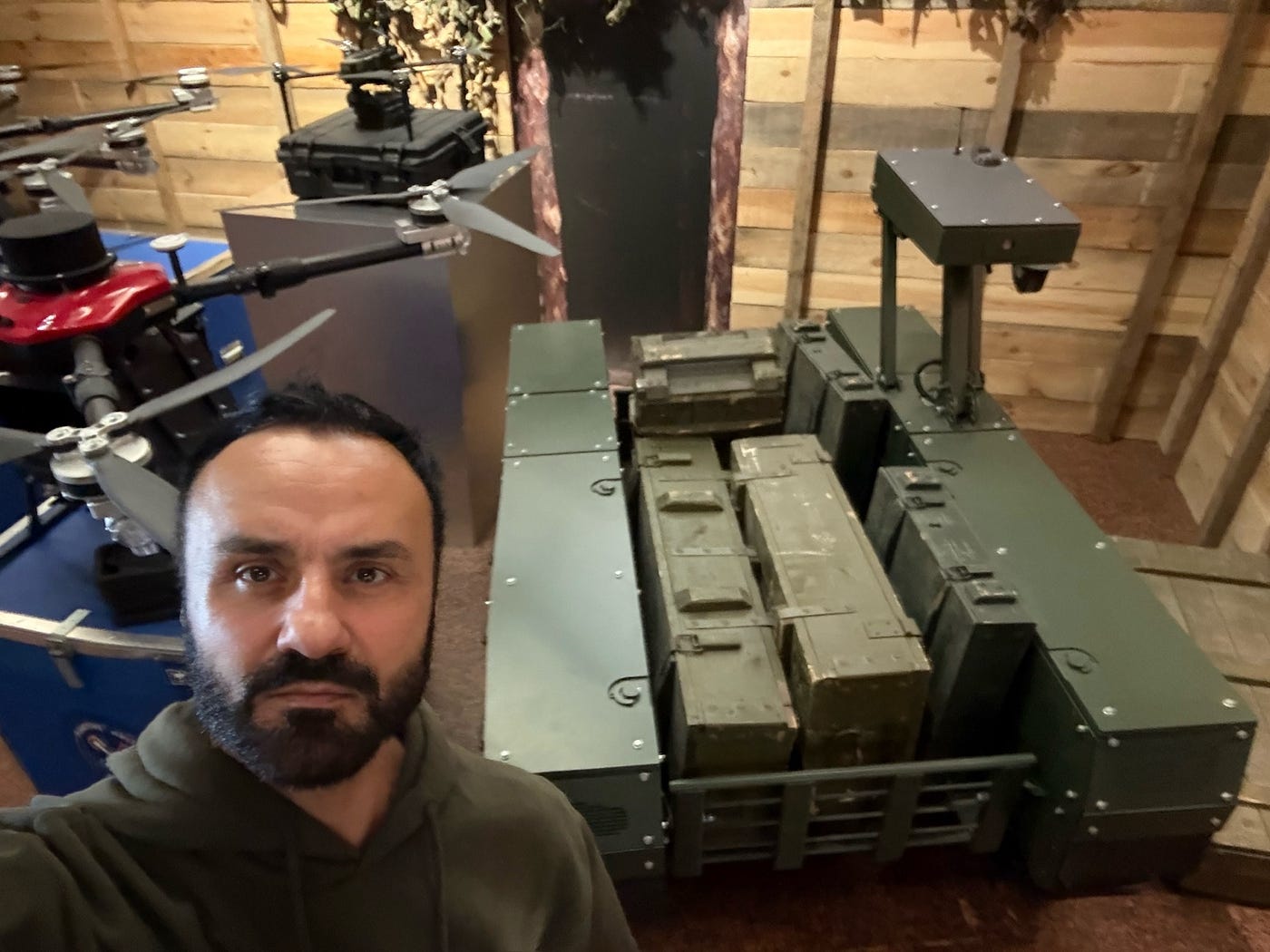
A Ukrainian UGV – copyrighted photo Giorgio Provinciali
The deep-strike inventory is filling out just as fast. Ukrainian engineers have built the DART, a small missile launched not from a runway but from stratospheric balloons at 12 to 18 kilometers altitude, with a warhead between 3.5 and 10 kilograms — its selling point is near-immunity to electronic warfare, as Militarnyi has detailed. The same anti-jamming obsession recurs everywhere, because the entire war is a contest over the electromagnetic spectrum.
The headline of the week, though, came from Europe. MBDA — the maker of Storm Shadow and a consortium that counts Italy’s Leonardo among its owners — signed a memorandum with Ukraine’s Luč design bureau to develop NEPTUNE2, a deep-strike evolution of the cruise missile whose first version sank the cruiser Moskva in April 2022.
Read that sentence twice.
The bureau that humiliated the Russian flagship is now the junior partner European primes want in the room. The relationship of 2022 has reversed.

Ukraine’s “Sting” — copyrighted photo Giorgio Provinciali
Russia’s own attempts to keep pace look ragged by comparison. RBC-Ucraina reported the first use over Kyiv of the Banderol, a missile-drone with a 500-kilometer range, 500 km/h speed, and a 150-kilogram warhead — faster than a Shahed and therefore harder to intercept, built by the sanctioned Kronstadt firm, carried by the Orion drone or the Mi-28N, and stuffed with Chinese, Japanese, American, and South Korean components. It will stay rare, because each one costs three times a Shahed.
The economic discipline that lets Ukraine build six systems a day is exactly what Russia cannot reproduce.
And then there is the Oreshnik, Moscow’s ‘hypersonic’ showpiece. When it first fell on some garages in Bila Tserkva, in only its third wartime use, we argued that nothing about it deserved the awe it was given. The leaked correspondence published this week by The Insider and dissected by Dallas Analytics — revealed by RBC-Ucraina — confirms it. The missile’s accuracy depends on a GU-503 gyroscope, a Soviet aviation instrument from the 1970s hastily adapted to a hypersonic body. At those speeds a half-degree wobble throws the warhead tens of kilometers off target. The plant that made the gyroscope told its customer in March 2025 that serial production had stopped, that the calibration rigs dated to the early seventies and had largely failed, and that there was no replacement. Under the Kremlin’s deadline pressure the factories assembled missiles without verifying the gyroscopes at all. Hence an Oreshnik landing on a garage cooperative in Bila Cerkva. A wonder weapon undone by a part it can no longer build — the V-weapon logic of 1944, terror substituting for accuracy.

Me reporting from Bila Tserkva, where the third “Oreshnik” fired against Ukraine (fourth including the one crashed in the territories of Donetsk illegally occupied by Russia) crashed— copyrighted photo Giorgio Provinciali
Ukraine, meanwhile, is building the thing that would change the equation outright. The developers behind the Fire Point “ballistic shield” set out four conditions for a working interceptor: the missile is ready aerodynamically, but it needs to be married to a command center, to radars, and to a seeker head before it can actually kill incoming ballistic targets.
On the offensive side, Defense Minister Mykhajlo Fedorov — who told reporters that air defense and counter-ballistics have been his priority since January, and floated joint ventures with allies to get there — has now declared that Ukrainian ballistic missiles will be built and will strike Russian soil. «Ukrainian ballistics will change everything in this war», he said, and change Ukraine’s standing in the world. He added the line that ought to focus every mind in Kyiv and Moscow alike: «there is a window of opportunity, and for the next six months Ukraine holds the battlefield advantage».

me at a randez-vouz in the Donbas 🇺🇦 – copyrighted photo Giorgio Provinciali
Underneath the hardware sits the part nobody photographs. The American startup Enabled Intelligence has opened an archive of more than 500,000 hours of real Ukrainian combat drone footage — already labeled and verified, ready to be poured into neural networks — for “authorized users” across the United States, Ukraine, and NATO. That is the raw material of machine autonomy: enough tagged reality to teach a drone to find and strike a target with no operator in the loop, which is precisely what survival demands once enemy EW severs the link.
The drone war is becoming a data war, and the half-million hours are its oil reserve.
Militarily, the volumetric front kills the concept of the safe rear, and with it most of the doctrine taught in Western staff colleges. Mass and movement, the twin verbs of mechanized war, both glow on a thermal camera. The advantage now belongs to whoever shortens the loop between seeing and striking — which is why the Lupynis’s autonomous final approach matters more than any range figure, and why the first air-to-air kill by a sea drone is a larger event than its modest tonnage suggests. We are watching warfare migrate from the platform to the algorithm.
Economically, the war has collapsed the cost of a kill. A five-hundred-dollar quadcopter threatens a vehicle worth a thousand times more; the Banderol at three times the price of a Shahed is a confession of Russian inefficiency written in rubles. Ukraine’s six-a-day cadence, fed by a marketplace where brigades order drones almost as one orders from Deliveroo, exposes the pathology of ten-year procurement cycles. The decisive scarcity has shifted from steel to spectrum, code, trained operators, and a handful of imported microchips. Which is also why Russia now spends its best missiles hitting the workshops themselves — the center of gravity has moved from the trench to the lathe.
Historically, the inversion is the thing to hold onto. A nation that imported half-century-old castoffs in 2022 now co-develops cruise missiles with the firm that arms half of Western Europe, and the G7 is preparing to hand it production licenses so that foreign weapons can be built, legally and at scale, on Ukrainian benches — alongside an urgent surge of air defense, a sharp increase in long-range capability, and a new sanctions package aimed squarely at Russian oil and gas.
The arsenal of democracy has acquired a second address: Kyiv.

A Ukrainian automated machinegun — copyrighted photo Giorgio Provinciali
There is a literary shadow over all of this, and it falls, fittingly, from an Italian who covered this same ground. In Kaputt, Curzio Malaparte — a war correspondent on the Eastern Front in the very lands we flee from — described Soviet dogs trained to run beneath German tanks with explosives strapped to their backs: the living turned into guided munitions, sent out to die on a single mission. He wrote it as horror and prophecy. The kamikaze drone is that dog, perfected and mass-produced — the same idea, stripped of the animal, manufactured six times a day. Malaparte saw the principle on this soil eighty years ago. We are watching its industrial maturity.
The next phase of this war will be decided in three places at once. In the air, the interceptor race tips toward whoever automates the kill chain first, and the 500,000 hours of labeled footage point straight at autonomy — the moment the man comes out of the loop entirely, with the legal reckoning the UN has already begun to demand trailing behind. On the water and beneath it, the Sea Trident and the next Sea Baby variants put the Kerch bridge and every occupied coastline under a threat Russia cannot yet detect. And in the deep-strike contest, NEPTUNE2, a working Ukrainian ballistic missile, and a degraded, half-blind Oreshnik together erode the deterrence theater Moscow has leaned on since the war began.
Fedorov’s six-month window is real and narrow.
The one certainty is the one we live with every day on these roads.

Alla and me took this picture in the Southern territories Ukraine freed from the Russians — copyrighted photo Giorgio Provinciali
In 1.575 days of war, we recorded over 300 videos from ground zero and wrote more than 1,600 articles.
We are doing our best to provide genuine, first-hand reports from zones where almost no press dares to go. This means living in a kill zone constantly. We take the risk, but without your invaluable support, our voices would remain unheard and silent. Without brave people sharing our articles from afar, they would remain unread. Our reports would go unseen, and our efforts would be lost. There’s still a lot of work to do here, as the people around us are also in no better situation.
We’re renewing our fundraising campaign and thanking everyone who joins us in helping to restore what Russia is destroying. Moving forward, not even with a small reimbursement for each article we write, is extremely challenging. That’s why we are grateful to all the kind people who support us and trust in our mission.
Even a small donation helps.
We’ll keep you updated on developments.
Thank you all, dear friends 💙💛
Some simple hints to make this article more visible:
- Use this ‘friend link’ to share this article: https://medium.com/@giorgioprovinciali/the-bureau-that-sank-the-moskva-is-now-the-partner-europe-wants-ce49593d0ddd?sk=273eacf5d9637c863f8c585462b73a99
- Holding the👏🏽 button allows up to 50 ‘claps’
- Click on the arrows to repost this article
- Leave a comment
Here’s a playlist that includes lots of videos we recorded over 4 years:
https://www.youtube.com/playlist?list=PLmIio7cmINntHr9tMgmz5z4vEAbY7B
메타데이터
- post_id
- ce49593d0ddd
- slug
- the-bureau-that-sank-the-moskva-is-now-the-partner-europe-wants-ce49593d0ddd
- url
- https://medium.com/@giorgioprovinciali/the-bureau-that-sank-the-moskva-is-now-the-partner-europe-wants-ce49593d0ddd
- canonical_url
- https://medium.com/@giorgioprovinciali/the-bureau-that-sank-the-moskva-is-now-the-partner-europe-wants-ce49593d0ddd
- author_url
- https://medium.com/@giorgioprovinciali
- status
- ok
- fetched_at
- 2026-06-22 08:06:21