What Do You Do When The One You Love Most Says She Must Leave?
On Cyclops and Selkies and Myself
What Do You Do When The One You Love Most Says She Must Leave?
On Cyclops and Selkies and Myself
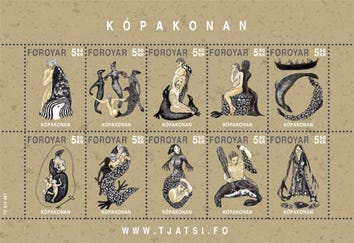
Stamp series of the Seal Woman (Kópakonan) from the Faroe Islands, 2007, design by Edward Fuglø; Wikimedia Commons
In the summer of 2021, I met the woman who felt like my future.
In October 2023, after we had lived together for five months, she told me she had to leave.
I did not understand why. She said she had explained many times. We parted on those terms. And in my pain, I chose not to ask more. I closed down.
Hurricane Helene devastated Asheville in late September 2024, but it put us back in contact with each other. And I finally asked her, Why?
With boats they could have turned this island into a fertile colony, with proper harvests. By the gray shore there lie well-watered meadows Where vines would never fail. There is flat land for plowing, and abundant crops would grow in the autumn… (Odyssey 9.130–136, Emily Wilson translation)
It can be jarring to see something familiar in a new way.
I’ve taught the Odyssey dozens of times over dozens of years. In the lines above, Odysseus is describing the island of the Cyclopes as he first saw it. Years ago, I read them straightforwardly. The island reflects its inhabitants: undeveloped and uncivilized. The Cyclopes lack society, laws, cities, government, craft, agriculture, and just about everything else.
At best, they’re pastoral. At worst, they’re monstrous one-eyed savages.
It’s a standard reading now, however, to read this passage as an example of a “settler’s perspective.” All Odysseus can see is what the island could be, if he was in charge. The meadows should be vineyards; the plains should be farmland; the neighboring island should be a fertile colony. He does not see what’s there for what it is. He reports it in a way that allows us to recognize its beauty, but he does not absorb it. He has no space in his soul for it.
And this, she tells me, resembles what she experienced with me.
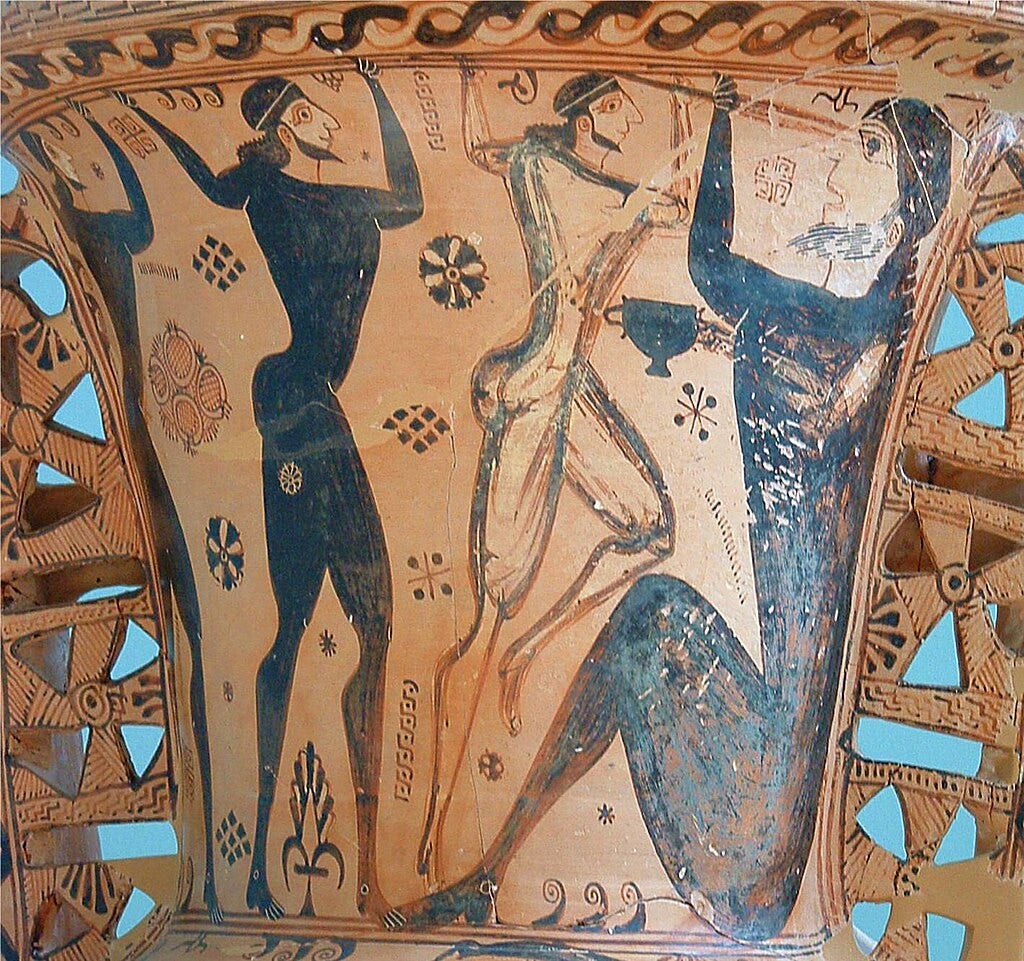
Funerary proto-Attic amphora, ca. 660 BCE. Detail of the neck: Odysseus and his men blinding the cyclops Polyphemus. Museum of Eleusis. Wikimedia Commons
This is not an instructive essay: this is a confession. I was blind.
We moved in together in April 2023, after nearly two years of a long-distance relationship. I started building toward a future. I knew that she was in a new city, a new studio, with new friends and colleagues, in addition to all the newness with me, and I tried to create a life for the two of us that would have safety and structure.
Though I never conceived of it this way, I must have viewed her as the raw material for this new life together, not as the beautiful, complicated, independent, connective woman that she is.
She felt that I was no longer curious. She points out that our time together fell into routine; our communication became formulaic and banal. I spent too much time on my computer. I was about checklists — shopping, cooking, looking at houses — and she needed real connection.
I swear that there was no malice or desire to subordinate her in what I did. I truly wanted to create a safe, supportive, nurturing environment for her.
Because she recognized that, she was in a double-bind: she didn’t want to hurt me by criticizing me for good intentions, even though in the process she was denying her experience. This deep inner conflict led her gradually to feel that she was losing herself — and she was.
She tried to tell me. I tried to hear. Somehow I could not absorb what she was saying. You need more space? Take this room, take more time to yourself. You do not feel seen or heard? Then explain everything to me. I will ask questions so you can clarify what I don’t understand.
I was asking her to do all the emotional work of opening my eyes, and she was already exhausted.
It was as if I knew all the vocabulary but none of the grammar of the language she spoke. The words made sense but the meaning was lost. And yet I felt satisfied that I understood the words.
Maybe the Irish-Scottish Selkie myth is a closer parallel. I remember when I first heard it from my friend David, an Asheville storyteller, and it became part of me. There are many versions.
A fisherman walking home from a day on the sea came across a sealskin on the rocks, and he picked it up and carried it home, where he placed it under the hearthstone. Later that night, he heard a knock at his door, and he found there a beautiful woman, cold and wet and naked but for the seaweed she was wrapped in. He brought her in, gave her clothes and fed her, and led her to a spare room to sleep.
She stayed the next day, and the next. She tended his house and accepted his kindness. They ate together and talked. He never asked where she came from, and she never said.
In time, their cohabitation became affection, and in the way of men and women, they grew to love each other. He called her his wife, and she bore him children. He was happy. And she seemed to be happy too, though many an evening he saw her looking out to the sea, lost to him.
One day, he came home with his catch, opened the door, and saw her standing by the hearth. She held the sealskin in her hand. One of her children had found it.
Oh, that! he said. I’d forgotten all about it.
Without a word, she walked past him and out of the house. The man never saw her again. Many afternoons he stood on the beach looking out to sea. He thought he saw her at times. He found fish left for him on the sand and his catch was larger some days. But she never returned.
Is this the experience of most women, or all women, who join themselves to men? Or does it begin even earlier, in their families, before women even make a choice?
For my beloved, this was her experience. She lost part of her essential nature.
She did not blame me for it, but she saw that I was not able to understand her experience. I was not open to it. She told me that she was struggling and I went into “fixing” or “defense” mode. I tried to listen. But I couldn’t let her experience simply be her experience: I had to solve or improve or correct it. I had to build something. I couldn’t let her stay in her own skin.
She used the word “patriarchy,” and “misogyny” is not far off. But she talks about them as systems we’re both steeped in, she and I, that shaped us even though they were doing harm.
The difference was that I did not perceive the harm. Not clearly, anyway. I could feel that we were not connecting as we had and I intuited that I did not understand as much as I wished. But I still trusted that we were building something, that we would find our way toward a solid relationship.
I see now that she could not imagine a relationship with someone who was not open to her experience, her pain, and her words. I see now that the space that she wanted was not in the house or in her daily schedule, but within me.
I see now that she had to leave.
Now that I see these things in my own past, I see them more often, like hearing a word for what I swear is the first time in my life only to encounter it again within days. This is not an instructive essay: this is a confession. I was blind.
Articles about women’s lives, and the things that cause them to lose themselves or to choose self-protection over relationships, are here and here and here. There are thousands more. What was I thinking when I read them?
I’m sure that most readers will see the difference between then and now. It’s the loss and the pain that cracked me wide open. It is wrenching to me that I activated so much pain within her and that I lost her for a year.
I will not be surprised if some readers resent my use of the Selkie myth. I understand. It tells the woman’s story and I’m appropriating it, in a way, and sanitizing it. There are versions in which the man knows exactly what he’s doing when he steals her sealskin. He does it to entrap her.
I prefer a version in which he’s ignorant and loving, but still culpable.
I prefer a version in which his sadness, standing on the shore each day, is as great as hers when she looked out to sea each evening, both of them lost.
Thank you for reading, my friends. For more on where where we are now…
[embed]How I Fell in Love with The Dread Pirate Roberts Learning to Love One Day at a Timemedium.com
메타데이터
- post_id
- ce4ca415ff26
- slug
- what-do-you-do-when-the-one-you-love-most-says-she-must-leave-ce4ca415ff26
- url
- https://medium.com/know-thyself-heal-thyself/what-do-you-do-when-the-one-you-love-most-says-she-must-leave-ce4ca415ff26
- canonical_url
- https://medium.com/know-thyself-heal-thyself/what-do-you-do-when-the-one-you-love-most-says-she-must-leave-ce4ca415ff26
- author_url
- https://medium.com/@bshook-92488
- status
- ok
- fetched_at
- 2026-07-21 13:34:43