ESTCube-LuNa early concept of operations
ESTCube-LuNa includes several redundant solutions for navigation, attitude determination and control, as well as for communications
ESTCube-LuNa early concept of operations
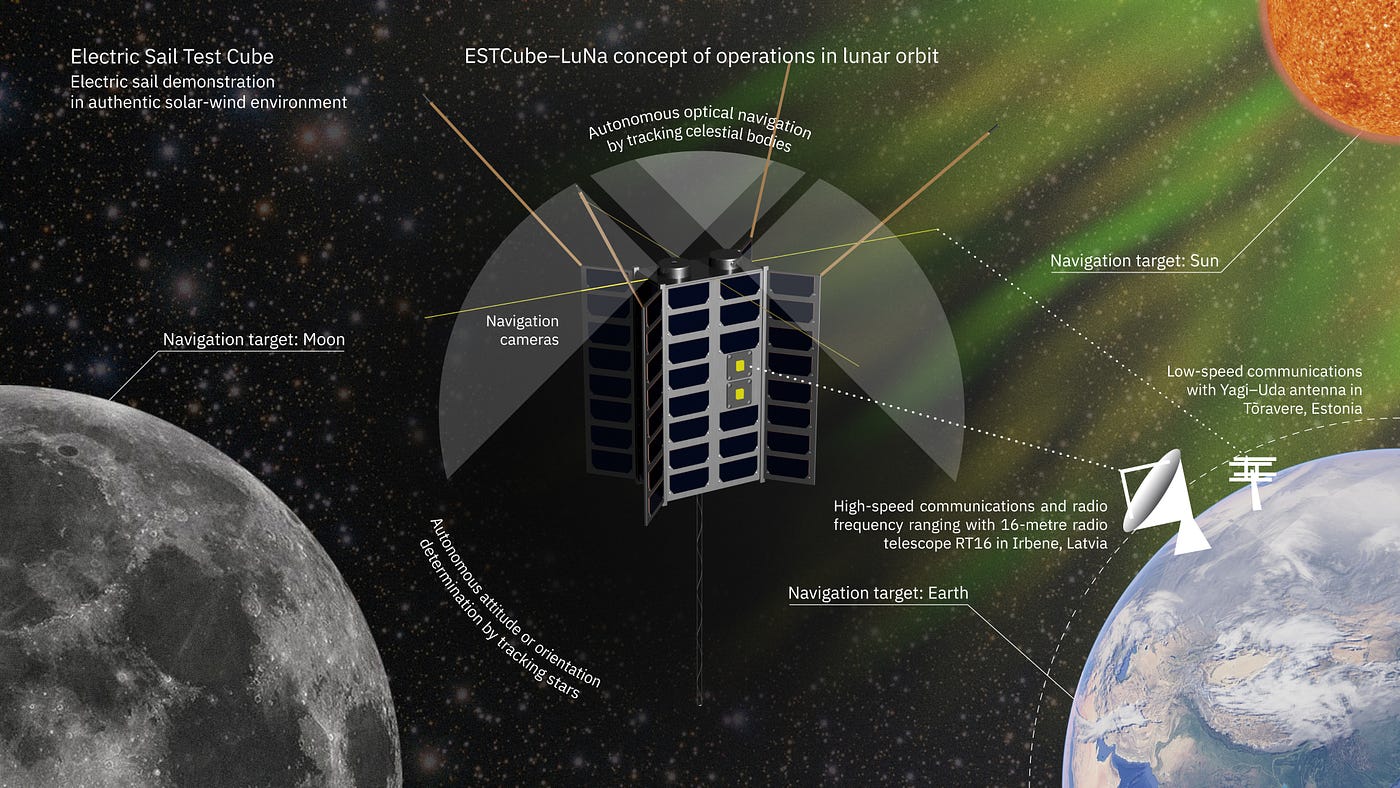
The ESTCube Lunar Nanospacecraft, or ESTCube-LuNa, concept of operations includes attitude control and navigation, which we have covered earlier, as well as communication solutions, which is the focus of this blog post. The plan is to use two parabolic antennas of 16 and 32 metres in size, located in Irbene, Latvia, for high-speed communications and for the E-sail experiment orbit determination. Credit: Space Travel Blog / ESTCube / UT Tartu Observatory / Mario F. Palos, Karl-Mattias Moor, Anna Maskava and Rute Marta Jansone.
Hi there,
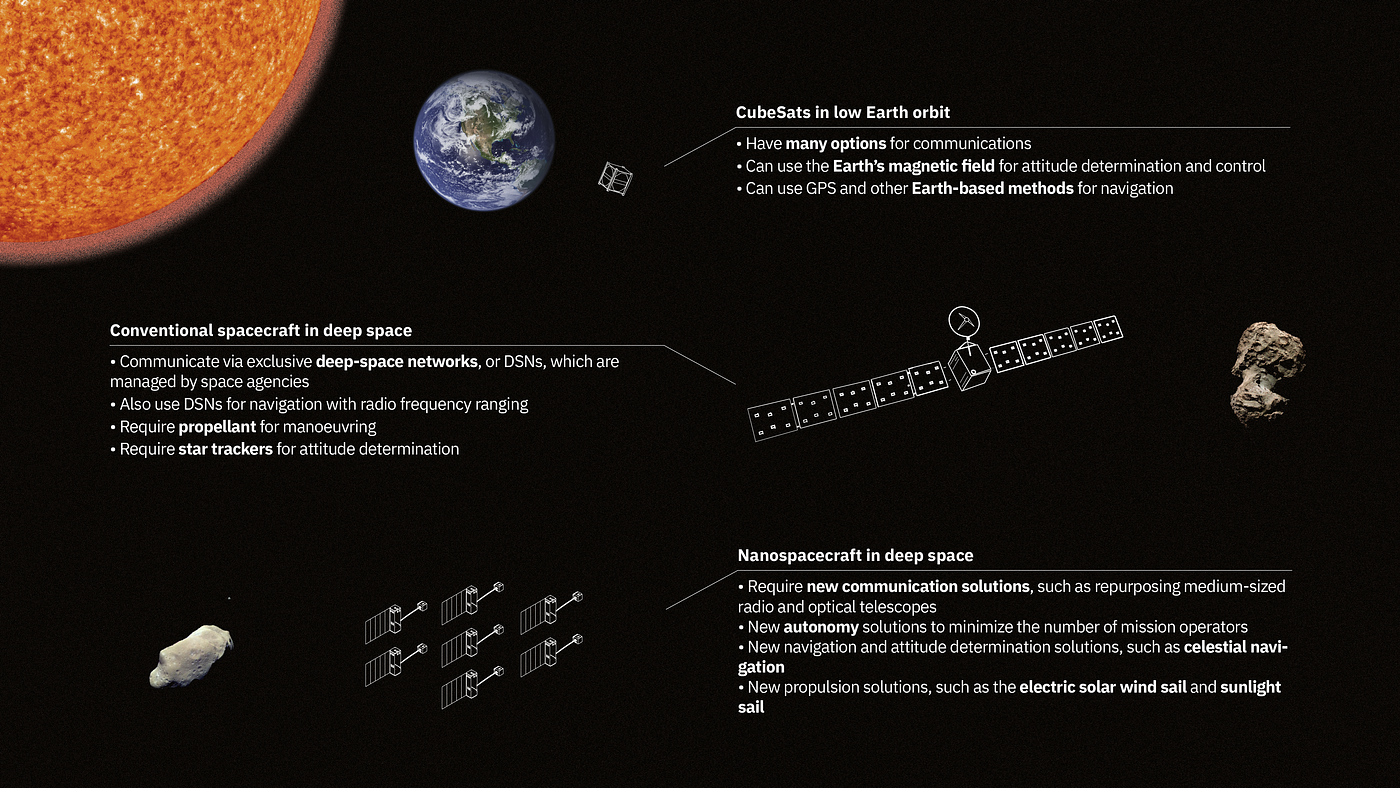
In an earlier blog post on ESTCube Lunar Nanospacecraft attitude and navigation, we promised to cover the mission operations. Here we are trying to figure out how to operate a nanospacecraft in lunar orbit without accessing agency-operated deep-space networks, or DSNs. It was back in 2006 when I decided to study Computer Science at Ventspils University College in Latvia (now Ventspils University of Applied Science, or VUAS). Only later did I learn about the Ventspils International Radio Astronomy Centre (VIRAC), which operates two parabolic antennas: Radio Telescopes 16 and 32, or RT-16 and RT-32. The corresponding numbers stand for their diameter in metres. Now, 18 years later, these dishes have been repurposed for two-way communications and are included in Sweden’s SSC Lunar Ground Network. We have been assuming RT-16 and RT-32 capabilities in designing ESTCube-LuNa operations and high-speed communications.


Radio telescopes RT-16 (left) and RT-32 (right) operated by VIRAC and repurposed for communications. Credit: Ventspils University of Applied Science.
For low-speed communications in the ultra-high frequency, or UHF, band, we have assumed a Yagi–Uda antenna located at UT Tartu Observatory in Tõravere, Estonia, and a turnstile antenna located on ESTCube-LuNa. While more similar ground stations around the globe are necessary for continuous daily and monthly coverage, the on-board turnstile solution was selected to work in any direction, so we expect low-speed communication blackouts only when the nanospacecraft is behind the Moon. We hope the global radio amateur community would be interested in supporting the lunar mission in UHF.
For high-speed communications, the VIRAC infrastructure is critical, and covering the other side of the Earth is necessary (we will be looking for additional partnerships while securing the mission funding). Now, for mission analysis, we assume that one of the radio telescopes will be available for planned communications sessions and for radio frequency, or RF, ranging experiments to determine the E-sail orbital displacement. This means that RT-16 and RT-32 will be busy most of the time, hence the need for low-speed communications and for an optical on-board navigation solution.

EnduroSat X-band patch antenna used as a design example for ESTCube-LuNa. Credit: EnduroSat.
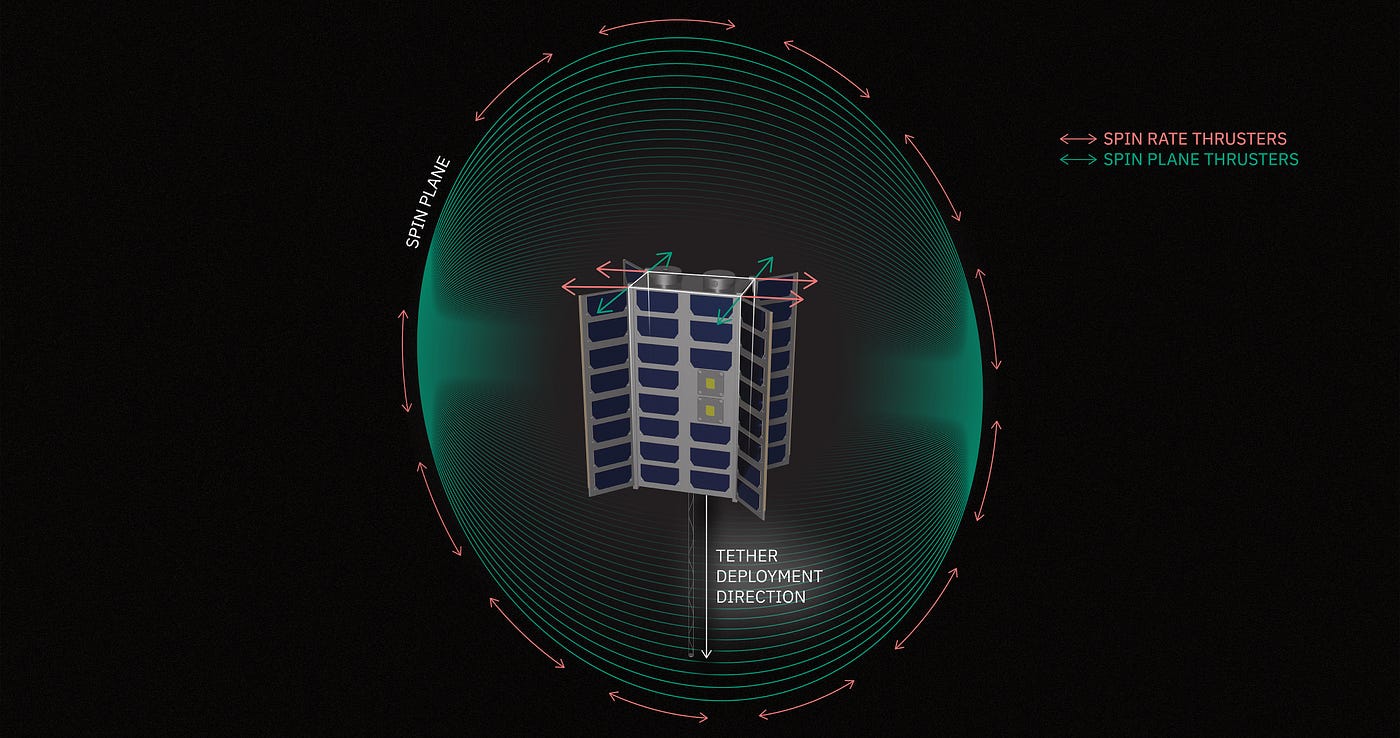
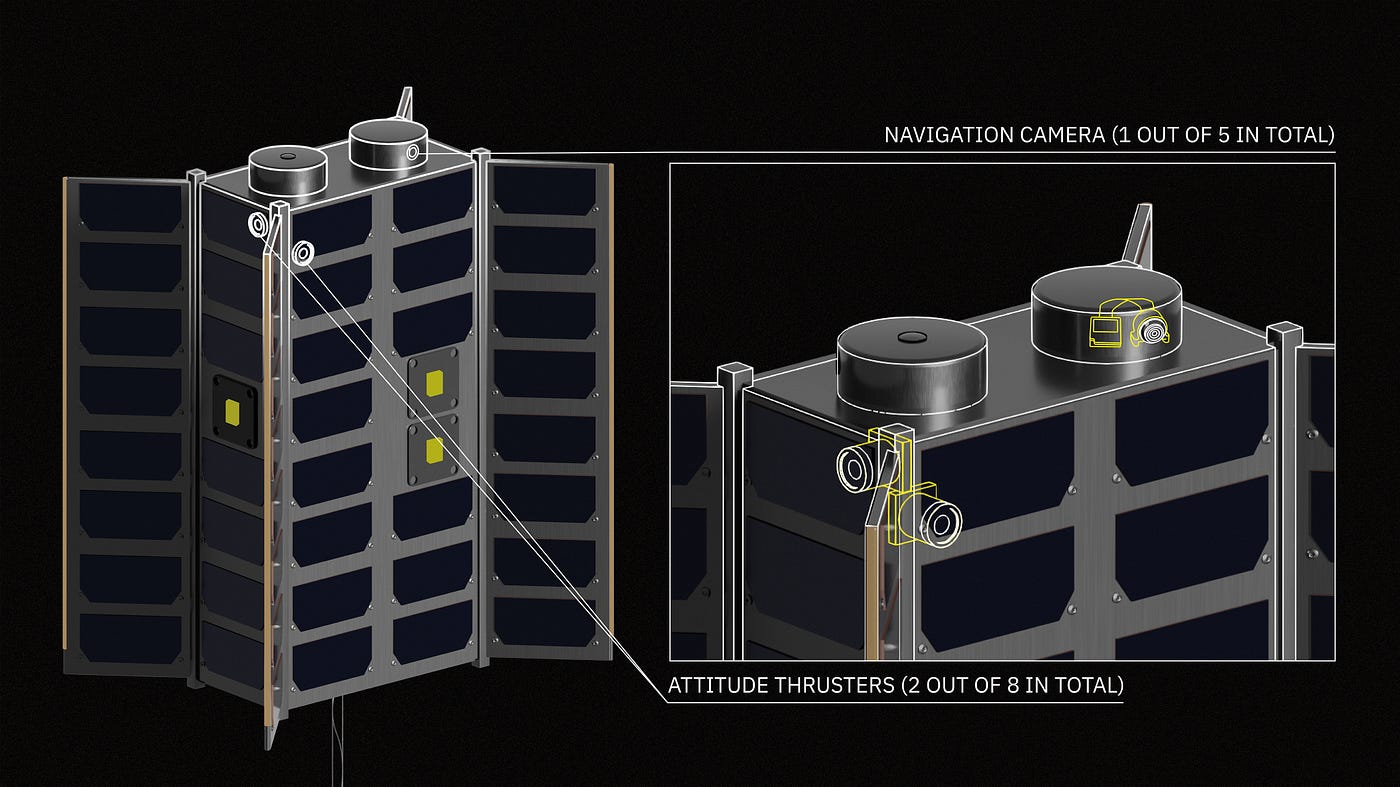
The primary purpose of high-speed communications is to downlink the experiment data, which requires one antenna on the spacecraft. Since ESTCube-LuNa operates in a spin-stabilised mode, the ability to point the on-board patch antenna towards the ground station will be very limited. Therefore, we have placed patch antennas on four sides of ESTCube-LuNa for improved coverage. As a design example, we have used the EnduroSat X-band antenna, which takes up only one quarter of a single-unit cubesat face. On one of the sides, as shown in the top image, there are two antennas required for the RF experiment’s downlink and uplink.
The E-sail orbital displacement and RF ranging experiments will have to be carefully planned in advance.
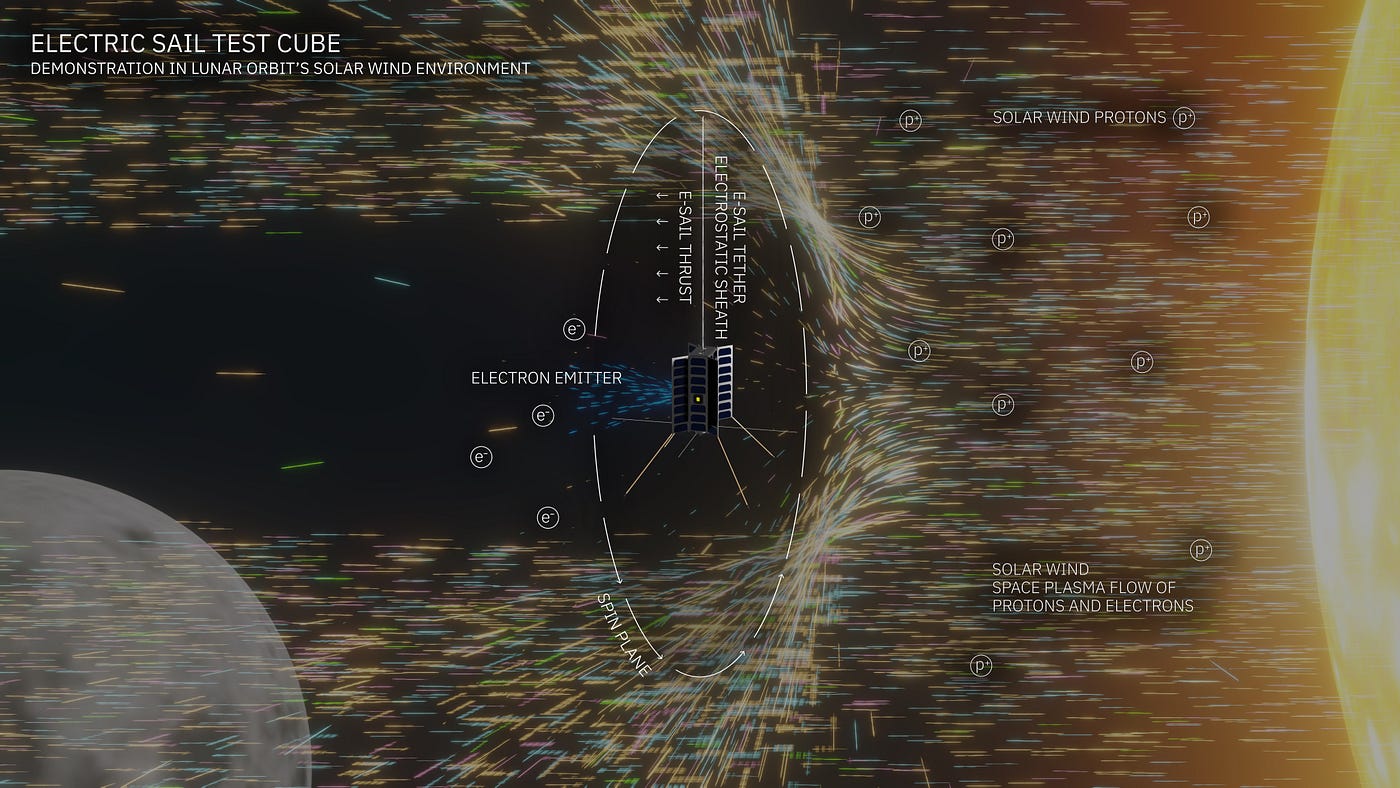
1st of all, we have to be patient: the E-sail spin plane will be in an optimal orientation twice a year when, for several days, we will be able to generate thrust and effectively change the orbital altitude.
2nd, we have to characterise the ESTCube-LuNa orbit before the E-sail experiment: this will be our baseline.
3rd, we need a high-order orbit propagator, such as DOCKS, to calculate how the baseline orbit would evolve in time without any thrust (lunar orbits are known to be unstable).
4th, ESTCube-LuNa starts the orbital displacement experiment which, we estimate, changes the baseline orbit by 14 km.
5th, we characterise the orbit after the E-sail experiment.
6th, we compare the propagated baseline with the newly characterised orbit.
Cheers, Andris
P.S. You can find more details in the following scientific article.
Slavinskis, A.; Palos, M.F.; Dalbins, J.; Janhunen, P.; Tajmar, M.; Ivchenko, N.; Rohtsalu, A.; Micciani, A.; Orsini, N.; Moor, K.M.; et al. Electric Sail Test Cube–Lunar Nanospacecraft, ESTCube-LuNa: Solar Wind Propulsion Demonstration Mission Concept. Aerospace 2024, 11, 230. https://doi.org/10.3390/aerospace11030230
Authors: Andris Slavinskis Editors: Janis Dalbins and Ivo Müürsepp (Tallinn University of Technology) Proofreading: Robert B. Davis Design: Anna Maskava, Mario F. Palos and Rute Marta Jansone
Attribution (text): Space Travel Blog / ESTCube / UT Tartu Observatory / Ventspils University of Applied Science Attribution (images): see captions
[embed]ESTCube-LuNa mission concept video.
메타데이터
- post_id
- ce4ef9071eca
- slug
- estcube-luna-conops-ce4ef9071eca
- url
- https://space-travel.blog/estcube-luna-conops-ce4ef9071eca
- canonical_url
- https://space-travel.blog/estcube-luna-conops-ce4ef9071eca
- author_url
- https://medium.com/@andris.slavinskis
- status
- ok
- fetched_at
- 2026-07-29 11:15:25