The Day the AI Got It Wrong
And the Human Who Saved More Than Just a System
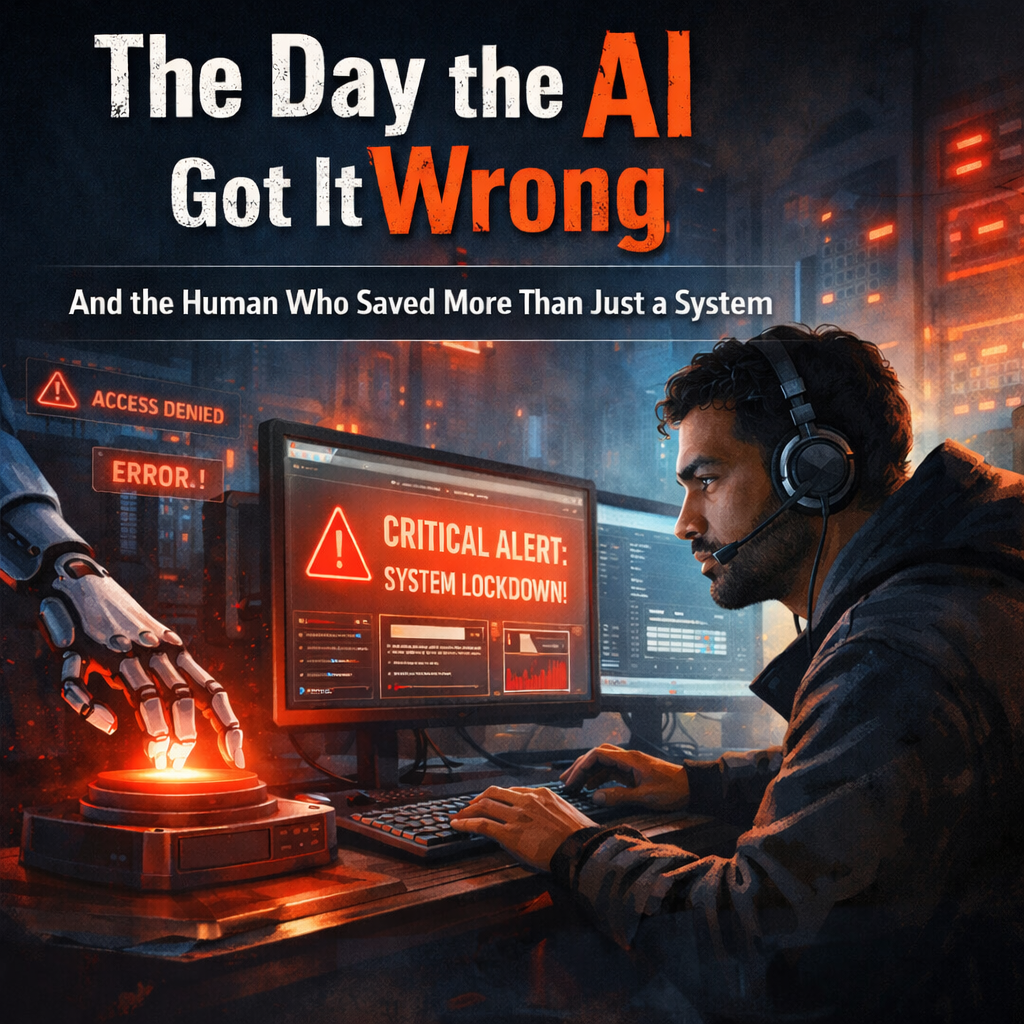
The Day the AI Got It Wrong
And the Human Who Saved More Than Just a System
It was 2:17 AM when the alert hit.
Not the usual kind the kind you ignore and snooze. This one was different. Critical, Escalated. Flashing red across every dashboard.
My friend stared at the screen, half-awake, half-annoyed. Another false positive, he thought. The new AI-based monitoring system had been triggering alerts all week. Smart, they said. Self-learning, they said.
“Too smart for its own good,” he muttered.
But something felt off.
The System That Never Sleeps
Three months earlier, the company had deployed a cutting-edge AI engine to monitor its global network. It promised everything:
- Real-time anomaly detection
- Automated incident response
- Self-healing infrastructure
The pitch was simple: “Let the machine handle it.”
And for a while, it worked beautifully.
Until it didn’t.
A Decision Made in Milliseconds
The alert read:
“Suspicious traffic pattern detected. Initiating automated containment.”
Within seconds, the system had already acted.
- Traffic rerouted
- Nodes isolated
- External connections blocked
Efficient. Precise. Ruthless.
Too ruthless.
Because among those “suspicious” connections There were real users. Thousands of them.
Customers locked out. Transactions failing. Systems going dark.
All because the AI made a call.
The Pattern It Didn’t Understand
My Friend noticed something subtle something the AI had missed.
The traffic spike wasn’t malicious.
It was predictable.
A regional festival sale. A surge in legitimate users from a specific geography.
A pattern that looked abnormal, only if you didn’t understand context.
And AI, for all its brilliance, didn’t.
The Human-in-the-Loop Moment
This was the moment that mattered.
- Not the algorithm.
- Not the automation.
- But the human.
My friend overrode the system.
Manually.
- Restored blocked routes
- Re-enabled access
- Tuned the detection thresholds
It took him 11 minutes.
It saved the company millions.
What the Machine Learned That Night
The next morning, the system logs told a different story.
Every correction my friend made was fed back into the model.
The AI didn’t argue.
It learned.
The next time a similar pattern appeared, the system paused.
Not because it was unsure.
But because it had learned when to ask for help.
The Truth We Don’t Talk About
We love the idea of fully autonomous systems.
No humans. No delays. No errors.
But here’s the uncomfortable truth:
AI doesn’t fail loudly. It fails confidently.
And that’s far more dangerous.
Why Humans Still Matter
Humans bring what machines lack:
- Context
- Judgment
- Intuition
- Doubt
That last one doubt is underrated.
Because sometimes, the most powerful thing you can do, is question a decision made in milliseconds.
The Future Isn’t AI vs Human
The future isn’t AI vs Human
but It’s AI with Human.
The real power lies in collaboration
- Machines handle scale
- Humans handle ambiguity
Together, they build systems that are not just intelligent but wise
A week later, my friend updated the system design document.
He added one line
“No critical decision should exist without a human escape hatch.”
Not because the AI was bad.
But because even the best systems need a second mind.
The goal was never to remove humans from the loop.
It was to put them in the right place within it.
Because sometimes the difference between failure and success is just one human decision at 2:17 AM.
If you’re building AI systems, remember automation scales power but humans define direction.
메타데이터
- post_id
- ce545e08eec3
- slug
- the-day-the-ai-got-it-wrong-ce545e08eec3
- url
- https://medium.com/@jitukot2000/the-day-the-ai-got-it-wrong-ce545e08eec3
- canonical_url
- https://medium.com/@jitukot2000/the-day-the-ai-got-it-wrong-ce545e08eec3
- author_url
- https://medium.com/@jitukot2000
- status
- ok
- fetched_at
- 2026-07-21 14:13:00




