The Architecture of Stillness — How Incense Unlocks Wisdom in Times of Chaos
Why failure in the traditional incense ritual is merely the beginning of a deeper, slower sensory mindfulness.
The Architecture of Stillness — How Incense Unlocks Wisdom in Times of Chaos
Why failure in the traditional incense ritual is merely the beginning of a deeper, slower sensory mindfulness.
In the sovereign geography of traditional Eastern holistic medicine, every botanical element holds a specific energetic target. Yet, among the vast catalog of natural substances, aromatics occupy a legendary status. Within the classical text Huangdi Neijing (The Yellow Emperor’s Classic of Medicine), it is written: “The five environmental qi each govern their respective domains, but fragrance alone routes directly to the Spleen.”
But what does this actually mean? To the modern Western mind, the spleen is merely an organ of the lymphatic system. However, in the foundational framework of Eastern apothecary, the Spleen (Pi) is not just a physical organ — it is understood as the supreme governor of intellect, analytical thought, and deep spiritual wisdom. Simply put, in this tradition, the Spleen is the center where our daily sensory inputs are digested and converted into clear, focused thoughts. When fragrance “routes directly to the Spleen,” it means scent has a unique, fast-track ability to clarify our thinking and restore our cognitive balance.
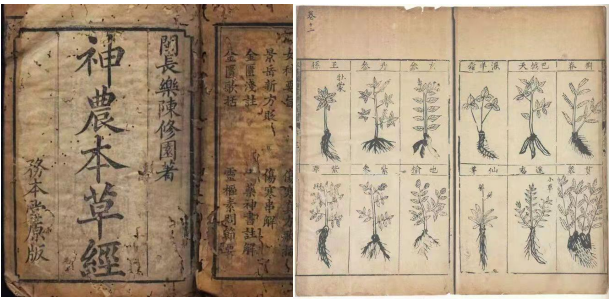
An archival look at the woodblock-printed pages of the Shennong Bencao Jing (The Divine Farmer’s Herbology Classic). This foundational text of Eastern holistic medicine documents the primordial botanical properties and energetic classifications of aromatic herbs, serving as the historical source for AromaMandala’s scholarly research.
The Alchemy of Primordial Yang
Why does human consciousness naturally gravitate toward botanical fragrance? The answer lies in an elemental physics of the spirit. In this ancient lineage, our essential inner nature is categorized as a form of primordial, celestial Yang energy (a concept representing the warm, active, and illuminating forces of life).
Pure botanical incense — masterfully compounded from resins and herbs harvested from the earth’s pristine soils — is recognized as the concentrated physical manifestation of the universe’s pure Yang energy.
When we ignite an aromatic artifact, such as our heavily detailed “Hundred Blessings” incense plaque (百福香牌), we are not merely performing a room-freshening exercise. We are staging an energetic alignment: utilizing the pure, uncorrupted Yang energy of nature to re-awaken and anchor the latent Yang within our own consciousness.

A close-up photograph of an artisan-crafted “Hundred Blessings” (百福) incense plaque by AromaMandala. The matte, terracotta-hued surface reveals intricate botanical textures and carved Chinese calligraphic characters, sitting elegantly on a vintage wooden tray under soft natural side-lighting.
The Heart as a Reflector of Chaos
The legendary Song Dynasty scholar Huang Tingjian perfectly captured this psychology of fragrance in his timeless verse:
“The perilous mind wanders a ten-thousand-foot cliff; turbulent desires breed five deadly weapons. Lean upon the small desk with a single stick of incense; the spiritual terrace instantly clears into pure, luminous emptiness.”
Huang Tingjian was reflecting an absolute truth: all the friction, anxiety, and anger we experience in times of chaos are ultimately a reflection of our own internal cognitive distortions. When the internal fire of desire rages, it creates weapons of internal conflict.
Huang Tingjian was reflecting an absolute truth: all the friction, anxiety, and anger we experience in times of chaos are ultimately a reflection of our own internal cognitive distortions. When the internal fire of desire rages, it creates weapons of internal conflict.
The ritual of watching a single wisp of smoke rise from an incense burner allows the mind to slow down. As the aromatic molecules path directly to the Spleen, they dissolve the erratic mental clutter. Your “Ling Tai” (靈台) — a classical term for the heart or the “spiritual terrace” mentioned in the poem — returns to an empty, quiet state.
When your internal architecture is perfectly empty and still, the chaos thrown at you by the external world can no longer ignite your anger. It is an ancient technology of consciousness designed to cultivate a profound, unshakeable mental mastery.
메타데이터
- post_id
- ce87ac2f626d
- slug
- the-architecture-of-stillness-how-incense-unlocks-wisdom-in-times-of-chaos-ce87ac2f626d
- url
- https://medium.com/@yalanzhangsun/the-architecture-of-stillness-how-incense-unlocks-wisdom-in-times-of-chaos-ce87ac2f626d
- canonical_url
- https://medium.com/@yalanzhangsun/the-architecture-of-stillness-how-incense-unlocks-wisdom-in-times-of-chaos-ce87ac2f626d
- author_url
- https://medium.com/@yalanzhangsun
- status
- ok
- fetched_at
- 2026-08-03 10:41:59