Use an Interactive Experience Center to Turn Visitor Attention Into Understanding
Two weeks. That’s how long Ink In Caps had to take Amazon’s freight, cargo, and last-mile delivery network — three layers of genuinely…
Use an Interactive Experience Center to Turn Visitor Attention Into Understanding

Two weeks. That’s how long Ink In Caps had to take Amazon’s freight, cargo, and last-mile delivery network — three layers of genuinely complex logistics — and turn it into something a non-expert could understand in under three minutes, at a live event, with zero room for error. No focus groups. No pilot run. Just a brief, a deadline, and a crowd waiting on the other side of it.
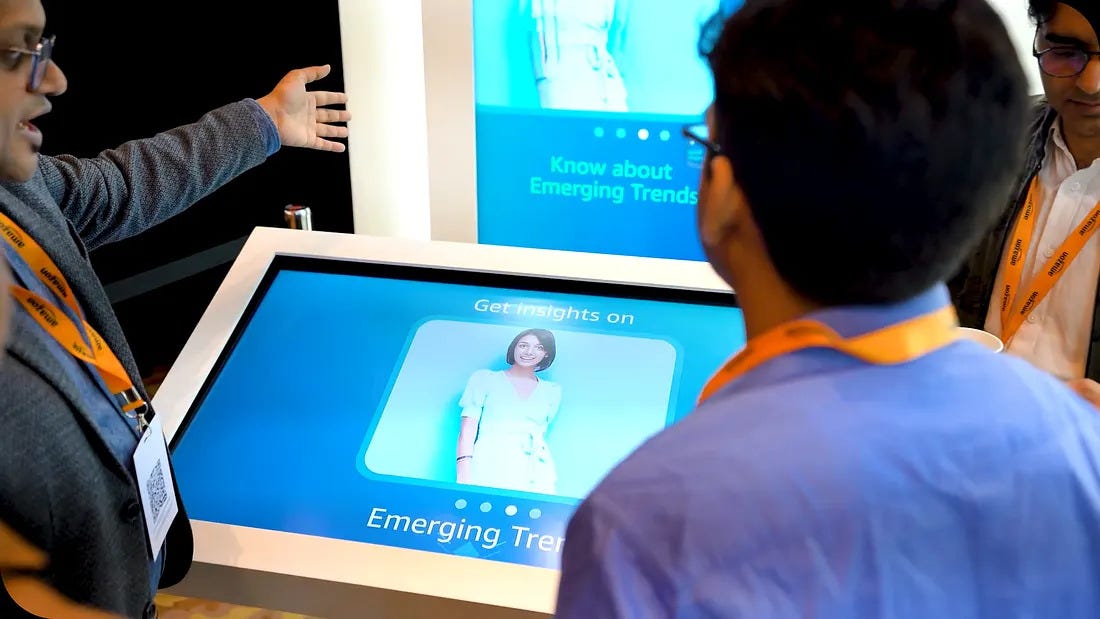
That kind of pressure forces a brand to confront a question most marketing teams avoid for years: does anyone actually understand what we do, or do they just nod politely? A well-built **tech experience center** exists to answer that question honestly — and Amazon’s activation at Sambhav 2025 is a clean example of how.

Attention Is Cheap. Understanding Is Expensive.
Booths, banners, and product walls are good at one thing: grabbing a glance. They’re far weaker at the harder job — making a visitor walk away actually understanding how something works.
This gap shows up everywhere:
- A visitor watches a 90-second product video and forgets it by the next booth.
- A sales rep explains a process verbally, and the listener retains maybe a third of it.
- A brochure gets picked up, skimmed, and left on a chair.
None of these formats ask anything of the visitor. And without a small ask — a decision, an action, a choice — there’s nothing for the brain to hold onto.

The Brief: Make Shipping Feel Like Something You Do, Not Watch
Amazon needed visitors at Sambhav 2025 to grasp how its Shipping division actually moves a package — through air freight, ground transit, and final-mile delivery — without sitting through a logistics explainer. The team at Ink In Caps proposed something more direct: let the visitor be the logistics manager for ninety seconds.
The result was a three-layer interactive game, built and deployed in 14–16 days from brief to live:
- Layer 1 — Flight: Players pilot a parcel through the sky, collecting power-ups and dodging hazards, mapped to Amazon’s air freight stage.
- Layer 2 — Truck: A truck drives forward while parcels fall from above; the player steers to collect them, representing ground transit.
- Layer 3 — Maze: The delivery partner navigates a last-mile maze to reach the recipient’s door, closing the loop on the journey.
Each layer mapped to a real stage of Amazon’s shipping process. The player didn’t read about logistics — they ran it, end to end, with a joystick in hand.

What It Took to Make That Feel Effortless
Behind the simple control scheme was a fair amount of engineering most visitors never saw. The team built the experience as a single Unity application with persistent session data carried across all three layers, so scoring and player identity stayed intact from layer to layer. A custom joystick had to be sourced and calibrated so every station behaved consistently, regardless of who was playing. Check-in ran through QR codes on event ID cards — and venue lighting, predictably, caused scanning issues. The team mitigated that with redundant scanning angles, clearer on-screen prompts, and a manual entry fallback so dropouts stayed rare.
This is the unglamorous reality behind every digital experience center example that looks effortless on the day: a long list of small reliability decisions made well in advance, so the visitor never sees the seams. The deeper engineering behind keeping interactive systems stable under real crowd pressure is covered here: **event-grade performance using locally deployed AI models**.

What Visitors Actually Did
- 200–250 unique plays completed across the activation
- 2–3 minute average session length — short enough to keep the queue moving, long enough to deliver the full three-stage story
- A remarkably low dropout rate for a live event format, with only 4–5 players leaving mid-game
- Repeat engagement: several players borrowed friends’ QR codes just to play again
The full build breakdown — including the hardware sourcing, the onboarding flow, and how prizes converted from points to real fulfilment — is documented here: Amazon Sambhav 2025 interactive shipping game.

The Quiet Win Nobody Plans For
One detail from the activation is worth sitting with: older visitors reported feeling like kids again while playing. That’s not a metric anyone wrote into the brief. It’s what happens when a brand stops explaining itself and starts letting people experience it instead. Emotional engagement of that kind doesn’t show up in a brochure — it shows up in how long someone stays, and what they tell a colleague afterward.
Designing Your Own Attention-to-Understanding Pipeline
If you’re weighing whether your next activation needs an interactive layer, a few questions are worth asking honestly:
- Can a visitor explain what your product does after sixty seconds at your booth?
- Does your current format ask anything of the visitor, or only show them something?
- Would a gamified, hands-on format compress your explanation without losing accuracy?
A tech experience center built around interaction — not just display — turns a passive crowd into an engaged one, and turns “I saw their booth” into “I understood what they do.” For more on how interaction design shapes lasting brand recall, see why people remember experiences and ignore ads.

Let’s Build Something Visitors Actually Play
Ink In Caps builds these systems on tight timelines, under real crowd pressure, with the reliability enterprise brands need on stage. If your next event needs visitors to walk away understanding — not just remembering a logo — get in touch with the IIC Lab team and let’s scope it.
메타데이터
- post_id
- ce9366a20a5f
- slug
- use-an-interactive-experience-center-to-turn-visitor-attention-into-understanding-ce9366a20a5f
- url
- https://medium.com/@ravivpatel1978/use-an-interactive-experience-center-to-turn-visitor-attention-into-understanding-ce9366a20a5f
- canonical_url
- https://medium.com/@ravivpatel1978/use-an-interactive-experience-center-to-turn-visitor-attention-into-understanding-ce9366a20a5f
- author_url
- https://medium.com/@ravivpatel1978
- status
- ok
- fetched_at
- 2026-06-21 09:28:28