Chapter 4 — Space as Language
Atmosphere, Materiality, and Meaning in Spatial Design and Branding
Chapter 4 — Space as Language
Atmosphere, Materiality, and Meaning in Spatial Design and Branding
- Introduction
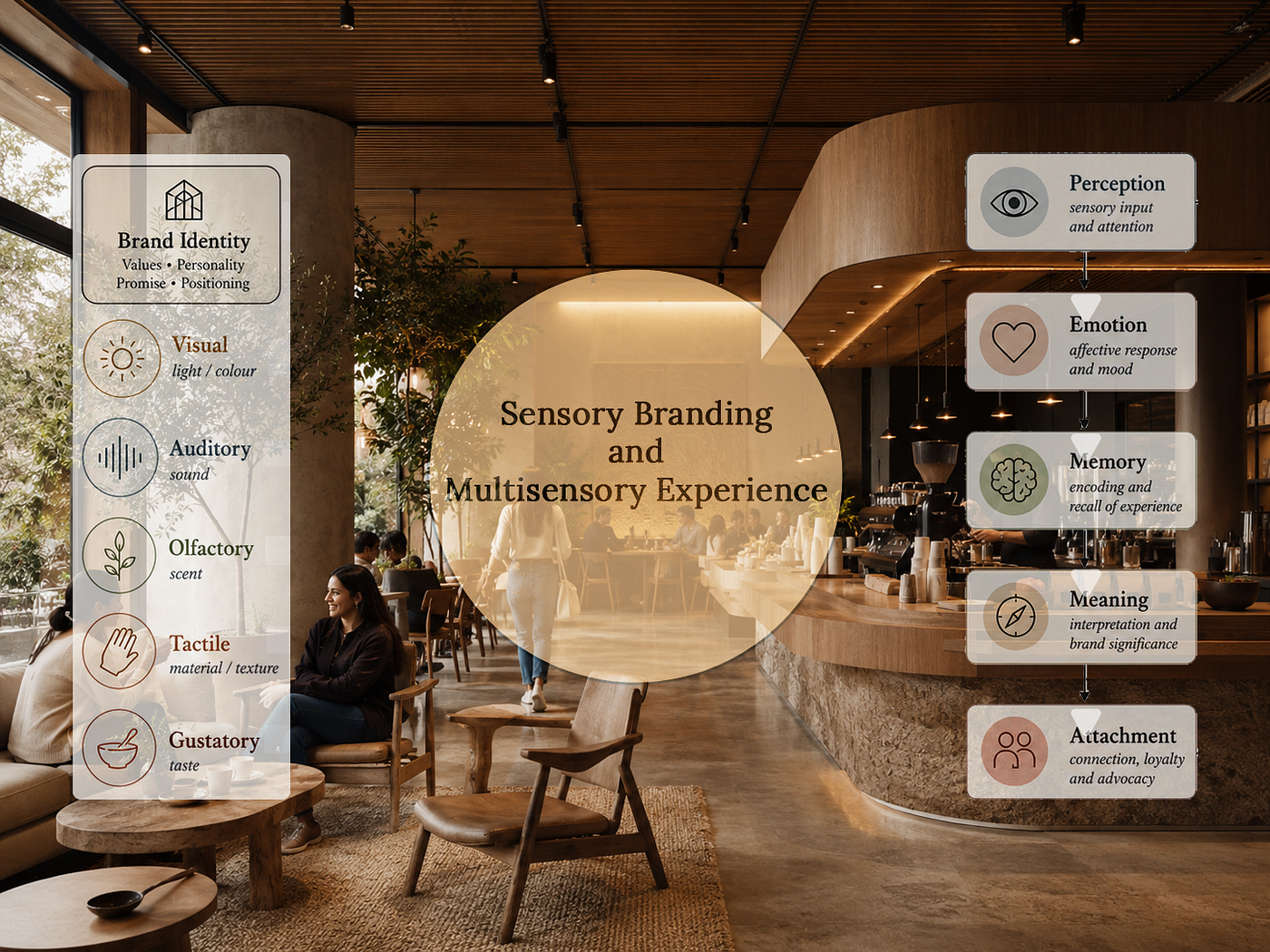
The convergence of spatial design, branding, and the phenomenological experience of place has emerged as a critical domain in contemporary design scholarship. If the brand constitutes a system of meanings and user experience is its field of interpretation, space can be understood as the medium through which those meanings become sensorially accessible. Space is not merely a functional support; it operates as a language through which values, narratives, hierarchies, behaviours, and forms of belonging are communicated. Through organisation, light, materials, proportions, thresholds, circulation, and environmental conditions, designed environments guide perception, shape behaviour, and construct atmospheres (Bitner, 1992; Kotler, 1973).
Design, in this context, is not limited to interiors or enclosed environments, but extends to the wider spatial conditions through which organisations, institutions, territories, services, and cultural entities become perceptible, inhabitable, and meaningful. The built environment does not transmit messages in a literal or linear way, but through sensory, material, spatial, and formal configurations that guide perception and interpretation. In this sense, space may be approached as a system of signs whose meanings are constructed through use, experience, cultural association, and embodied perception (Broadbent et al., 1980; Eco, 1997).
Spatial design is therefore primarily a social and experiential process which renders visible the strategies of materializing the inherent elusiveness of atmospheres into the form of a concept, configured in a design-network of humans, materials, environmental conditions, and spatial practices, and defining the conditions under which a specific intermediary status between subject and object can arise (Sloane, 2014). This chapter examines how atmosphere, materiality, and meaning function as integrative dimensions in spatial and environmental design that simultaneously communicate brand identity and shape user, visitor, and stakeholder experience.
The chapter synthesizes research across branded environments, cultural and institutional spaces, hospitality, retail, public-facing environments, sensory communication, phenomenological approaches to spatial perception, and the strategic use of visual, spatial, atmospheric, and material elements as instruments of identity construction.
2. Defining Atmospheres in Spatial and Environmental Design
Atmosphere is conceptualized as a gathering of mood, human practice, material and environmental conditions, and values that has sufficient coherence and distinction to constitute a distinct spatial environment, where the designed environment is inherently aesthetic, experiential, and porous to outside influence (Jørgensen & Holt, 2019). This definition moves beyond simplistic notions of ambience to position atmosphere as a complex, co-produced phenomenon that emerges through the interplay of spatial configurations, material choices, environmental qualities, symbolic codes, and user perception.
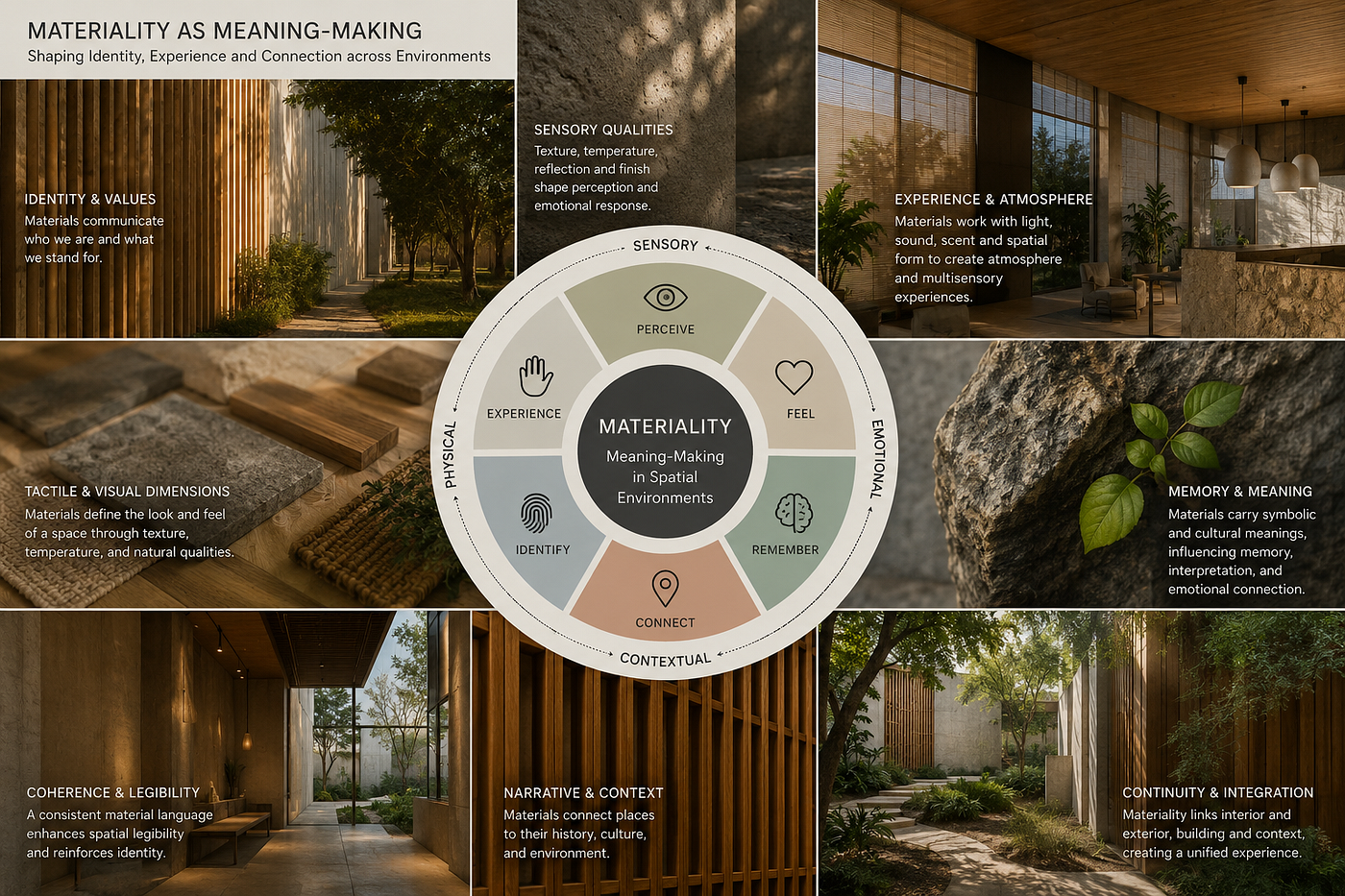
Atmosphere is not an isolated element, but an overall effect that surrounds the user and conditions perception. It is experienced before it is analytically understood, emerging through the encounter between body, space, light, materiality, sound, scale, temperature, movement, and human presence. In this sense, atmosphere can be understood as a spatial quality that is both designed and perceived, both materially constructed and experientially completed by the user (Böhme, 2017; Zumthor, 2006).
Designers anticipate user experiences via images but also through specific material, environmental, and spatial knowledges as a crucial form of cultural capital for “making an atmosphere,” with the turning of an atmosphere into a “thing” being complex and multilayered and going beyond what is commonly subsumed under “beautification” (Sloane, 2014). This underscores that atmospheric production requires systematic knowledge integration across multiple domains — materiality, cultural understanding, environmental perception, spatial organisation, and design methodology — rather than relying on aesthetic surface treatment alone.
Atmospheres are experiences of place involving transformations of users’ behaviours, emotions, and interpretations, with atmospheric stimuli, service performances, spatial rituals, and place-making practices enhancing place experiences and creating value for organisations, institutions, brands, and communities (Hill et al., 2022). This perspective links atmospheric design directly to behavioural, emotional, and symbolic outcomes, providing a foundation for understanding how designed environments function as strategic tools for identity, recognition, belonging, and relational engagement.
Atmosphere therefore acts as a mediator between identity and experience. A spatial environment may be perceived as welcoming, austere, institutional, experimental, intimate, civic, luxurious, accessible, or exclusive before its explicit messages are consciously interpreted. These perceptions result from the combined action of environmental cues such as light intensity, colour temperature, material texture, spatial density, acoustic reverberation, circulation, thresholds, and the relation between built form and human presence.
The design process must therefore translate identity intentions into coherent atmospheric qualities. An organisation that seeks to communicate openness may rely on transparency, visual continuity, accessible thresholds, generous circulation, and diffuse light. An institution that wishes to express authority may use symmetry, scale, material permanence, and controlled spatial sequences. A brand or cultural entity that values proximity may construct a denser, tactile, and more informal environment. In each case, atmosphere becomes the experiential form through which abstract identity is made perceptible.
3. Spatial Branding as a Theoretical Framework
Spatial branding has emerged as a broader theoretical construct that positions designed environments — interior, exterior, transitional, public, commercial, institutional, or cultural — as vehicles for brand identity communication. Spatial branding plays a crucial role in creating immersive, coherent, and meaningful experiences that resonate with users and visitors, reinforce identity, and influence perception, behaviour, and memory (Martin, 2025). This integration of branding and spatial design moves beyond the traditional separation of these disciplines to recognize their fundamentally interdependent relationship.
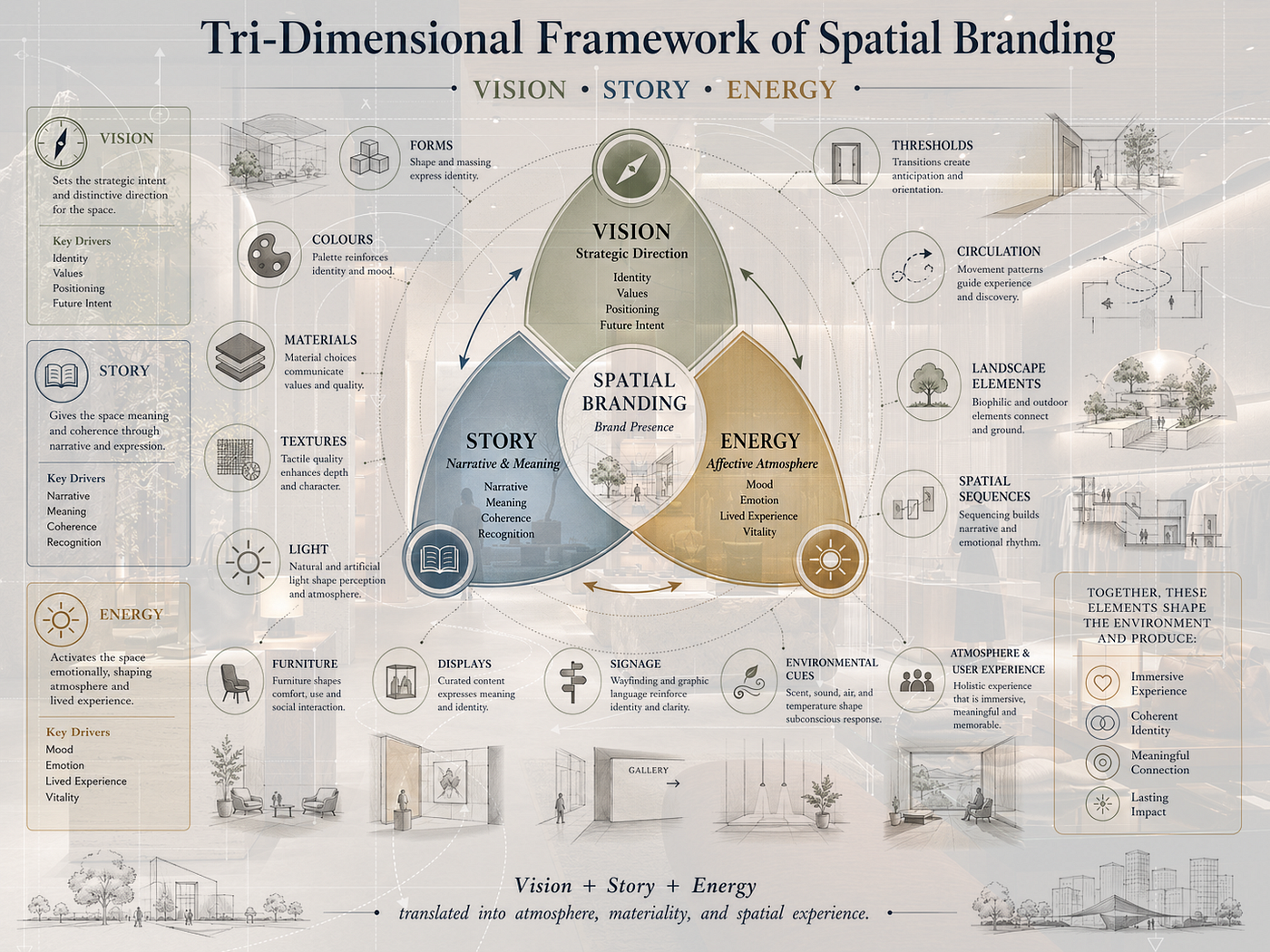
The theory of spatial branding explores the role of designed environments in reinforcing identity, narrative coherence, and user attachment, with aspects contributing to spatial branding including vision, story, and energy (Ramadhina & Astuti, 2024). This tri-dimensional framework provides a structured vocabulary for analyzing how spaces operate as branding instruments across multiple registers — the strategic vision of the brand or organisation, its narrative articulation, and the affective quality or “energetic” dimension that users, visitors, inhabitants, or communities experience.
The combination of clear vision, unique story, and energy in spatial design has supported the construction of identity or brand through the media of space, visible in the selection of forms, colours, materials, textures, light, thresholds, circulation systems, landscape elements, spatial sequences, furniture, displays, signage, and environmental cues, with an atmosphere formed through the orchestration of colour compositions, patterns, materials, spatial proportions, and environmental conditions (Sari et al., 2022). This demonstrates how the three-part framework operationalizes through concrete design decisions — colour, material, spatial organization, environmental quality, and atmospheric composition — that collectively construct brand presence.
— // —
References
Bitner, M. J. (1992). Servicescapes: The impact of physical surroundings on customers and employees. Journal of Marketing, 56(2), 57–71. https://doi.org/10.1177/002224299205600205
Böhme, G. (2017). The aesthetics of atmospheres (J.-P. Thibaud, Ed.). Routledge. https://doi.org/10.4324/9781315538181
Broadbent, G., Bunt, R., & Jencks, C. (Eds.). (1980). Signs, symbols and architecture. John Wiley & Sons.
Eco, U. (1997). Function and sign: The semiotics of architecture. In N. Leach (Ed.), Rethinking architecture: A reader in cultural theory (pp. 173–193). Routledge.
Hill, T., Canniford, R., & Eckhardt, G. M. (2022). The roar of the crowd: How interaction ritual chains create social atmospheres. Journal of Marketing, 86(3), 121–139. https://doi.org/10.1177/00222429211023355
Jørgensen, L., & Holt, R. (2019). Organization, atmosphere, and digital technologies: Designing sensory order. Organization, 26(5), 673–695. https://doi.org/10.1177/1350508419855698
Kotler, P. (1973). Atmospherics as a marketing tool. Journal of Retailing, 49(4), 48–64.
Martin, I. (2025). Examining the role of interior branding in retail design strategy. Frontiers in Business Innovations and Management, 2(8), 1–5. https://doi.org/10.64917/fbim-012
Ramadhina, R. M. L., & Astuti, S. B. (2024). Branding through interior design: Exploring theory, and interpretation. Review of Urbanism and Architectural Studies, 22(2), 44–51. https://doi.org/10.21776/ub.ruas.2024.022.02.5
Sari, S. M., Nilasari, P. F., & Tedjokoesoemo, P. E. D. (2022). Implementation of interior branding in retail interior design. GATR Journal of Management and Marketing Review, 7(1), 13–22. https://doi.org/10.35609/jmmr.2022.7.1(2)
Sloane, M. (2014). Tuning the space: Investigating the making of atmospheres through interior design practices. Interiors: Design, Architecture and Culture, 5(3), 297–314. https://doi.org/10.2752/204191114X14126916211184
Zumthor, P. (2006). Atmospheres: Architectural environments. Surrounding objects. Birkhäuser.
메타데이터
- post_id
- ce972a7ac3c8
- slug
- chapter-4-space-as-language-ce972a7ac3c8
- url
- https://medium.com/@francdccnha/chapter-4-space-as-language-ce972a7ac3c8
- canonical_url
- https://medium.com/@francdccnha/chapter-4-space-as-language-ce972a7ac3c8
- author_url
- https://medium.com/@francdccnha
- status
- ok
- fetched_at
- 2026-07-15 23:16:22