Understanding Decarbonization Priorities.
What Should Come First — Methane or Carbon Dioxide?
Understanding Decarbonization Priorities.
What Should Come First — Methane or Carbon Dioxide?
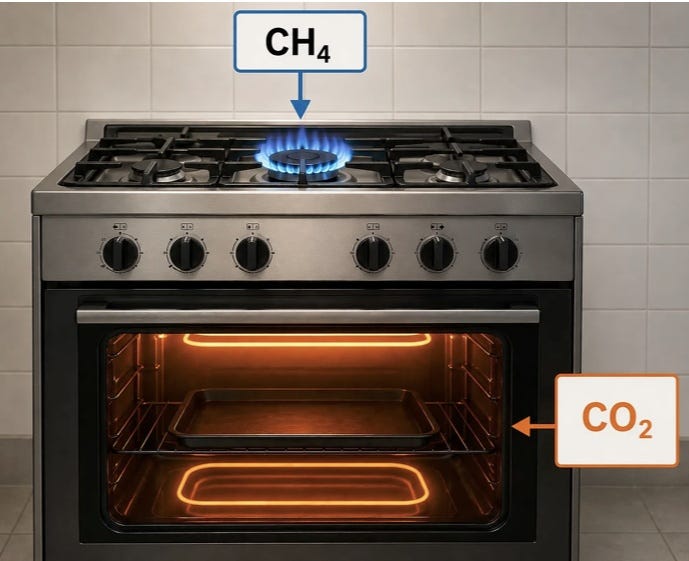
GWP metaphor
Greenhouse gases are not equal in their ability to retain heat in the atmosphere. These differences arise from their molecular structures and the way they interact with the infrared radiation emitted by the Earth’s surface.
Restricting the discussion to the two principal actors in the climate debate — carbon dioxide (CO₂) and methane (CH₄) — it becomes clear that methane possesses molecular characteristics that make it significantly more effective at absorbing infrared radiation. In terms of warming potential, a single methane molecule exerts a much greater effect than a single carbon dioxide molecule.
According to the IPCC Sixth Assessment Report (AR6, 2021), methane’s Global Warming Potential (GWP), measured over a 100-year time horizon, is approximately 27 to 30 times greater than that of carbon dioxide, depending on the methodology employed and whether climate feedback effects are included. Earlier assessments frequently reported values between 28 and 34, which explains why both ranges continue to appear in technical and public discussions.
In the terminology of the IPCC, GWP measures the relative capacity of a greenhouse gas to trap heat over a specified period of time, using CO₂ as the reference gas, with an assigned value of one.
Yet warming power alone does not tell the whole story. The atmospheric lifetimes of these gases differ profoundly, and this distinction fundamentally alters how their impacts should be evaluated.
Methane remains in the atmosphere for approximately 12 years before being broken down through natural chemical processes. Carbon dioxide, by contrast, does not have a single, well-defined atmospheric lifetime. A portion is absorbed relatively quickly by the oceans and the biosphere, but a substantial fraction remains in the climate system for centuries, while a smaller share can persist for thousands of years.
This distinction is critical. Methane behaves like an intense but short-lived source of warming: its impact is powerful, yet relatively brief. Carbon dioxide, on the other hand, is less potent on a molecule-by-molecule basis, but it accumulates and remains in the climate system for much longer periods, producing a persistent and cumulative warming effect.
For this reason, strategies aimed at achieving faster climate benefits often prioritize methane mitigation. Reductions in CH₄ emissions can produce measurable effects within relatively short time horizons. Reducing CO₂ emissions, however, is indispensable for limiting long-term warming and stabilizing the climate for future generations.
This difference is often illustrated through a simple metaphor. Methane resembles the flame of a gas stove: it generates intense heat immediately, but the effect fades quickly once the flame is extinguished. Carbon dioxide is more akin to the heat stored inside an oven: less intense at first, yet capable of radiating warmth long after the fire has gone out.
The implication for climate policy is straightforward. If the objective is to slow warming in the coming decades, methane deserves urgent attention. If the objective is to stabilize the climate over the course of the century and beyond, carbon dioxide must remain at the center of decarbonization efforts. Ultimately, effective climate strategies require both: methane reductions to buy time, and carbon dioxide reductions to secure the future.
메타데이터
- post_id
- ceb1063af87c
- slug
- understanding-decarbonization-priorities-ceb1063af87c
- url
- https://medium.com/@fernandoalmeidapradojr/understanding-decarbonization-priorities-ceb1063af87c
- canonical_url
- https://medium.com/@fernandoalmeidapradojr/understanding-decarbonization-priorities-ceb1063af87c
- author_url
- https://medium.com/@fernandoalmeidapradojr
- status
- ok
- fetched_at
- 2026-07-13 06:23:13