At the Threshold, All Is Revealed
“Cruelty, greed, and division are not new, but when the old order that institutionalized them is threatened, its beneficiaries come out…
At the Threshold, All Is Revealed
“Cruelty, greed, and division are not new, but when the old order that institutionalized them is threatened, its beneficiaries come out fighting to hold onto advantages that used to go unquestioned.” — Rebecca Solnit, The Beginning Comes After The End
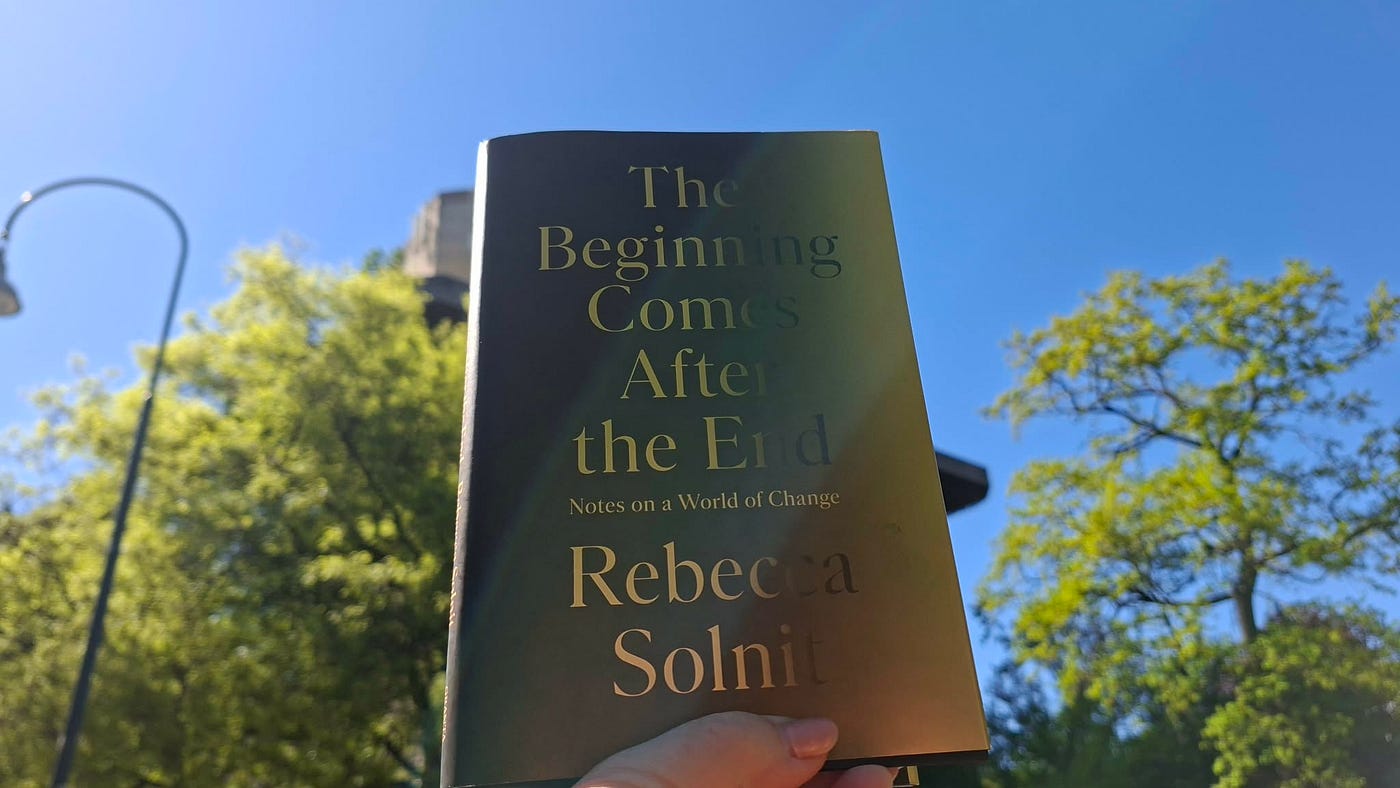
April 2026, at a neighbourhood park in Vienna, Austria
Who do you become when the structure around you begins to dissolve?
The world is in change. It always has been, and it always will be. The collapse of old narratives, the building of new ones is always there. Uncertainty is not a phase but a condition. It is at the intersection of these three where we meet monsters and heroes. Are they people, or are they just behaviors that emerge in uncertainty?
Rebecca Solnit’s The Beginning Comes After the End: Notes on a World of Change pages and ideas linger in the space between what is ending and what has not yet taken shape and often, how easy it is to miss the progress achieved because we have been living right in it. Solnit writes about an interconnected world in motion. One idea kept coming back to me, that beginnings do not come after endings in any neat or chronological way but form in fragments, often unnoticed.
At the workplace, these fragments of change are either visibly dramatic or fester in the dark. A role that once felt aligned begins to feel distant and purposeless. A project continues, but something in it no longer holds. Conversations carry on, while seeming to circle around something unspoken. An era end, a new one in the making, with no clear ending, no defined moment where one can say: this is where it stopped making sense. And yet, something has shifted.
That subtle shift holds the threshold.
This kind of threshold is not a clear doorway, but a space of disorientation. The old way of understanding or doing things no longer works, but the new one has not yet revealed itself. There is a temptation to rush through it, to restore, to find quick explanations and continue with the familiar. But the history of change is ever in motion and thwarts that. The new beginning asks for a different kind of approach.
What becomes visible in these moments of threshold is not only the change itself, but the way people respond to it.
Some hold on more tightly to what they know, trying to preserve structure and certainty. Others withdraw, waiting for something clearer to emerge. And some begin, almost hesitantly, to question what had previously gone unquestioned. These responses can feel personal, as if each individual is navigating their own confusion. But they are rarely only that.
Solnit writes, “Sometimes there is a poetic beauty to the truth that everything is connected. When the problem is contamination, the news of inseparability is instead a nightmare.” There is something distressing in recognizing that what we experience as individual uncertainty is often part of a larger dynamic. The tension, the silence, the need for control, the moments of quiet integrity or bursts of uncivility, they move through systems, shaped by patterns that have been there long before the moment of change.
In that sense, thresholds do not create something new. They reveal what was already present.
It is easy to speak about such moments in terms of office “heroes” and “monsters”, as if change produces them. It might be more helpful though to see them as expressions of behavior that have been forming over time. Under pressure, certain tendencies become more visible. Control can harden into rigidity. Silence can turn into complicity. At the same time, integrity can deepen into courage, and curiosity into a form of leadership that does not rely on the old and tested.
When a world ends, another one is trying to begin, exposing what was already broke and creating openings for change, in unexpected ways. In other words, the breakdown can be revelation. It is at these moments we should remember that we are not living through isolated endings. Personal, political, environmental, emotional, nothing stands alone.
The workplace does not reveal who we are when things are stable. It reveals who we become when the story stops making sense. So, what we encounter at the threshold is not simply the result of change. It is a clearer view of what has been quietly taking root all along.
Each week, I take a book off the page into real life, translating stories and themes into how we work, lead, grow, and connect. These are not book reviews, but reflections: part literature, part lived experience, part observations. Through my passion for literature, I explore the many dimensions of workplace communication. Perhaps you will discover a book that speaks to where you are right now.
Exploring workplace communication through the lens of great books!
메타데이터
- post_id
- ceb75e3e7e04
- slug
- at-the-threshold-all-is-revealed-ceb75e3e7e04
- url
- https://medium.com/@jamlinda/at-the-threshold-all-is-revealed-ceb75e3e7e04
- canonical_url
- https://medium.com/@jamlinda/at-the-threshold-all-is-revealed-ceb75e3e7e04
- author_url
- https://medium.com/@jamlinda
- status
- ok
- fetched_at
- 2026-06-09 15:37:30