How to Choose the Right Healthcare Software Development Company (Without the Guesswork)
Choosing a software development company for a healthcare project is sort of one of the biggest decisions you will ever make. Do it right…
How to Choose the Right Healthcare Software Development Company (Without the Guesswork)
Choosing a software development company for a healthcare project is sort of one of the biggest decisions you will ever make. Do it right, and you end up with a system that works well, keeps data secure, and keeps expanding as your business grows. Do it wrong, and suddenly you are dealing with missed deadlines, cost overruns, and that kind of software that just does not really do what it was supposed to in the first place.
The problem is there are hundreds of companies out there all saying sort of the same stuff, like “experienced team”, “on time delivery”, “quality guaranteed.” So how do you really cut through the noise and find the right fit?
This guide will kind of walk you through exactly that. No jargon , no fluff — just a clear and practical way to make a confident decision.
Start by Understanding What You Actually Need
Before you even start searching for a company, you need to have a basic idea of what you want to build. You do not need a 50-page document. But you do need answers to a few key questions:
- What problem are you trying to solve?
- Who will use this software — doctors, patients, admin staff, or all three?
- Does it need to connect with any existing systems?
- What platforms do you need — web, mobile, or both?
- Do you have a rough budget and timeline in mind?
Even rough answers to these questions can help you have way better conversations with potential partners. It also helps you notice which companies are truly curious about your project, versus the ones that only wanna close a deal, pretty fast.
Why Healthcare Software Is Not Like Other Software
This point is worth saying clearly not every software development company is really ready to build healthcare products. Healthcare software has its own set of rules, risks, and responsibilities. So it’s not just “normal” coding and shipping, there is more to it.
For example, in the USA, any software that deals with patient data has to comply with HIPAA . In Europe, there is GDPR too, and globally there are other standards like HL7 and FHIR that tell you how health information should be carried between systems. So if a company isn’t used to these things, you might end up with a solution that works in a technical sense, but turns out legally problematic.
Beyond simple compliance, healthcare software touches real people. Like, a bug in a retail app and suddenly a customer cannot finish a purchase , or at least it feels that way. Meanwhile a bug in clinical software could mess with patient care in a more direct way , not just a minor annoyance. So yeah, the stakes are higher, and honestly experience in healthcare specifically matters a whole lot.
When you are evaluating healthcare software development services, look for teams that have built similar products before — not just software in general.
Step 1: Look at Their Healthcare Portfolio
The first thing to check is their past work. Has this company built healthcare software before? What kind? Look for projects like:
- Patient management systems
- Telemedicine or remote care platforms
- Electronic Health Records (EHR) systems
- Healthcare mobile apps
- Hospital management or billing software
- AI tools for diagnosis or patient monitoring
Don’t just read the case studies on their site — yeah those always end up looking great. But try asking in a more direct way, like “Can you walk me through a healthcare project you built from start to finish?” Then pay attention to the details they actually say. If they’ve truly done real work, they’ll talk about the compliance hurdles they ran into, the integrations they had to assemble, and the kind of user testing they did with medical staff.
If they give you vague, general answers, that is a red flag.
Step 2: Ask About Compliance Knowledge
This is non-negotiable when it comes to healthcare software development services. Before you commit to any company, ask them point-blank:
- Are you familiar with HIPAA compliance?
- Have you worked with FHIR or HL7 standards?
- How do you handle data encryption and access control?
- Have you completed security audits on past healthcare projects?
A good company will answer these questions, easily and confidently, like they already know what matters. They’ll likely toss questions back too — about how you handle data, what your user base looks like, and what existing systems you’ve got running. Honestly that’s a good sign. It suggests they are already thinking as a healthcare partner, not merely as a coding shop.
If a company looks a bit uncertain or says something like, “we can learn it as we go,” just walk away. Compliance is not the sort of thing you want someone figuring out on the job, with your product in place.
Step 3: Check Their Technical Skills
Healthcare software usually has to connect with a bunch of different systems , like hospital databases, insurance platforms, lab systems, pharmacy software, plus wearable devices and such. Because of that, developers need to be technically solid, but also kind of adaptable, flexible in the sense that they can hop between those contexts without getting stuck.
Ask about the technologies they use. Common ones in healthcare software include:
- Frontend frameworks like Angular or React for web applications
- Backend languages like Node.js, Python, or Java
- Cloud platforms like AWS, Azure, or Google Cloud (preferably with healthcare-specific compliance certifications)
- Database systems that support encrypted, structured health data
- API development for connecting with third-party systems
You don’t really need to be a technical expert to jump into this conversation. Just ask, “What technologies do you typically use for healthcare projects and why?” A good team will sort of explain their choices in normal plain words, and they’ll also mention why certain tools work better for these healthcare situations.
Step 4: Evaluate Their Communication and Process
Technical skills matter, but a company can still be technically really strong and yet horrible to work for. Bad communication causes more project failures than just bad code, even when everything else looks ok.
Here is what good communication looks like in a software development partnership:
- They assign you a dedicated project manager or point of contact
- They hold regular update meetings (weekly or bi-weekly)
- They use project management tools so you can track progress
- They tell you about problems early, not after it is too late to fix them
- They ask for your feedback at key stages, not just at the end
In those first chats with a company , notice how fast they come back, how plainly they walk you through things, and if they listen to you, or just talk at you. Those early moments are kind of a preview of how the entire project will unfold, more or less.
Also ask them about how they actually develop things, like day to day, not just the end results. Do they work in sprints? and do they do regular testing, or is it more ad hoc, at least most times. When a change request comes in, how do they handle that, do they re-plan, what kind of approval steps do they use. Having a structured process usually means fewer surprises for you.
Step 5: Think About Long-Term Support
A lot of people put almost all their attention on building the software and they kind of forget about what happens after launch. Healthcare software is not like a one-and-done project or whatever. It needs steady updates , continual security patches, also new features, and compliance reviews when regulations keep changing.
Before signing with any company, ask:
- Do you offer post-launch maintenance packages?
- How do you handle bug fixes after delivery?
- Will the same team that built it also maintain it?
- How quickly can you respond if something breaks?
A company that plans to hand over the code , then disappear is kind of not the right match for a healthcare product. I mean you really want a team that sees themselves as more of a long-haul partner, not just a vendor.
Step 6: Compare Pricing — But Not Just the Numbers
Cost is always part of the decision, but it should not be the only factor, because know there is more to it. When you are comparing quotes from different companies, try to look beyond the grand total number.
Ask for a detailed breakdown. What is included? What is not? Are there extra charges for revisions, third-party tools, or additional testing? What happens if the project scope changes?
Also consider value. A company charging $30/hour that delivers poor quality, misses deadlines, or builds something that fails a compliance audit will cost you far more in the long run than a company charging $50/hour that does it right the first time.
The goal is not to find the cheapest healthcare software development services — it is to find the best value for what you are building.
Step 7: Read Reviews and Talk to Past Clients
Don’t just trust what a company claims about itself, ok. Instead, look around for independent feedback, like on Clutch, GoodFirms, or even Google. Those places tend to collect verified customer reviews that give you a more balanced take , not only the marketing version of events.
Even better — ask the company directly for client references you can speak to. A confident, experienced team will have no problem connecting you with past clients. Ask those clients:
- Did the project finish on time and within budget?
- How did the team handle problems or unexpected changes?
- Would you work with them again?
What people say when they are not trying to sell you something is always more valuable than any company brochure.
Red Flags to Watch Out For
As you go through this process, keep an eye out for warning signs:
- Vague proposals with no clear timeline or deliverables
- Promises that sound too good — “we can build it in 4 weeks” for a complex system
- No questions back from them — a good team wants to understand your project deeply
- No mention of compliance when you are clearly building healthcare software
- No post-launch support plan offered
- Pressure to sign quickly without time to review
Trust your gut too. If something feels off in the early conversations, it usually does not get better once the contract is signed.
Putting It All Together
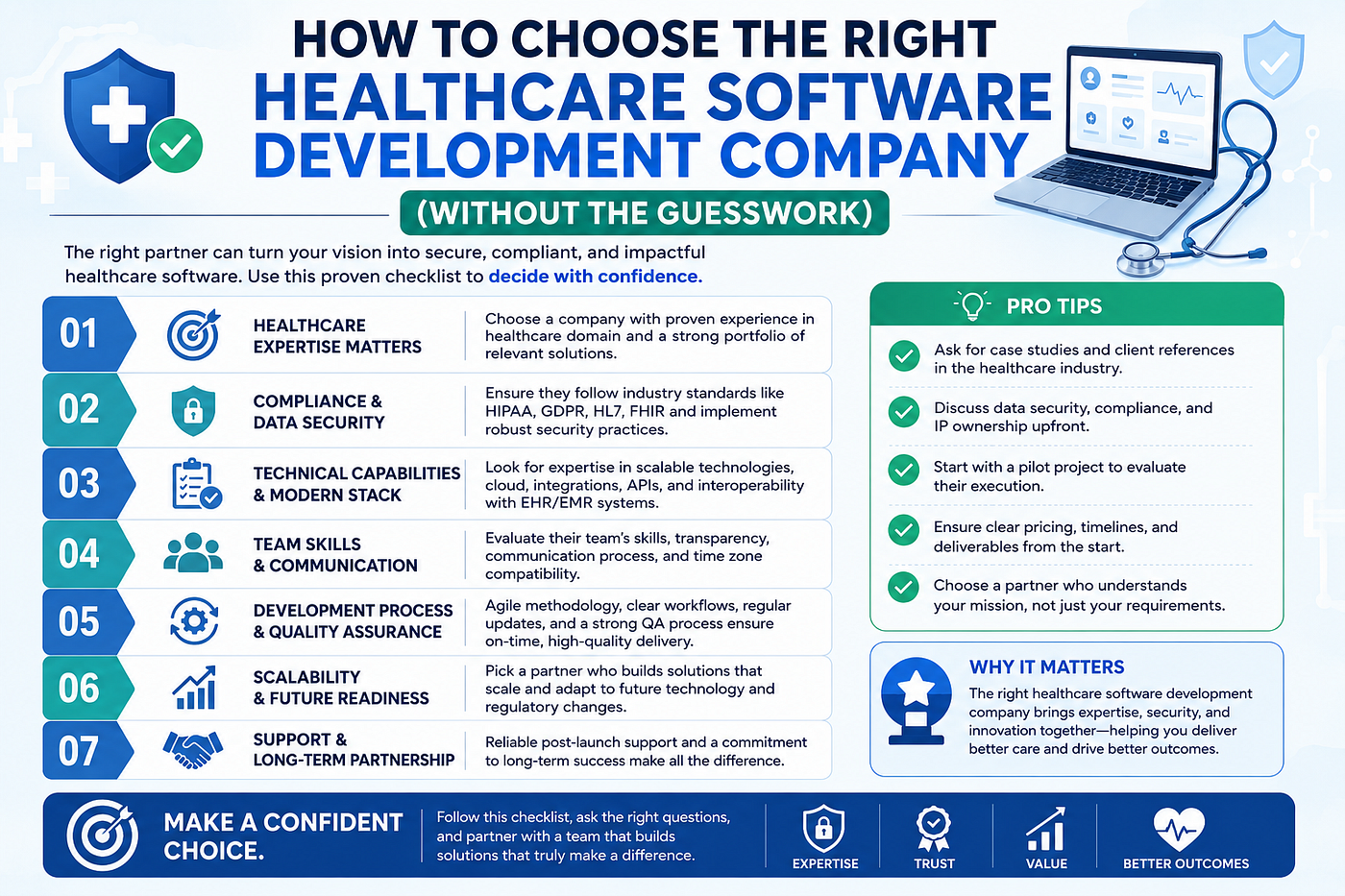
Choosing the right healthcare software development company takes a little time and effort upfront — but it saves you enormous headaches later. Here is the simple checklist to take with you:
- Know what you want to build before you start talking to companies
- Verify real healthcare experience through their portfolio and direct conversation
- Test their compliance and security knowledge with direct questions
- Assess their technical skills and technology choices
- Watch how they communicate from the very first conversation
- Make sure they offer long-term support, not just delivery
- Compare value, not just price
- Check independent reviews and speak to past clients
The right partner for your healthcare software development needs won’t just write code. They’ll take time to grasp your goals, help you sort through the tricky health tech landscape, and make something that really does the job for the people who end up using it.
Take the time to find that partner. It is worth it.
Have a healthcare software project in mind? Start with a discovery call with a team that has real experience in healthcare software. Ask them the questions from this guide — their answers will tell you everything you need to know.
메타데이터
- post_id
- cebb5bd73039
- slug
- how-to-choose-the-right-healthcare-software-development-company-without-the-guesswork-cebb5bd73039
- url
- https://medium.com/@step2gen/how-to-choose-the-right-healthcare-software-development-company-without-the-guesswork-cebb5bd73039
- canonical_url
- https://medium.com/@step2gen/how-to-choose-the-right-healthcare-software-development-company-without-the-guesswork-cebb5bd73039
- author_url
- https://medium.com/@step2gen
- status
- ok
- fetched_at
- 2026-07-10 03:02:36