What Are GID Values and How MVNOs Are Identified?
In the world of mobile connectivity, GID values — short for Group Identifier Level 1 (GID1) and Group Identifier Level 2 (GID2) — play a…
What Are GID Values and How MVNOs Are Identified?
Source
In the world of mobile connectivity, GID values — short for Group Identifier Level 1 (GID1) and Group Identifier Level 2 (GID2) — play a crucial role in how networks, devices, and profiles recognize mobile operators, especially MVNOs (Mobile Virtual Network Operators).
Understanding how GID values are stored and interpreted is essential for anyone deploying SIM or eSIM solutions, whether in consumer devices or IoT deployments. This article explains what GID values are, how they work, and the difference between the Elementary File (EF) method and the Profile Metadata method — with a look at why the industry is moving toward metadata.
1. What Are GID Values?
GID1 and GID2 are optional identifiers defined in 3GPP standards. They are used to:
- Identify operator or MVNO-specific configurations
- Help devices automatically load the correct APN settings
Think of GID values as operator fingerprints inside a SIM profile — a quick way for a phone or IoT device to know which network rules or configurations to apply.
For example, multiple different MVNOs might operate on the same underlying MNO with same ICCID and IMSI ranges but require different APNs or branding. GID values allow devices to recognize and apply those differences automatically.
2. How MVNOs Use GID Values
MVNOs often set a unique GID1 (and sometimes GID2) in their SIM or eSIM profiles so that devices:
- Display the correct carrier name
- Automatically load network settings or APN vlaues
Without GID values, devices may default to generic MNO settings, potentially breaking data services.
3. Two Ways to Store GID Values
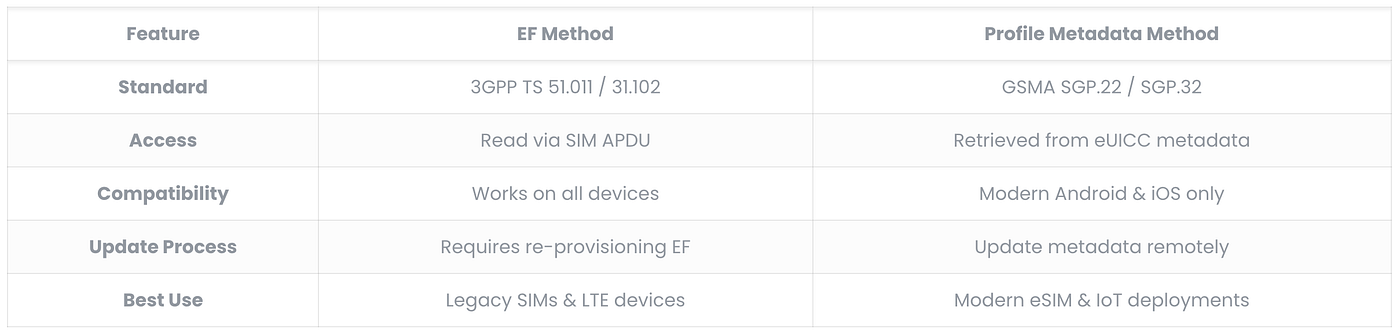
A. The Elementary File (EF) Method
What it is: GID1 and GID2 are stored as Elementary Files in the SIM’s file system:
- EF_GID1: File ID 0x6F3E
- EF_GID2: File ID 0x6F3F
How it works:
- Devices read the EF values directly using standard SIM commands (READ BINARY APDUs).
- Common in physical SIMs and legacy LTE devices.
- Set during manufacturing or profile personalization.
Pros:
- Works on all legacy devices (maximum backward compatibility).
- Accessible by any SIM reader or diagnostic tool.
Cons:
- Changing values requires file system re-provisioning.
- Less flexible for large-scale eSIM deployments.
B. The Profile Metadata Method
What it is: GID values are defined inside the profile metadata (GSMA SGP.22 or SGP.32 standards) instead of EF files.
How it works:
- The eUICC provides the GID values via profile attributes.
- No EF_GID1/EF_GID2 file exists in the SIM’s file system.
- The device retrieves them from the metadata layer.
Pros:
- Easy to update without touching the SIM file system.
- Cleaner for modern eSIM and IoT profile provisioning.
- Enables future-proof provisioning without legacy constraints.
Cons:
- Only works if the device OS supports metadata retrieval.
- Not all older hardware recognizes metadata-only GID values.
4. EF vs. Metadata — Side-by-Side
Source
5. The Modern Direction — Metadata Wins
Both Android and iOS now support retrieving GID values via profile metadata, making it the preferred approach for future deployments.
For MVNOs, this means:
- Faster time-to-market for new profiles
- No need to maintain EF files for modern devices
- Simplified over-the-air updates in eSIM environments
At Simplex Wireless, we provide IoT and eSIM solutions that follow the latest GSMA standards, we have decided to locate the identifiers to the metadata to follow the latest SGP.22 and .32 specifications
> Learn more about our IoT and eSIM solutions and how we can help your MVNO deployment succeed.
This article was curated by Jan Lattunen, CCO Simplex Wireless
About the Author: Jan Lattunen manages Sales and Marketing for Simplex Wireless. Jan has 20 years’ experience in working with SIM card technology and was involved in launching the eSIM in North America with major carriers and OEMs. His expertise in telecommunications is around SIM cards. On a personal note, Jan is a family man and avid cyclist with advocacy for safety in the roads. You can connect with Jan on https://linkedin.com/in/JanLattunen
메타데이터
- post_id
- cebf81e1ec79
- slug
- what-are-gid-values-and-how-mvnos-are-identified-cebf81e1ec79
- url
- https://medium.com/@simplexwireless/what-are-gid-values-and-how-mvnos-are-identified-cebf81e1ec79
- canonical_url
- https://medium.com/@simplexwireless/what-are-gid-values-and-how-mvnos-are-identified-cebf81e1ec79
- author_url
- https://medium.com/@simplexwireless
- status
- ok
- fetched_at
- 2026-06-10 08:34:46