When My Hairline Started Ghosting Me
A Personal Dive into Male Hair Loss and Modern Solutions
When My Hairline Started Ghosting Me
A Personal Dive into Male Hair Loss and Modern Solutions
Five years ago, I stood in front of the bathroom mirror and had a moment of archeological discovery: my hairline was retreating like it had spotted an advancing army. One week it was fine; the next it was like my forehead had expanded under a covert renovation plan. The temples were receding, the top was thinning, and every strand that fell into the sink felt dramatic, like each one was a tiny betrayal.
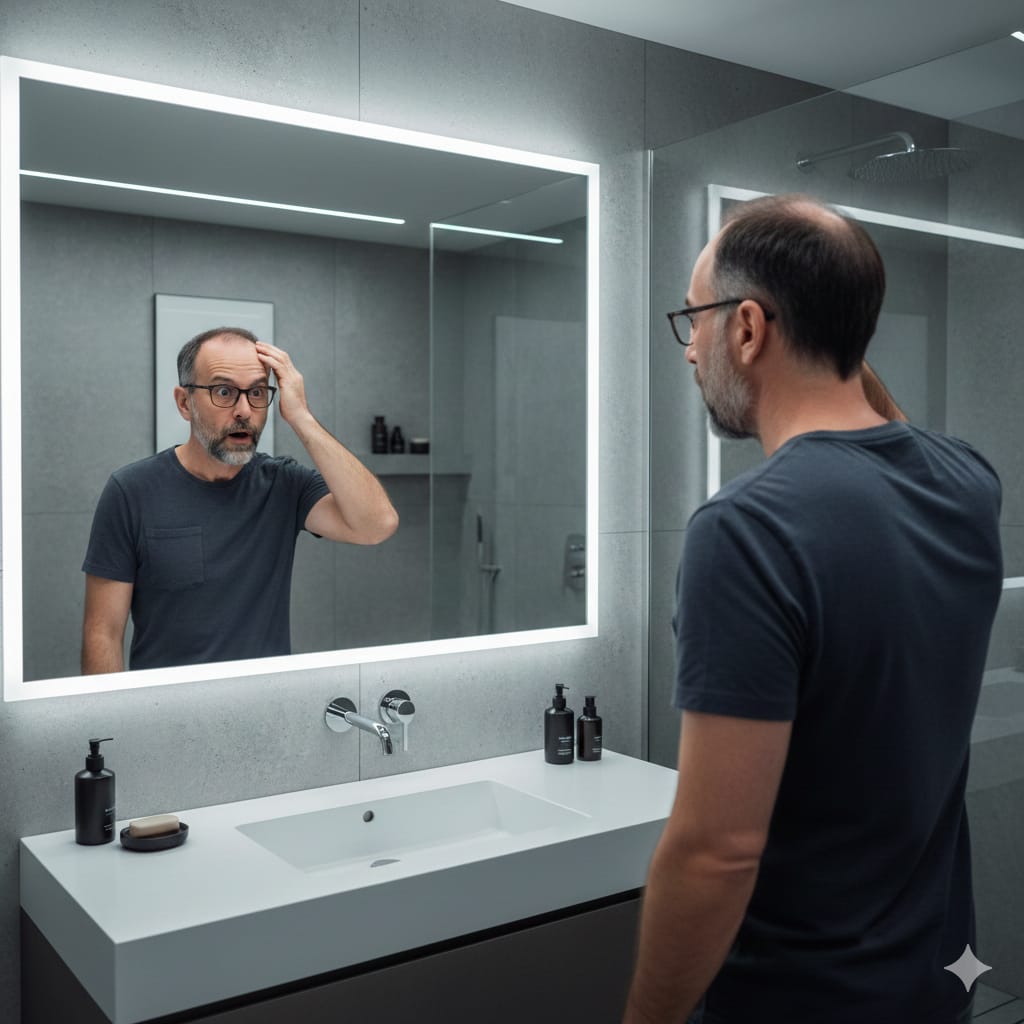
I wasn’t alone. Turns out, millions of men experience this same creeping sense of loss, not just of hair but of confidence (boy, do we love our hair). This article is my attempt to unpack why hair loss happens, how science has tried to stop it (or at least slow it down), and where things are headed, with real mechanisms, a bit of history, and a smattering of hope (plus some humor because hell, we need it).
What Is Male Pattern Hair Loss, Really?
The most common form of hair loss in men is androgenetic alopecia — that fancy term dermatologists use to sound important. It’s not just random strands giving up; it’s a patterned progression. For many men, this means a receding hairline, thinning crown, and, eventually, if left unmanaged, a shiny top that reflects every ceiling light in agony.
Androgenetic alopecia is driven largely by genetic predisposition and hormones — specifically a hormone called DHT (dihydrotestosterone). While hair loss isn’t life-threatening, its psychological impact can be massive. Losing hair often comes with a hit to self-esteem, anxiety, and even body image issues — especially in a world obsessed with Instagram filters and Zoom calls.
Hair Growth 101: The Cycle That Keeps Things Growing
Let’s get a bit biological (don’t worry, no lab coat required). Your hair doesn’t just grow nonstop forever. It goes through phases:
- Anagen: The growth phase — your hair is actively sprouting.
- Catagen: A transition phase — growth stops.
- Telogen: The resting phase — hair waits, then sheds.
In androgenetic alopecia, the anagen phase shortens while the telogen phase stays long. This means less hair growth and more shedding, and over time, the follicle shrinks, a process called miniaturization.
DHT: The Hormone That Really Messes Things Up
So what is this dastardly DHT? It’s a hormone created when the enzyme 5-alpha reductase converts testosterone. DHT is more potent than testosterone and attaches to androgen receptors in hair follicles. In genetically sensitive hair follicles, typically at the temples and crown — DHT causes:
- Shortened growth cycles
- Miniaturization of follicles
- Increased inflammation around the hair root
Eventually, the follicle becomes so weak that it produces thin, vellus-like hairs (think barely there peach fuzz) or stops producing hair entirely.
Where History Meets Follicles: A Brief Tour of Hair Loss Treatments
Ancient to Pre-Modern Remedies
Believe it or not, ancient civilizations were just as obsessed with glorious locks as we are. Egyptians, Greeks, and Persians concocted mixtures of oils, animal fats, and herbs to “treat” hair loss. Some cultures embraced wigs and hairpieces as early as 3000 BC. Despite the creativity, most of these remedies had zero science backing them — unless you count lipstick on the mirror as evidence. In truth, they were mostly placebo with a scent.
This was an era when trial and error probably looked a lot like “Does this goat fat help?” No, Jeff, it does not.
20th Century Scientific Awakening
Things didn’t get really scientific until the mid-1900s, when researchers began to link hormones — specifically androgens — to hair loss. In the decades that followed, technology brought us the first real medical remedies.
Game Changers: Minoxidil and Finasteride
In modern medicine, only two drugs have stood the test of rigorous clinical evidence and gained wide regulatory approval for male pattern hair loss:
Minoxidil: The Hair-Growth Sidekick
Originally developed as a blood pressure medication, minoxidil’s hair-growth side effect was discovered pretty much by accident, the same way many great discoveries happen (or so I tell myself when my hair doesn’t cooperate).
Minoxidil doesn’t block DHT. Instead, it:
- Extends the anagen phase — giving hair more time to grow before it sheds.
- Improves follicle blood flow — delivering oxygen and nutrients right where they’re needed.
- Stimulates growth channels in follicles — kick-starting cellular activity tied to hair production.
The result? Hair that is thicker, longer, and, at least in many users — more robust. But take note: if hair follicles are already gone (not just shrunken), minoxidil won’t grow new ones, it only helps what’s still there.
Finasteride: The DHT Blocker
Finasteride takes a different approach. It doesn’t try to push hair to grow harder, it helps stop the hormone that causes miniaturization in the first place. It does this by blocking the 5-alpha reductase enzyme, which means your body produces less DHT from testosterone.
With less DHT lingering around your scalp:
- Follicle miniaturization slows down.
- Some existing hairs may thicken.
- Hair loss slows significantly.
In clinical trials, finasteride has been shown to preserve hair and even regrow hair for many men when taken consistently over time.
Important: stopping treatment means DHT levels return to baseline, and hair loss resumes.
Combination Therapy: The Dynamic Duo
Many dermatologists now suggest combining minoxidil + finasteride for better results than either alone. The idea is:
- Finasteride reduces the damage signal (DHT),
- Minoxidil boosts the growth signal.
Together they form a one-two punch that’s more effective than either approach by itself.
There are even combination formulations being used topically now, such as products that deliver both drugs directly to the scalp to enhance local effects.
Beyond Pills and Topicals: Regenerative and Device-Based Innovations
Modern science hasn’t stopped at drugs. There’s a whole frontier of regenerative therapies designed to awaken your follicles or repair them in deeper ways:
PRP (Platelet-Rich Plasma)
A patient’s own blood is spun to concentrate platelets, which are rich in growth factors. These are then injected into the scalp. The theory is that these factors stimulate follicular cells, reduce inflammation, and may “reprogram” follicles toward healthier growth. Some research suggests PRP can improve blood supply and trigger gene pathways for hair growth, even in miniaturized follicles.
Laser Therapy
Low-level laser therapy (LLLT) involves using specific light wavelengths to stimulate cellular activity within hair follicles. It’s FDA-cleared and non-invasive — think of it as a follicle caffeine boost. The idea is stimulating mitochondria in cells to increase energy production and encourage growth.
Hair Transplants
The oldest surgical solution, hair transplantation takes DHT-resistant follicles (usually from the back of the head) and relocates them to thinning areas. Advances like Follicular Unit Extraction (FUE) have made this more precise and less invasive than older methods. This is a permanent relocation, but quality depends highly on surgical skill.
The (Possible) Future: Hair Cloning and Next-Gen Molecules
Research in 2025 and beyond is exploring even more exciting possibilities — including things that might eventually go beyond merely slowing hair loss to actually reversing it.
One example is PP405, a molecule thought to reactivate dormant follicles by altering cellular metabolism — essentially giving follicles a new burst of energy and pushing them back into growth mode in ways that don’t directly involve blocking DHT.
Other novel approaches are also underway, including molecules targeting androgen receptors directly, drugs designed through AI to trigger hair follicle activation, and even early work in hair cloning, culturing your own follicles in a lab to create a new donor supply. Clinical timelines for these are still years away, but the science is progressing.
Psychological Side Effects and Broader Considerations
Here’s the part nobody tells you at first: hair loss isn’t just cosmetic. It can affect mental health, self-esteem, and how you see yourself in the world — especially when culture constantly throws youth and full heads of hair at you as signs of attractiveness.
And the treatments themselves can have psychological or physical side effects. For example, some people taking finasteride report changes in mood or libido — which has sparked ongoing debate and research.
So if you decide to pursue medical treatments, conducting them under dermatological supervision is wise, not just for effectiveness, but safety.
Wrapping Up: The Science of Hair and Hope
Here’s the simple takeaway if you’re staring at your own creeping hairline:
- Hair loss is biological, not cosmetic — the main driver (DHT) shrinks follicles over time.
- Minoxidil and finasteride are the current pillars of evidence-based treatment.
- Combination therapy often works better than one alone.
- New frontiers (PRP, laser, next-gen drugs) may offer more options.
- No therapy is an instant or guaranteed cure — consistency and early intervention matter most.
And hey — even if every follicle eventually quits one day — confidence isn’t defined by hair alone. But knowing why things happen and what your options are? That’s powerful.
Sources
All information in this article was based on research and medical literature available at the time of writing:
- Mechanisms of androgenetic alopecia and treatment options — PubMed and medical journals on male pattern hair loss. (PubMed)
- Pharmacology and clinical evidence of finasteride and minoxidil. (Wikipedia)
- Combination therapy effectiveness. (Eprints Undip)
- Hair follicle regeneration insights (PRP). (The London PRP Clinic)
- Emerging treatments like PP405. (Wikipedia)
- Psychological perspective from health reporting. (The Washington Post)
- Reports on treatment side effects. (New York Post)
Disclaimer
This article is for informational purposes only and was written based on the scientific literature, clinical data, and expert opinion available at the time of writing (early 2026). It does not constitute medical advice, diagnosis, or a recommendation for any specific treatment. Always consult a qualified healthcare professional before starting or changing any hair loss therapy.
메타데이터
- post_id
- cec55f86124f
- slug
- when-my-hairline-started-ghosting-me-cec55f86124f
- url
- https://medium.com/@wind.amiras/when-my-hairline-started-ghosting-me-cec55f86124f
- canonical_url
- https://medium.com/@wind.amiras/when-my-hairline-started-ghosting-me-cec55f86124f
- author_url
- https://medium.com/@wind.amiras
- status
- ok
- fetched_at
- 2026-07-21 19:05:56