The Mis Recognition of the Enemy: Anti Trans Politics and the Crisis of Black Liberatory Thought
Abstract
The Mis Recognition of the Enemy: Anti Trans Politics and the Crisis of Black Liberatory Thought
Abstract
This essay argues that the deployment of anti trans. politics within African American communities represents not a defensible strategic or theological position but a profound theoretical failure; one that reproduces, within the body of Black liberatory thought, the very structures of domination that Black liberation exists to dismantle. Drawing on the frameworks of Patricia Hill Collins, Kimberlé Crenshaw, C. Riley Snorton, Dean Spade, and Sylvia Wynter, the essay demonstrates that the exclusion of Black trans people from Black political community and solidarity: (1) contradicts the foundational logic of intersectional analysis; (2) relies on a misreading of African history and culture that reproduces colonial epistemology; (3) participates in administrative violence against the most targeted members of the Black community; and (4) betrays the prophetic tradition of Black theological thought that has historically grounded liberation politics. The essay concludes that a Black liberation politics adequate to the demands of the present cannot be built on the erasure of Black trans lives and that the theoretical resources for understanding why already exist within the Black intellectual tradition itself.
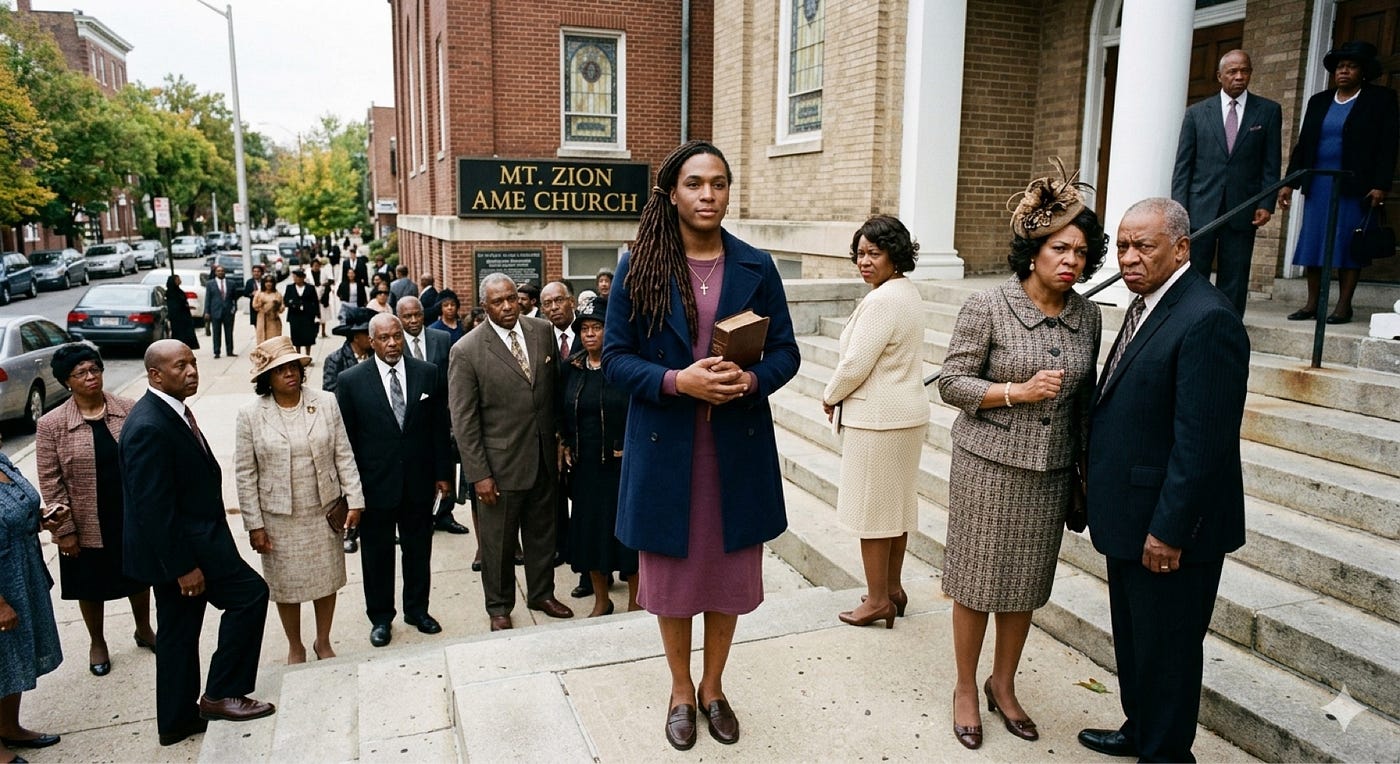
Image created using Gemini
A claim circulates with increasing force in certain currents of African American political and religious life: that the visibility and inclusion of trans and gender nonconforming African Americans within Black political community constitutes a threat to Black liberation rather than an expression of it. The argument takes several forms. Sometimes it presents as a demographic claim: that trans identity is a distraction from the material struggles that define Black political life. Sometimes it presents as a civilizational claim: that gender nonconformity is a Western imposition, alien to authentic African identity. Sometimes it presents as a strategic claim: that association of Blackness with trans visibility alienates potential coalition partners. In each case, the argument purports to be made in the interest of Black people as a whole. In each case, it requires the exclusion of some Black people, trans Black people, as the price of that supposed wholeness.
This essay argues that each version of this claim is not merely wrong but theoretically incoherent. More precisely: each version reproduces, within Black liberatory thought, the structures of domination that Black liberation exists to dismantle. To make this argument, it draws on the Black feminist, critical race, and trans studies frameworks that have most rigorously theorized the relationship between naming, classification, and power; the same frameworks whose insights about the term “biological male” as applied to trans women generally illuminate with particular sharpness the specific failure of anti trans politics within African American communities. The argument does not require appeals to abstract principles of inclusion. It follows, with logical force, from the foundational commitments of Black liberation thought itself.
Patricia Hill Collins’s concept of the matrix of domination holds that systems of race, gender, class, and sexuality are not parallel tracks on which political progress can be made independently. They are mutually constitutive; each system requiring and reinforcing the others, each embedded in a common structure of power that Collins calls the matrix. The matrix does not permit liberation in one dimension while domination in another remains intact.{1}
This foundational claim has a direct and uncomfortable implication for a Black politics that seeks racial liberation while enforcing gender domination against its own trans members. Such a politics is not a partial liberation. It is a replication of the master’s logic in the master’s house. It has simply redistributed who holds the whip. The bodies subjected to classification, surveillance, and exclusion have changed; the architecture of domination has not.
Collins’s concept of the outsider within is equally instructive here.{2} Black trans folk are not outsiders to Blackness: we are Black! Our gender variance does not diminish, dilute, or complicate our racial identity. It is simply another dimension of who we are, a dimension that, like Blackness itself, has been systematically targeted for elimination. To position trans Black people as outsiders to Black community or the Black struggle is to perform, from within, the same logic of exclusion that white supremacy performs from without. The mechanism is identical; only the actor changes.
The logic of distraction: perhaps the most commonly deployed version of the anti trans argument deserves particular scrutiny, because it reveals how thoroughly certain strands of Black political thought have internalized the epistemological priorities of the cis heteronormative mainstream. The logic of distraction requires that there be a “real” struggle which is implicitly organized around the interests of cisgender, heterosexual Black people, and most often Black men, from which trans issues divert attention and resources. But this is precisely the logic that intersectionality was developed to contest.{3} The struggles of Black trans women are not adjacent to or derivative of the “main” struggle; they are the struggle, intensified and concentrated at the point where racial, gendered, and carceral violence converge.
Kimberlé Crenshaw’s theory of intersectionality was developed to account for the ways in which legal and social categories interact to produce forms of discrimination that neither category alone can explain.{4} Applied to the situation of Black trans women in the United States, intersectionality reveals a pattern of compounded, mutually reinforcing vulnerabilities that are among the most acute of any demographic group in the United States.
The rates of violence against Black trans women are not incidental data points. They are indices of a system of racial and gendered terror. The Human Rights Campaign has documented for over a decade that Black trans women are murdered at rates that dwarf those of virtually any other demographic.{5} These figures almost certainly undercount the actual toll, owing to the systematic misidentification of Black trans women in death records and law enforcement reporting. Employment discrimination, housing insecurity, incarceration in facilities that expose us to systematic violence, and medical abandonment compound this lethal vulnerability across every domain of life.
To characterize this as a distraction from the Black freedom struggle is not merely callous. It is a failure of political analysis. It treats the most targeted members of our community as acceptable losses and acceptable losses have always been the methodology of white supremacy, not of liberation.
Crenshaw’s structural intersectionality further illuminates how anti trans legislation that relies on the “biological male” designation generates compounded material harm for Black trans women specifically. When states codify such designations into law, the administrative effects; determining where a person may be incarcerated, which facilities they may access, what identification documents they may carry, fall with disproportionate force on those who are already most vulnerable to state violence. Black trans women are not bystanders to these legislative campaigns: we are their primary targets. A Black politics that acquiesces in these campaigns, or actively supports them, is a Black politics that has taken sides against Black people.
The “Western imposition” argument carries a surface plausibility that makes it simultaneously seductive and dangerous. It draws on the genuine and important work of decolonial scholars who have demonstrated that many Western categories and institutional forms were violently imposed on African and diasporic communities. It correctly identifies the history of European colonial intervention in African social organization. But it applies this insight selectively and, in doing so, misreads the historical evidence in ways that serve a contemporary politics of exclusion rather than a politics of decolonial recovery.
The historical record does not support the claim that gender variance is a Western import to African cultures. Marc Epprecht’s extensive scholarship on African sexual and gender diversity demonstrates that precolonial African societies across the continent included recognized roles for gender variant and same sex desiring individuals, and that the colonial encounter; far from introducing such diversity, systematically suppressed, criminalized, and erased it.{7} The administrative and legal architectures that enforce rigid gender binaries in postcolonial African states are, in most cases, inheritances of European colonial law, not expressions of precolonial African tradition.
The ethnographic record is unambiguous. The sekrata of Madagascar, the yan daudu of the Hausa, the female husbands documented across multiple West African societies, and analogous gender diverse roles in indigenous cultures throughout the Global South all testify to the fact that the rigid, policed, binary gender system is not an African inheritance but a colonial imposition.{8} The irony is precise and devastating: those who invoke authentic African identity to exclude gender nonconforming Black people are themselves reproducing the colonial epistemology they claim to resist. It is not trans identity that was imported from Europe. It is the demand that trans people disappear.
This misreading is not politically innocent. When anti trans arguments within African American communities invoke African authenticity, they are not recovering a precolonial tradition; they are rehearsing a narrative of African culture that was constructed by European colonial administrators and missionaries to justify the suppression of indigenous gender and sexual diversity. To repeat that narrative as though it were anti colonial is to mistake the colonizer’s script for the ancestor’s voice.
C. Riley Snorton’s Black on Both Sides provides the genealogical ground for understanding what is at stake when Black politics turns against its trans members. Snorton traces how the American racial formation was constituted, from its inception, through the simultaneous production of Blackness and gender transgression as interlocking categories of abjection.{9} The enslaved Black body was always already a gender-transgressive body in the white legal imaginary; stripped of the protections of normative femininity and masculinity alike, subjected to sexual violation and reproductive exploitation without legal recourse, deployed as a kind of gender fungible labor that exceeded and violated the category of the human.
Snorton’s figure of the “fugitive”, the enslaved person who escaped through cross gender presentation, is not a historical footnote. It is a prototype. It demonstrates that gender variance and the project of Black freedom have been intertwined since the beginning of the African American experience on this continent.{10} Black trans people, in this light, do not represent a departure from Black history. They represent its most direct inheritors; those whose bodies continue to bear, in the most visible and unmediated way, the marks of a racial formation that was always also a gender regime.
Sylvia Wynter’s theorization of the overrepresentation of Man offers the sharpest framework for naming what is at stake when Black liberation politics turns against its trans members. Wynter argues that Western modernity produced a particular genre of the human, what she calls Man, that presented itself as the universal template for humanness while in fact reflecting a narrow, racialized, and gendered form of being. The bodies that do not fit within Man’s template, Black bodies, colonized bodies, gender nonconforming bodies, are not merely excluded from the category of the fully human; they are constitutively necessary to its definition. Man requires his Others in order to know himself.{11}8
A Black liberation politics organized around the exclusion of trans people is a politics that has accepted Man’s grammar even as it contests Man’s racial exclusions. It seeks a seat at the table of a humanness whose fundamental architecture it leaves unchallenged. Wynter’s call for what she names the “demonic ground”, an epistemological position outside the genre of Man from which to theorize new forms of humanness is, in this context, also a demand that Black liberation thought refuse any politics premised on the expendability of Black trans lives.{12}To refuse trans inclusion is not strategy. It is surrender; a capitulation to the very grammar of humanness that anti Black racism was built to enforce.
Dean Spade’s critical trans politics directs attention to the mundane, administrative architecture through which trans lives are organized and constrained. Spade argues that the state does not primarily oppress trans people through spectacular violence but through the proliferation of administrative categories; birth certificates, identification documents, medical records, school enrollment systems, incarceration classifications that assign, track, and enforce gender across every institutional domain.{13}
When anti trans sentiment within African American communities supports or acquiesces in legislation that codifies the “biological male” designation into law, it is not simply expressing a cultural or theological preference. It is participating in the construction of administrative architectures that will be deployed against Black trans people in every institutional domain of their lives. The state that is empowered to forcibly assign gender to Black trans women is the same state whose carceral apparatus has always been deployed disproportionately against Black communities broadly.{14} There is no version of this politics that ends well for Black people as a whole, and its immediate, concrete harm falls on those Black community members who are already most exposed to institutional violence.
The analogy to racial classification is not rhetorical. The history of racial classification in the United States demonstrates repeatedly that the state’s assignment of racial categories was never merely descriptive; it was generative of the racial hierarchy it purported to map. The one-drop rule, the hypodescent system, the racial taxonomies embedded in the census, all were administrative decisions dressed in the language of natural fact. Together they produce the racial order they claimed only to record. The deployment of “biological male” against trans women participates in this same epistemological tradition. A Black politics that lends its authority to this deployment has misidentified both the enemy and the mechanism.
A significant strand of anti trans sentiment within African American communities is organized through Black church traditions that frame gender normativity as scripturally mandated and essential to community dignity. This argument requires engagement with particular care, because the Black church has been among the most important institutions in African American life; a site of survival, resistance, and communal care across centuries of racial terror. The critique offered here is not a dismissal of that tradition. It is a claim, made within the prophetic wing of that tradition, that communities organized around liberation cannot simultaneously organize against the liberation of their most vulnerable members without betraying the very Gospel they invoke.
The prophetic tradition of the Black church, from Howard Thurman’s insistence that the Gospel is addressed to those who “stand with their backs against the wall” to Pauli Murray’s embodied witness as a Black queer woman ordained to the priesthood to James Cone’s Black theology of liberation, has consistently held that the God of the oppressed cannot be invoked in the service of oppression.{15} Black trans people stand, in the precise sense Thurman intended, with our backs against the wall. A theology that turns against us in the name of liberation is a theology that has confused the wall for the horizon.
Pauli Murray is a particularly significant figure here, precisely because her life was itself an argument. Murray experienced what she understood as gender variance throughout her life, resisted the gender binary imposed on her by law and medicine, and nevertheless became one of the most consequential legal architects of both civil rights law and women’s rights law in American history. Murray’s life does not permit a clean separation between Black freedom struggle and gender nonconformity. It demonstrates, in the most intimate and historical terms, that they have always been the same struggle.
The argument that trans visibility harms Black liberation is, finally, an argument that requires Black trans people to disappear, to render ourselves invisible, to exist only at the margins where we do not disturb the dominant image of what Blackness looks like. This demand is not new. It has been made of Black women who were told to subordinate gender to race within liberation movements.{16} It has been made of Black queer people who were told that their sexuality was a distraction from the struggle. It has been made of every Black person whose full humanity exceeded the narrow template that a politics of respectability could accommodate.
In every case, those who were asked to disappear were asked to pay for a liberation that was never quite meant for them. In every case, the demand for their disappearance was presented as a strategic necessity, a temporary sacrifice, a regrettable but pragmatic concession to political reality. In every case, the sacrifice was neither temporary nor strategic; it was structural. The liberation purchased by their erasure was a liberation that reproduced, in the name of freedom, the logic of expendability that slavery had perfected.
Black liberation has always been most powerful, most theoretically coherent, and most practically effective when it has refused the demand for partial humanity. Collins’s vision of a coalition politics grounded in the mutual recognition of interlocking oppressions, rather than the hierarchization of identity claims, remains the most rigorous model for what an inclusive Black liberatory politics might look like.{17} The freedom movements that changed American history were not those that asked some Black people to wait. They were those that insisted, with what Wynter would call insurgent humanism, that the full range of Black humanity was the subject and the measure of liberation.
Trans Black people are part of the full range of Black humanity. Our struggle is not a detour from the road to Black freedom. It is the road traversed, as it has always been traversed, by those who had the most to lose and the most to teach. The theoretical resources for understanding why are not imports from elsewhere. They live in the Black intellectual tradition itself: in Collins’s matrix, in Crenshaw’s intersectionality, in Snorton’s genealogies, in Wynter’s demonic ground, in Thurman’s theology of the disinherited, in Murray’s embodied witness.
The enemy of Black liberation is not a Black trans woman living her life in full. The enemy is the structure of domination; racial, gendered, administrative, and carceral. that targets her precisely because her existence refuses the terms of a social order built on Black expendability and gender policing. A Black politics that misidentifies its enemy, that mistakes the target of white supremacy for the problem, has not only failed its most vulnerable members. It has failed itself.
To exclude Black trans people from Black political solidarity is not strategy. It is surrender! The Black liberatory tradition has never; at its most vital, its most rigorous, its most prophetic been a tradition that confused surrender with strategy.
Notes
-
Patricia Hill Collins, Black Feminist Thought: Knowledge, Consciousness, and the Politics of Empowerment, 2nd ed. (New York: Routledge, 2000), 18. Collins defines the matrix of domination as “the overall organization of power in society,” structured through intersecting oppressions that are “part of one overarching structure of domination.”
-
Collins, Black Feminist Thought, 11–13. The outsider-within concept describes those who occupy marginal positions within institutions or communities — present enough to observe the dominant logic, excluded enough to see its contradictions.
-
The logic being critiqued here is a version of what Audre Lorde identified as the problem of hierarchizing oppressions. See Audre Lorde, Sister Outsider: Essays and Speeches (Trumansburg, NY: Crossing Press, 1984), 138–39: “There is no hierarchy of oppressions.”
-
Kimberle Crenshaw, “Mapping the Margins: Intersectionality, Identity Politics, and Violence against Women of Color,” Stanford Law Review 43, no. 6 (1991): 1241–99. Crenshaw’s structural intersectionality specifically addresses how women of color fall into gaps created when legal frameworks consider race and gender in isolation, a logic extensible to the position of Black trans women within liberation politics that centers cisgender experience.
-
Human Rights Campaign, Fatal Violence Against the Transgender and Gender Non-Conforming Community in 2023 (Washington, DC: Human Rights Campaign Foundation, 2023). HRC has documented consistently elevated rates of fatal violence against Black transgender women for over a decade. The organization notes that these figures almost certainly undercount the actual toll due to misidentification and underreporting.
-
For the concept of “acceptable losses” as a mechanism of white supremacy applied to Black liberation strategy, see Keeanga-Yamahtta Taylor, From #BlackLivesMatter to Black Liberation (Chicago: Haymarket Books, 2016), esp. ch. 1. Taylor’s analysis of how respectability politics and strategic exclusion have historically operated within Black political movements is directly relevant here.
-
Marc Epprecht, Heterosexual Africa? The History of an Idea from the Age of Exploration to the Age of AIDS (Athens: Ohio University Press, 2008); and Marc Epprecht, Sexuality and Social Justice in Africa: Rethinking Homophobia and Forging Resistance (London: Zed Books, 2012). Epprecht’s careful historical and ethnographic research dismantles the claim that homosexuality and gender variance are Western imports to Africa, demonstrating pre-colonial indigenous traditions of gender and sexual diversity across the continent.
-
On the sekrata of Madagascar, see Benedicte Madinier, “Le Sekrata, genre fluide de Madagascar,” Cahiers d’etudes africaines 59, no. 234 (2019). On the yan daudu of the Hausa, see Rudolf Gaudio, Allah Made Us: Sexual Outlaws in an Islamic African City (Oxford: Wiley-Blackwell, 2009). On female husbands across West African societies, see Ifi Amadiume, Male Daughters, Female Husbands: Gender and Sex in an African Society (London: Zed Books, 1987). The muxe cited are from Zapotec culture in Oaxaca, Mexico, and serve as comparative evidence of pre-colonial gender diversity in the Global South. See Lynn Stephen, “Sexualities and Genders in Zapotec Oaxaca,” Latin American Perspectives 29, no. 2 (2002): 41–59.
-
C. Riley Snorton, Black on Both Sides: A Racial History of Trans Identity (Minneapolis: University of Minnesota Press, 2017), 2–8. Snorton’s foundational argument is that “blackness and transness are not merely analogous formations but share a historical relation” rooted in the particular way that the enslaved Black body was subjected to forced gender transgression and reproductive exploitation under chattel slavery.
-
Ibid., 57–89. Snorton traces the figure of the “fugitive” — the enslaved person who escaped through cross-gender presentation — as a historical prototype for the trans subject, demonstrating that gender variance and racial abjection have been co-produced rather than independently constructed.
-
Sylvia Wynter, “Unsettling the Coloniality of Being/Power/Truth/Freedom: Towards the Human, After Man, Its Overrepresentation — An Argument,” CR: The New Centennial Review 3, no. 3 (2003): 257–337. Wynter’s analysis of “Man” as a genre of the human that over represents itself as the universal form of humanness while requiring the abjection of racialized and colonized others is among the most significant contributions to Black critical theory of the twentieth century.
-
On the concept of “demonic ground” as an epistemological position from which to theorize beyond the genre of Man, see Sylvia Wynter, “Beyond the Categories of the Master Conception: The Counterdoctrine of the Jamesian Poiesis,” in C. L. R. James’s Caribbean, ed. Paget Henry and Paul Buhle (Durham: Duke University Press, 1992), 63–91.
-
Dean Spade, Normal Life: Administrative Violence, Critical Trans Politics, and the Limits of Law (Brooklyn: South End Press, 2011), 19–43. Spade’s argument that the state primarily governs trans people through the accumulation of administrative categories — rather than through spectacular violence alone — is essential for understanding how anti-trans legislation operates as a technology of governance even when individual acts of violence are disavowed.
-
Ibid., 74–107. Spade’s analysis of how administrative normalization produces and reinforces gender hierarchy through seemingly neutral bureaucratic decisions is directly applicable to the way in which “biological male” designations embedded in law produce cascading institutional harm.
-
Howard Thurman, Jesus and the Disinherited (New York: Abingdon-Cokesbury Press, 1949). Thurman’s foundational argument — that the Gospel is addressed to “those who stand with their backs against the wall” — provides the theological ground for a prophetic Black church tradition that cannot be reconciled with the exclusion of its most vulnerable members. Pauli Murray, whose ordination as an Episcopal priest in 1977 came after decades of intersectional activism as a Black queer woman, embodies the prophetic tradition most directly relevant here. See Pauli Murray, Song in a Weary Throat: An American Pilgrimage (New York: Harper & Row, 1987). On James Cone’s liberationist theology, see James H. Cone, A Black Theology of Liberation, 40th anniversary ed. (Maryknoll, NY: Orbis Books, 2010).
-
The parallel to the treatment of Black women within mid-twentieth-century civil rights organizations is well-documented. See Belinda Robnett, How Long? How Long? African-American Women in the Struggle for Civil Rights (New York: Oxford University Press, 1997); and Kimberle Crenshaw, “Race, Reform, and Retrenchment: Transformation and Legitimation in Antidiscrimination Law,” Harvard Law Review 101, no. 7 (1988): 1331–87.
-
Collins, Black Feminist Thought, 273–90. Collins’s vision of a coalition politics grounded in the recognition of interlocking oppressions, rather than the hierarchization of identity claims , remains the most theoretically rigorous model for what an inclusive Black liberatory politics might look like.
메타데이터
- post_id
- cedbbabcf5d3
- slug
- the-mis-recognition-of-the-enemy-anti-trans-politics-and-the-crisis-of-black-liberatory-thought-cedbbabcf5d3
- url
- https://medium.com/@naomiward/the-mis-recognition-of-the-enemy-anti-trans-politics-and-the-crisis-of-black-liberatory-thought-cedbbabcf5d3
- canonical_url
- https://medium.com/@naomiward/the-mis-recognition-of-the-enemy-anti-trans-politics-and-the-crisis-of-black-liberatory-thought-cedbbabcf5d3
- author_url
- https://medium.com/@naomiward
- status
- ok
- fetched_at
- 2026-06-09 15:37:30