Content Moderation in Short Video App Development Using AI
The explosive growth of short video platforms has transformed how people create, consume, and share content. From entertainment to…
Content Moderation in Short Video App Development Using AI
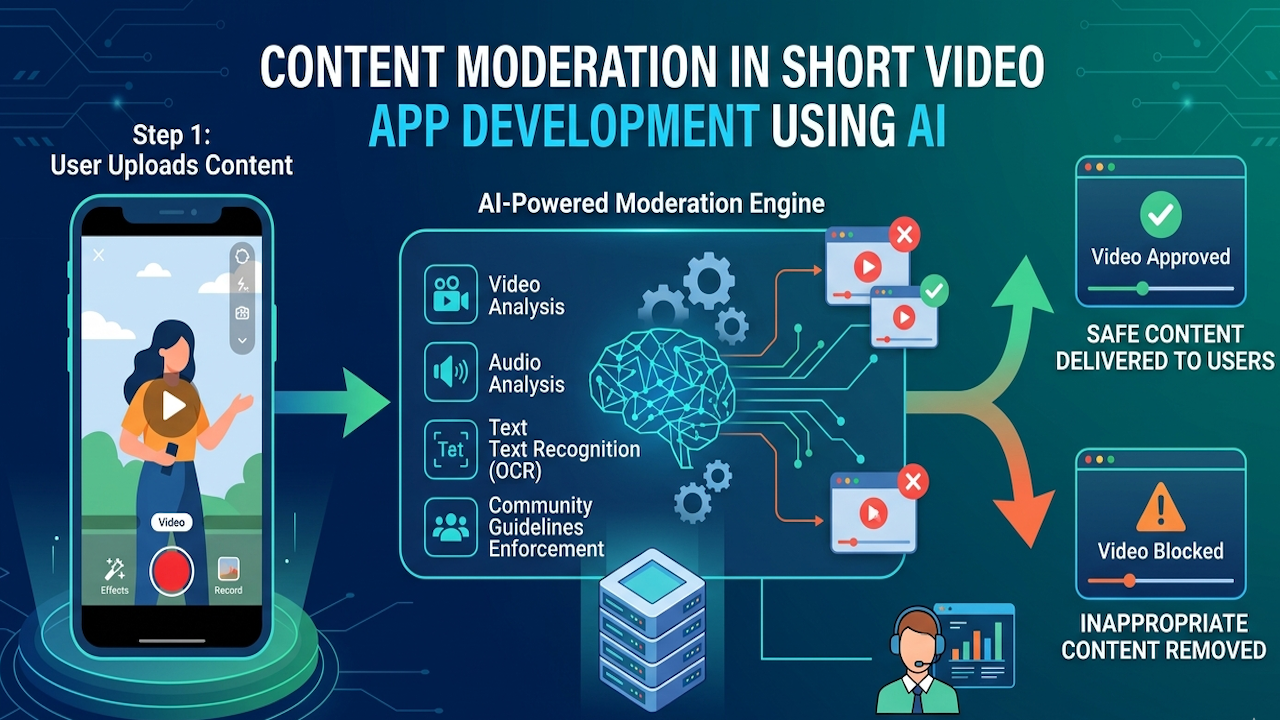
The explosive growth of short video platforms has transformed how people create, consume, and share content. From entertainment to education, these platforms have become a central part of digital life. However, with this growth comes a critical challenge: content moderation. Ensuring that user-generated videos are safe, appropriate, and compliant with community guidelines is no small task. This is where artificial intelligence (AI) plays a vital role in modern short video app development.
In this article, we’ll explore how AI-powered content moderation works, the technologies behind it, and how developers can integrate it effectively into short video applications.
Why Content Moderation Matters in Short Video Apps
Short video platforms rely heavily on user-generated content, which makes them vulnerable to harmful, inappropriate, or misleading material. Without proper moderation, platforms risk:
- Violating legal and regulatory requirements
- Losing user trust and engagement
- Facing reputational damage
- Becoming unsafe for younger audiences
Manual moderation alone cannot handle the sheer volume of content uploaded every second. AI-driven moderation systems provide scalability, speed, and consistency — making them essential for any modern short video app development strategy.
Types of Content That Need Moderation
Before diving into AI solutions, it’s important to understand the types of content that require monitoring:
- Explicit or adult content
- Violence or graphic imagery
- Hate speech or harassment
- Misinformation or harmful narratives
- Spam or misleading promotions
An effective moderation system should be capable of detecting and handling all these categories in real time or near real time.
How AI Powers Content Moderation
AI moderation systems rely on a combination of machine learning (ML), deep learning, and natural language processing (NLP). These technologies work together to analyze video, audio, and text.
1. Computer Vision for Video Analysis
Computer vision models analyze video frames to detect inappropriate visuals. These models are trained on large datasets to recognize patterns such as nudity, weapons, or violent scenes.
Key techniques include:
- Convolutional Neural Networks (CNNs) for image classification
- Object detection models (e.g., YOLO, Faster R-CNN)
- Frame-by-frame video scanning
For example, when a user uploads a video, the system can automatically scan frames and flag suspicious content before it is published.
2. Audio Analysis and Speech Recognition
Short videos often include spoken content, which must also be monitored. AI can convert speech to text using Automatic Speech Recognition (ASR), then analyze it for harmful language.
Key components:
- Speech-to-text conversion
- Keyword detection
- Sentiment analysis
This allows the system to detect hate speech, abusive language, or inappropriate dialogue embedded within videos.
3. Natural Language Processing (NLP)
NLP is used to analyze captions, comments, hashtags, and descriptions. It helps identify harmful or misleading text content.
Common NLP tasks:
- Text classification
- Toxicity detection
- Named entity recognition
- Contextual understanding
For example, AI can flag offensive comments or detect spammy captions that violate platform policies.
4. Machine Learning Classification Models
Machine learning models are trained to classify content into categories such as “safe,” “sensitive,” or “violating.” These models improve over time as they process more data.
Approaches include:
- Supervised learning with labeled datasets
- Reinforcement learning with user feedback
- Hybrid models combining rules and ML
The more data the system processes, the better it becomes at identifying nuanced content.
Real-Time vs Post-Upload Moderation
AI moderation can be implemented at different stages:
Real-Time Moderation
- Happens during video upload or live streaming
- Prevents harmful content from being published
- Requires low-latency processing
Post-Upload Moderation
- Scans content after it is published
- Flags or removes content based on violations
- Allows human review for edge cases
Most platforms use a hybrid approach to balance speed and accuracy.
Building an AI Moderation Pipeline
For developers working on short video app development, implementing a moderation pipeline involves several steps:
Step 1: Content Ingestion
- User uploads video
- Metadata (title, tags, description) is captured
Step 2: Preprocessing
- Extract video frames
- Separate audio
- Normalize text data
Step 3: AI Analysis
- Run computer vision models on frames
- Apply speech recognition to audio
- Analyze text using NLP
Step 4: Decision Engine
- Combine results from all models
- Assign risk scores
- Decide whether to allow, flag, or block content
Step 5: Human Review (Optional)
- Escalate uncertain cases
- Improve model accuracy with feedback
Tools and Technologies for AI Moderation
Developers can leverage various tools and frameworks to build moderation systems:
- TensorFlow / PyTorch for training ML models
- OpenCV for video processing
- FFmpeg for video frame extraction
- Cloud AI services (like AWS Rekognition, Google Cloud Vision)
- Speech APIs for audio transcription
Using pre-trained models can significantly reduce development time, especially for startups or MVPs.
Challenges in AI-Based Moderation
While AI offers powerful capabilities, it also comes with limitations:
1. Context Understanding
AI may struggle to understand context. For example, educational or artistic content may be mistakenly flagged.
2. False Positives and Negatives
- False positives: Safe content flagged incorrectly
- False negatives: Harmful content missed
Balancing accuracy is a constant challenge.
3. Cultural Sensitivity
Content that is acceptable in one region may be offensive in another. AI models must be trained with diverse datasets.
4. Adversarial Behavior
Users may try to bypass moderation using tricks like:
- Altered spellings
- Filters or overlays
- Background audio manipulation
Continuous model updates are required to handle such tactics.
Best Practices for Developers
To build an effective moderation system, consider the following best practices:
Combine AI with Human Moderation
AI should assist — not replace — human moderators. A hybrid system ensures better accuracy.
Use Multi-Modal Analysis
Analyze video, audio, and text together for more reliable results.
Implement Feedback Loops
Use user reports and moderator decisions to retrain models and improve performance.
Ensure Transparency
Clearly communicate moderation policies to users and provide appeal mechanisms.
Prioritize Privacy
Handle user data responsibly and comply with data protection regulations.
Ethical Considerations
AI moderation must be designed responsibly. Developers should be aware of:
- Bias in AI models: Ensure fairness across different demographics
- User privacy: Avoid unnecessary data collection
- Freedom of expression: Balance safety with open communication
Ethical AI design is not just a technical requirement — it’s a business necessity.
The Future of AI in Content Moderation
As AI technology evolves, content moderation will become more advanced and accurate. Emerging trends include:
- Real-time moderation in live streaming
- Advanced deepfake detection
- Context-aware AI models
- Federated learning for privacy-preserving AI
These innovations will further strengthen the role of AI in short video app development.
Conclusion
Content moderation is a critical component of any short video platform, and AI has made it possible to manage this challenge at scale. By leveraging machine learning, computer vision, and NLP, developers can build systems that detect harmful content quickly and efficiently.
However, AI is not a perfect solution. The most effective approach combines intelligent automation with human oversight, ensuring both accuracy and fairness. As short video platforms continue to grow, investing in robust AI moderation systems will be essential for maintaining user trust, platform safety, and long-term success.
메타데이터
- post_id
- cedd7798dc1f
- slug
- content-moderation-in-short-video-app-development-using-ai-cedd7798dc1f
- url
- https://medium.com/@nayelbasim444/content-moderation-in-short-video-app-development-using-ai-cedd7798dc1f
- canonical_url
- https://medium.com/@nayelbasim444/content-moderation-in-short-video-app-development-using-ai-cedd7798dc1f
- author_url
- https://medium.com/@nayelbasim444
- status
- ok
- fetched_at
- 2026-07-27 01:40:07