RingCentral Review 2026: Features, Pricing, Pros, Cons and Best Alternatives
Choosing a business communication platform is no longer just about making and receiving calls. Modern organizations need voice, messaging…
RingCentral Review 2026: Features, Pricing, Pros, Cons and Best Alternatives
Choosing a business communication platform is no longer just about making and receiving calls. Modern organizations need voice, messaging, video meetings, integrations, automation, analytics, and support for distributed teams — all within a single environment.
RingCentral has long been one of the most recognized names in the UCaaS (Unified Communications as a Service) market. It serves thousands of businesses worldwide and is often included in shortlists alongside Zoom Phone, 8x8, Dialpad, Nextiva, Teliqon and Vonage.
But is RingCentral still the right choice in 2026?
This review explores RingCentral’s core features, pricing structure, strengths, limitations, user feedback, and the scenarios where alternative platforms may be a better fit.
What Is RingCentral?
RingCentral is a cloud-based communications platform that combines business telephony, team messaging, video conferencing, contact center capabilities, and integrations into a single ecosystem.
The company’s flagship product, RingEX, provides organizations with:
- Cloud PBX
- VoIP calling
- Business SMS
- Video meetings
- Team messaging
- Call routing and IVR
- Call recording
- Analytics and reporting
- CRM integrations
The platform primarily targets small and medium-sized businesses, mid-market organizations, and enterprise customers that require a scalable communications infrastructure.
Key Features of RingCentral
Cloud PBX
At its core, RingCentral is a cloud phone system designed to replace traditional PBX hardware.
Key capabilities include:
- Auto attendants
- Multi-level IVR
- Ring groups
- Call queues
- Call forwarding
- Voicemail
- Call recording
- Extension management
Because everything is hosted in the cloud, organizations can deploy the system without purchasing on-premise telephony equipment.
Business Calling
RingCentral supports inbound and outbound calling through desktop, browser, and mobile applications.
Users can:
- Make calls from any device
- Transfer calls between devices
- Use local business numbers
- Manage multiple extensions
- Access call history and recordings
For remote and hybrid teams, this flexibility is one of the platform’s strongest advantages.
Video Meetings
Unlike many telephony providers that rely on third-party integrations, RingCentral includes native video conferencing.
Features include:
- HD video meetings
- Screen sharing
- Team collaboration
- Meeting recordings
- Calendar integrations
Organizations seeking a unified phone and video solution often view this as a major benefit.
Team Messaging
RingCentral also includes an internal collaboration workspace where employees can:
- Exchange messages
- Share files
- Create team channels
- Manage conversations
This reduces the need for separate communication tools for many businesses.
Contact Center Capabilities
For customer support and sales operations, RingCentral offers advanced contact center solutions.
Features include:
- Omnichannel routing
- Workforce management
- Quality monitoring
- AI-assisted workflows
- Performance analytics
These capabilities make RingCentral particularly attractive to larger organizations operating customer service teams.
RingCentral Pricing
RingCentral offers several subscription tiers, with pricing varying depending on billing cycle and contract terms.
The most common plans include:
PlanTypical Starting PriceCoreFrom $20/user/monthAdvancedFrom $25/user/monthUltraFrom $35/user/month
While entry-level pricing appears competitive, many advanced features require higher-tier subscriptions.
Businesses should carefully evaluate:
- Required integrations
- Call recording requirements
- Analytics needs
- Contact center features
- AI functionality
before estimating the total cost of ownership.
What Users Like About RingCentral
Based on user reviews across multiple review platforms, several strengths appear consistently.
Extensive Feature Set
RingCentral is often described as one of the most complete UCaaS platforms available.
Businesses appreciate having:
- Voice
- Messaging
- Video
- Collaboration
- Contact center tools
within a single ecosystem.
Strong Integration Marketplace
The platform integrates with many popular business applications, including:
- Salesforce
- HubSpot
- Zendesk
- Microsoft Teams
- Microsoft 365
- Google Workspace
This allows organizations to incorporate communications directly into existing workflows.
Reliability
Many customers highlight platform stability and call quality as major advantages.
For enterprise organizations, reliability remains one of RingCentral’s strongest selling points.
Support for Hybrid Work
The ability to work from desktops, browsers, and mobile devices makes RingCentral particularly useful for distributed teams.
Common Complaints About RingCentral
Despite its strengths, RingCentral is not without criticism.
Pricing Can Become Expensive
One of the most frequent concerns involves cost.
Many advanced features require upgrades to higher plans, while additional services may involve separate licensing fees.
Organizations often report that the final monthly cost is significantly higher than the advertised entry-level pricing.
Complexity for Small Businesses
Smaller companies sometimes find RingCentral overwhelming.
The extensive feature set can create a steeper learning curve than simpler business phone systems.
Additional Costs for Specialized Features
Features such as:
- Contact center functionality
- AI capabilities
- Additional numbers
- Premium support
may increase overall spending.
Customer Support Concerns
While many customers report positive experiences, others mention longer resolution times for more complex issues.
Who Should Choose RingCentral?
RingCentral is typically a strong fit for:
Enterprise Organizations
Businesses with hundreds or thousands of employees benefit from:
- Scalability
- Reliability
- Advanced administration
- Enterprise-grade integrations
Companies Focused on Collaboration
Organizations heavily dependent on video meetings and internal communication often find RingCentral particularly valuable.
Salesforce and HubSpot Users
Companies already invested in major CRM ecosystems can leverage RingCentral’s mature integrations.
When an Alternative May Be Better
Although RingCentral performs well in many areas, there are scenarios where alternative platforms may provide a stronger fit.
International Telephony
Organizations requiring extensive global virtual number coverage may prefer providers specializing in international telecommunications.
Hospitality Industry
Hotels and hospitality groups often require integrations with:
- Oracle Hospitality Opera
- Micros Fidelio
- TigerTMS
- JDS
RingCentral does not focus heavily on this segment.
Outbound Sales Teams
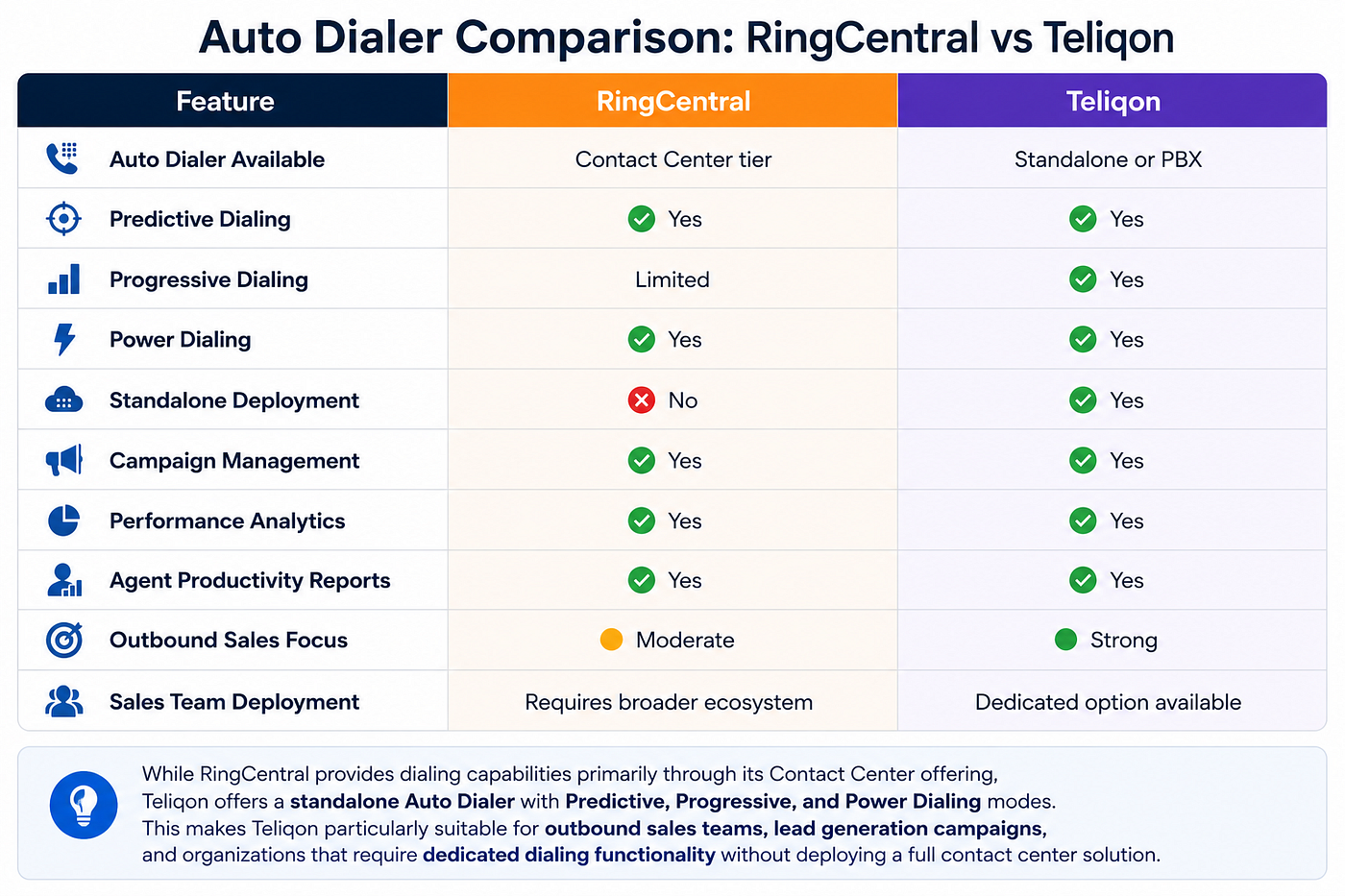
Sales organizations seeking standalone predictive and progressive dialers may prefer specialized platforms that provide outbound calling without requiring a full contact center deployment.
Bulk Messaging and SMS Providers
Businesses focused on:
- Bulk SMS
- OTP delivery
- SMPP connectivity
- Messaging APIs
often choose platforms designed specifically for communication infrastructure rather than collaboration-first UCaaS solutions.
RingCentral vs Teliqon
While RingCentral excels in enterprise collaboration and video communications, Teliqon focuses on global telecommunications and business communications infrastructure.
Teliqon’s strengths include:
- Virtual numbers in 170+ countries
- Bulk SMS and OTP delivery
- SMPP connectivity
- Standalone Auto Dialer
- Predictive, Progressive, and Power Dialing
- Hospitality integrations
- Oracle Opera support
- Micros Fidelio support
- TigerTMS support
- Flexible deployment options
RingCentral remains stronger in:
- Video conferencing
- Enterprise collaboration
- Unified workspace experience
The right choice ultimately depends on business requirements.
RingCentral remains one of the strongest UCaaS platforms available in 2026. It delivers an impressive combination of cloud telephony, messaging, collaboration, video conferencing, and enterprise integrations.
However, it is not the ideal solution for every organization.
Companies focused on hospitality, international telephony, outbound sales, bulk messaging, or global virtual number coverage may benefit from evaluating alternative platforms alongside RingCentral before making a final decision.
For enterprises seeking an all-in-one collaboration platform, RingCentral remains a compelling option. For businesses with specialized communication requirements, solutions such as Teliqon may provide a better fit.
RingCentral Pricing Explained: What Businesses Actually Pay
One of the biggest misconceptions about RingCentral is that the advertised subscription price represents the final cost. In reality, the total investment often depends on the features, integrations, and communication channels your business requires.
Core Plan
The Core plan is designed for small teams that need a modern cloud phone system.
Typical features include:
- Business calling
- IVR
- Team messaging
- Basic integrations
- Mobile and desktop apps
This plan is often sufficient for startups and small businesses with relatively simple communication requirements.
Advanced Plan
The Advanced plan is where many organizations begin to unlock RingCentral’s most valuable capabilities.
Additional features typically include:
- CRM integrations
- Advanced call management
- Enhanced reporting
- Automatic call recording
- Multi-site administration
Many businesses discover that the Advanced plan becomes the practical minimum once sales teams, support departments, and CRM workflows are involved.
Ultra Plan
The Ultra tier targets larger organizations with more demanding requirements.
Additional capabilities may include:
- Advanced analytics
- Enhanced storage
- Expanded video meeting functionality
- Enterprise-grade administration
For larger organizations, the Ultra plan can provide significant value, although costs can increase rapidly as user counts grow.
Hidden Costs to Consider
When evaluating RingCentral, businesses should also account for:
- Additional phone numbers
- Contact center licenses
- International calling
- Premium support options
- AI-powered features
- Third-party integrations
For organizations with hundreds of users, these costs can significantly affect total ownership expenses.
Real User Reviews: What Customers Like and Dislike
RingCentral receives generally positive ratings across major review platforms, but user experiences reveal both strengths and limitations.
What Users Like
Reliable Cloud Telephony
Many customers highlight call quality and platform stability as key reasons for choosing RingCentral.
Strong Integration Ecosystem
Users frequently praise integrations with:
- Salesforce
- HubSpot
- Microsoft Teams
- Zendesk
- Microsoft 365
These integrations help reduce manual work and improve productivity.
Unified Communication Experience
Organizations appreciate having:
- Calling
- Messaging
- Video meetings
- Collaboration tools
within a single platform.
Scalability
Businesses can add users, locations, and features without replacing infrastructure.
Common User Complaints
Pricing Complexity
One of the most common concerns involves understanding the real cost of the platform.
Many businesses report needing higher-tier plans to access the functionality they expected.
Feature Overload
Small businesses sometimes find the platform more complex than necessary.
Support Delays
While support experiences vary, some customers report longer resolution times for technical issues.
Additional Licensing
Features such as advanced contact center functionality may require separate products or subscriptions.
Why Businesses Switch From RingCentral
Despite its strong market position, organizations occasionally migrate to alternative providers.
The most common reasons include:
Reducing Communication Costs
Companies often seek lower overall ownership costs while maintaining essential functionality.
Expanding International Coverage
Businesses operating globally may require broader access to:
- Local numbers
- Mobile numbers
- International DIDs
Improving Outbound Sales Operations
Sales-focused organizations often need:
- Predictive Dialing
- Progressive Dialing
- Power Dialing
- Campaign Management
without deploying a full contact center solution.
Hospitality-Specific Requirements
Hotels and hospitality groups frequently require integrations with:
- Oracle Opera
- Micros Fidelio
- TigerTMS
- JDS
which are not a primary focus of RingCentral.
Bulk Messaging Requirements
Organizations with large-scale messaging needs often look for providers specializing in:
- Bulk SMS
- OTP delivery
- SMPP connectivity
- Messaging APIs
Best RingCentral Alternatives in 2026
Different businesses have different communication priorities. As a result, there is no universal alternative that fits every organization.
Teliqon
Best for:
- International communications
- Virtual numbers
- Hospitality
- Bulk SMS
- Auto Dialer deployments
Strengths:
- Virtual numbers in 170+ countries
- Bulk SMS and OTP
- SMPP connectivity
- Predictive, Progressive, and Power Dialing
- Hospitality integrations
- Flexible deployment options
Zoom Phone
Best for:
- Organizations heavily invested in Zoom Meetings
- Video-first collaboration
Nextiva
Best for:
- Small and medium-sized businesses
- Customer experience management
Dialpad
Best for:
- AI-powered communications
- Modern sales teams
8x8
Best for:
- Global enterprises
- International voice infrastructure
Vonage
Best for:
- Developers
- CPaaS and API-based communications
Frequently Asked Questions
Is RingCentral a VoIP provider?
Yes. RingCentral is a cloud-based VoIP and UCaaS platform that provides business telephony, messaging, and video communications.
Is RingCentral good for small businesses?
Yes, although some smaller organizations may find the platform more feature-rich and expensive than necessary.
Does RingCentral include video conferencing?
Yes. Video meetings are one of the platform’s core features.
Does RingCentral support CRM integrations?
Yes. RingCentral integrates with Salesforce, HubSpot, Zendesk, Microsoft Dynamics, and many other business applications.
Does RingCentral provide international phone numbers?
Yes, but availability varies by country and may involve additional costs.
Does RingCentral offer an auto dialer?
Certain dialing capabilities are available through its contact center solutions, although organizations looking for standalone outbound sales dialers may evaluate alternative providers.
Is RingCentral suitable for call centers?
Yes. RingCentral offers contact center solutions for customer service and sales operations.
Does RingCentral support SMS?
Yes. SMS functionality is available, although capabilities may vary depending on plan and region.
What are the biggest disadvantages of RingCentral?
The most frequently cited concerns include pricing, feature complexity, and additional costs for advanced functionality.
What is the best alternative to RingCentral?
The answer depends on business requirements. Companies prioritizing global telecommunications, hospitality integrations, international numbers, bulk messaging, and outbound sales automation often consider Teliqon among the strongest alternatives.
RingCentral vs Teliqon: Which is better?
RingCentral is generally stronger for enterprise collaboration and video communications. Teliqon is often a better fit for global telephony, hospitality, virtual numbers, SMS infrastructure, and outbound sales operations.
Does RingCentral require on-premise hardware?
No. RingCentral is a fully cloud-based platform.
Can RingCentral support remote teams?
Yes. Remote and hybrid work environments are among RingCentral’s primary use cases.
Is RingCentral suitable for international businesses?
Yes, although organizations requiring extensive international number coverage may compare alternative providers.
How long does RingCentral implementation take?
Deployment timelines vary based on company size, integrations, and migration requirements. Small businesses can often deploy within days, while larger enterprises may require several weeks.
RingCentral vs Teliqon: Complete Feature Comparison
When comparing RingCentral and Teliqon, it’s important to understand that the two platforms were built with slightly different priorities.
RingCentral is primarily known as a UCaaS platform focused on enterprise collaboration, video conferencing, and unified communications.
Teliqon positions itself as a Global Cloud Communications Platform that combines business telephony, international voice services, virtual numbers, messaging infrastructure, outbound sales tools, and hospitality-focused communications.
Auto Dialer Comparison
Omnichannel Communications

CRM and Business Integrations

Hospitality Industry Comparison

International Number Coverage

Who Should Choose RingCentral?
RingCentral is typically the better option for organizations that:
Need an Enterprise Collaboration Platform
If your business heavily relies on:
- Video meetings
- Internal collaboration
- Team messaging
- Unified workspaces
RingCentral provides a mature ecosystem designed around employee communication.
Have Large Distributed Teams
Organizations with hundreds or thousands of users often benefit from:
- Centralized administration
- Enterprise security
- Mature governance controls
- Large-scale deployment capabilities
Prioritize Video Conferencing
Companies that conduct a significant number of internal meetings may find RingCentral’s video capabilities particularly valuable.
Already Use Salesforce or Microsoft Ecosystems
Businesses deeply integrated with:
- Salesforce
- Microsoft 365
- Microsoft Teams
often find RingCentral easy to adopt.
Who Should Choose Teliqon?
Teliqon is often the stronger choice for businesses that prioritize telecommunications infrastructure and customer communications.
International Businesses
Organizations operating across multiple countries can benefit from:
- Virtual numbers in 170+ countries
- Global DID coverage
- International voice services
Sales Teams
Teliqon is particularly attractive for outbound sales organizations that need:
- Predictive Dialing
- Progressive Dialing
- Power Dialing
- Campaign management
without deploying a full enterprise contact center.
Hospitality Companies
Hotels and hospitality groups can leverage integrations with:
- Oracle Opera
- Micros Fidelio
- TigerTMS
- JDS
which are typically unavailable in most UCaaS platforms.
SMS-Focused Organizations
Businesses that rely on:
- Bulk SMS
- OTP delivery
- SMPP connectivity
- Messaging APIs
often require capabilities beyond what traditional UCaaS platforms provide.
Businesses Seeking Flexibility
Organizations that want:
- Flexible deployment
- Scalable communications
- Custom integrations
- Global telecom services
may find Teliqon better aligned with their requirements.
Decision Matrix: Which Platform Is Better?
Choose RingCentral if your primary goal is enterprise collaboration, video communications, and unified internal communications.
Choose Teliqon if your organization requires international telecommunications, virtual numbers, hospitality integrations, bulk messaging, outbound sales automation, and flexible cloud communications infrastructure.
For many businesses, the decision comes down to a simple question:
Do you need a collaboration-first UCaaS platform, or a communications-first global telecom platform?
The answer will usually determine which solution is the better fit.
Sources & References
The information in this article is based on publicly available product documentation, independent software reviews, analyst reports, and verified customer feedback platforms.
Official Sources
- RingCentral Official Website https://www.ringcentral.com
- RingCentral Plans & Pricing https://www.ringcentral.com/office/plansandpricing.html
- RingCentral App Gallery & Integrations https://www.ringcentral.com/apps
- RingCentral Contact Center (RingCX) https://www.ringcentral.com/contact-center.html
Independent Reviews & Industry Analysis
- Forbes Advisor — RingCentral Review https://www.forbes.com/advisor/business/software/ringcentral-review/
- Forbes Advisor — RingCentral Pricing https://www.forbes.com/advisor/business/software/ringcentral-pricing/
- Forbes Advisor — RingCentral Alternatives https://www.forbes.com/advisor/business/software/ringcentral-alternatives/
- TechRadar — RingCentral Review https://www.techradar.com/reviews/ringcentral-phone
- Business.com — RingCentral Business Phone System Review https://www.business.com/reviews/ringcentral-business-phone-systems/
- GetOmnichannel — RingCentral Review https://getomnichannel.com/call-center-software/ringcentral-review/
- CloudTalk — RingCentral Review https://www.cloudtalk.io/phone-system-reviews/ringcentral/
Customer Reviews & User Feedback
- Gartner Peer Insights — RingEX Reviews https://www.gartner.com/reviews/product/ringex
- G2 — RingCentral Reviews https://www.g2.com/products/ringcentral/reviews
- G2 — RingCentral Contact Center Reviews https://www.g2.com/products/ringcentral-contact-center/reviews
- Capterra — RingCentral Reviews https://www.capterra.com/p/122931/RingCentral/
- TrustRadius — RingCentral Reviews https://www.trustradius.com/products/ringcentral/reviews
Hospitality Integration References
- Oracle Hospitality OPERA Cloud https://www.oracle.com/hospitality/products/opera-property-services/
- Oracle Hospitality Solutions https://www.oracle.com/hospitality/
- TigerTMS Hospitality Communications https://www.tigertms.com
- JDS Hospitality Solutions https://www.jdshospitality.com
Additional Resources
- Teliqon Official Website https://teliqon.io
- Teliqon Documentation https://docs.teliqon.io
- Teliqon Integrations https://teliqon.io/resources/integrations
Research Methodology
This review combines information from official vendor documentation, independent industry analysts, software review platforms, and customer feedback sources. Product features, integrations, and pricing may change over time. Readers are encouraged to verify the latest information directly with the vendor before making purchasing decisions.
메타데이터
- post_id
- ceeb2428139f
- slug
- ringcentral-review-2026-features-pricing-pros-cons-and-best-alternatives-ceeb2428139f
- url
- https://medium.com/@serhiy.bohush_6427/ringcentral-review-2026-features-pricing-pros-cons-and-best-alternatives-ceeb2428139f
- canonical_url
- https://medium.com/@serhiy.bohush_6427/ringcentral-review-2026-features-pricing-pros-cons-and-best-alternatives-ceeb2428139f
- author_url
- https://medium.com/@serhiy.bohush_6427
- status
- ok
- fetched_at
- 2026-06-27 18:20:27
