AI and education: the paradox of progress that threatens the ability to learn
The paradox of educational AI
AI and education: the paradox of progress that threatens the ability to learn
The paradox of educational AI
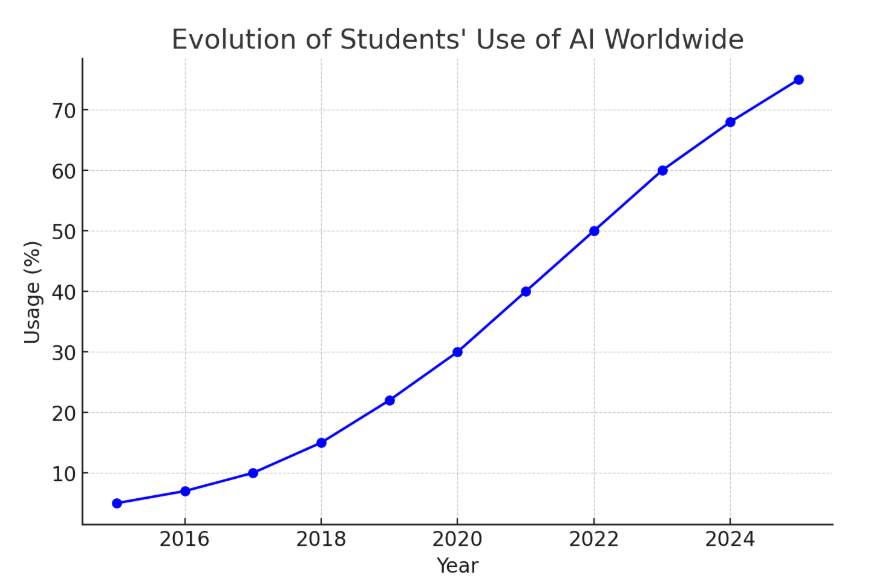
Artificial intelligence: a fashionable term, omnipresent, used in every situation, and presented as the solution to all our problems and to the complexity of a world that evolves at dizzying speed. In barely two years, AI has gone from being a technological gimmick to becoming a kind of inseparable companion, always present, always ready to help, explain, or make decisions. It has installed itself in our lives, in our minds, in our pockets, in our routines, and, of course, in education.
This rapid integration reflects the concerns highlighted in the Harvard report ‘Generation AI: Navigating the Opportunities and Risks of Artificial Intelligence’, which describes how quickly AI is reshaping everyday cognitive habits. If it sometimes seems too good to be true, it nevertheless remains the tool everyone turns to. Looking for information ? AI will fetch it. You don’t understand a concept ? Ask AI to rephrase it. You’re a teacher who wants to correct an assignment, design a homework task, or create spiral-learning exercises for a particular level? No problem, here comes AI. It justifies, summarises, completes… perhaps a bit too well.
However, if everything is available in a few seconds, if every problem finds an instant solution, what is the purpose of learning? Behind every form of progress, a paradox emerges: AI aspires to elevate us, yet may ultimately prevent us from learning.
AI as a learning amplifier
To give credit where it is due: AI is an undeniable pedagogical revolution. For the first time, anyone can access a bottomless well of knowledge without financial, social, or geographic barriers. Whether one wants to explore law, understand quantitative finance, or study Japanese literature, resources are instant, precise, and of a quality that would have seemed impossible a decade ago.
A 2025 study by Science Direct shows how AI-enabled adaptive learning platforms can genuinely reshape the learning experience by adjusting content, difficulty, and feedback in real time to each learner’s needs. These systems, driven by machine-learning models capable of detecting gaps, anticipating progress, and proposing targeted activities, offer a form of personalised guidance that common teaching simply cannot provide. They illustrate how AI can broaden access to tailored education on a global scale, and why this technological shift is far more than a simple convenience.
We still remember the time spent, sometimes wasted, reading, reorganising, and rephrasing our lessons, while student life often felt more like a race against the clock than intellectual growth. In this context, the productivity gains offered by AI are far from superficial: they bring relief, efficiency, and the freedom to focus on what truly matters. Ultimately, AI is not just intelligent, it has become indispensable. A prosthesis for our tired brains, an extension of our capabilities, a chance to do more, faster… perhaps even more cleverly.
The dependence that leads to unlearning
But behind this appealing picture lies a silent threat: cognitive dependence. By providing immediate answers to all our questions, AI gradually weakens our ability to think for ourselves. When we no longer need to search, compare, hesitate, or argue, we lose that fundamental reflex: constructing our own thought. The brain, inherently inclined toward minimal effort, quickly adjusts to this constant outsourcing of cognitive work.
This phenomenon is accompanied by a diffuse but deep unlearning. By systematically relying on the machine, we diminish our analytical and problem-solving skills. And if tomorrow this tool were to vanish, due to a breakdown, restriction, or malfunction, we would painfully discover that our abilities have eroded. These gaps would be difficult to repair because they would have formed at a crucial moment: the period of intellectual development.
Excessive reliance on AI can short-circuit essential cognitive growth, particularly during formative years. The Guardian notes that “some users, particularly younger ones, report diminished capacity for problem-solving and independent thought” and that educators are increasingly worried that AI-generated shortcuts could atrophy human cognitive skills.
Among children and teenagers, whose brains are still constructing essential neural networks, the situation is even more critical. Learning, memorising, rephrasing, making cognitive effort are not mere details: they are what shape autonomous thought. Deep memory that is not activated becomes fragile; neural connections that do not form in childhood cannot be fully recovered in adulthood.
And AI often gives us ready-made solutions. We “understand”, yes, but without having built the reasoning ourselves. We obtain the conclusion without walking the path. The result: the illusion of knowledge. We read a lot, but we think little. We believe we understand, but we do not truly know. And that is where real impoverishment begins.
The illusion of competence over understanding
The great confusion of our time can be summed up as follows: having a good answer is not the same as understanding. Yet for many students, AI has blurred this essential distinction. Instantly obtaining a solution to an exercise, a literary commentary, or a mathematical proof gives the impression of mastery. But it is only an impression.
This leads to what some call knowledge laziness: why make the effort to think, formulate a hypothesis, or test an intuition when a machine can provide the reasoning? Once again, the brain follows the path of least resistance.
The problem is that this convenience creates cognitive fragility. Knowledge that has not been built has no roots. It does not withstand novelty, variation, or complexity. In real-life situations, exams, or professional contexts, students who have delegated too much suddenly discover that their understanding is shallow.
This is precisely what the National Library of Medicine’s article warns about: AI can create a veneer of competence that collapses when authentic reasoning is required.
AI excels at providing answers. But genuine learning is not about storing answers: it is about understanding, organising, connecting, discussing, and criticising. It is about building reasoning.
Homogenisation of knowledge, impoverishment of thought
Beyond the individual level, another danger emerges: the homogenisation of thought. Generative AIs operate through statistical layers built upon massive amounts of text. They draw on the most common solutions, the most frequently used reasoning, the most shared ideas. They homogenise.
If all students use the same tools for learning, writing, and structuring thought, we may gradually shape a generation that thinks with the same cognitive biases, the same blind spots, the same linguistic patterns. Originality disappears, the diversity of intelligences shrinks, and critique becomes both rarer and weaker. This risk is even greater because AI presents itself as neutral, while it is not. Each model contains the biases of its training data: cultural, political, linguistic, historical. Knowledge expands, yes, but often subtly reshaped without our awareness.
The Guardian argues that widespread adoption of generative‑AI tools is leading to what researchers call a “global knowledge collapse”. As AI‑generated content floods the internet and becomes the basis for new AI models, and as people increasingly rely on AI for information, a feedback trend emerges. Dominant ideas and common knowledge are constantly amplified, while obscure, minority or local knowledge gradually disappear.
In a world where education would be entirely shaped by standardised tools, we would be heading toward a society of individuals whose thinking is smooth and transparent like glass. Yet creativity, innovation, and social progress require divergence, confrontation of ideas, and originality. The homogenisation of knowledge can only impoverish us collectively — a major risk for education.
A quest to reconcile progress and learning
This paradox does not mean that AI has no place in education but rather that we must understand how it can find its place. The first step is to develop digital literacy as a fundamental part of education. Understanding the basic functioning of models, knowing their limits, being able to detect and challenge their biases, these skills should be learned as reliably as grammar or problem-solving. The next generation, which will grow up with AI, must not only use it but also question it.
The second idea is that AI should be provided after learning, not instead of learning. AI should help validate what we already know, deepen a topic, or add new perspectives. Above all, it should never replace the first draft of reflection. AI is a friend, not a rival. Humans learn; machines assist.
A third direction is to rethink assessment. As long as evaluations focus solely on final products, AI will remain the easy path: producing a polished project with minimal effort. Evaluations should prioritise understanding, the ability to explain a mechanism, defend a viewpoint, or analyse a text or solution rather than merely produce one.
AI should be a tool that supports thinking, not a brain outside our skulls. It should accelerate our ideas and push us further, but never become a shortcut that replaces effort. It is our responsibility to use it wisely and remain aware of its limitations.
Protecting ourselves from the pitfalls of artificial intelligence has become necessary. Passive, automatic use, replacing thought instead of supporting it, is an easy habit to adopt. Education must evolve to integrate these tools while preserving the quality of teaching: understanding, reasoning, and intellectual production. But if AI already shows its limits and risks within education, what about the professional world? The implications there are just as profound, and perhaps even more consequential.
About this article
This article has been written by a student on the Grenoble Ecole de Management’s Advanced Masters in Digital Strategy Management. As part of a content creation assignment, students are given the task of writing articles based on their digital interests and disseminating the articles online. Articles are marked but we make minimal changes to the content. Thanks for reading! James Barisic, Programme Director, MS DSM.
메타데이터
- post_id
- cefcb2632bd9
- slug
- ai-and-education-the-paradox-of-progress-that-threatens-the-ability-to-learn-cefcb2632bd9
- url
- https://medium.com/digital-gems/ai-and-education-the-paradox-of-progress-that-threatens-the-ability-to-learn-cefcb2632bd9
- canonical_url
- https://medium.com/digital-gems/ai-and-education-the-paradox-of-progress-that-threatens-the-ability-to-learn-cefcb2632bd9
- author_url
- https://medium.com/@marinelorinm
- status
- ok
- fetched_at
- 2026-07-18 02:47:26