Inside Pablo Escobar’s Empire: 10 Hidden Essentials
What rubber bands, a soccer ball, and a radiotelephone reveal about the most powerful drug lord in history.
Inside Pablo Escobar’s Empire: 10 Hidden Essentials
What rubber bands, a soccer ball, and a radiotelephone reveal about the most powerful drug lord in history.
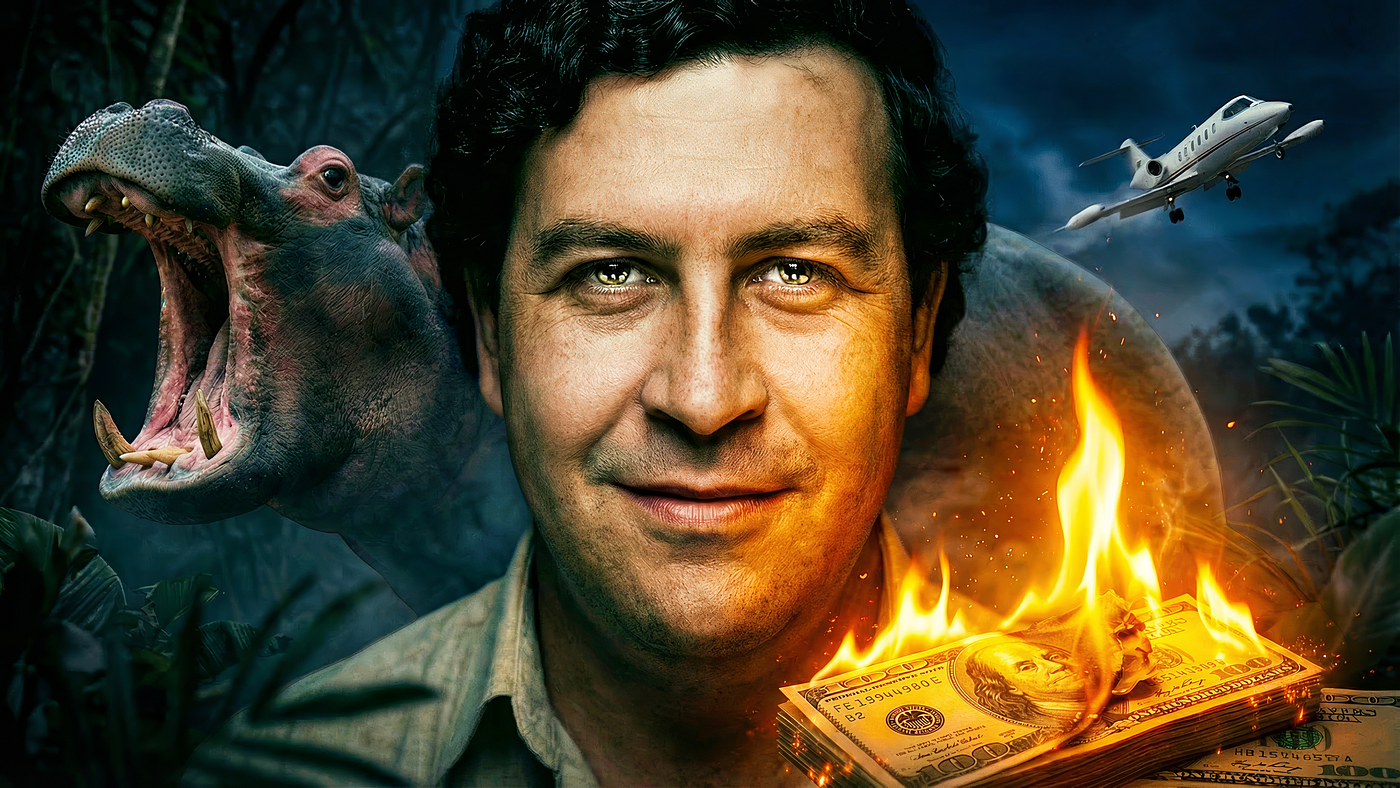
Quick Facts
- Born: December 1, 1949, Rionegro, Antioquia, Colombia
- Died: December 2, 1993, Medellín, Colombia (one day after his 44th birthday)
- Role: Colombian drug trafficker; founder and leader of the Medellín Cartel
- Region: Colombia, primarily Antioquia and the city of Medellín
Pablo Escobar reportedly spent $2,500 a month on rubber bands. Not because he liked office supplies. Because the cartel could no longer physically count its cash. They had to weigh it.
That single detail is the doorway into Pablo Escobar’s empire. He wasn’t running a small operation that got lucky. He was running a logistics business so large it broke ordinary categories of money, infrastructure, and government.
These are the ten essentials that ran the operation. Some of them built him up. One led directly to his death. And one is still causing chaos in Colombia today.
Historical Context: How a Colombian Smuggler Became Richer Than Most Countries
Pablo Escobar rose in a Colombia caught between two converging forces. American cocaine demand exploded through the 1970s and 1980s, while Colombia’s institutions, from the courts to the national police, were chronically weak and easily infiltrated. Into that gap stepped a new kind of criminal organization: vertically integrated, internationally networked, and wealthy enough to challenge the state head-on.
By the mid-1980s, the Medellín Cartel controlled an estimated 80 percent of the cocaine entering the United States. The scale of money flowing back into Antioquia, Colombia’s mountainous coffee-growing department, was historically unprecedented. It funded private armies, bought judges and journalists, and triggered open warfare between traffickers and the Colombian state.
Escobar himself was a product of this moment. A working-class kid from outside Medellín turned smuggling skill, raw political ambition, and a willingness to kill into a personal empire worth, at its peak, an estimated 30 billion dollars.
1. Rubber Bands: A Cash Logistics Problem
Pablo’s brother Roberto served as the organization’s accountant. According to him, they wrote off roughly ten percent of their annual cash as “spoilage” (Source: Roberto Escobar, The Accountant’s Story, 2009).
The reason was as mundane as it was absurd. Rats. Literal rats crawled into the cartel’s warehouses and chewed up the money. Millions of dollars, lost to rodents.
That’s why $2,500 a month went to rubber bands. Wrapping cash into countable, stackable bricks wasn’t an office supply line item. It was infrastructure.
Pablo didn’t have a money problem. He had a money logistics problem.
2. The Learjet: A Middle Finger to Every Government
When you have more money than you can store, you spend it proving you’re untouchable. Escobar owned a fleet of aircraft, but the Learjet was personal. He used it to fly his family to Florida for Disney World trips and to grab American fast food that wasn’t available at home.
The most extraordinary piece of evidence is a single photograph. Escobar in front of the White House with his family, posing like any other tourist, already deeply embedded in international cocaine trafficking.
The plane wasn’t transportation. It was a statement to every government trying to catch him.
3. The Soccer Ball: Money Laundering and Loyalty
To clean roughly $420 million a week, the cartel needed businesses with easily manipulated cash flow. In 1980s Colombia, nothing moved money like football.
Escobar didn’t just support Atlético Nacional. He bankrolled the club. Ticket sales, transfer fees, and gate revenue all turned out to be useful tools for moving dirty money into the legitimate banking system.
But the soccer ball did a second job. In the poorest neighborhoods of Medellín, Escobar built fields, gave kids somewhere to play, and made himself their hero. Many of those kids grew up to become his enforcers.
One object, two functions: money laundering and public relations.
4. Bandeja Paisa: The Comfort Blanket of a Billionaire
With the wealth to fly in chefs from anywhere in the world, Escobar’s tastes stayed stubbornly local. His favorite dish was bandeja paisa: red beans, rice, ground beef, fried pork belly, an egg, plantain, chorizo, an arepa, and avocado, served on a single plate.
Even after he built his own prison, he insisted on fresh ingredients for it. The dish was his comfort blanket. The reason he looked thicker in his later photographs than in his early ones is no mystery once you know what he ate.
5. The List: Plata o Plomo Inside Escobar’s Empire
Plata o plomo. Silver or lead. Take the bribe or face the bullet. The line became shorthand for how the Medellín Cartel governed.
Escobar ran a shadow state. Judges, police officers, politicians, and military officers were on his payroll, and he needed to track every one of them. That meant a list.
If your name landed on the wrong side of that list, you were already finished. You just didn’t know it yet. Inside Escobar’s empire, he was judge, jury, and the man who decided who lived.
6. La Catedral: The Prison Pablo Escobar Built for Himself
In 1991, Escobar surrendered to Colombian authorities on one extraordinary condition. He would build his own prison, choose his own guards, and select his own inmates. The government agreed.
The result, called La Catedral, included:
- A disco
- A bar
- A jacuzzi
- A waterfall
- A full-size soccer field
He invited professional footballers to play matches with him inside. He hosted weddings. From behind walls he was legally allowed to call a prison, he ran his entire operation undisturbed.
It collapsed when he murdered two of his own associates inside the facility. The government finally sent in the military. Escobar walked out the same night.
7. The Hippos: The Only Part of Escobar’s Empire Still Growing
At his estate Hacienda Nápoles, Escobar built a private zoo. Elephants, giraffes, ostriches, and four hippopotamuses imported from Africa.
After his death, most of the animals were relocated. But hippos are enormous and dangerous to transport, so the four were simply left where they were.
Three decades later, those four hippos have multiplied into well over a hundred. Some estimates run as high as 170. They live wild in the Magdalena River, destroying native ecosystems and threatening fishermen.
The “narco-hippos” are the only part of Pablo Escobar’s empire still growing.
8. Two Million Dollars in Cash: Burned to Keep a Daughter Warm
This story also comes from Roberto Escobar.
Pablo was hiding from authorities in the Andes mountains. The temperature dropped. His daughter Manuela was sliding toward hypothermia. There was no wood. There was no fuel.
What he did have was sacks of cash.
He set roughly two million dollars on fire to keep his daughter warm. When you have billions, cash becomes just paper.
It captures the central paradox of Pablo Escobar. He was responsible for thousands of deaths. He was also the kind of father who would burn an empire’s worth of money so one child wouldn’t get cold.
That same love would end him.
9. The Radiotelephone: The Tool That Ended Pablo Escobar’s Empire
Escobar was a micromanager. He needed constant contact with his soldiers, his pilots, and, above all, his family. The radiotelephone went with him everywhere.
The Search Bloc, the specialized Colombian police unit hunting him, knew this was his weakness. With radio triangulation technology and support from American intelligence units like Centra Spike, they closed in every time he transmitted.
December 2, 1993. The day after his 44th birthday. Escobar called his son Juan Pablo. The conversation ran too long. The signal was traced. The house was found. Within hours, he was dead on a rooftop in Medellín.
He fell holding the one piece of technology he could not give up. The radiotelephone that kept him connected to his family led the men hunting him straight to his door.
10. The Family Photograph: His Motivation and His Weakness
Every horror in the previous nine essentials was justified by Escobar himself with three words. For my family.
He was responsible for an estimated 4,000 to 5,000 deaths, including attacks on civilian airplanes and the killing of children. He was also, by every account, an obsessive father.
His wife Tata. His son Juan Pablo. His daughter Manuela. They were the center of everything.
When he was on the run, separation from them broke him psychologically. He took risks just to hear their voices. He stayed on the radiotelephone too long because he could not hang up on his son.
His enemies knew this. They targeted his family to force him into the open.
In the end, Pablo Escobar wasn’t brought down by his enemies or his arrogance. He was taken down by his love. The family photograph was his motivation, his justification, and his single fatal weakness, all in one frame.
Why This Still Matters
Three decades after his death, Pablo Escobar’s empire is still visible in Colombia. It’s there in the wild hippo population taking over the Magdalena River. It’s there in the corruption his money normalized. It’s there in the trauma of a country that lost thousands of citizens to his war. His story remains a brutal case study in what happens when a single criminal organization grows wealthier than the state trying to police it. The model he built did not end with him.
Conclusion
Ten objects, one through-line: every essential of Pablo Escobar’s empire reveals a tradeoff. The rubber bands hint at how much money he had. The Learjet, the prison, and the soccer fields show what that money could buy. The family photograph shows the one thing money could never protect him from.
If this changed how you picture him, send it to someone who only knows him from the Netflix series. The real history is stranger, darker, and more instructive than any dramatization.
Watch the full Video here: https://youtu.be/q1Ny_FcM1CI?si=GvhkR5997SJqg3LI
Sources & Further Reading
- Mark Bowden, Killing Pablo: The Hunt for the World’s Greatest Outlaw (Atlantic Monthly Press, 2001)
- Roberto Escobar with David Fisher, The Accountant’s Story: Inside the Violent World of the Medellín Cartel (Grand Central Publishing, 2009)
- Juan Pablo Escobar, Pablo Escobar: My Father (Thomas Dunne Books, 2016)
- ESPN 30 for 30, The Two Escobars, directed by Jeff and Michael Zimbalist (2010)
- U.S. Drug Enforcement Administration (DEA), historical records on the Medellín Cartel
메타데이터
- post_id
- cf1e9fc82f9a
- slug
- inside-pablo-escobars-empire-10-hidden-essentials-cf1e9fc82f9a
- url
- https://medium.com/@theessentialten/inside-pablo-escobars-empire-10-hidden-essentials-cf1e9fc82f9a
- canonical_url
- https://medium.com/@theessentialten/inside-pablo-escobars-empire-10-hidden-essentials-cf1e9fc82f9a
- author_url
- https://medium.com/@theessentialten
- status
- ok
- fetched_at
- 2026-06-09 15:37:30

