Vienna’s Schools of Psychotherapy: What Freud, Adler, and Frankl Taught Us
Vienna… the city of classical music, late-afternoon coffees, and magnificent palaces. But here’s what’s fascinating: behind that romantic…
Vienna’s Schools of Psychotherapy: What Freud, Adler, and Frankl Taught Us
Vienna… the city of classical music, late-afternoon coffees, and magnificent palaces. But here’s what’s fascinating: behind that romantic backdrop, seeds of three of the 20th century’s deepest psychological revolutions were sown. Figures like Freud, Adler, and Frankl laid the foundations of modern psychotherapy in the foggy streets of Vienna, all while seeking answers to countless questions about ourselves: What truly motivates us? Why is it so tough to trace certain behaviors back to their origins? What is it that keeps us going in life?
In this post, you’ll find a brief yet striking account of the three distinct approaches collectively known as the Vienna Schools of Psychotherapy. Be sure to read till the end — sometimes the most crucial hints hide in the closing lines.
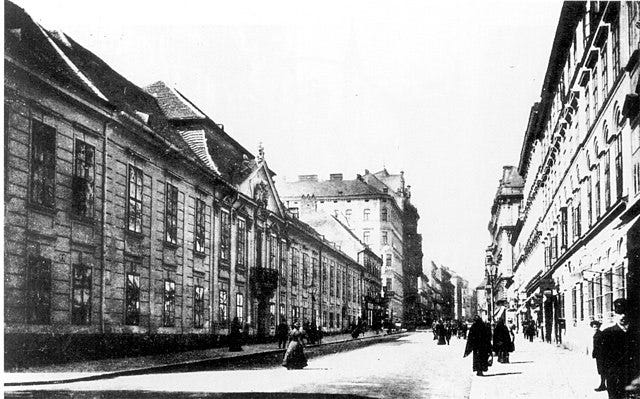
Palais Schoenborn, today: 1080 Vienna, Laudongasse 15, before 1900, surly bevor 1912 (tramway)
1) Freud and Psychoanalysis: The Door to the Unconscious
When we mention Vienna, can we skip psychoanalysis? In the early 1900s, Sigmund Freud introduced a brand-new perspective on the human psyche through concepts like “dream analysis” and “free association.” He basically said, “A whole bunch of drives and impulses guide our behavior, but we’re unaware of most of them.”
- Repressed Drives: According to Freud, a significant portion of our wishes and desires remain locked in the unconscious. Because of the rules imposed by civilization, these drives enter a constant emergence–repression loop.
- Oedipus Complex: One of Freud’s most hotly debated ideas. In short, it explains how a child’s relationship with their parents shapes the building blocks of their future self and personality.
- Ego-Id-Superego: The unending clash between the ego (the self), the id (instinctual impulses), and the superego (internalized social norms) is like a film playing nonstop in the background of our mental world.
Freud particularly insisted we “listen to our dreams,” because they act like movie screens reflecting our unconscious desires and fears. If this all sounds a bit out there, recall a recent dream; maybe Freud has been trying to tell you something.
2) Adler and Individual Psychology: The Power of Social Ties
One of the figures who branched off from Freud’s ideas and forged his own path was Alfred Adler. He essentially said, “Alright Freud, the unconscious matters, but let’s not ignore social connections.” His Individual Psychology focuses on the concept of the “inferiority complex.”
- Inferiority Complex: According to Adler, every individual struggles with an innate sense of inadequacy. Over time, the strategies we use to compensate for that feeling shape our personalities.
- Social Embeddedness: Humans aren’t driven purely by sexual impulses or aggression; we’re also motivated by the need to “find our place” in society and to realize our potential.
- Family Dynamics and Birth Order: In Adlerian therapy, family context and sibling relationships play a major role in shaping one’s personality.
To Adler, we’re all inherently social beings. Depression, anxiety, conflicts… much of it may stem from not feeling valuable enough or failing to form healthy bonds with others. This is why Adler places our sense of self firmly in a social context.
3) Viktor Frankl and Logotherapy: A Life Without Meaning Is Incomplete
Now we arrive at my personal favorite: Viktor Frankl and Logotherapy. Frankl survived the harrowing reality of Nazi concentration camps during World War II, emerging with a philosophy centered on “meaning.” Consider this: Even under the worst circumstances, there can be a force that keeps us hopeful. Frankl believed that force is meaning.
- The Quest for Meaning: Frankl argued that the fundamental human drive isn’t “seeking pleasure” or “avoiding pain,” but rather “finding meaning in life.” As long as you have a sense of meaning, you can endure even suffering in a more tolerable way.
- Holding On to Life: In his book Man’s Search for Meaning, Frankl illustrated how, even in concentration camps, having an inner purpose was a powerful anchor for survival — how hope and resilience can flourish under the harshest conditions.
- September 2, 1997: Frankl passed away in Vienna at the age of 92, leaving behind a life philosophy that places “meaning” at the heart of our existence.
In Frankl’s view, therapy becomes a journey leading you to answer the question, “Why am I alive?” These days, many therapists draw on Frankl’s methods to help clients discover their purpose in life.
The Legacy of Vienna
Think about it: Freud delved into the unconscious, Adler emphasized social ties and the inferiority complex, and Frankl discovered the secret to survival through the search for meaning. What they all have in common is the understanding that humans are layered beings:
- We have a side shaped by repressed impulses (Freud).
- We are social creatures, molded by the roles society imposes on us (Adler).
- Deep down, we can’t live without meaning (Frankl).
When you think about psychotherapy, there isn’t just one approach. Vienna’s three big schools are simply the earliest, most vibrant blooms in this garden of ideas. Today, there’s a wide variety of schools, from cognitive-behavioral therapy to schema therapy, from mindfulness-based approaches to holistic methods. But in one way or another, they all passed through the path these three pioneers paved.
Final Thoughts
If you want to better understand your inner world, make peace with your past, or gain strong motivation for your future, following in the footsteps of Freud, Adler, and Frankl isn’t a bad place to start. In fact, today’s ever-popular “personal development” movement can be seen as an offshoot from these very roots.
Vienna’s history isn’t just about musical and architectural genius — it rightfully deserves recognition for the pioneering minds that revolutionized psychotherapy. Maybe someday you’ll find yourself strolling through Vienna. If that happens, don’t just sit with your coffee and Mozart chocolate; take a walk through the streets Freud once roamed, and let the footsteps of Adler and Frankl guide you as you soak up that atmosphere. Who knows, maybe in that moment, the city will whisper a meaning that opens an unexpected door in your own life.
(If you enjoyed this piece or have any questions, feel free to drop them in the comments. After all, sometimes the best journeys begin with a good conversation.)
메타데이터
- post_id
- cf1f7461292e
- slug
- viennas-schools-of-psychotherapy-what-freud-adler-and-frankl-taught-us-cf1f7461292e
- url
- https://medium.com/@etherealInk/viennas-schools-of-psychotherapy-what-freud-adler-and-frankl-taught-us-cf1f7461292e
- canonical_url
- https://medium.com/@etherealInk/viennas-schools-of-psychotherapy-what-freud-adler-and-frankl-taught-us-cf1f7461292e
- author_url
- https://medium.com/@etherealInk
- status
- ok
- fetched_at
- 2026-07-21 05:58:31