Why General Human Intelligence May Be Harder to Reproduce Artificially Than We Think
Before asking whether artificial general intelligence can be built, we should ask what human intelligence is actually a solution to
Why General Human Intelligence May Be Harder to Reproduce Artificially Than We Think
Before asking whether artificial general intelligence can be built, we should ask what human intelligence is actually a solution to
Abstract
Artificial General Intelligence is often described as the next great technological milestone. Yet discussions of AGI typically assume that intelligence is fundamentally a general problem-solving capability that can eventually be reproduced through sufficiently powerful algorithms and computing resources. This essay argues that such an assumption may overlook a deeper question: where do problems come from in the first place? Problems are not objective features of the universe. They emerge because living organisms exist within evolutionary landscapes in which some outcomes matter and others do not. Human intelligence may therefore be less a standalone computational capability than the downstream consequence of billions of years of evolutionary pressure that shaped a hierarchy of significance, value and adaptive behaviour. Viewed through the lens of attractor dynamics and metastable dissipative structures, intelligence may emerge from an evolved organizational landscape rather than from a compact algorithm alone. The challenge facing AGI may therefore not be computation itself, but understanding the deeper processes that created the conditions under which intelligence became possible.
1. The AGI Dream
Artificial General Intelligence (AGI) has become one of the defining technological ambitions of the twenty-first century. Researchers at organizations such as DeepMind, OpenAI and Anthropic envision systems capable not merely of performing individual tasks, but of exhibiting the flexible, adaptive intelligence associated with human beings. The goal is not another specialized tool. The goal is a machine that can learn, reason, plan, create and adapt across domains with a breadth approaching that of the human mind.
Recent advances have made this ambition appear increasingly plausible. Large language models can write essays, generate computer code, pass professional examinations and engage in sophisticated dialogue. Reinforcement learning systems have mastered games once thought to require uniquely human intuition. The pace of progress has been sufficiently rapid that many now regard human-level AGI as a matter of engineering rather than principle.
Underlying much of this optimism is a powerful assumption: intelligence is fundamentally a computational capability. If the relevant computational principles can be discovered, and if sufficient data and computing power are available, then intelligence should ultimately be reproducible in artificial systems. From this perspective, the challenge is largely one of scale, architecture and optimization.
This essay does not argue that AGI is impossible. Nor does it appeal to mysticism, vitalism or the claim that biological brains possess supernatural properties. Instead, it asks a more fundamental question that often receives surprisingly little attention.
Before asking whether human-level intelligence can be reproduced, we should first ask what human intelligence actually is.
For all the discussion surrounding AGI, there remains remarkably little agreement about the nature of the thing being pursued. Is intelligence merely a sufficiently powerful problem-solving algorithm? Is it a computational process that can be abstracted from any physical substrate? Or is human intelligence the visible outcome of a much deeper evolutionary and thermodynamic history that cannot be so easily separated from the processes that created it?
The answer to that question may determine whether AGI is an engineering challenge, or whether the problem is far more difficult than we currently imagine.
2. What Is Human-Level General Intelligence?
Before debating whether AGI can be achieved, it is worth pausing to ask what human-level general intelligence actually means.
At first glance the answer appears obvious. Humans can reason, solve problems, learn new skills and adapt to unfamiliar situations. Consequently, AGI is often defined as a system capable of performing any intellectual task that a human can perform.
Yet this definition conceals an important difficulty. Human intelligence is not a collection of independent abilities. It is an integrated adaptive capacity that operates across an enormous range of contexts.
A child can learn a language from sparse examples. An adult can transfer insights from one domain to another. A scientist can develop theories about phenomena never previously encountered. A musician can improvise. A parent can navigate complex social relationships. Humans can reason abstractly, learn continuously, generate goals, modify those goals and adapt to situations for which no explicit training has occurred.
What is remarkable is not any individual capability. It is the ability to move among them.
Human intelligence therefore appears fundamentally general. It is not simply the possession of knowledge. Nor is it merely the execution of algorithms. Rather, it is the capacity to adapt effectively across a continually changing landscape of circumstances.
This distinction is important because many modern AI systems already display impressive forms of competence. They can write essays, generate software, solve mathematical problems and answer technical questions. Yet competence in a large number of tasks is not necessarily the same thing as general intelligence.
The difference may be illustrated by considering what happens when circumstances change unexpectedly. Human beings routinely encounter situations for which they have never been explicitly trained. Nevertheless, they often succeed in transferring knowledge from one domain to another, constructing novel solutions and modifying their behaviour in real time. This flexibility remains one of the defining characteristics of human cognition.
The question therefore becomes: what is the source of this flexibility?
Many AGI discussions implicitly assume that human intelligence is fundamentally a problem-solving engine and that the challenge is to reproduce the computational principles responsible for that engine. But before accepting this assumption, we should consider a deeper possibility.
What if intelligence itself is not the primary phenomenon?
What if intelligence is instead the visible consequence of a much larger adaptive process that has been unfolding throughout the history of life on Earth?
3. The Hidden Assumption: Problems Already Exist
Most discussions of artificial intelligence begin with a seemingly self-evident premise.
Intelligence solves problems.
From this perspective, the challenge facing AGI appears straightforward. If we can identify the computational principles that allow humans to solve problems, we should be able to reproduce those principles in machines.
Yet this formulation contains a hidden assumption that is rarely examined.
It assumes that problems already exist.
But what exactly is a problem?
From the perspective of physics, the universe contains particles, fields, energy gradients and physical processes. Nowhere within the laws of physics do we find concepts such as success, failure, danger, opportunity, value or purpose. These categories do not appear in Maxwell’s equations, general relativity or quantum mechanics.
A problem is not simply a feature of the external world.
A problem is a feature of the relationship between an organism and the world.
A cliff is a problem for a human being but not for a mountain. A lack of oxygen is a problem for an animal but not for a rock. A mathematical theorem is a problem for a mathematician but not for a tree.
The same physical reality can therefore be either highly significant or completely irrelevant depending on the nature of the system encountering it.
This observation suggests that intelligence may not be the primary phenomenon after all.
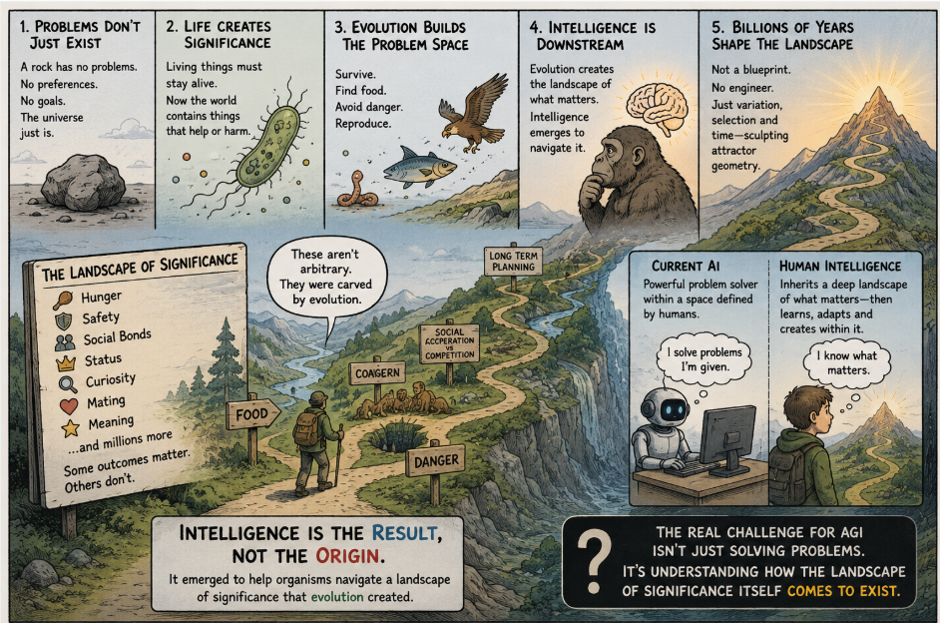
Before there can be problem solving, there must first be a distinction between what matters and what does not matter. There must be a landscape of significance within which certain outcomes are preferred over others.
The existence of such a landscape is often taken for granted because human beings inherit it automatically. Hunger matters. Pain matters. Social exclusion matters. Survival matters. We experience these things so naturally that it is easy to forget they are not intrinsic properties of the universe itself.
The universe does not define problems.
Living systems do.
This raises an important question for AGI.
When we speak of building a machine capable of solving arbitrary problems, where do those problems come from? How does a system determine what is relevant, what is valuable and what deserves attention?
The answer cannot simply be intelligence itself, because the recognition of a problem must logically precede the attempt to solve it.
Before we can understand intelligence, we may first need to understand the origin of the landscape of significance within which intelligence operates.
4. Evolution Created the Problem Space
If problems are not intrinsic features of the universe, then where do they come from?
The answer lies in the history of life itself.
For a rock, there are no problems. The rock has no preferences, no goals and no consequences associated with one state rather than another. The universe simply unfolds around it.
The situation changes the moment living systems appear.
A bacterium must maintain its internal organization. Nutrient gradients suddenly matter. Toxins matter. Temperature matters. What was previously a neutral physical environment becomes a landscape of significance.
The emergence of life therefore creates something fundamentally new: the distinction between conditions that support continued existence and conditions that threaten it.
From this distinction, the first problems emerge.
As evolution proceeds, the landscape becomes increasingly complex.
Single-celled organisms must locate nutrients.
Animals must avoid predators.
Social species must navigate hierarchies.
Humans must cooperate, compete, communicate and plan.
At every stage, evolution shapes the significance landscape within which organisms operate.
Importantly, intelligence does not create this landscape.
Intelligence emerges within it.
The hierarchy of what matters is already present before sophisticated cognition appears. Hunger existed before reasoning. Fear existed before language. Social bonding existed before mathematics.
The role of intelligence is therefore not to invent significance from nothing. Its role is to navigate an already existing landscape of significance more effectively.
This point is often overlooked in discussions of AGI.
When engineers speak of creating a general problem-solving system, they typically focus on reasoning, learning and decision making. Yet these capabilities evolved within organisms whose goals were ultimately determined by biological survival and reproduction.
Evolution did not first create intelligence and then assign it problems to solve.
Evolution created problems, and intelligence emerged as one solution.
This suggests a profound inversion of the standard narrative.
Rather than viewing intelligence as the primary phenomenon from which adaptive behaviour emerges, it may be more accurate to view intelligence as a downstream consequence of a much older process: the evolutionary construction of a landscape in which some outcomes matter and others do not.
The question for AGI therefore becomes more difficult than it first appears.
Before reproducing human intelligence, we may need to understand how billions of years of evolution created the hierarchy of significance within which human intelligence operates.
5. Intelligence Is Downstream of Evolutionary Pressure
The preceding discussion leads to a possibility that is rarely considered in AGI debates.
What if intelligence is not the primary phenomenon?
What if intelligence itself is a consequence of something deeper?
The conventional narrative assumes that intelligence is a general-purpose problem-solving capability. Evolution is then viewed as having discovered this capability because it proved useful.
But an alternative interpretation is possible.
Perhaps evolution did not discover intelligence at all.
Perhaps evolution discovered a vast hierarchy of biological significance, and intelligence emerged as a downstream adaptation that allowed organisms to navigate that hierarchy more effectively.
Under this view, the causal chain looks very different:
Evolutionary Pressure ↓ Value Landscape ↓ Problem Definition ↓ Intelligence
The distinction is important because it shifts the focus from intelligence itself to the conditions that made intelligence useful.
Human beings do not simply solve problems.
Human beings recognize problems.
They identify relevance.
They distinguish signal from noise.
They allocate attention.
They determine priorities.
They decide what matters.
These capacities are so deeply embedded within human cognition that they are often mistaken for intelligence itself.
Yet they may actually be inherited consequences of billions of years of evolutionary selection.
The ability to identify a threat, recognize an opportunity, prioritize a goal or assign value to an outcome did not arise in a vacuum. It emerged within organisms whose continued existence depended upon making such distinctions.
This raises a profound question for AGI.
Can intelligence be separated from the evolutionary landscape that produced it?
Many AI systems are extraordinarily capable once objectives are specified. They can optimize, reason and plan within a given framework. Yet the framework itself is usually supplied externally by human designers.
Humans, by contrast, inherit a vast hierarchy of significance that shapes cognition long before deliberate reasoning begins. Our goals, motivations, fears, desires and intuitions are not separate from intelligence. They are part of the landscape within which intelligence evolved.
This suggests that what we call human intelligence may be inseparable from the evolutionary pressures that created the distinction between what matters and what does not.
If so, reproducing human-level general intelligence may require more than reproducing problem-solving ability.
It may require reproducing the landscape of significance from which problem-solving itself emerged.
6. Billions of Years of Attractor Geometry
The difficulty becomes even clearer once we consider how human intelligence was actually constructed.
Evolution did not design the brain from first principles.
There was no blueprint, no objective function and no engineer optimizing for general intelligence.
Instead, evolution operated through countless cycles of variation and selection across billions of years. Every generation inherited solutions that had proven sufficiently successful under previous conditions. Over time, these solutions accumulated, interacted and became increasingly integrated.
The result was not merely a larger brain.
The result was the emergence of an extraordinarily complex adaptive landscape.
The human brain therefore cannot be understood simply as a computational device. It is the present state of a dynamical system whose origins extend deep into evolutionary history. Its architecture reflects not only recent human evolution, but the accumulated legacy of multicellular life, nervous systems, social behaviour, language and culture.
Each stage contributed constraints that shaped the next.
Seen in this way, intelligence may be less like a software program and more like a landscape.
A landscape possesses structure. Certain trajectories are easier than others. Certain states are stable while others are unstable. Learning modifies the landscape. Development modifies the landscape. Experience modifies the landscape.
The behaviour we call intelligence emerges from movement through this evolving geometry.
This perspective differs significantly from the idea that intelligence can be reduced to a collection of algorithms.
Algorithms are rule sets.
Landscapes are organizations.
Algorithms transform inputs into outputs.
Landscapes constrain and guide the trajectories available to a system.
Human cognition often appears more consistent with the latter description. We do not merely execute rules. We continuously adapt within a vast web of biological, social and environmental constraints.
From this perspective, the most important product of evolution may not be a particular algorithm for intelligence.
It may be the attractor geometry itself.
Billions of years of evolutionary history have sculpted a landscape within which perception, learning, memory, reasoning and decision making naturally emerge.
The challenge for AGI therefore becomes more profound than simply discovering better algorithms.
The question becomes whether the relevant object is an algorithm at all.
Or whether human intelligence is the behaviour of an extraordinarily complex attractor landscape whose geometry was shaped by the evolutionary history of life itself.
7. Intelligence as a Metastable Dissipative Structure
If intelligence is not primarily an algorithm, then what is it?
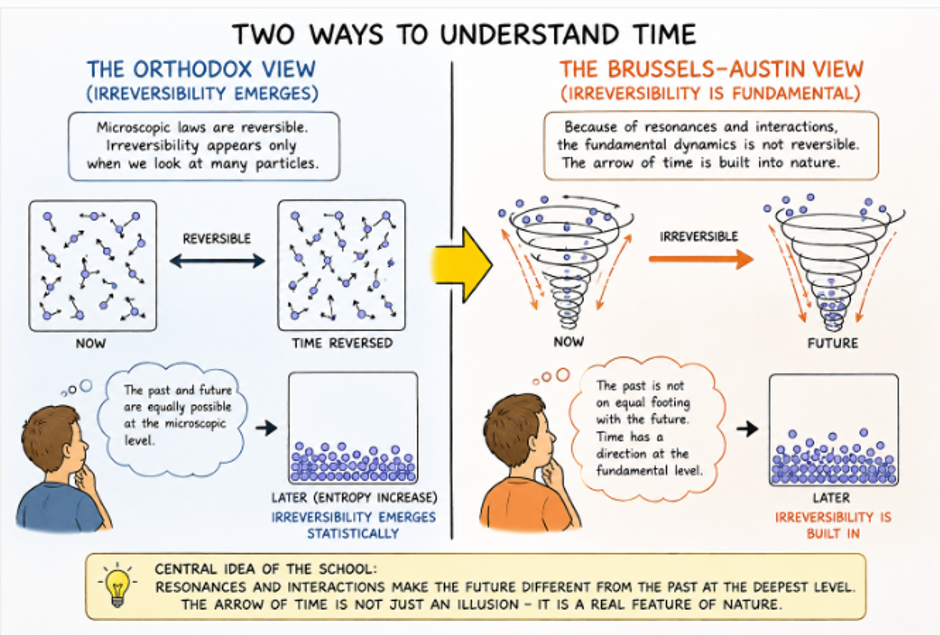
One possibility is that intelligence is best understood as the behaviour of a metastable dissipative structure.
Living systems exist far from thermodynamic equilibrium. They continuously consume energy, maintain internal organization and adapt to changing environmental conditions. The brain represents one of the most sophisticated examples of such a system.
Crucially, the brain is never inactive.
Even in the absence of external stimuli, billions of neurons remain engaged in ongoing patterns of activity. Energy continues to flow. Neural populations remain dynamically coupled. The system continuously occupies and transitions among metastable states.
Within this framework, intelligence does not begin when a problem appears.
The system is already active.
A stimulus simply perturbs an existing dynamical organization.
The response is not the execution of a pre-existing algorithm. Rather, the system reorganizes itself, settling into a new metastable configuration capable of maintaining coherent function under altered conditions.
Learning can be viewed similarly.
Traditional computational descriptions often portray learning as the storage of information. In contrast, a dynamical perspective suggests that learning modifies the attractor landscape itself. Future perturbations therefore encounter a different organization than they did previously.
The system has changed.
This distinction is subtle but important.
The primary object is no longer information.
The primary object is organization.
Information becomes a useful description of how the organization changes rather than the fundamental currency from which cognition is constructed.
From this perspective, many of the features associated with intelligence — adaptation, creativity, transfer learning and resilience — may arise naturally from the properties of a metastable dissipative structure. Such systems are neither rigid nor chaotic. They maintain enough stability to preserve coherence while retaining enough flexibility to adapt to novel circumstances.
This may help explain why human intelligence appears so general.
The brain is not solving isolated problems one at a time. It is continuously reorganizing itself within an evolving landscape shaped by development, experience and evolutionary history.
The resulting behaviour appears intelligent.
But the intelligence may be an emergent property of the underlying organization rather than the operation of a specific algorithm.
If this is correct, then the central challenge facing AGI changes significantly.
The task is no longer simply to discover the algorithm that generates intelligence.
The task becomes understanding the principles by which a metastable dissipative structure acquires, maintains and modifies the extraordinarily rich attractor landscape from which intelligent behaviour emerges.
8. The Compressibility Problem
At this point, the debate shifts from neuroscience to a deeper question in complexity theory.
Even if intelligence is entirely physical and entirely lawful, it does not automatically follow that it is easily compressible.
Computability and compressibility are not the same thing.
A system may obey precise rules while still resisting simplification. Its behaviour can be reproduced, yet the shortest description of that behaviour may be the system itself.
This possibility is rarely emphasized in AGI discussions.
The dominant assumption is that if intelligence exists, there must ultimately be a sufficiently compact set of computational principles from which it can be reconstructed. The challenge is then viewed as discovering the correct architecture, objective function or learning algorithm.
But what if the relevant object is not easily compressible?
What if the attractor landscape underlying human intelligence represents the accumulated consequences of billions of years of evolutionary history, developmental processes and environmental interaction?
In such a scenario, there may be no elegant shortcut.
The landscape may be fully lawful and fully describable, yet the description may not be substantially simpler than the phenomenon itself.
This possibility has important implications.
Current AI systems improve primarily through scaling:
- larger models
- larger datasets
- larger computing budgets
Implicitly, this strategy assumes that the relevant structure can be compressed into a tractable algorithmic framework and progressively approximated through optimization.
But if human intelligence emerges from a computationally irreducible attractor landscape, scaling alone may encounter fundamental limitations.
The obstacle would not be computational power.
Nor would it be a failure of engineering.
The obstacle would be that the object being reproduced is inherently more complex than anticipated.
The shortest description of the landscape may be the landscape itself.
From this perspective, the challenge facing AGI is not simply discovering how intelligence works.
It is determining whether the processes that generated human intelligence can be meaningfully compressed into an algorithmic form without losing the very properties that make intelligence general in the first place.
The question therefore becomes:
Can human intelligence be computed?
Perhaps.
But the more important question may be:
Can human intelligence be compressed?
9. Why Scaling May Not Be Enough
The extraordinary success of modern AI has encouraged a simple and compelling narrative.
More data.
More parameters.
More computing power.
More intelligence.
To date, this strategy has worked remarkably well.
Language models have demonstrated capabilities that many experts believed were decades away. Tasks once considered uniquely human have gradually become accessible to machine learning systems. It is therefore understandable that many researchers believe continued scaling will eventually culminate in AGI.
Yet this confidence rests upon an important assumption.
It assumes that the relevant structure underlying intelligence can be progressively approximated through scaling.
In other words, it assumes that intelligence is fundamentally compressible.
The argument developed throughout this essay suggests a different possibility.
If human intelligence emerges from a metastable dissipative structure whose attractor landscape has been sculpted by billions of years of evolutionary history, then scaling may address only part of the problem.
Increasing model size may improve performance.
Increasing computational resources may improve performance.
Increasing training data may improve performance.
But none of these necessarily recreate the landscape of significance from which human intelligence emerged.
Humans do not merely possess knowledge.
Humans inherit a hierarchy of relevance.
They know what to ignore.
They know what to attend to.
They know what matters.
Much of this structure was not explicitly learned. It was inherited through the evolutionary processes that shaped the nervous system itself.
This raises a practical concern.
Current AI systems are trained within objectives supplied by human designers. The significance landscape is externally imposed.
Human beings, by contrast, are products of the significance landscape.
The distinction may be profound.
A machine may become increasingly capable at solving tasks while remaining fundamentally dependent upon externally specified objectives. Human intelligence evolved within a system that generated its own hierarchy of significance through survival, reproduction, social interaction and adaptation.
The challenge for AGI may therefore be greater than generally assumed.
The problem is not merely one of scale.
The problem may be that scaling reproduces competence without necessarily reproducing the deeper organizational structure from which human generality emerges.
If this is correct, then future progress may require more than larger models and larger datasets.
It may require understanding how landscapes of significance are created, maintained and modified within adaptive systems.
The obstacle is not that machines cannot become intelligent.
The obstacle is that we may not yet understand the process that made human intelligence possible in the first place.
This essay has not argued that AGI is impossible. Nor has it argued that biological intelligence possesses mystical properties unavailable to machines. It has argued something more modest. Human intelligence may be downstream of billions of years of evolutionary pressure that shaped a landscape of significance long before intelligence itself appeared. If that is true, the central challenge facing AGI may not be discovering the correct algorithm. It may be understanding the deeper processes that created the conditions under which intelligence became possible in the first place.
메타데이터
- post_id
- cf222bcc453e
- slug
- why-general-human-intelligence-may-be-harder-to-reproduce-artificially-than-we-think-cf222bcc453e
- url
- https://medium.com/@bill.giannakopoulos/why-general-human-intelligence-may-be-harder-to-reproduce-artificially-than-we-think-cf222bcc453e
- canonical_url
- https://medium.com/@bill.giannakopoulos/why-general-human-intelligence-may-be-harder-to-reproduce-artificially-than-we-think-cf222bcc453e
- author_url
- https://medium.com/@bill.giannakopoulos
- status
- ok
- fetched_at
- 2026-06-15 20:49:13