A Torn Sail Nearly Tore Us Apart
What a fierce Atlantic storm taught me about resilience, human and dog nature, self-trust and moisture
A Torn Sail Nearly Tore Us Apart
What a fierce Atlantic storm taught me about resilience, human and dog nature, self-trust and moisture
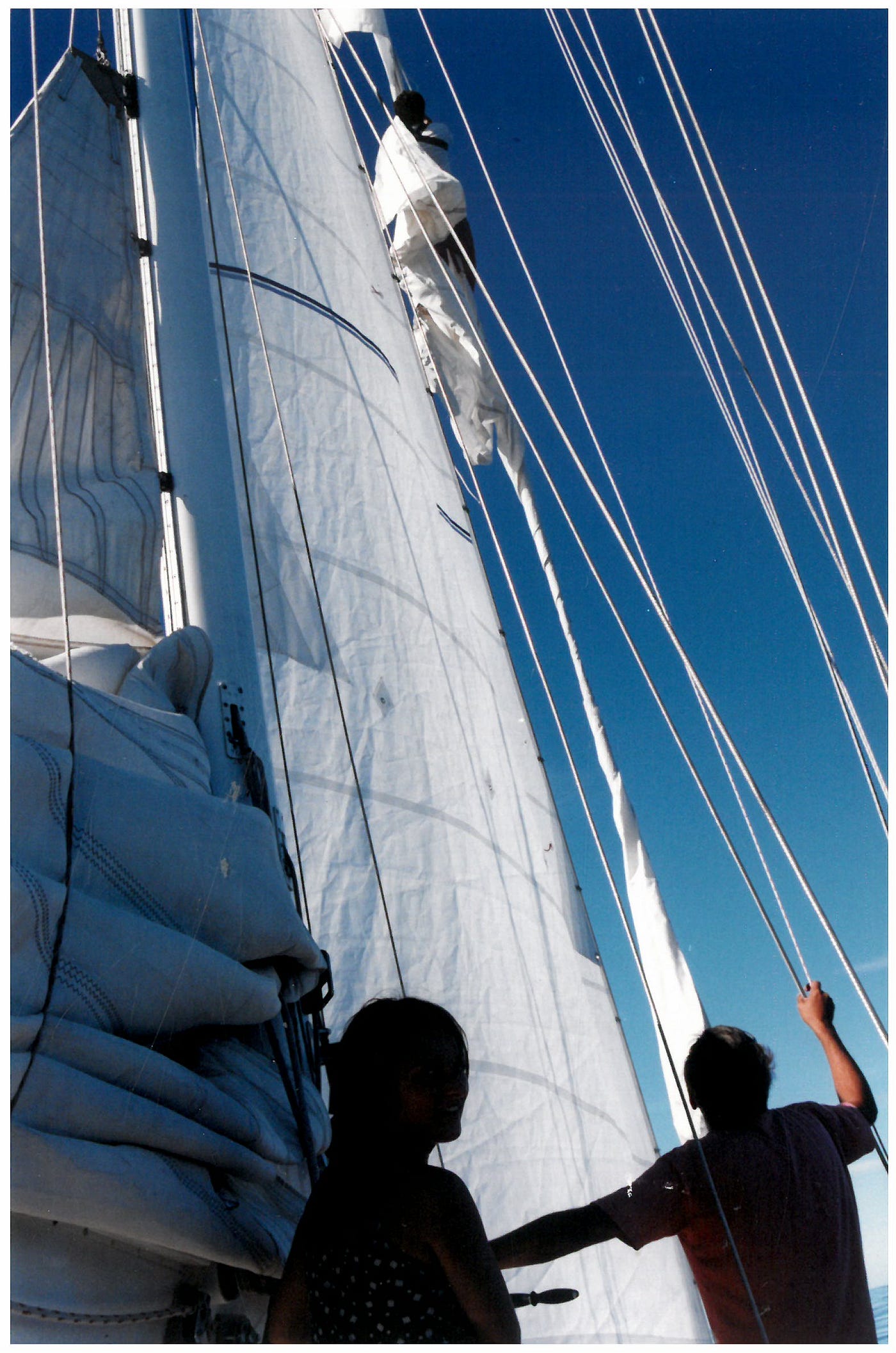
The captain high above the deck, untangling the sail after the storm, my photo
A strong easterly wind was blowing in intervals. It was raining heavily, and the waves were huge. We were in the middle of a massive storm somewhere in the Atlantic Ocean. A wave caused the sailing boat to swerve, a gust of wind hit us from the wrong angle, and the genoa (front sail) was torn in half in an instant. I couldn’t believe my eyes. It was as if it had been made of paper.
I was sailing from Croatia to the Americas aboard a 17-meter (55-foot) sailboat with two men, two women, and a dog named Sailor. A ripped sail reminded us that sailing is not simply leisure sunbathing and enjoying the calm while drinking rum, as people imagine it.
We had already been through several storms and huge waves, so I thought I knew what to expect, but Day 53 since we left our home port was hard for me, maybe the hardest in seven months of sailing. That day, which started with a ripped genoa, somehow ended with my heart being ripped out.
The front sail, ripped it two, was flying all over the deck, hitting everything in its path with unbelievable force. It looked as though it would destroy anything it touched. The captain took two of us crew members onto the deck to catch the wild sail dancing in the wind. It was tricky because the waves and wind were tossing us around like toys while the rain soaked us from above.
“Find your balance, hold on to something solid nearby, and try not to end up in the ocean,” the captain yelled, trying to make himself heard over the raging sea and the howling wind.
After jumping around the deck for a while, we caught the broken sail and wrapped it around the wire that was supposed to hold it until the storm passed.
But one small piece of the torn sail just couldn’t be wrapped up. It was left loose. The sailing boat was swinging on the boiling ocean, constantly drenched by rain and waves and hit by wind gusts. The captain worked especially hard on that last stubborn piece. He even had to climb up to reach it. It took him almost the entire day:
The wire won’t be able to withstand the pressure and vibrations, if we leave this piece of sail flapping around, no matter how small it is. The wind is too strong. The wire will snap for sure within a day or two, under this pressure. And if the whole wire starts whipping around the boat in the storm, it’ll destroy everything it hits. Once it starts lashing the boat, it will cripple the vessel and anyone it reaches. It will become extremely dangerous, perhaps even impossible to catch it. We have to wrap that little piece of sail around the wire very tightly so it stays still, and hope it lasts until the rough weather stops. Only then can we take the sail off the wire and fold it below deck. There’s no other way.
He finally managed to secure it with a rope, making sure both the sail and the loosened sections were firmly fastened to the wire.
The captain knew what he was doing because he had sailed and lived on that boat for decades. I trusted him completely, both with sailing, ship equipment, and the engine. A slightly different rumble from the machine would wake him up instantly. That ability once saved our lives when the pump started pumping ocean water into the boat instead of pumping it out in the middle of the night. He woke up and fixed it. It was a stormy night, of course, because stormy nights are exactly when things break. And flooding in the middle of the Atlantic is never good news. I was grateful that he knew his boat so well.
I also realized I didn’t know his boat well enough. Not the way I wanted to. He never let me learn how to use the rudder properly. You know, to feel the helm in my hands well enough to trust myself with the boat. When the shit hits the fan, you need that knowledge deep in your body, so it works automatically while your brain deals with everything else. It’s like driving a car. After a while, you no longer think about what you’re doing; you just do it. I wanted that confidence with the sailing boat, but we sailed mostly on autopilot. Every time I asked the captain if I could steer manually, I got a “Nope.” He would say the wind was either too strong or too weak for the huge waves we were riding. We had already been at sea for more than fifty days, and he still wouldn’t let me get used to it.
He was still upset about the “Stromboli case” in the Mediterranean Sea. Well, so was I. He also had to buy a new dinghy engine after my Absinthe adventure. I believed he was “punishing” me by not letting me learn. I believed he wasn’t like that with the male crew member. Sometimes I even believed he wasn’t teaching me because I’m a woman. Other times I thought it was because I was half their age. Sometimes I didn’t even know what I had done to upset them, but I could clearly feel both of them sulking for some reason, wearing long faces.
But the truth is, both of them were decent men. Nice, helpful, good people. I knew that before and after our sailing trip. But on the boat, sometimes I couldn’t even look at them. I had no doubt the feeling was mutual.
Living on a boat is very hard on human relationships. If you want a divorce, go sailing with your spouse. If you want to lose a friend, take them sailing. That’s just how it is.
Maybe it’s because there’s nowhere to run to cool off, nowhere to hide while you swallow your anger. After a few days of rough weather, everyone on board becomes tired and anxious. But being condemned to the constant company of the same two people can occasionally become unbearable.
I guessed they were both annoyed by my insistence on searching for stories and meeting people, as well as by my occasionally sharp tongue. I said only one percent of what I actually wanted to say and swallowed the rest for the sake of peace on the boat. I knew how important hierarchy was, and I respected it, but I was allergic to the mansplaining from my fellow crew member. I couldn’t hide my facial expressions, which clearly showed how I felt. If you don’t have a poker face, you simply don’t have a poker face.
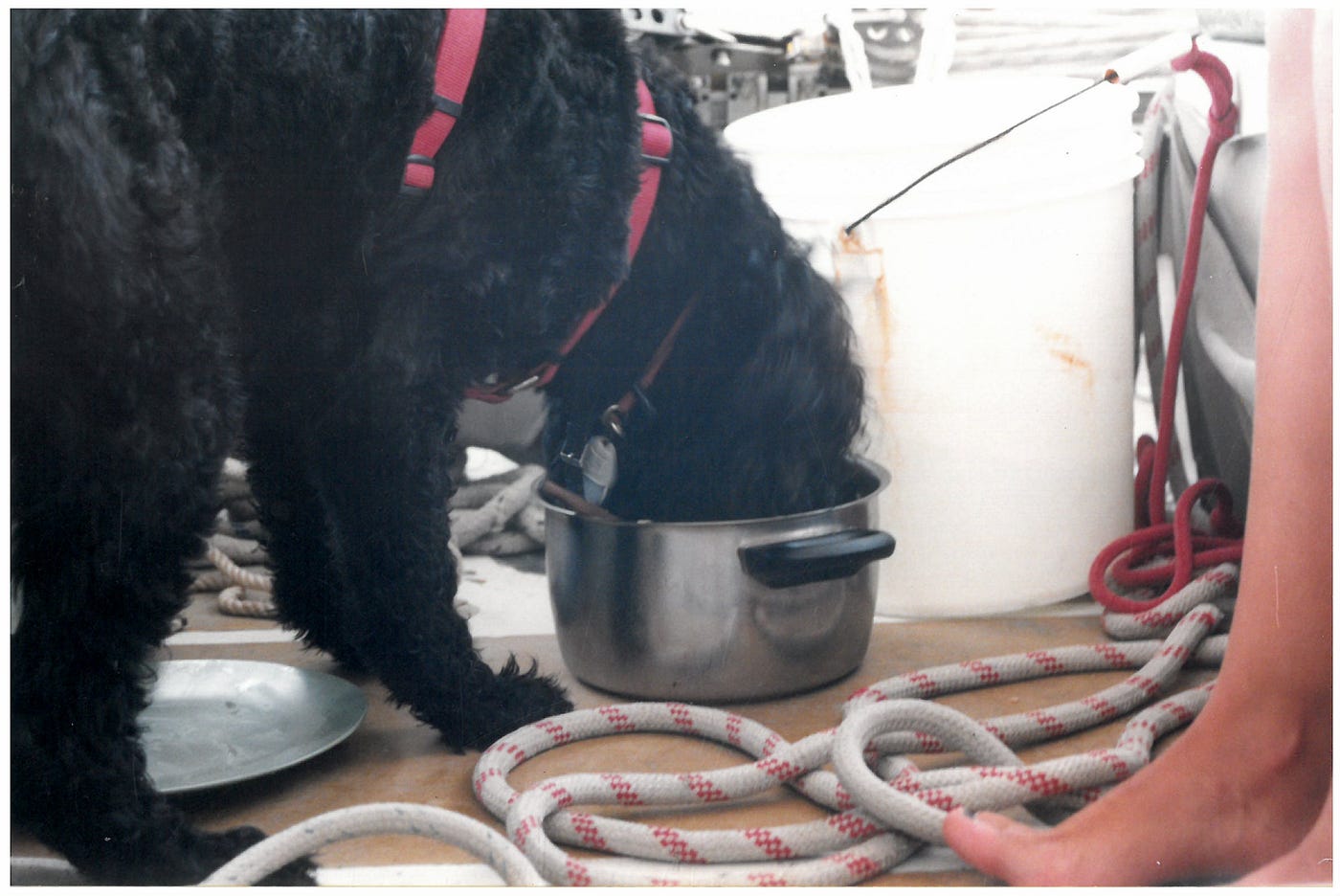
A “prewash”, my photo
The captain let the dog lick the dishes. I felt my stomach churn. He knew how I felt because we had talked about it before we left land, and he had promised he wouldn’t let the dog do that anymore. He simply broke his promise. When I complained, he said, “This is his house,” meaning it wasn’t mine. He even called a dog licking human dishes a “prewash.”
My fellow crew member would get angry for days if I didn’t immediately do something he thought should be done, like sorting the garbage. But once he got unbelievably mad at me over a haircut. He literally didn’t speak to me for days. That’s a perfect example of how tiny things can grow into huge grudges and resentment.
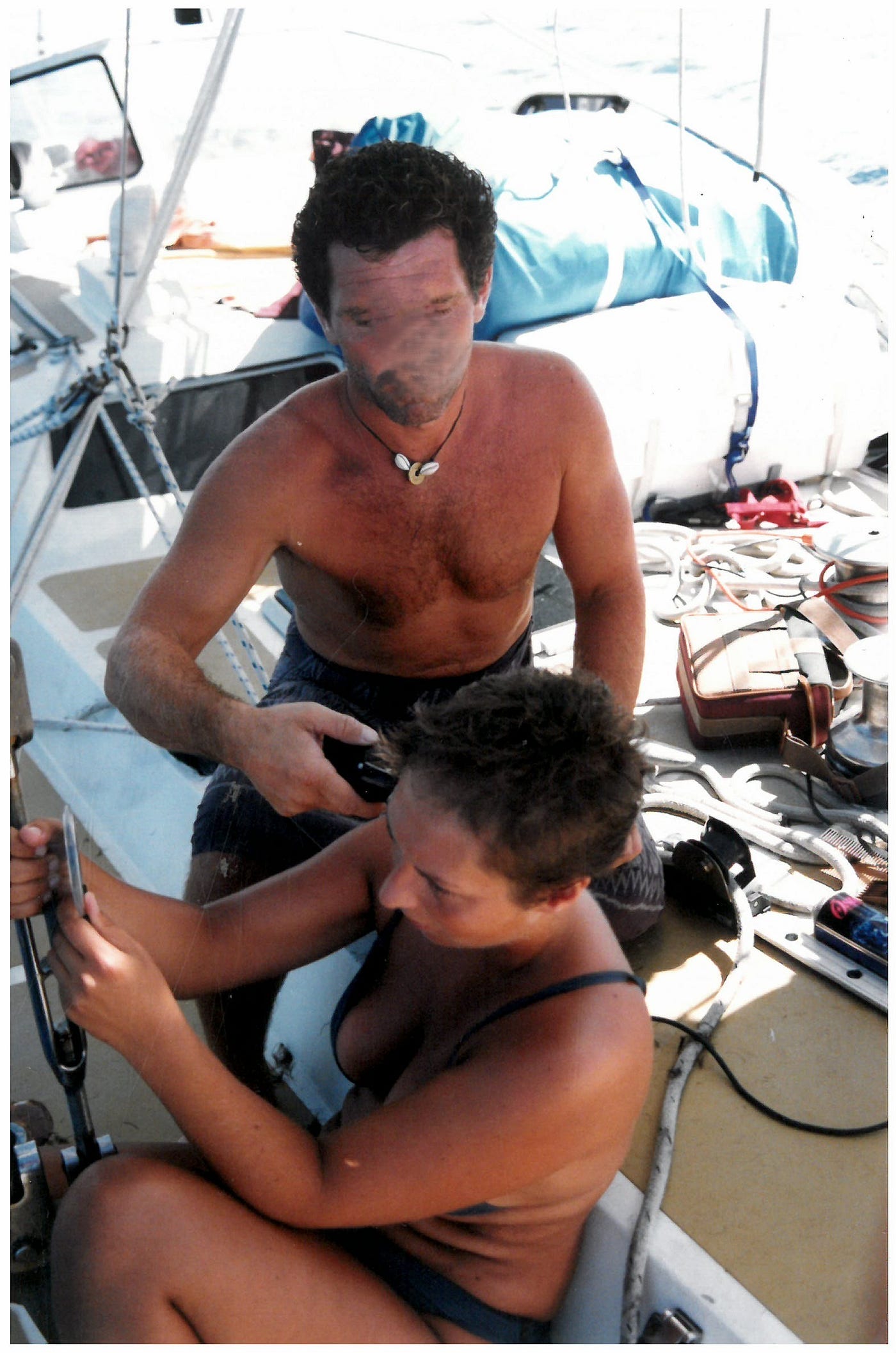
The captain gave his dog Sailor a haircut on board. He was a big, curly black Portuguese Water Dog with fur that needed trimming. I saw the captain had clippers. My very short hair had grown long enough to stick up in every direction after a month and a half at sea, so I asked him to cut my hair after he finished the dog’s. I wasn’t disgusted by the dog’s hair, and if we cleaned it and changed the clipper attachment, that was good enough for me. The captain said, “OK,” but I immediately felt a wave of icy air coming from my fellow crew member. His face went pale, then red, then almost green as he disappeared below deck, looking at me as if I had murdered his entire family. He got angry simply because he had wanted the captain to cut his hair next. But he never said that to the captain or me. It lasted for days. Finally I had to say, “Sorry, I didn’t mean to; I didn’t know you wanted a haircut.” And that was coming from a really gentle soul I knew all my life. I knew his family well, and we were actually good friends when on land.
My photo
The best part, although I must admit it was pretty rare, was when he got angry with the captain, or vice versa. I would quietly enjoy the moment while staying out of their way. Later, I would talk to them separately, letting them blow off steam and softening the conflict so we could move on.
Since we occasionally got on each other’s nerves so badly, all three of us welcomed two girls who wanted to „hitchhike“ the ship across the Atlantic. They wanted to sail with us as passengers from the Canary Islands to the Caribbean to find new jobs there. We hoped they would break the bad energy that had been building up between the three of us for weeks.
Two fresh souls did make a difference, and the tension between the three of us eased a little. The weather forecast said the storm would end within three days, but it would still be cloudy. I couldn’t remember what the sun looked like anymore.
A little south of us, another sailboat was having similar problems with equipment, the weather, and tensions among the crew. We could hear them over the radio.
The wind and waves eased a little from time to time, and it rained “only” when we sailed beneath storm clouds. We needed this little non-raining interlude so much that we tried to catch dry passages between black stratus clouds. We were already on deep water below us, and water was poured on us from the sky. Everything was wet, wet, wet, or at least moist. But escaping the clouds was pointless. The sky was full of them. We all knew it was going to rain again as soon as we came close.
The wind changed as the clouds swirled beneath us. It reminded me of the columns of rising air shooting up through my body while paragliding. I used to catch columns to gain altitude. The columns formed above sunny meadows, and you could spot them by the little white “sheep” clouds that formed above them. They helped paragliders to fly higher. It once happened that the cloud’s updraft was so strong it sucked a paraglider high into the sky. These dark ocean stratus clouds, swirling the wind beneath them, seemed to have gone rogue. Instead of helping, they were raining!
Lack of sunshine was worse than all the exhaustion from enduring the horrible weather. We were constantly being thrown around on the boat, never having a second of peace and that tired our bodies a lot. But the worst part was that everything was wet and couldn’t dry in that weather even when it’s not raining. Below deck was full of wet clothes trying to dry, and everything felt damp and disgusting. Smelly, too. Even the sheets on our beds got moist.
The day sail broke; I had my favorite third guardia (night watch). We divided the night into three parts. One of the crew would stay awake in each shift to guard. We changed the shifts every day. I usually loved the last shift, just before dawn, when I could watch the sunrise by myself while everyone else was asleep. But stormy nights made no difference in shifts. The main goal is to keep the crew, passengers, dog, and the boat in one piece throughout your shift.
I didn’t have proper sailing gear, so the captain lent me his old rain gear when needed. It helped a lot and leaked a little, but it didn’t matter much because the wind, rain, and ocean were warm.
If the gust came from different sides, it could slam the mainsail over, and that could tear it. We had just seen that happen to the genoa, and we couldn’t afford to lose the mainsail as well. We had discussed that possibility before everyone went to sleep.
As the only person awake on the yacht, I concentrated on the autopilot and the direction of the wind. That was difficult because it was still blowing in gusts and the sailboat was very unstable since we had a mainsail only. The waves grew huge, over six meters (around 20 feet).
Naturally, the wind started blowing from the dangerous side only after my night watch began. Thanks, Mother Nature! At the same time, the autopilot malfunctioned, and while I was changing the course, it shut down completely. I called the captain, waking him up by shouting.
He came out of his cabin immediately, and together we corrected the situation manually. Once the boat stabilized, he switched the autopilot back on. He went back to bed again and the wind hit us from the other side again. I entered the new course, but the autopilot wouldn’t accept it. It turned us around, and the sail started banging. It almost tore! I knew I should have switched off the autopilot and steered the boat manually, but I just didn’t dare. The ship was too heavy for me to steer it in this Armageddon. But something else hit me: If I knew this ship well, I would be more confident.
More than fifty days at sea, and I had held the rudder for maybe ten minutes. Great. Everybody is asleep, and now the boat is my responsibility. It was never a good time to practice, ha..? Is it a good time now, when I’m by myself on a stormy night? What if we all sink, captain? I don’t want five people (including me) and a dog on my soul!
I was angry, and I let the captain know it.
Luckily, he came running from his cabin every time I called. He would start the engine, turn the boat around, and restore order.
I could have done that if I had been allowed to practice before!
Dawn finally came, everyone awoke, and the captain finally let me steer. I insisted, even though my shift was over. The waves were still huge, the wind was still blowing hard, only the rain had stopped.
I was fighting the waves and wind for a while. My muscles were exhausted. I could barely hold the helm, and my hands were literally shaking. But at least I finally got a feel for how the boat responded to the wheel.
How could the captain leave me on night watch in such weather without teaching me how to steer? I couldn’t understand it. He just tossed me into the fire! I wasn’t flattered when he said he had faith in me, because I felt like I had failed. I was exhausted, sleep-deprived, shaken, and felt horrible altogether. I went below deck. The stench of damp clothes that never had a chance to dry, hit me hard.
I accidentally stepped on the Sailor’s tail. I didn’t see the black dog in the dark. He bit my foot, but he broke my heart.
I knew it was only an automatic reaction. I knew he would never bite me on purpose. It was the same dog I loved so much, the one who had once saved me from falling into the ocean, or at least thought he had.
I had been sunbathing on deck when the captain changed course and tacked. That made the sailboat heel, and I slid across the deck with a playful, theatrical yell. The sweet dog immediately rushed over and planted his front paws on my stomach, trying to stop me from sliding any farther. I melted.
And now he had bitten me. It wasn’t a hard bite; I knew he could bite much harder. That was just a warning, and I knew he hadn’t meant it. But it killed me inside.
I could only lie helplessly on my bunk on clammy sheets and cry, letting all my anguish flow out with my tears.
“Great,” I thought, sobbing and wiping my eyes. “Even I’m producing moisture!”
메타데이터
- post_id
- cf282e9974ec
- slug
- a-torn-sail-nearly-tore-us-apart-cf282e9974ec
- url
- https://medium.com/globetrotters/a-torn-sail-nearly-tore-us-apart-cf282e9974ec
- canonical_url
- https://medium.com/globetrotters/a-torn-sail-nearly-tore-us-apart-cf282e9974ec
- author_url
- https://medium.com/@rozeta.bo
- status
- ok
- fetched_at
- 2026-07-18 08:08:13