Where a Light Duty Gantry Crane Makes Sense in Everyday Industrial Lifting
Light duty gantry crane applications are far more common in industrial environments than many people realize. Walk through a maintenance…
Where a Light Duty Gantry Crane Makes Sense in Everyday Industrial Lifting
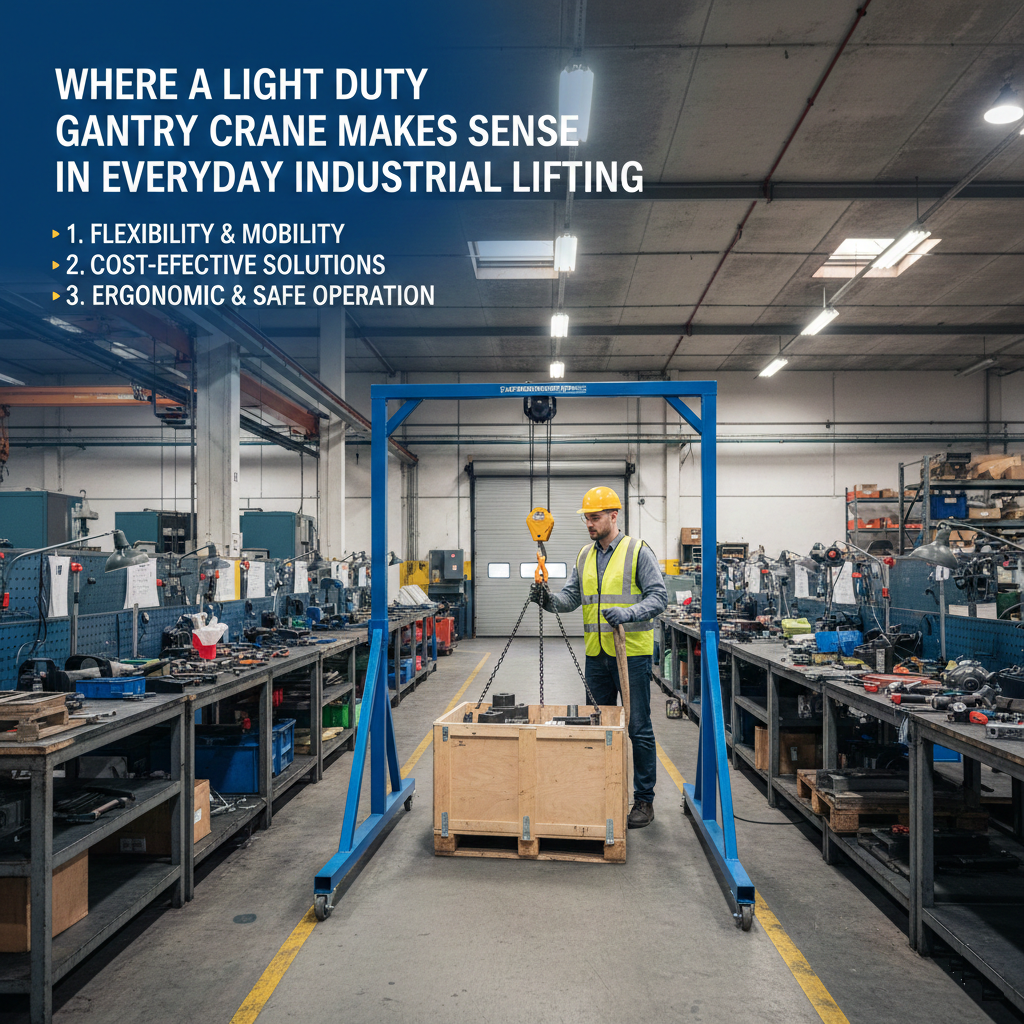
**Light duty gantry crane** applications are far more common in industrial environments than many people realize. Walk through a maintenance area, fabrication shop, or assembly floor and most lifts are not massive picks that require complex planning. They are everyday movements — tools, fixtures, motors, assemblies — handled repeatedly as part of normal operations.
In these environments, efficiency and control matter more than maximum capacity. Over time, teams learn that using oversized lifting systems for routine work introduces unnecessary complexity, fatigue, and wear. This article looks at where lighter lifting solutions make sense, how to decide between mobile and fixed systems, and why understanding load behavior is just as important as choosing the lifting device itself.
What “Light Duty” Really Means in Industrial Lifting
The term light duty is often misunderstood. It does not mean unsafe, temporary, or low importance. In practical terms, light duty refers to lifting tasks that are moderate in weight, frequent in repetition, and limited in travel distance.
A light duty gantry crane is typically used when:
- Loads fall within predictable weight ranges
- Lifts are short and controlled
- Work areas change or rotate
- Operators need flexibility more than reach
In many facilities, these conditions describe the majority of daily lifts. Designing workflows around lighter systems reduces setup time and allows crews to focus on the task rather than the equipment.
Everyday Lifting Scenarios Where Flexibility Matters More Than Reach
Industrial lifting is not always linear. Equipment moves between workstations. Maintenance tasks shift based on downtime. Assembly layouts evolve as production needs change.
Common scenarios include:
- Removing motors or pumps for service
- Positioning fixtures during assembly
- Handling tooling or molds
- Temporary lifting during repairs
In these cases, fixed lifting paths can become a limitation. Flexibility often matters more than the ability to cover a large radius or extreme height. Systems that adapt to the work area instead of forcing the work to adapt to the system tend to perform better over time.
Light Duty Gantry Crane: When Mobility Solves the Problem
A light duty gantry crane is well suited to environments where lifting needs move with the workflow. Because it is not permanently anchored, it allows operators to position lifting support exactly where it is needed.
This mobility provides several advantages:
- Lifts can occur at multiple stations without new infrastructure
- Floor layouts remain adaptable
- Equipment can be repositioned as tasks change
Rather than relying on overhead structures that may not exist or cannot be modified, gantry systems create lifting capability where it is required, when it is required. Over repeated use, this reduces unnecessary handling and improves consistency.
When Fixed Support Is Better: Column Mounted Jib Crane Use Cases
Not every lift benefits from mobility. In areas where tasks are repetitive and locations remain constant, a **column mounted jib crane** often provides better long-term efficiency.
These systems work best when:
- Lift radius is consistent
- Load paths are predictable
- The work area does not change
Fixed support removes the need for repositioning and allows operators to develop reliable routines. In these cases, permanence improves speed and reduces variation. The key is matching the lifting system to how the space is actually used, not how it appears on paper.
Load Awareness in Daily Lifts (Often Overlooked)
Routine lifts can become risky when load awareness is assumed rather than verified. Assemblies change. Modifications add weight. Tools are combined without recalculating totals.
This is where **heavy duty hanging scales** play an important role. By confirming actual load weight during initial or repeated lifts, teams reduce the chance of unexpected stress on lifting components.
Load verification:
- Prevents gradual overloading
- Supports consistent equipment behavior
- Helps operators make informed adjustments
In daily operations, small checks like this contribute significantly to long-term equipment reliability.
Common Mistakes in “Everyday” Lifting Decisions
Most lifting issues do not come from major failures. They develop slowly through small decisions made repeatedly.
Common mistakes include:
- Using oversized systems for light, frequent tasks
- Ignoring changes in load configuration
- Treating all lifts as identical
- Underestimating operator fatigue
Over time, these habits increase wear and reduce predictability. Matching lifting solutions to real working conditions helps avoid these problems before they become routine.
Job-Site Reality vs Common Assumptions

Key Takeaways
- Not all industrial lifts require heavy infrastructure.
- Light duty systems often match everyday lifting needs more effectively.
- Mobility supports changing workflows; fixed systems support repetition.
- Load awareness improves safety and consistency over time.
- The best lifting solution aligns with how work actually happens, not assumptions.
Conclusion
Effective lifting is not about using the strongest equipment available. It is about using the right system for the task at hand. In many industrial settings, everyday lifts benefit from simplicity, flexibility, and predictable behavior rather than maximum capacity.
By understanding when lighter lifting solutions make sense — and when fixed support is the better option — teams can reduce strain, improve workflow, and maintain consistency over time.
From your experience on the floor, what types of lifts tend to benefit most from flexibility rather than permanence?
메타데이터
- post_id
- cf32f8ee9239
- slug
- where-a-light-duty-gantry-crane-makes-sense-in-everyday-industrial-lifting-cf32f8ee9239
- url
- https://medium.com/@cranedepot/where-a-light-duty-gantry-crane-makes-sense-in-everyday-industrial-lifting-cf32f8ee9239
- canonical_url
- https://medium.com/@cranedepot/where-a-light-duty-gantry-crane-makes-sense-in-everyday-industrial-lifting-cf32f8ee9239
- author_url
- https://medium.com/@cranedepot
- status
- ok
- fetched_at
- 2026-06-25 07:00:49