Would Orwell Recognize a World Where Reality Itself Has Become Administratively Editable?
The deeper warning of 1984 was never simply about the left or the right. That is the shallow reading. It is the political reading. It is…
Would Orwell Recognize a World Where Reality Itself Has Become Administratively Editable?
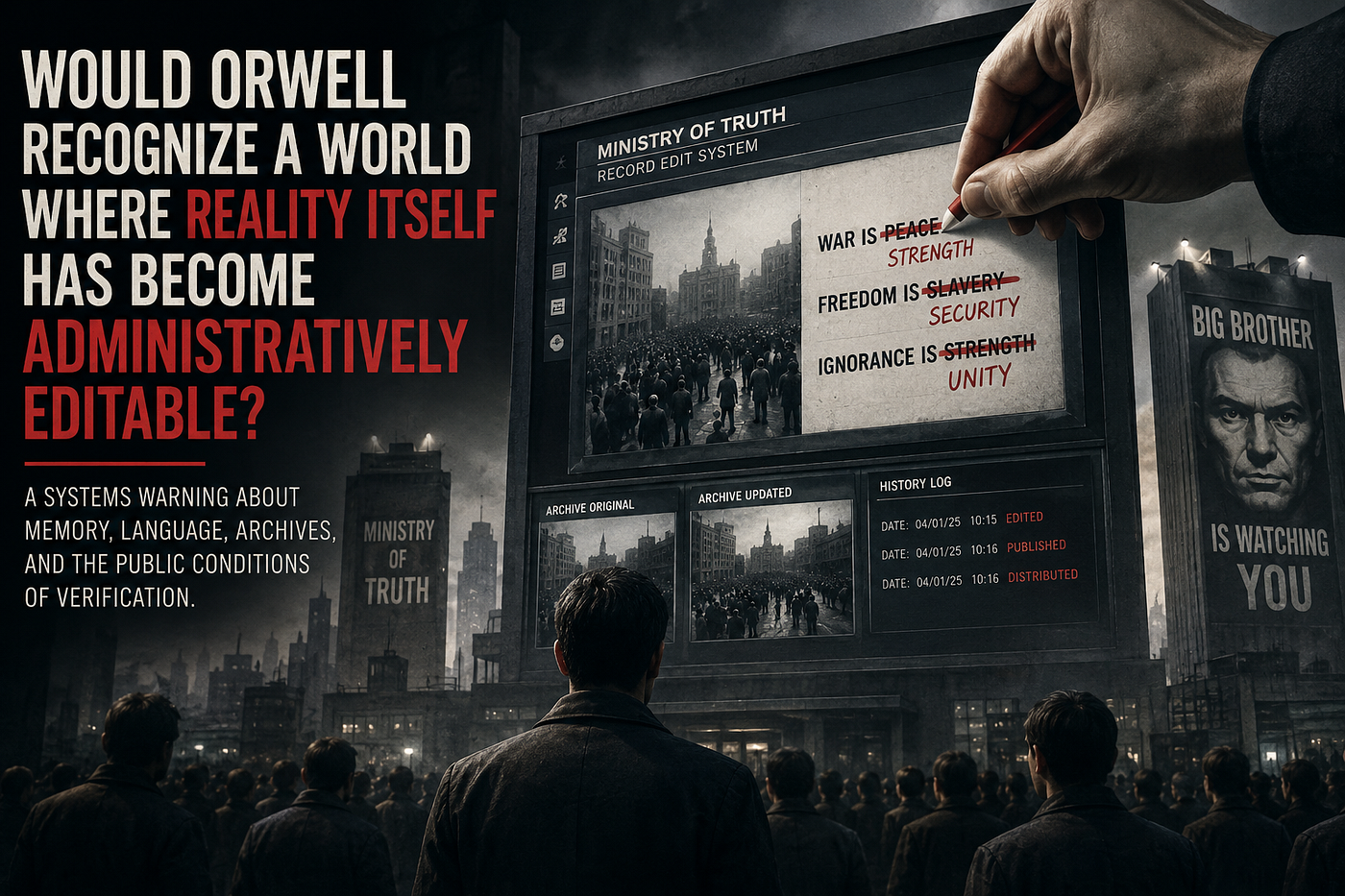
The deeper warning of 1984 was never simply about the left or the right. That is the shallow reading. It is the political reading. It is the version that allows every faction to use Orwell as a weapon against its enemies while ignoring the machinery he was actually describing.
Orwell was warning about systems.
Not only governments. Not only political parties. Not only ideology. He was warning about systems that control language, rewrite memory, manage institutional narratives, and make yesterday’s record negotiable. He was warning about systems that collapse shared reference points until truth becomes whatever the current authority structure can enforce.
That is why 1984 still matters.
It was not merely a novel about surveillance. It was a novel about epistemic control. It was about controlling what can be known, what can be remembered, what can be said, and what can be verified.
The danger was never only that someone might silence a person. The deeper danger was that the entire environment around that person could be rearranged until their memory no longer had public support.
A statement could be true one day and unacceptable the next. A fact could exist in the archive one moment and disappear the next. A word could mean one thing in one generation and its opposite in another. A record could be edited, a photograph altered, a statistic reframed, or a slogan reversed, and the public would be expected to move with the update.
Not because reality had changed, but because the system had changed the administrative status of reality.
That is the terrifying core of Orwell.
In 1984, the past is not destroyed once. It is continuously managed. It is not erased in one dramatic act. It is processed, revised, corrected, normalized, and reissued. The machinery of falsification is bureaucratic. It has departments, procedures, language, and workers whose job is not to think of themselves as liars, but as technicians of continuity.
That is what makes the warning so modern.
The most dangerous systems do not always announce themselves as systems of domination. They present themselves as systems of order, safety, correction, moderation, optimization, alignment, compliance, or public responsibility.
The vocabulary changes, but the structure remains familiar.
Control the archive, and you control what can be referenced. Control the vocabulary, and you control what can be expressed. Control the incentives, and you control what people are willing to say. Control the institutions, and you control what is treated as legitimate. Control memory, and you control the boundaries of public reality itself.
This is why the central issue is not simply censorship.
Censorship is visible. It leaves a wound. It creates martyrs. It alerts people that something has been forbidden.
A more sophisticated system does not merely ban speech. It changes the conditions under which speech can survive.
It makes certain claims socially expensive. It makes certain questions professionally dangerous. It makes certain memories seem irresponsible. It makes certain words unusable. It turns disagreement into pathology, hesitation into guilt, and skepticism into disloyalty.
Eventually, people begin to self-edit before any authority has to intervene.
That is when control becomes efficient.
The archive does not need to be burned if it can be quietly revised. The public record does not need to be abolished if it can be endlessly updated. Language does not need to be outlawed if its meanings can be reassigned. Memory does not need to be erased if people can be trained to distrust their own recollection.
At that point, society does not simply lose facts. It loses the machinery required to verify facts.
That distinction matters.
People can survive disagreement. In fact, a healthy society requires disagreement. Competing interpretations are not the problem. Debate is not the problem. Institutional criticism is not the problem. Political conflict is not the problem.
The problem begins when the shared instruments of verification collapse.
When no archive is stable, no vocabulary is neutral, no institution is trusted, no record is final, and no memory is safe from revision, every fact must pass through a narrative filter before it can be socially recognized.
At that point, people do not merely disagree about reality. They inhabit different administrative versions of it.
This is the real systems warning in Orwell.
A society does not need to become openly totalitarian to become epistemically unstable. It only needs to make truth dependent on power, access, incentives, and institutional permission.
Once that happens, reality becomes editable.
Not in the philosophical sense. Objective reality does not disappear. The physical world remains. Actions still have consequences. Systems still fail. Bridges still collapse. Economies still respond to constraints. Bodies still break. Machines still obey physics.
But public reality, the reality people are allowed to reference, cite, remember, and organize around, becomes something else.
It becomes managed.
It becomes conditional.
It becomes a living document controlled by whoever has administrative authority over memory.
That is the danger Orwell saw with such precision.
He understood that power does not only want obedience. It wants custody over the past. It wants the ability to say not only, “This is what you must do,” but also, “This is what happened.” It wants authority over the record because the record determines what arguments can be made in the present.
If the past can be rewritten, accountability can be dissolved.
If language can be narrowed, thought can be narrowed.
If institutions can coordinate around a narrative, dissent can be made to look irrational before it is ever answered.
If yesterday can be revised without consequence, tomorrow can be governed without memory.
This is why Orwell’s warning is not owned by any political side.
Every ideology is capable of building machinery that protects itself from reality. Every institution is capable of preferring narrative stability over truth. Every movement is capable of punishing inconvenient facts. Every bureaucracy is capable of mistaking its own preservation for the public good.
The issue is not whether the system calls itself progressive, conservative, democratic, revolutionary, scientific, patriotic, humanitarian, or technocratic.
The issue is whether it preserves the conditions required for truth to remain externally checkable.
Can people inspect the record? Can they challenge official language? Can they compare claims against evidence? Can they question institutional memory? Can they notice contradiction without being punished? Can they say that yesterday’s statement conflicts with today’s statement? Can they point to reality without first asking permission from the narrative?
These are the questions Orwell still forces on us.
Once those conditions disappear, force becomes secondary. The system no longer needs to drag every dissenter into a cell. It can isolate them linguistically, professionally, socially, and informationally.
It can make them sound outdated. It can make them sound dangerous. It can make them sound confused. It can make them sound as if they are violating a moral order merely by remembering what was said before.
That is tyranny by editable memory.
It is more subtle than tyranny by force.
Force tells you that power is afraid of truth. Editable memory tells you that power intends to replace truth as the reference layer of society.
That is why the archive matters.
That is why definitions matter.
That is why institutional transparency matters.
That is why public records matter.
That is why timestamped statements matter.
That is why independent verification matters.
That is why it matters when people notice that language is changing faster than understanding, that records are being corrected without admission, or that institutions are speaking in synchronized abstractions instead of accountable claims.
A civilization depends on more than infrastructure. It depends on reference points.
It needs a shared ability to say, “This happened.”
It needs a shared ability to say, “This was changed.”
It needs a shared ability to say, “This claim contradicts that record.”
It needs a shared ability to say, “No authority structure gets to make reality true by administrative update.”
Without that, society becomes unstable at the deepest level.
Not because everyone disagrees. Disagreement is not the enemy of truth.
The real danger begins when verification fails.
A free society does not require universal consensus. It requires durable mechanisms for testing claims, preserving records, contesting narratives, and resisting the conversion of institutional preference into official reality.
That is the real lesson of Orwell.
Not merely that authoritarianism is bad.
Not merely that censorship is dangerous.
Not merely that propaganda exists.
The deeper lesson is that when language, memory, archives, institutions, and incentives are captured together, truth itself becomes dependent on administration.
And once reality becomes administratively editable, the public no longer lives inside a shared world.
It lives inside a managed one.
메타데이터
- post_id
- cf3df485626b
- slug
- would-orwell-recognize-a-world-where-reality-itself-has-become-administratively-editable-cf3df485626b
- url
- https://medium.com/@ophi06/would-orwell-recognize-a-world-where-reality-itself-has-become-administratively-editable-cf3df485626b
- canonical_url
- https://medium.com/@ophi06/would-orwell-recognize-a-world-where-reality-itself-has-become-administratively-editable-cf3df485626b
- author_url
- https://medium.com/@ophi06
- status
- ok
- fetched_at
- 2026-06-14 11:28:49