The Room Full of Mannequins
Most people spend their lives surrounded by others and never once make contact.
The Room Full of Mannequins
Most people spend their lives surrounded by others and never once make contact.
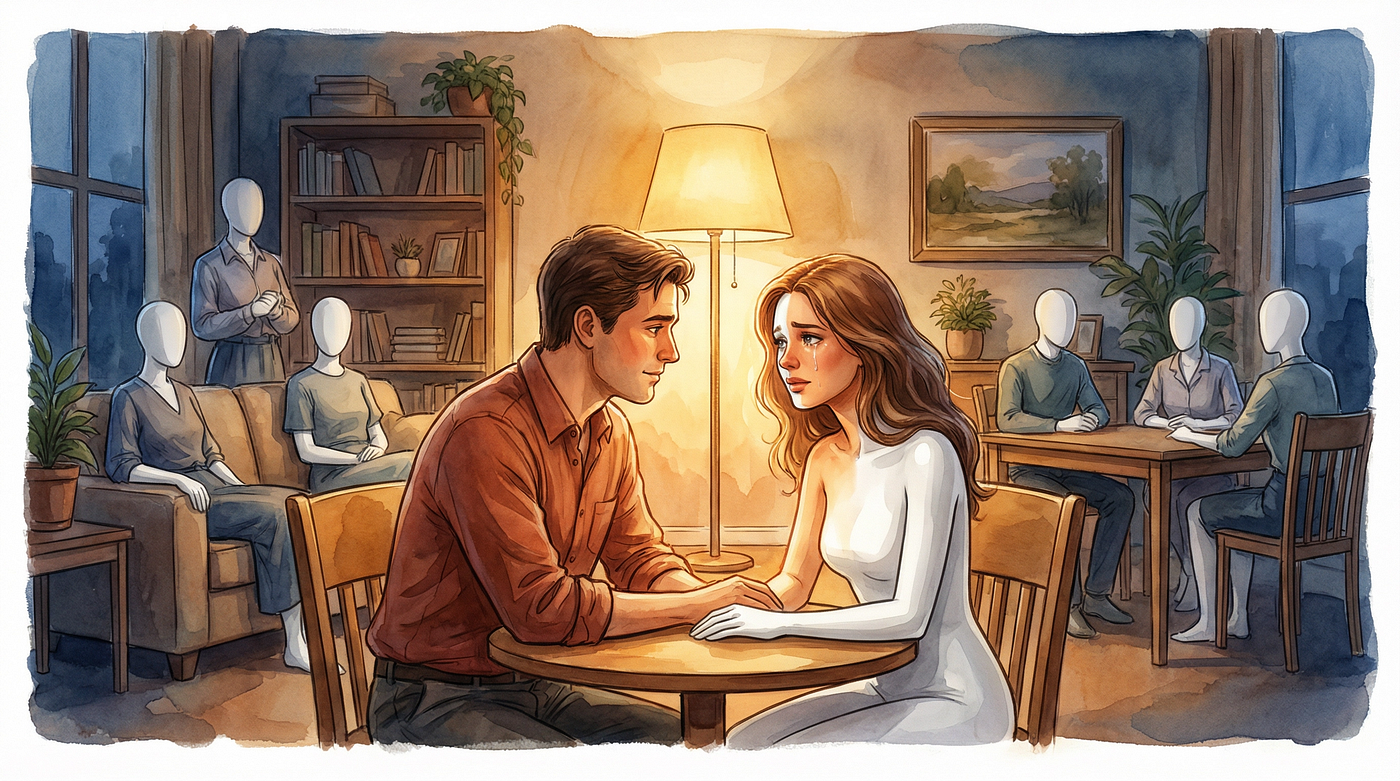
She was never an extra in your story.
This article was originally published on my Substack, “**The Thinking Rock**”.
You are sitting across from someone you love. They are telling you something about their day, a small frustration, a coworker who said the wrong thing, a moment that landed oddly and left a residue they haven’t quite shaken. You are nodding. You are making the face that means I hear you. And behind that face, you are composing tomorrow’s grocery list.
You’re not a monster for this. But you’re not exactly present, either, and the distance between those two things is where most relationships quietly go to starve.
Most of us don’t actually experience other people. We experience our models of other people, fast, automatic, and pre-fabricated, assembled by our brains in less time than it takes to blink. The barista is “the barista.” Your colleague is a set of work behaviours you either tolerate or don’t. The driver who cut you off this morning received a full psychological profile (careless, entitled, probably voted wrong) constructed from roughly one second of observed lane-change technique.
That driver has a kitchen. A particular arrangement of mugs and spice jars, and one drawer that sticks. She has a way of laughing that the people who love her would recognize from across a parking lot. She got a phone call yesterday that rearranged the shape of her week, or she didn’t, but either way, she is carrying an interior life as vivid and particular as yours, and you reduced the whole sprawling mess of it to an obstacle before your foot moved from brake to gas.
This isn’t a guilt thing. Guilt has never once made anyone actually see another person. It just makes them feel bad about not seeing, which is a different thing entirely and, in practice, useless.
Furniture
Your brain processes other human beings the way it processes furniture. I know that sounds harsh. But when you walk into a room, you don’t examine each chair. You register chair, assign it a function (sittable, in my way, ignorable), and move on. The chair’s history doesn’t exist for you. It’s a shape serving a purpose.
You do the same thing with people. All day. And you have to, because your brain cannot render seven billion full human beings in real time. The compression is a survival feature. But functional is not the same thing as alive, and the cost of all that compression is that you can spend an entire Tuesday surrounded by conscious beings and never once make contact with one.
Martin Buber, a philosopher who wrote with the kind of density that makes your eyes water, identified two modes of encountering the world back in 1923. He called them I-It and I-Thou. In the first, you process other people the way you process a menu: scanning for relevance, extracting what serves you, discarding the rest. In the second (and this is where language begins to strain), you stop processing altogether. You just… meet someone. Not their function. Not their role in your storyline. Them.
You’ve felt this. Maybe a handful of times. A conversation where the static cleared and something passed between you and another person that was not information, not a transaction. Something more like recognition. The sudden, physical understanding that the person sitting across from you contains a world. And that you’ve been interacting with a pamphlet.
What You’ve Actually Been Lonely About
The disconnection epidemic everyone talks about, the loneliness crisis, the collapse of community, we blame it on technology. We blame suburbs, remote work, and the decline of third places. Those things contribute. But the deeper engine is older than any of them.
It runs on the speed at which we convert people into categories.
You can be lonely in a crowded room. Not because you lack people. Because you’ve turned everyone in that room into furniture, including the person you drove there with. The one whose full dimensionality you last experienced sometime around month six of the relationship, before familiarity compressed them into a set of predictable behaviours you navigate around the way you navigate a coffee table in the dark.
I noticed this in my own life during a stretch when work had gotten loud. Multiple projects, tight timelines, the kind of season where you mistake being busy for being engaged.
My wife Clare was telling me something one evening, I don’t even remember what, and I caught myself not just half-listening but constructing my response before she’d finished her sentence. Not to what she was saying. To what I’d already decided she was saying, based on the model of her I carry around in my head. The shorthand version. The compressed file. And I realized with a kind of low-grade horror that I do this constantly, that the person I share a life with gets the same furniture treatment I give the guy at the gas station, just dressed up in better eye contact.
If this is the kind of writing that makes you stop scrolling, you’ll want to subscribe.
The person sitting next to you at dinner tonight is a stranger. Not because you don’t know their preferences and habits. You know all of that. What you don’t know, what you stopped looking for, is the part that can’t be summarized. The part that shifts and contradicts itself and contains fears they haven’t spoken. The part that makes them a person and not a file.
Looking, for Real
The fix isn’t a communication framework or a love language quiz. It’s almost embarrassingly simple, which is probably why nobody does it.
Slow down enough to look.
Not glance. Not scan-and-categorize. Look. At the person making your coffee. At the one in the meeting who keeps talking too much, who you’ve already reduced to a two-word dismissal (and who, for all you know, fills the silence at work because the silence at home has become total). At the person you married, who is telling you something right now, in this room, using their actual voice.
When you genuinely attend to another human being without agenda, without the low-grade surveillance system that monitors whether they approve of you, something happens that’s hard to describe. The petty grievance you’ve been nursing dissolves. Not because you chose to release it. Because you saw something bigger, and the grievance couldn’t survive in the same room.
Every act of cruelty, from the civilizational to the domestic, requires someone to stop seeing first. Before the exploitation, before the indifference, before the slow corrosion of contempt that builds up in long relationships like plaque in an artery, someone compressed a full human life into a function. The mechanisms change across centuries. The blindness does not.
But the person you most need to see right now isn’t some abstract stranger. It’s probably someone in the next room, carrying a version of the same bewildered, unscripted, quietly terrified experience of being alive that you are. They were never an extra in your story. They’re the main characters of their own, and you’ve been too busy running the compressed version to notice.
Tonight, when they start talking about their day, just look at their face. Not to evaluate. Not to respond. Just to see what’s actually there.
You might find the most familiar person in your life suddenly looks like someone you’re only beginning to meet.
If any of this landed, and you want to go deeper into this territory and into a lot more of what governs our lives outside our control, and into regaining it for true life success, ***The Twelve Truths*** is worth checking out.
Like what you read? Please support my work with a **coffee. Thank you! This means more to me than you know. Also, check out my other writings [HERE.](https://djrivard1.gumroad.com/)**
메타데이터
- post_id
- cf44d8d3681a
- slug
- the-room-full-of-mannequins-cf44d8d3681a
- url
- https://medium.com/activated-thinker/the-room-full-of-mannequins-cf44d8d3681a
- canonical_url
- https://medium.com/activated-thinker/the-room-full-of-mannequins-cf44d8d3681a
- author_url
- https://medium.com/@djrivard
- status
- ok
- fetched_at
- 2026-06-27 18:20:27