The Age of Severance and the Children Who Remember
Identity, Myth, and the Structural Reckoning of an Age Defined by Severance
The Age of Severance and the Children Who Remember
Identity, Myth, and the Structural Reckoning of an Age Defined by Severance

If we take the long view of time — the mythic, cyclical vision preserved in the Vishnu Purana — we are said to be living in Kali Yuga: an age not merely of corruption, but of inversion. An era when form detaches from essence. When power detaches from truth. When language drifts from lived reality.
We are told this age lasts 432,000 years. That we are barely five thousand years in. A cosmic infancy. One percent.
And yet the nervous system does not experience history in percentages.
A newborn does not live inside cosmology. A newborn lives inside regulation — heartbeat, warmth, synchrony. When that synchrony is ruptured, the body does not register “early-stage decline.” It registers threat. Existential discontinuity.
Cosmic time moves in millennia. Attachment trauma moves in seconds.
This is where the fracture becomes intimate.
If Kali Yuga is the age of severance — fragmentation from truth, from dharma, from sacred order — then infant separation is not an isolated social policy. It is the age expressed at the cellular level.
The body becomes the archive of the era.
Adoption as Field Disturbance
For generations, adoption has been framed mechanistically: a child is transferred, a family is formed, love compensates. The system stabilizes.
But this narrative assumes individuals are discrete units, that identity is singular, that trauma is an event that fades with time.
Lived experience tells another story.
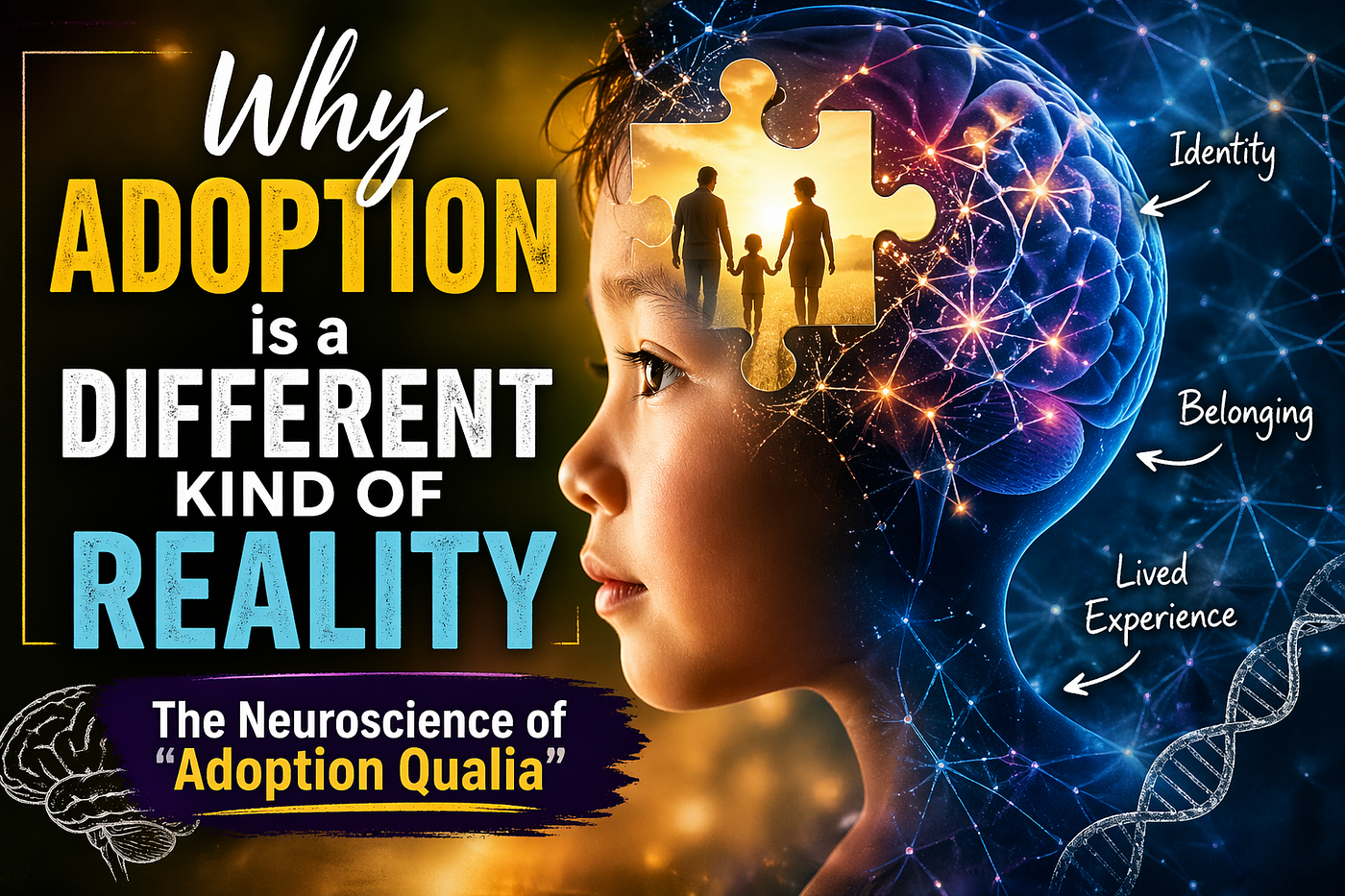
Adoptees describe dual belonging. Persistent dissonance. Grief that does not decay. A sense that the rupture is not past tense but structural. Identity is not replaced; it is layered, split, forced into collapse.
When a birth certificate is amended, the document changes. The body does not.
The prevailing model calls this adjustment. The nervous system calls it incoherence.
What if adoption is not a transaction, but a field disturbance? Not a one-time event, but a pattern that propagates across scales — biological, psychological, legal, cultural?
At the molecular level, early separation affects stress calibration. At the neural level, attachment circuitry encodes rupture. At the narrative level, gratitude is prescribed to stabilize discomfort. At the legal level, origin records are sealed or altered.
The disturbance repeats fractally because the underlying conditions remain unexamined.
Mythology Knows What Modern Policy Forgets
Myth has always understood the power of the displaced child.
In the Mahabharata, Karna is set afloat, raised in another lineage, denied recognition of his birth. His tragedy unfolds not because he was unloved, but because concealed origin creates structural misalignment.
In the Book of Exodus, Moses is river-hidden and raised in the household of empire. His identity revelation destabilizes power.
In Oedipus Rex, concealed lineage produces catastrophe.
In the Bhagavata Purana, Krishna is relocated for survival in a corrupt age, his birth hidden until the time is right.
Across traditions, the displaced child is not peripheral. They are liminal. They stand between worlds. They reveal fault lines.
Myth does not trivialize severance. It treats it as cosmically consequential.
Healing Inside a World That Was Never Severed
The internal journey of adoptees unfolds within environments dominated by non-adopted continuity.
In everyday life, origin is assumed. Medical histories are casual. Family resemblance is benign. Holidays reinforce biological mirroring. Identity flows without fracture.
For adoptees, healing requires more than integration. It often requires reconstruction.
Deconstructing imposed narrative. Reclaiming or searching for origin knowledge. Learning that grief is not betrayal. Regulating a nervous system shaped by pre-verbal rupture. Holding dual truths without collapse.
And all of this while translating experience into a culture invested in rescue mythology.
The labor is invisible.
Non-adopted individuals can grieve without destabilizing their family’s legitimacy. Adoptees often cannot. Their sorrow can feel like an indictment of the system that formed them.
So they contain it.
Containment stabilizes society. But compression delays coherence.
Severance as the Signature of the Age
If Kali Yuga is characterized by fragmentation — by the thinning of truth — then adoption, as structured through secrecy and moral substitution, becomes one of its clearest expressions.
Severance renamed salvation. Loss reframed as destiny. Identity edited for comfort.
This is not an attack on adoptive parents. Many love deeply. The question is structural: can systems built on concealment produce coherence without reckoning with rupture?
When adoptees speak, they are often told they are overreacting. Ungrateful. Stuck in the past.
But diagnostic instruments are always inconvenient.
They do not create distortion. They detect it.
The intensity of separation trauma is not disproportionate to a cosmic timeline. It is proportionate to the rupture itself. Fractals do not need completion to express pattern. The whole architecture of severance can exist in a single event.
One infant, separated. One record, sealed. One narrative, enforced.
Multiply that by generations.
That is how ages are built.


The Importance of Today’s Adoptees
Today’s adoptees are not relics of outdated practice. They are contemporary witnesses to structural misalignment.
They carry heightened pattern sensitivity because they had to navigate dual-reference identity from the beginning. They understand that belonging cannot be legislated. That love does not erase loss. That truth withheld reverberates.
In an age of fragmentation, those who have lived fragmentation most intimately possess rare literacy.
They can see when narrative and biology diverge. When compassion and accountability separate. When institutions protect coherence over truth.
Their testimony is not disruption. It is data.
If we are indeed living in an age defined by severance, then today’s adoptees are not marginal voices in a niche debate. They are central figures in a broader reckoning about identity, power, and truth.
They are not the malfunction in an otherwise healthy system.
They are the mirror.
And whether society chooses to look into that mirror will determine whether this age continues its repetition — or begins its repair.
The importance of today’s adoptees is not symbolic.
It is structural.
메타데이터
- post_id
- cf4609ca3a61
- slug
- the-age-of-severance-and-the-children-who-remember-cf4609ca3a61
- url
- https://medium.com/thoughtless-delineation/the-age-of-severance-and-the-children-who-remember-cf4609ca3a61
- canonical_url
- https://medium.com/thoughtless-delineation/the-age-of-severance-and-the-children-who-remember-cf4609ca3a61
- author_url
- https://medium.com/@thoughtless-del
- status
- ok
- fetched_at
- 2026-08-06 13:06:17