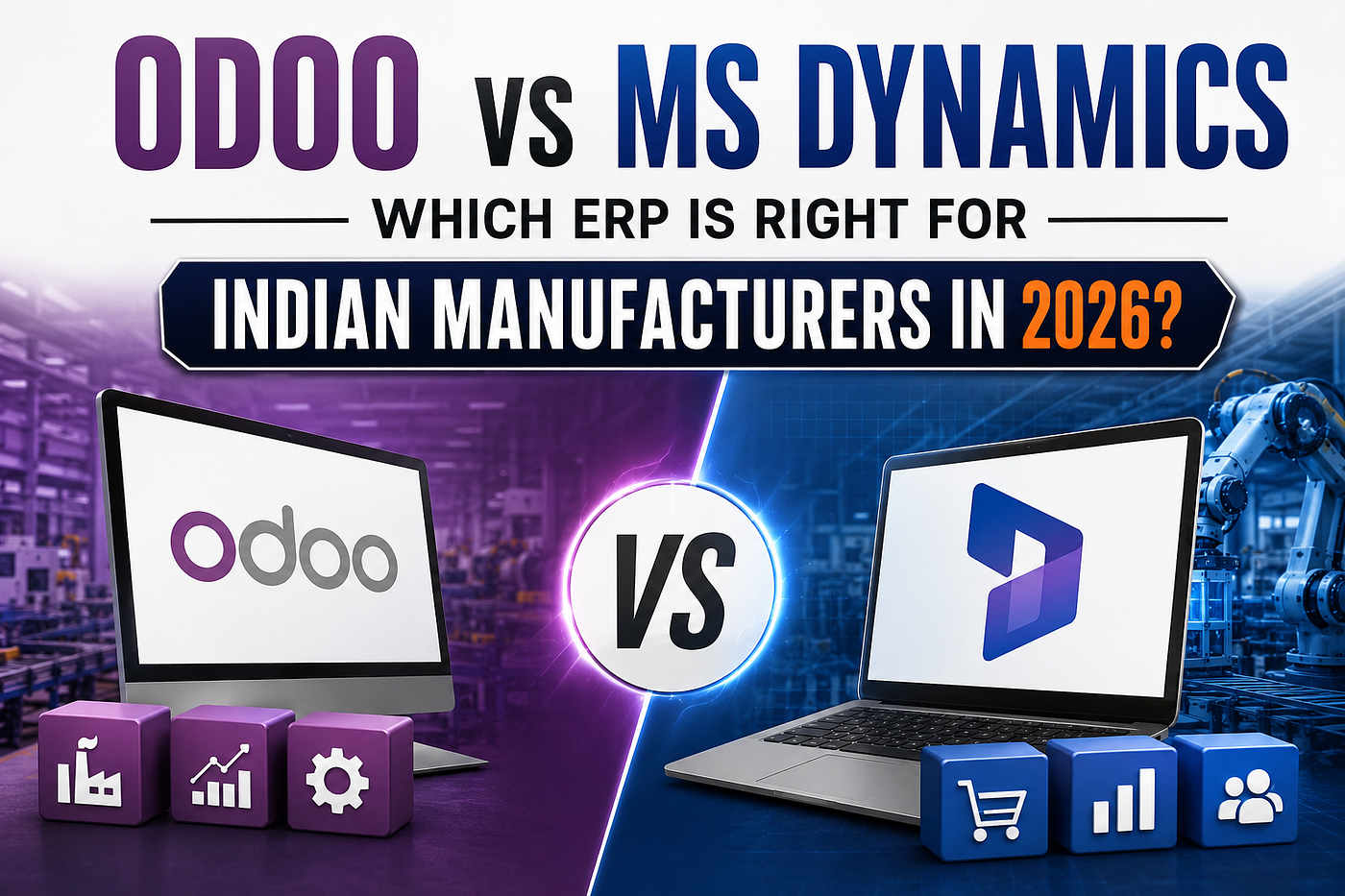
The ERP Decision That Costs Indian Manufacturers Crores: Odoo vs MS Dynamics, Finally Explained…
I want to start with a story that will feel familiar to anyone who has worked in Indian manufacturing.
The ERP Decision That Costs Indian Manufacturers Crores: Odoo vs MS Dynamics, Finally Explained Honestly
I want to start with a story that will feel familiar to anyone who has worked in Indian manufacturing.
A plant owner in central India spent fourteen months implementing Microsoft Dynamics 365. The total cost, when the project finally closed, was close to Rs.90 lakhs. Six months after go-live, most department heads were still maintaining parallel Excel sheets because the system felt too complex for daily use. By month nine, the leadership team was quietly exploring whether they could migrate to something simpler.
This is not a story about a bad product. Dynamics 365 is a serious enterprise system. This is a story about a mismatch between platform and context. And it plays out, in some version, more often than the ERP industry admits.
Watch the Full Video: https://www.youtube.com/watch?v=xs5g9xGm1Ls (Embed this video as a YouTube iframe on your platform)
The video above covers the core comparison in a concise format. The deeper analysis continues below.
What Makes the Indian Manufacturing Context Different
The standard Odoo vs MS Dynamics comparison you find online is written for a global audience. It treats both platforms as competing for the same buyer. In India’s mid-market manufacturing segment, that framing misses something important.
A manufacturing company doing Rs.30 to Rs.80 crore in India is not a small company by any measure. But it is almost certainly operating with a thin IT function, evolving rather than standardized processes, and a leadership team that needs results in months, not years. The ERP decision is not just a technology choice. It is a question of organizational readiness.
Two Platforms, Two Fundamentally Different Philosophies
Dynamics 365 was built on the assumption that the organization implementing it already knows exactly how it wants to operate. It offers powerful, enterprise-grade tools for organizations that have mature processes and the internal capability to configure and maintain a complex system.
Odoo was built on a different assumption: that businesses are still figuring things out as they grow, and the system should be flexible enough to grow with them. Seventeen versions in, that philosophy has produced a platform that punches well above its price point.
Neither philosophy is wrong. One fits the typical Indian mid-market manufacturer, and the other does not, yet.
The Five-Year View Changes the Conversation
Most ERP buyers think about implementation cost. Fewer think rigorously about what they will spend over five years.
For Odoo, a five-year total cost of ownership for a mid-size Indian manufacturer lands around Rs.50 to Rs.70 lakhs. That includes licensing, annual support, and the natural customization that comes as the business evolves.
For Dynamics 365 across the same five-year period, the number typically runs Rs.2 crore to Rs.4 crore. License renewals are more expensive, partner rates are higher because good Dynamics consultants in India are scarce, and the change management overhead is ongoing as the platform updates.
The gap is real and it compounds. For a company where that capital could go into equipment, inventory, or people, this is not an abstract number.
The Adoption Problem Nobody Talks About
Here is the thing about enterprise software that the sales cycle never surfaces: people have to actually want to use it.
Odoo’s interface is clean and intuitive. Production supervisors, store managers, and purchase executives get comfortable with it quickly. The friction of learning a new system is real but manageable.
Dynamics 365 carries complexity that is appropriate for its design context. For experienced ERP users in a well-resourced enterprise, it is fine. For a 55-person manufacturing company where most employees are using ERP for the first time, it creates adoption resistance that quietly erodes the system’s value.
I keep coming back to this point because the ROI of any ERP is almost entirely determined by whether people use it well, not by how many features it has.
Where Dynamics Wins Clearly
This analysis would not be complete without acknowledging where Dynamics genuinely outperforms Odoo. The Microsoft ecosystem integration is powerful and real. Power BI fed from Dynamics data is excellent. The governance and compliance frameworks for complex multi-entity organizations are stronger. And Microsoft’s Copilot integration is making Dynamics meaningfully more intelligent in ways Odoo has not yet matched.
For manufacturers above Rs.200 crore, or those with institutional investors and formal audit requirements, Dynamics is worth the investment. The question is whether that is you today.
A Framework for Making the Decision
Ask yourself three questions before you decide:
• Can your organization absorb a 12-month implementation while continuing to run operations normally?
• Does the cost difference change how you would allocate capital to growth in the next three years?
• Are your processes standardized enough that a rigid enterprise system will not require constant expensive customization?
If the honest answers push you toward simplicity, speed, and cost efficiency, Odoo is the better choice for now. You can always migrate when the business grows to the scale where Dynamics becomes genuinely necessary rather than just impressive.
The most expensive ERP mistake is not choosing the wrong platform. It is choosing the right platform for a version of your business that does not exist yet.
Read the Complete Analysis
The full comparison including implementation timelines, detailed cost breakdowns, manufacturing feature analysis, Indian partner ecosystem realities, and a practical FAQ for decision-makers is published here:
Read the Full Article: https://www.apagen.com/odoo-vs-ms-dynamics-365-which-erp-actually-works-for-indian-manufacturers-in-2026/
If you are evaluating ERP options for your manufacturing business and want a grounded, vendor-neutral assessment, that is a good place to start.
메타데이터
- post_id
- cf47ea592db9
- slug
- the-erp-decision-that-costs-indian-manufacturers-crores-odoo-vs-ms-dynamics-finally-explained-cf47ea592db9
- url
- https://medium.com/@apagen/the-erp-decision-that-costs-indian-manufacturers-crores-odoo-vs-ms-dynamics-finally-explained-cf47ea592db9
- canonical_url
- https://medium.com/@apagen/the-erp-decision-that-costs-indian-manufacturers-crores-odoo-vs-ms-dynamics-finally-explained-cf47ea592db9
- author_url
- https://medium.com/@apagen
- status
- ok
- fetched_at
- 2026-06-09 15:37:30