The DevOps Skill That’s Quietly Reshaping Cloud Work in 2025
Converged Observability and Automation: How platform engineers are merging infrastructure-as-code with AI-driven insights to tame…
The DevOps Skill That’s Quietly Reshaping Cloud Work in 2025
Converged Observability and Automation: How platform engineers are merging infrastructure-as-code with AI-driven insights to tame multi-cloud chaos.
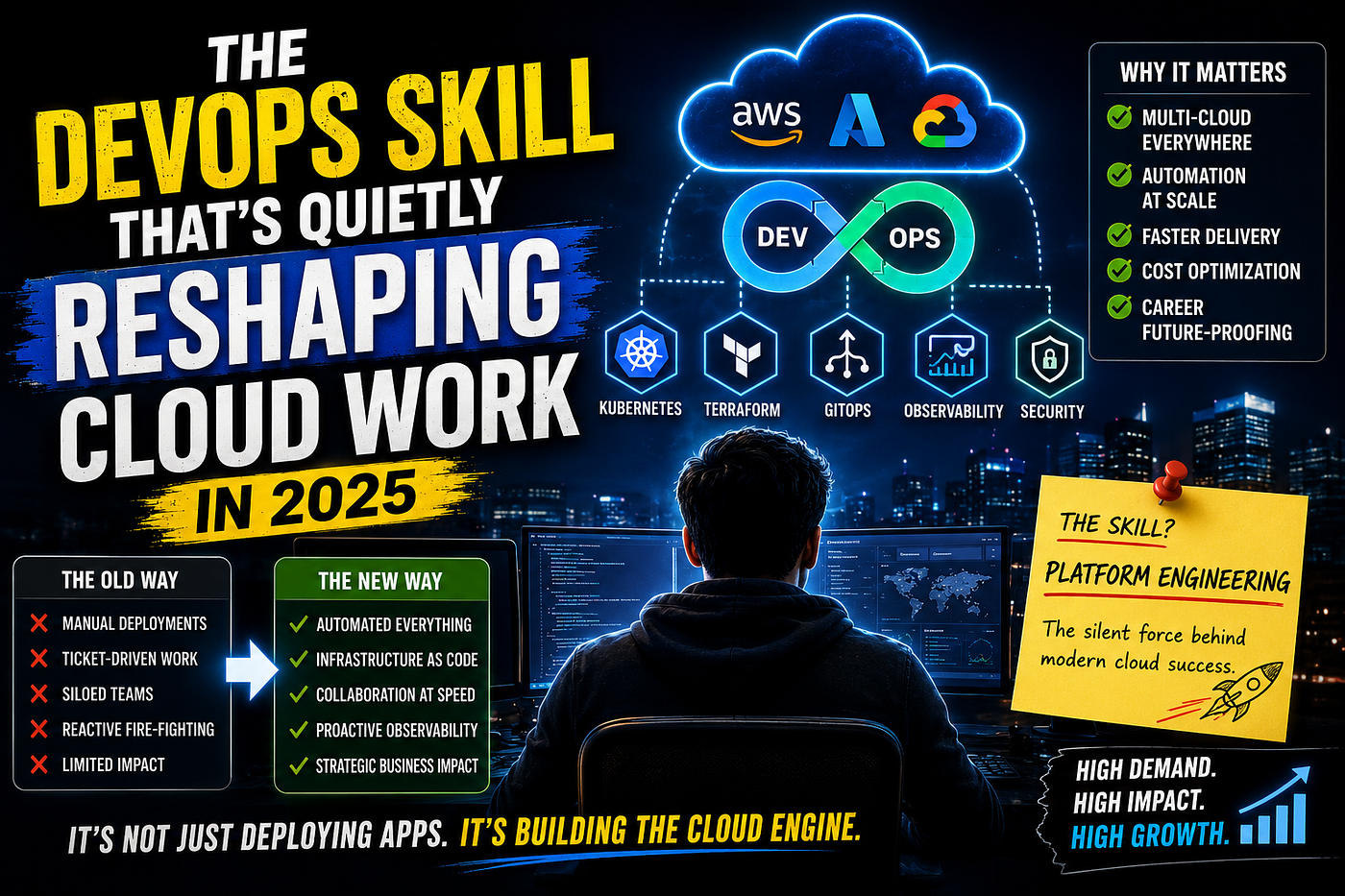
Image generated by Author
What if your cloud cost alerts could predict failures before they happen? Not after a cascade of PagerDuty pages at 2am. Not after the post-mortem. Before — while there is still time to reroute traffic, scale a node, or simply let a human make a call with real context.
That is no longer a fantasy scenario for well-funded hyperscalers. It is becoming standard practice at scaling companies that have figured out a quiet but significant shift in platform engineering: converged observability. The idea is straightforward in theory and genuinely hard in practice. You stop treating monitoring, cost analysis, network policy, and deployment automation as separate concerns with separate tools and separate dashboards. You treat them as a single system — one that reads infrastructure state, understands service dependencies, and feeds that context back into the automation layer before anything breaks.
The Engineer Who Saw It First
A senior platform engineer at a mid-sized fintech company in London spent most of 2023 doing what most engineers do: triaging alerts, reviewing Grafana dashboards, and writing Terraform modules in a separate workflow that had nothing to do with what the monitoring stack was telling him. The cost anomaly tool sat in one tab. The tracing tool in another. The deployment pipeline in a third.
Then a production incident in Q3 changed his approach. A cost spike in their AWS EKS cluster had been visible in the billing dashboard for three days before it turned into a latency issue. The data was there. The pattern was there. But nobody connected it to the deployment that had gone out 72 hours earlier, because the two systems did not talk to each other. The post-mortem lasted four hours. The fix took twenty minutes.
What Actually Changed
The tooling landscape shifted first. AWS introduced native cost anomaly detection directly tied to EKS workload metadata in late 2023. OpenTelemetry matured enough that teams could instrument services once and fan out signals to multiple backends — metrics, traces, logs — without maintaining separate agents. Platforms like Datadog and Grafana Cloud began offering unified policy dashboards where a single view shows spend, SLO health, and deployment status simultaneously.
But the deeper change was cultural. Teams at companies like Spotify, Cloudflare, and fintech-native organizations stopped treating observability as a purely reactive function. They began embedding it directly into the infrastructure-as-code layer. A Terraform module would include not just the resource definition but also the default alert thresholds and budget tags. A Helm chart deployment would trigger an automatic SLO baseline check. The two workflows converged into one.
The Insight Nobody’s Talking About
Most conversations about DevOps in 2025 focus on AI-assisted code generation or faster CI/CD pipelines. Those are real. But the quieter shift — the one that is actually changing how infrastructure teams are organized and evaluated — is the move toward what practitioners are calling converged observability.
The insight is not that observability matters — everyone already knows that. The insight is that the separation between observability and automation is itself the bottleneck. When your alerting system cannot trigger a Terraform change, and your cost dashboard cannot pause a deployment, you are not running a modern infrastructure team. You are running two teams with a shared Slack channel.
The Numbers Are Already There
Consider what the data is showing. According to the 2025 State of Cloud Monitoring report, 67% of unplanned cloud cost overruns are traceable to deployment events that happened between 48 and 96 hours prior — well within the window where a converged system would have flagged the correlation. AWS EKS teams that enabled cost allocation tags linked to workload namespaces saw a 34% reduction in unexplained spend within two quarters of adoption.
On the security and identity side, the SPIRE project (part of the CNCF) has become the de facto standard for workload identity in multi-cloud environments. SPIRE issues short-lived X.509 certificates to workloads automatically, removing the need for static credentials. When SPIRE telemetry is piped into a unified observability layer, security teams gain real-time visibility into certificate rotation failures, unauthorized service-to-service calls, and policy drift — without building a separate SIEM workflow.
The cross-platform angle is also worth noting. Teams managing hybrid Windows-Linux environments — still common in enterprise financial services and healthcare — have long struggled with telemetry fragmentation. Windows Event Logs, Linux syslog, and container stdout all spoke different dialects. The rise of the OpenTelemetry Collector as a universal agent has changed that. Organizations like Wrotek, a European cloud consultancy, reported a 40% reduction in mean time to resolution after standardizing all telemetry — across Windows and Linux nodes — into a single OTel pipeline feeding a unified dashboard.
Why This Reshapes Career Trajectories
If you are a platform engineer today, this shift matters because it changes what you are measured on. The old metric was uptime. The emerging metric is signal clarity — how quickly can your system surface a meaningful correlation between a deployment, a cost event, a security anomaly, and a user-facing degradation? Engineers who can instrument systems to answer that question are commanding 20 to 30% salary premiums in cloud infrastructure roles in 2025, according to hiring data from tech-focused recruiters.
For engineering managers and CTOs, it changes hiring and team structure. The traditional split between a monitoring team and a DevOps/platform team is increasingly being collapsed into a single Platform Engineering function. The engineers who thrive in that function are the ones who think in systems — not just systems as infrastructure, but systems as feedback loops. They write code, yes. But they also design the signal architecture that tells the rest of the team whether the code is behaving as expected in production.
Where to Start If You Are Behind
The path forward is not about adopting a specific tool. It is about rethinking where observability lives in your workflow. Start by auditing your current stack for gaps: are your deployment events tagged with the same labels as your cost allocation? Can your alerting system query historical deployment data? If not, that is the gap to close first.
Second, invest time in OpenTelemetry. It is now stable across all three signal types — metrics, traces, and logs — and it is the only instrumentation standard that works equally well across cloud providers. If you are still running vendor-specific agents on every node, that is technical debt that will cost you when you need to switch providers or run a hybrid stack.
Third, if your organization runs mixed Windows-Linux infrastructure, treat telemetry standardization as a strategic initiative, not a cleanup project. The operational cost of maintaining two separate monitoring workflows is a drag that compounds over time. Getting everything into a single OTel pipeline is a six-month project that pays back in the first incident it prevents.
What 2026 Looks Like
The prediction for 2026 is not complicated: converged observability moves from leading-edge practice to hiring requirement. Job descriptions for senior platform engineers will explicitly list OTel proficiency, cost-aware deployment practices, and cross-signal correlation capabilities as must-haves. Organizations that have not made this investment will find themselves rebuilding for the third or fourth time as their tooling debt compounds.
The more interesting prediction is what happens to AI-assisted operations in this context. Right now, most AI-driven ops tools are flying partially blind because they are ingesting fragmented telemetry. Once teams standardize on a unified signal layer, AI-assisted root cause analysis and predictive scaling move from prototype features to reliable infrastructure. The convergence is not just a DevOps best practice — it is the prerequisite for the next generation of intelligent automation.
The Skill That Compounds
The engineer in London who watched that four-hour post-mortem unfold eventually rebuilt his team’s workflow around a single principle: every signal should be contextual. A cost spike is not just a billing event — it is a deployment signal, a scaling signal, a policy signal. An SLO breach is not just a monitoring alert — it is a business event with a traceable technical cause. When your infrastructure treats those signals as connected, you stop chasing fires and start preventing them.
That is the DevOps skill that is quietly reshaping cloud work in 2025. It does not have a flashy product launch. It is not a new programming language or a viral framework. It is a discipline — a way of thinking about infrastructure as a unified feedback system rather than a collection of loosely connected tools. And like most compound skills, the engineers who invest in it early will find themselves in a very different position by the time everyone else catches on.
메타데이터
- post_id
- cf4c1e361609
- slug
- the-devops-skill-thats-quietly-reshaping-cloud-work-in-2025-cf4c1e361609
- url
- https://medium.com/devmap/the-devops-skill-thats-quietly-reshaping-cloud-work-in-2025-cf4c1e361609
- canonical_url
- https://medium.com/devmap/the-devops-skill-thats-quietly-reshaping-cloud-work-in-2025-cf4c1e361609
- author_url
- https://medium.com/@yatinsindhi03
- status
- ok
- fetched_at
- 2026-07-10 12:09:34