Project 250: What went wrong with the Tacoma Narrows Bridge
Continuing “Project 250”, a personal project based on Michael Sorkin’s Two Hundred Fifty Things an Architect Should Know. — 51. What went…
Project 250: What went wrong with the Tacoma Narrows Bridge
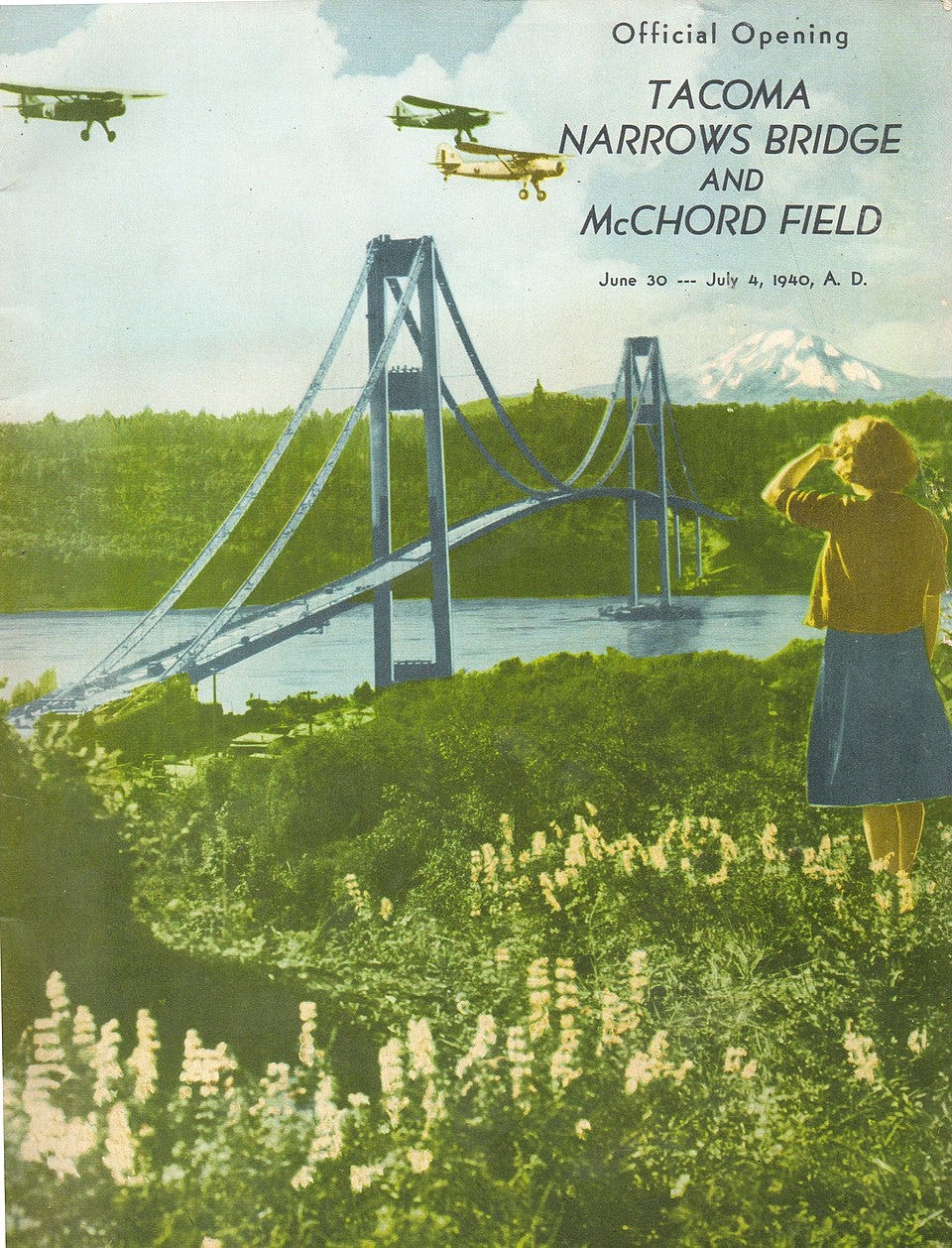
Continuing “Project 250”, a personal project based on Michael Sorkin’s Two Hundred Fifty Things an Architect Should Know. — 51. What went wrong with the Tacoma Narrows Bridge.
There are failures that live as data, and then there are failures that stay with you. The collapse of the Tacoma Narrows Bridge is one of those moments I carry not as history, but as a quiet question that sits inside every line I draw. As architects, we do not always claim bridges as our territory, but we are responsible for something deeper. We are responsible for how form meets force, and how intention meets reality. That day, what failed was not just a structure. It was a way of thinking. It was a moment where confidence moved faster than comprehension, and where elegance was not yet paired with endurance.
The bridge opened in 1940 with a kind of confidence we all recognize. It was slender, efficient, almost poetic in its restraint. In many ways, it represented everything we admire. Clarity, economy, elegance. At a time when resources mattered deeply, reducing material felt like intelligence. But there is a difference between reduction and understanding. The bridge removed what seemed unnecessary, and in doing so, it also removed the capacity to absorb what was not yet fully understood. It performed beautifully under expected conditions, but design is not tested in expectation. It is tested in deviation.
We often explain the failure through physics, through aeroelastic flutter, through equations that describe how wind interacts with structure. But wind is not new. It did not behave differently that day. It did what it has always done. What was different was our relationship to it. The bridge did not fail because wind was unpredictable. It failed because we underestimated how deeply it would participate in the life of the structure. We designed the object, but we did not fully design the interaction. And in that gap, failure found its entry.
I think about this often when I think about bridges in India. Growing up, watching the Howrah Bridge in movies was never just about getting from one side to the other. It was movement, density, sound, weather, human energy, all held together in one continuous experience. That bridge does not resist its context. It absorbs it. It carries the weight of millions, the monsoon air, the constant vibration of a living city. It is not delicate, but it is deeply resilient. It does not pretend the world is still. It is designed because the world is not. It reminds me that durability is not about rigidity. It is about accommodation.
This is where the lesson becomes personal for me. As designers, we are trained to create clarity, to simplify, to refine. But life does not arrive simplified. People do not move through our spaces in predictable ways. Forces do not behave in isolation. The Tacoma Narrows Bridge reminds me that performance is not proven in moments of calm. It is revealed in moments of stress. A system that works only when conditions are perfect is not a system. It is an assumption. And assumptions, when left untested, quietly become risks embedded in form.
There is also a larger question here, one that goes beyond architecture. If we retreated every time something failed, where would we be. If every collapse led to hesitation, if every miscalculation led to fear, we would stop building altogether. We would stop trying. The truth is, progress has never come from avoiding failure. It comes from staying in the work long enough to understand it more deeply. It comes from the willingness to look at something that did not hold and ask why, without turning away. Resilience is not the absence of failure. It is the decision to remain engaged after it.
What followed Tacoma was not silence. It was learning. It was the expansion of knowledge, the integration of wind tunnel testing, the acknowledgment that structures live in dynamic environments. The next bridge did not abandon elegance. It carried it differently. With more awareness, with more humility, with more respect for forces that cannot be seen but must always be considered. It marked the moment where engineering and architecture began to listen more closely to the invisible.
As an architect, I find myself returning to a simple idea. We do not just design objects. We design relationships. Between material and force. Between people and space. Between intention and reality. And every one of those relationships is alive. It changes, it evolves, it pushes back. The success of our work is not in how still it stands, but in how intelligently it responds.
So the question is not how we avoid failure. The question is how we continue despite it. How we design again, more thoughtfully. How we build again, more aware. How we move forward without losing the courage to create. Because if we stop at failure, we stop becoming. And architecture, like life, has never been about stopping. It has always been about continuing, with a little more understanding each time. And perhaps that is the real bridge we are asked to build. Not between two points in space, but between who we were when we failed and who we choose to become after.
메타데이터
- post_id
- cf5915bb179a
- slug
- 51-what-went-wrong-with-the-tacoma-narrows-bridge-cf5915bb179a
- url
- https://medium.com/@archimom/51-what-went-wrong-with-the-tacoma-narrows-bridge-cf5915bb179a
- canonical_url
- https://medium.com/@archimom/51-what-went-wrong-with-the-tacoma-narrows-bridge-cf5915bb179a
- author_url
- https://medium.com/@archimom
- status
- ok
- fetched_at
- 2026-06-17 08:20:12





