SIGCSE 2026: Love and learning
… and computing education
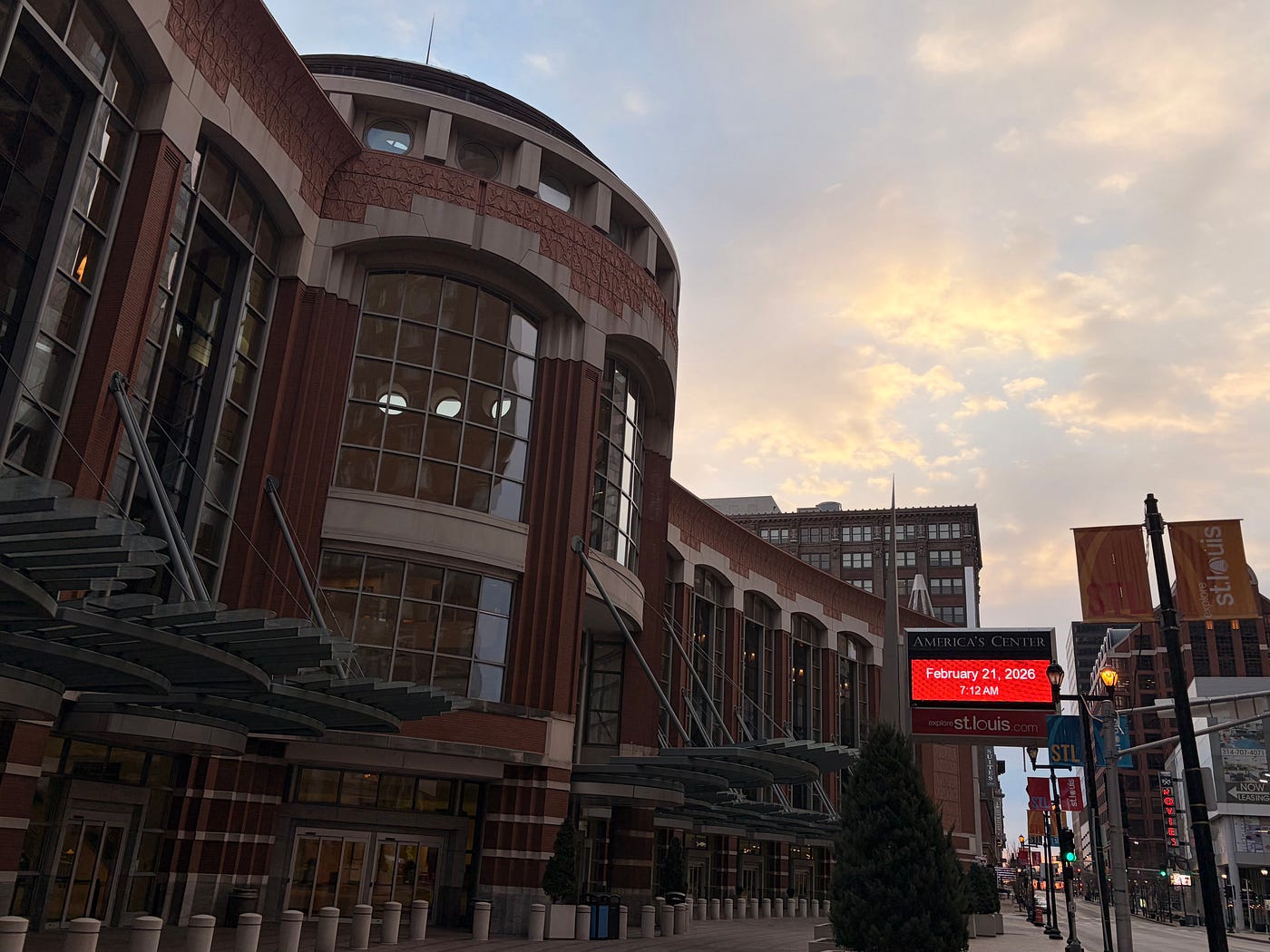
The America’s Center convention center.
SIGCSE 2026: Love and learning
I didn’t want to go to St. Louis this February.
There were more than a few reasons. There were the 200+ anti-trans bills the Missouri state legislature has proposed since 2022, taking away trans people’s health care, safety, identification, jobs, and humanity. Despite the city’s best efforts to create sanctuary, it’s hard to feel safe in a state that is so politically, culturally, and religiously hostile to my existence.
And then there’s St. Louis itself. I’ve been a few times before, and enjoyed the food, jazz, and blues, and I have wonderful colleagues at Washington University whom I’ve enjoyed connecting with over the years. But as a city, I feel it struggle so much. The infrastructure, the car dependency, and thousands of pedestrian injuries and deaths per year. My favorite kind of cities let me explore on foot, but this one does not. I’m grateful for its metro connections, even though it seems like they’re a last resort for many, rather than the spine of the city’s mobility.
Despite those few deterrents, I had a lot to do at the Technical Symposium this year. I was invited to give the opening keynote, and very excited to speak to the political moment, connecting our country’s slide into authoritarianism to computing education, and the constructive actions we might all take in CS education and CS education research. I had a record three ACM TOCE sessions to chair, including an editorial board and author lunch, and multiple birds-of-a-feather sessions ot co-facilitate. And then there was the Teaching Accessibility pre-symposium workshop, the disability and LGBTQ birds of a feather sessions I was helping organize, and the few thousand wonderful colleagues I only see once a year.
After a lively day of lobbying for even more robust trans rights in Washington state, I flew to Missouri to make the most of St. Louis’s fragile refuge and my words, not knowing where I’d be emotionally on the other side of the week.

Mid-day in the accessibility pre-symposium.
Wednesday: Accessibility in CS Education
I spent most of Wednesday helping co-facilitate the all-day AccessComputing sponsored Accessibility in CS Education pre-symposium. It was a medley of talks, discussions, and community organizing.
The first session was about disability:
- Stacy Branham and Isabela Figueira (UC Irvine) talked about students with disability’s transition into college, framing it in terms of life transitions, where people are outside of established social contexts. They learned that multiple intersecting life transitions related to disability interacted with college transitions, compounding challenges.
- Jason McKenna (Vex Robotics), a former classroom middle school teacher, talked about neurodiversity and team robotics design. They worked to lower barriers to entry for special education teachers and adjusted engineering notebook visibility to ensure inclusive team participation.
- Richard Ladner (University of Washington) talked about disability data definition and collection, and how experts vary in evaluations and institutions vary in reporting reliability, necessitating care when reporting disability data.
After, I facilitated table discussions about grand challenges in accessible CS teaching this year and forward, in technology, teaching, policy, and more. Groups raised issues of chilled speech and canceled funding, inaccessible tools, the Department of Justice ruling on accessible content, the complex tradeoffs of AI, fear, teacher learning, and more.
After a break, we talked about accessibility and teaching:
- Ritesh Kanchi (Harvard) discussed teacher led accessibility labor, and how it varied from scaling tools and systems. He noted infrastructure gaps like lacking embeddedness, transparency, and embodiment of standards, links to conventions of practice, all leading to instructor turnover, fragility, and deterioration of accessibility. Instructional staff having split attention was a major factor.
- Vivian Motti (George Mason) talked about teaching at the intersection between security, privacy, and accessibility, because not all content is available to be made accessible.
- Cathy Law (Oregon State University), Rachel F. Adler (University of Illinois), and Chunyu Liu (University of Illinois) talked about teaching accessibility in game design contexts, with educational videos and games around color vision, hearing, and dyslexia. They found youth shift their assumptions about who software is and isn’t designed for.
- Kyrie Zhou (University of Texas at San Antonio) considered how communities collectively share accessibility resources in higher education teaching in preparation for Title II compliance, noting gaps in infrastructure, training, process, and funding.
After a lively lunch, we talked about tools:
- Wilfredo Robinson Moore & Namrata Roy (St. Louis University) talked about accessible data visualizations, finding a diversity of preferences around using and not using generative AI to support exploration.
- Jason McKenna (Vex Robotics) returned to stage and talked about accessible robotics with VEXcode 5.0, where they’ve tackled numerous complexities around accessible programming.
- Rachel Fenichel (Raspberry Pi Foundation) talked about screen reader support in Blockly, an open source library for making block-based programming languages. It’s implemented in SVG, which makes adding ARIA a challenge. They created a cursor that tracks focus, added keyboard shortcuts and ARIA roles, then tested with sighted and blind kids in collaboration with micro:bit. The main challenge is that many kids and teachers don’t know how to code or a screen reader.
- Tim Kluthe (University of Nevada Las Vegas) talked about accessible Parson’s problems, offering intricate interaction designs for navigating their puzzle like structures.
After a break, we had one last set of miscellaneous talks:
- Hannah Williams (University of Nevada, Las Vegas) talked about data science accessibility, including wrangling, analysis, and visualization, describing more descriptive names for analyses, accessible charts in Quorum.
- Nicole Moreno González (Grinnell College) talked about a web-based Scheme IDE, covering numerous ways of redesigning tooling to account for accessibility, as the IDE had not been originally designed with accessibility in mind.
- Brianna Blaser (University of Washington) talked about AccessComputing student supports as part of CRA‘s’ UR2PHD effort. Students with disabilities sought many supports, some specific to disability, some general, ranging from mentorship, physical demands of travel, accommodations gaps in doctoral education.
- **Alannah Oleson* (University of Denver) talked about the [Teaching Accessible Computing](https://bookish.press/tac)*, which they and I co-edited with Richard Lander. Notably, we continue to add chapters to the book that cover additional areas, including foundations of disability, accessibility basics, operating systems, capstones, and sustainable computing, as well as landscape chapters on accessible computing research and disability history.
We ended with small group discussions about Title II compliance in the U.S., which are mandating accessible content and applications. I learned that most institutions are far from ready; some haven’t even started. It made me proud of how seriously and proactively my university has taken the work (even if we also aren’t ready).

I take a sip of water as the audience reflects on their experiences with love in computing education.
Thursday: Opening Keynote, etc.
The first day of the conference was a busy one. I started the day with a keynote rehearsal to check A/V, and then giving the keynote itself, and then rushed off to chair an ACM TOCE session, run an ACM TOCE lunch, and then co-facilitate two back to back birds-of-a-feather sessions.
The organizing team kicked off the conference with a medley of key facts. I was surprised to learn that this is the 5th time the conference has been in St. Louis! I was proud to hear that Philip Guo’s Online Python Tutor paper won the SIGCSE Test in Time award. And was pleased to see the continued growth in submissions, with 574 papers (174 accepted), just a tad more than we see annually at ACM Transactions on Computing Education. The conference also had more than 867 reviewers helping peer review these submissions.
After the opening, I started my keynote.
When I was first invited to give it, I was both excited, but a bit overwhelmed. How could I possibly speak to this fraught moment? What does CS education have to do at all with fascism, civil rights violations, and the fraying of our democratic institutions? After several months of pondering, I decided that I really didn’t want to talk at all about the horrible things happening in the world, but rather, what we might do about them, in our roles as educators and researchers.
I’d spent much of 2025 wrestling with that question myself and a lot of where I had landed was needing to prioritize the positive things in my life and build upon them. Joy, love, connection, and care are things I have always been particularly bad at. What would a keynote about those be like? I settled on focusing on love in particular, and working through the many things that have been written about it in relation to education, and what connection it might have to computing education.
Here’s a captioned recording of a rehearsal for my talk, which largely mirrors what I gave live:
[embed]My SIGCSE TS 2026 opening keynote.
Immediately after the keynote session, I went to chair an ACM TOCE session on youth, identity, and teachers, and then run an ACM TOCE Editorial Board lunch to recognize our Associate Editors and presenting authors. I then had a couple hours for hallway conversations, where I talked to dozens of attendees about their experiences with love in education, and the many ways that they hoped to grow as people, to grow as teachers.

The Editorial Board, authors, and I enjoy a tasty lunch at BLT’s
The evening was also wonderfully full of connection. I co-facilitated a birds-of-a-feather session with more than 50 LGBTQ+ folks in our community, where we gossiped, talked about mentorship and research on queer learners, how to support queer students, and more. And then I co-facilitated a birds-of-a-feather session on disability and accessibility, connecting with a group of educators interested in teaching about accessible computing, and the many challenges of changing faculty behavior, when ableism is built in so deeply into society.
After some bites at the reception, and a UW group photo, I ended the evening with a lovely gathering with folks from our LGBTQ+ BoF at Odditeas, where we talked about everything from capitalism, field trips, strange books, and their myriad connections to teaching computer science.

Jean calls people forward!
Friday: Networking, TOCE, and CSTA
After a late rise, some tasty coffee at Park Avenue Coffee Roasters, and some morning chats with students, I helped run a session with Richard Lander and Alannah Oleson on our edited book, Teaching Accessible Computing. We had a lively lightning talk session covering many of the chapters on topics like data structures, machine vision, and security. We had wonderful small group conversations about many other topics, building communities of educators and researchers around these topics.
I had lunch with my wonderful former Ph.D. student Alannah Oleson and postdoc Jean Salac, and other wonderful students, and then headed to the second TOCE session where one of Jean’s papers was featured as the 2025 Distinguished Paper (selected by an independent committee of Associate Editors, not me in my Editor-in-Chief role).
- **Jean Salac *(Carleton College*) examined all of the practical questions of engaging youth around critical pedagogy, especially youth who are economically marginalized in society (DOI). We found many tensions in this teaching, in programming, programming languages, and project-based learning, where students had a rich critical consciousness, but struggles translating their conceptions of justice into code and owning bias they embedded into their own code.
- **Ismaila Sanusi (University of Eastern Finland) and [Fred Martin](https://caicc.utsa.edu/faculty/profiles/martin-fred.html) *(UT San Antonia*) on middle school machine learning education (DOI). They considered a penguin data set, and prompted them to explore visualizations and find parameters to separate overlapping clusters, enacting classifier behavior in interactive, embodied ways. They also explored youth-contributed data.
- **Ayaan Kazerouni* (Cal Poly*) spoke about a multi-institutional study of socially responsible computing in Hispanic-serving institutions in California (DOI). He talked about coursework that considered ethical and societal aspects of CS, and space for their own cultural assets, with examples like equitable tip allocation and personally meaningful data. They didn’t find differences in communal goal endorsement (it was high for all), but did see a significant increase in sense of belonging with the socially responsible curricula on campuses in first year classes at campuses without restricted enrollments.

We discuss the CSTA revised learning standards implementation plan.
After the session, I connected with some colleagues for 1 on 1 chats, then head to a CSTA dinner for planning, plotting, and shaping the final stages of the revised CSTA learning standards. It was a lovely chance to reconnect with the amazing K-12 CS education policy and research community, but also think through the many ways we’ll need to integrate the revised standards into practice across the country.

Titus gestures as he opens his closing keynote.
Saturday: Closing Keynote, TOCE, and departure
After exploring a new cafe for a mocha and breakfast sandwich, I snuck into the closing plenary to chat with Titus Winters, the closing plenary keynote speaker. We had a wide ranging reflection on the state of the world and its future, and then the organizers launched into the closing to give gratitude to the organizing committee, recognize student research competition winners, and announcing the Sacramento, CA location for 2027 (planned for February 17–20).
Titus then took the stage. Titus is a Senior Principal Scientist at Adobe who’s been very engaged in education, serving on multiple ACM and IEEE curriculum requirements. Titus began by reflecting on his early experiences with SIGCSE, ICER, and education research rigor. He talked about the opportunity and challenge of just how flexible CS is about what is relevant, necessary, and even true, given how unbound the field is from the natural world. As he entered industry, this led him to think deeply about the role of learning, mentorship, and standards in software engineering.
With this background, he noted just how much theory and practice have diverged in the past few years, with AI being pretty good at generating messy but mostly correct code and models improving rapidly. Tech hiring is stagnating and hiring assessments no longer account for LLM capabilities. He observed how industry fantasies have taken hold from flashy applications, despite really obvious limitations and quality issues that models generate. He concluded that prompts and AI generation is not enough; it takes a different set of skills to make its output useful, and education has mostly focused on the part that AI is good at, instead of the skills that it is not good at.
Have we automated ourselves out of a need for CS education? He argued not. He quoted Harlan Mills:
Our present programming courses are patterned along those of a course in French Dictionary. In such a course we study the dictionary and learn what the meanings of French words are in English… Of course, the result is that some people can write French potetry and some not, but the skills critical to writing poetry were not learned in the course they just took in French dictionary.
He observed that we say programming is craft, creative, human expression, but then education fails to actually engage students in these activities, instead asking them to uncreatively match exact requirements that they had no role in setting. He argued that this form of teaching avoids exactly the things that LLMs cannot do, while prioritizing the exact things that LLMs can do. He argued that industry has been searching for graduates that have been practicing and mastering the art of programming, not declarative knowledge. “Teach poetry, not dictionary. AI makes old problems urgent.”
He critiqued the wishful thinking in industry, hoping that LLMs would be a silver bullet, when the reality is that it is just an amplifier of underlying structures, processes, and capabilities of organizations. He challenged the education community to deeply reconsider curriculum: is it engineering (with shared concepts, theory guided by practice) or is it math (disinterested in practice, but powerfully principled)? He encouraged us to not waste this opportunity, using the unavoidable rethinking we have to do to come up with new principles for teaching, learning, curriculum, and mastery in CS education.
Titus then turned to software engineering education, conceptualizing software engineering as the multi-person construction of multi-version programs. He argued that all of software engineering are exactly the things that students need to make the most of GenAI: planning, design, architecture, verification, validation, testing, code review, even taste. He laid out some concrete examples of disconnect:
- Why teach binary search trees, when hashtables are practically more useful, because application performance is often bounded by memory limits, not CPU time, and hashing can be a fruitful forcing function to approximate equality? Why prioritize sorting when ordering is rare (e.g., who would sort JSON blobs?) Modern architectures make arrays and hashtables surprisingly valuable, and many of the more esoteric data structures — and even computational complexity—much less practically useful.
- Recursion is a useful idea, but it almost always fails because of call stack exhaustion, and languages don’t always guarantee tail recursion. It’s a valuable concept, and students should know it, but it’s not always a good tool. Titus argued that wisdom is knowing when not to. Similarly, regular expressions can be great tools, but also explosions of memory, security vulnerabilities, and extremely defect and performance bottleneck prone.
He concluded: “Intelligence is knowing how to do something. Wisdom is knowing not to.” He observed a lot of CS curriculum as a reflection of what was important for building operating systems in the 1990’s. It doesn’t need to be highly responsive to the latest tech trends, but he argued that there are foundational software engineering concerns that CS has long ignored, imploring us to center these engineering foundations, lest we become an irrelevant math department. He pleaded with us to be ruthless in trimming the irrelevant “traditions” in our curricular ideas, and in our pedagogy and assessments, centering software quality over basic functionality — the poetry, the process, the practice, the people, the wisdom.
The audience questions wrestled with gaps in the faculty and TA teaching workforce, budget constraints imposing scale anathema to evaluating quality, the need for space to deliberate on these challenges, . Titus noted throughout his answers that none of these challenges demand perfection in quality or assessment, but just a focus and pragmatism on these oft ignored topic.
After the keynote, I had one more ACM TOCE session to chair, which I had labeled “skill progression”:
- Ansul Shah (UC San Diego) spoke about active live coding in CS1 (DOI). They found in prior that popular perceptions of live coding were not in line with reality, with no impact on programming, student learning, or engagement. He instead built upon the ICAP framework and cognitive apprenticeship theories of engagement to comprehensively explore students actively live coding with instructors. He found that there was no impact on programming process or learning, but it led to higher behavioral engagement, and felt they were able to get more immediate feedback. He noted that the primary factor shaping grades was prior experience, and that probably washed out pedagogical impacts.
- Bogdan Dimion (University of Toronto Mississauga) spoke on fine grained skill development across courses (DOI), tracking the prevalence of errors across a curriculum, finding errors decline over time, but also pop up again with programming language transitions, or between larger gaps between related courses.
- Jonathan Liu (University of Chicago) shared a literature review of teaching algorithm design (DOI), trying to understand why research on the topic had been so sparse. After a careful attempt at a principled definition of an algorithms course, they found more than 100 papers that fit the definition. They found that most papers were one-off contributions from authors, that there was a narrow breadth of topics, that abstraction skills are often underutilized by students in and after algorithms courses, and that algorithms lends itself quite well to real-world problems.
There was only one flight on Alaska back to Seattle in the afternoon, so I set out during the lunch break to the airport, to head home, a bit before the conference officially ended.
Reflections
So much of my experience of this year’s conference was a form of reciprocity. I came to frame the conference around a particular kind of love in teaching, and try to model that love. So much of that came back to me as love and connection. Attendees shared their stories of educational trauma, of their healing, of their evolving perspectives on teaching, and even of their beautifully mature “whatever” love pedagogies that they just did not have names for. I left feeling not only an immense amount of hope that our community would continue to grow and change together, but also that our community might be part of a broader transformation in centering the humanity and relationality that has always been inherent to education in general.
메타데이터
- post_id
- cf5d52723f16
- slug
- sigcse-2026-love-and-learning-cf5d52723f16
- url
- https://medium.com/bits-and-behavior/sigcse-2026-love-and-learning-cf5d52723f16
- canonical_url
- https://medium.com/bits-and-behavior/sigcse-2026-love-and-learning-cf5d52723f16
- author_url
- https://medium.com/@amyjko
- status
- ok
- fetched_at
- 2026-06-26 03:39:16




