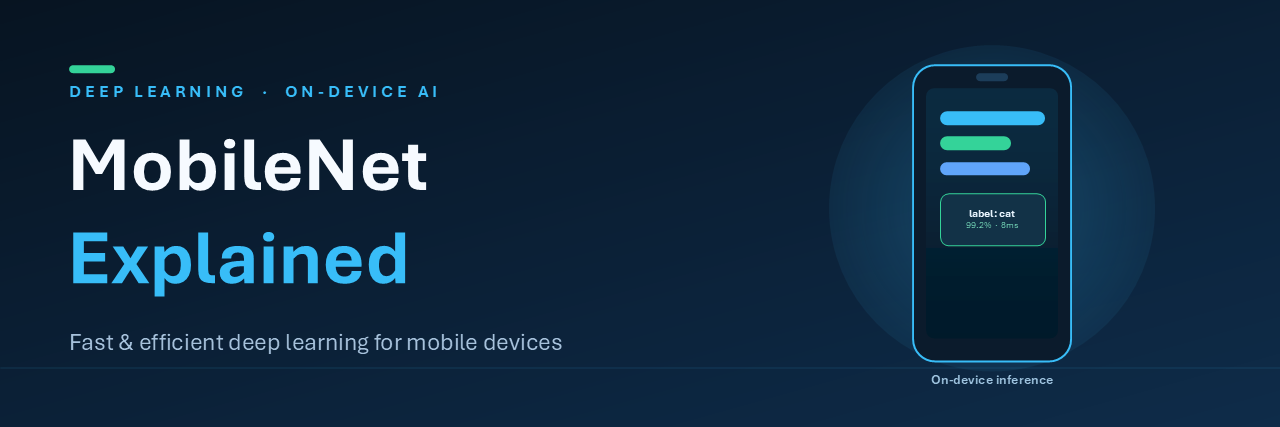
MobileNet Explained: Fast and Efficient Deep Learning for Mobile Devices
Learn MobileNet architecture step-by-step using a Husky, Golden Retriever, and German Shepherd classification example.
MobileNet Explained: Fast and Efficient Deep Learning for Mobile Devices
Designed using Copilot
Learn MobileNet architecture step-by-step using a Husky, Golden Retriever, and German Shepherd classification example.
Deep learning models such as VGG16, ResNet, and DenseNet achieve impressive accuracy, but they often require millions of parameters and significant computational power. Running these models on smartphones, embedded systems, drones, or IoT devices can be challenging.
This is where MobileNet comes in.
MobileNet was designed by Google to provide:
· Smaller model size
· Faster inference
· Lower memory usage
· Good accuracy
Instead of using standard convolutions everywhere, MobileNet introduces a clever technique called Depthwise Separable Convolution, dramatically reducing computation while maintaining performance.
In this article, we’ll explore MobileNet layer-by-layer using a dog breed classification example.
The Problem
Suppose we want to classify images into three dog breeds:
- Husky
- Golden Retriever
- German Shepherd
Our dataset contains thousands of labeled images.
A traditional CNN can solve this problem, but deploying it on:
- Mobile phones
- Raspberry Pi
- Smart cameras
- Edge AI devices
may be too expensive computationally.
MobileNet solves this challenge.
Traditional CNN Approach
Consider an input image:
224 × 224 × 3A standard convolution layer might use:
32 filters
3 × 3 kernel
Output:
224 × 224 × 32The problem is that every filter operates across all input channels simultaneously.
This requires many multiplications.
For mobile devices, this becomes expensive.
MobileNet’s Key Idea
Instead of one large convolution operation:
Standard Convolution
       ↓
Depthwise Convolution
       +
Pointwise Convolution
This approach is called:
Depthwise Separable Convolution
It reduces computation by approximately:
8–9 timescompared to standard convolutions.
Understanding Depthwise Convolution
Assume the input image is:
224 × 224 × 3representing:
Red
Green
Blue
channels.
Instead of applying filters across all channels together, MobileNet processes each channel independently.
Husky Example
Suppose the image contains a Husky.
Channel 1 (Red)
Detects:
- Fur brightness
- Facial contrast
Channel 2 (Green)
Detects:
- Eye region
- Ear boundaries
Channel 3 (Blue)
Detects:
- Background snow
- Fur texture
Each channel gets its own convolution filter.
Red Channel   → Filter 1
Green Channel → Filter 2
Blue Channel  → Filter 3
Output:
224 × 224 × 3This operation is called:
Depthwise Convolution
Why Depthwise Convolution Alone Isn’t Enough
After depthwise convolution, channels remain separate.
The network knows:
- Fur texture
- Ear shape
- Eye regions
But it hasn’t combined these clues yet.
To recognize a Husky, features must interact.
That’s where Pointwise Convolution comes in.
Pointwise Convolution
Pointwise convolution uses:
1 × 1 convolutionacross all channels.
Think of it as feature mixing.
For example:
Fur Texture
+
Pointed Ears
+
Blue Eyes
=
Husky
The network combines information from all channels to form meaningful patterns.
Output become:
224 × 224 × 32feature maps.
Why It Saves Computation
Suppose:
Input:
224 × 224 × 3Output:
224 × 224 × 32Kernel:
3 × 3Standard Convolution Cost
Parameters:
3 × 3 × 3 × 32
=
864
MobileNet Cost
Depthwise:
3 × 3 × 3
=
27
Pointwise:
1 × 1 × 3 × 32 = 96Total:
27 + 96
=
123
Instead of:
864we only need:
123parameters.
Huge savings!
MobileNet Architecture
A simplified MobileNet architecture looks like:
Input Image
      ↓
  3×3 Conv
      ↓
Depthwise Conv
      ↓
Pointwise Conv
      ↓
Depthwise Conv
      ↓
Pointwise Conv
      ↓
Depthwise Conv
      ↓
Pointwise Conv
      ↓
Global Average Pooling
      ↓
Dense Layer
      ↓
Output Classes
The network repeatedly stacks:
Depthwise Conv
      +
Pointwise Conv
blocks.
What Does MobileNet Learn?

Image created by author using AI guidance
Early Layers
The model learns simple features:
Husky
- Fur edges
- Eye boundaries
Golden Retriever
- Smooth fur contours
German Shepherd
- Dark facial patterns
Middle Layers
Features become more meaningful.
Husky
- Pointed ears
- Thick fur
Golden Retriever
- Long ears
- Golden coat
German Shepherd
- Black saddle pattern
- Upright ears
Deep Layers
The model learns breed-level concepts.
Husky
Blue eyes
   +
Dense fur
   +
Snow-like texture
Golden Retriever
Golden coat
      +
Friendly facial structure
German Shepherd
Black-and-tan coloration
     +
Strong muzzle
Global Average Pooling
Traditional CNNs often use large fully connected layers.
These layers add many parameters.
MobileNet replaces them with:
Global Average PoolingExample:
Before:
7 × 7 × 1024After pooling:
1 × 1 × 1024Benefits:
- Fewer parameters
- Less overfitting
- Faster inference
Final Classification Layer
The final layer predicts probabilities.
Example output:

Prediction:
HuskyMobileNet in TensorFlow
Import Libraries
from tensorflow.keras.applications import MobileNet
from tensorflow.keras import layers, models
Load Pretrained MobileNet
# Load MobileNet pretrained on ImageNet
base_model = MobileNet(
    weights='imagenet',
    include_top=False,
    input_shape=(224,224,3)
)
Freeze Feature Extractor
# Prevent pretrained weights from being updated
base_model.trainable = False
Build Classification Model
# Create a custom classifier on top of MobileNet

model = models.Sequential([

    # Pretrained MobileNet feature extractor
    base_model,

    # Convert feature maps into a feature vector
    layers.GlobalAveragePooling2D(),

    # Learn higher-level breed-specific features
    layers.Dense(128, activation='relu'),

    # Reduce overfitting
    layers.Dropout(0.3),

    # Output layer for 3 dog breeds
    layers.Dense(3, activation='softmax')
])
Compile Model
# Configure training process

model.compile(
    optimizer='adam',
    loss='categorical_crossentropy',
    metrics=['accuracy']
)
Train Model
# Train on dog breed images

history = model.fit(
    train_ds,
    validation_data=val_ds,
    epochs=10
)
Advantages of MobileNet
Extremely Fast
Suitable for:
- Smartphones
- Tablets
- Embedded systems
Small Memory Footprint
Requires much less storage than larger CNNs.
Good Accuracy
Provides an excellent trade-off between:
- Speed
- Size
- Accuracy
Easy Transfer Learning
Can be fine-tuned for:
- Medical imaging
- Face recognition
- Defect detection
- Wildlife classification
Limitations of MobileNet
Slightly Lower Accuracy
Usually less accurate than:
- ResNet
- DenseNet
- EfficientNet
Less Suitable for Large Servers
If computational resources are abundant, larger models may perform better.

When Should You Use MobileNet?
MobileNet is an excellent choice when:
✅ Running on smartphones
✅ Deploying to edge devices
✅ Real-time inference is required
✅ Memory is limited
✅ Building lightweight AI applications
Examples include:
- Dog breed recognition apps
- Wildlife monitoring cameras
- Smart doorbells
- Medical screening tools
- Industrial defect detection systems
A Quick Reference Guide

Image created by author using AI guidance
Final Thoughts
MobileNet revolutionized lightweight deep learning by replacing expensive convolutions with Depthwise Separable Convolutions.
Using our dog breed example:
- Early layers detected fur edges and textures.
- Middle layers identified ears, eyes, and coat patterns.
- Deep layers learned breed-specific concepts.
- The final classifier distinguished between Huskies, Golden Retrievers, and German Shepherds.
The result is a model that is significantly smaller and faster than traditional CNNs while maintaining strong classification performance, making MobileNet one of the most practical architectures for real-world AI deployment.
References
MobileNet Paper : https://arxiv.org/abs/1704.04861TensorFlow MobileNet
Keras Applications Guide: https://keras.io/api/applications/
MobileNetV2 Paper : https://arxiv.org/abs/1801.04381
MobileNetV3 Paper : https://arxiv.org/abs/1905.02244
메타데이터
- post_id
- cf8b4bdbe77c
- slug
- mobilenet-explained-fast-and-efficient-deep-learning-for-mobile-devices-cf8b4bdbe77c
- url
- https://medium.com/data-and-beyond/mobilenet-explained-fast-and-efficient-deep-learning-for-mobile-devices-cf8b4bdbe77c
- canonical_url
- https://medium.com/data-and-beyond/mobilenet-explained-fast-and-efficient-deep-learning-for-mobile-devices-cf8b4bdbe77c
- author_url
- https://medium.com/@sabitha.manoj0891
- status
- ok
- fetched_at
- 2026-06-25 16:53:31