Web3 Marketing in 2026: How Founders Can Grow Beyond Hype?
Web3 has never had a shortage of attention.
Web3 Marketing in 2026: How Founders Can Grow Beyond Hype?
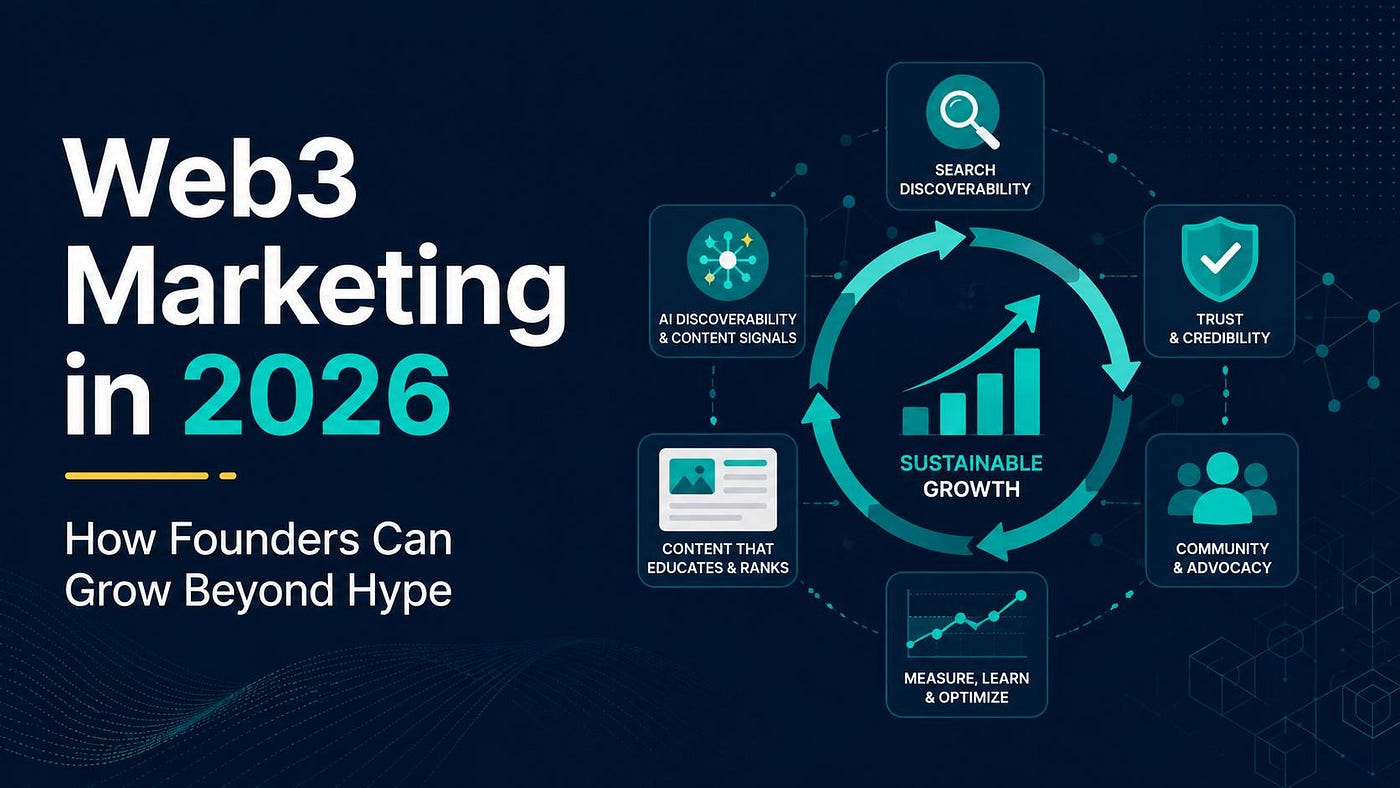
Image Created By Vimal Joseph Using Flow and Photoshop
Web3 has never had a shortage of attention.
It has had a shortage of attention that turns into durable growth.
For years, the familiar launch playbook was simple: announce a token, recruit influencers, open Discord, manufacture urgency, push an airdrop, chase exchange listings, and hope momentum becomes a community before attention moves somewhere else.
That formula is far less dependable in 2026.
The market itself makes the point. According to CoinGecko’s 2026 Q2 Crypto Industry Report, total crypto market capitalization fell 12.6% in Q2 2026 and ended June at $2.1 trillion. Spot trading volume on centralized exchanges fell 27.9% quarter over quarter to $1.95 trillion. Average daily market trading volume also declined to $93.1 billion.
Yet weaker speculative activity does not mean crypto adoption has stopped. Chainalysis found that APAC on-chain crypto activity grew 69% year over year during the 12 months ending June 2025, with transaction value rising from $1.4 trillion to $2.36 trillion. India ranked first in its 2025 Global Crypto Adoption Index, followed by the United States, Pakistan, Vietnam, and Brazil.
That combination matters.
Capital can retreat while infrastructure, payments, stablecoins, institutional participation, and user adoption continue developing underneath.
For founders, that changes marketing. Growth in 2026 is less about manufacturing excitement and more about being discoverable, credible, useful, measurable, and difficult to replace.
Crypto Is Maturing, Even When Prices Are Not
A bull market can hide weak marketing. Rising prices make mediocre communities look engaged, paid acquisition look efficient, and token incentives look like product-market fit.
A slower market removes that camouflage. CoinGecko reported that the stablecoin market still stood at $305.1 billion at the end of Q2 2026, despite a 1.6% quarterly decline. That resilience matters because stablecoins increasingly represent functional blockchain activity rather than another speculative narrative.

Image Created By Vimal Joseph Using Flow and Photoshop
There is also a large activation problem waiting to be solved. Andreessen Horowitz’s State of Crypto 2025 estimated roughly 40 million to 70 million active crypto users, compared with an estimated 716 million people who owned crypto. That gap suggests the next major marketing opportunity is not simply convincing more people that crypto exists. It is converting awareness and ownership into useful, repeatable behavior.
The winning Web3 marketing stack therefore looks different. Founders need six connected growth engines: product proof, search and AI discovery, community retention, trust, ecosystem distribution, and measurement.
1. Start With Product Proof, Not a Bigger Narrative
A Web3 project does not need to sound revolutionary before people understand what it does.
It needs evidence that the product solves a real problem.
In 2026, positioning works best when the story can be verified through something users can see, test, compare, or measure.
Make the first minute useful
Your landing page should tell a qualified visitor three things quickly:
- What can I accomplish here?
- Why is this better than the alternative?
- What should I do next?
A DeFi protocol should not begin with a philosophical paragraph about democratizing finance if users really came to compare yield, liquidity, settlement speed, collateral options, or risk.
A blockchain infrastructure company should surface supported chains, developer documentation, benchmarks, integrations, and implementation paths.
Specificity reduces friction.
Build marketing around proof assets
Turn product activity into material your marketing team can repeatedly distribute.
Useful proof assets include:
- transaction or settlement data
- integration announcements
- case studies with measurable outcomes
- security audits
- developer benchmarks
- ecosystem dashboards
- customer implementation stories
- transparent product changelogs
One strong customer story can feed a landing page, founder post, newsletter, sales deck, short video, AI-search answer, and partner campaign.
That is far more valuable than producing seven unrelated posts because the content calendar says something must be published every day.
Segment by user job, not crypto identity
“Crypto users” is usually too broad to be actionable.
A stablecoin infrastructure company may simultaneously sell to treasury teams, fintech developers, exchanges, payment businesses, and individual users. They have different anxieties and different criteria for trust.
Build separate acquisition paths around the job someone needs to complete.
The copy, evidence, CTA, and onboarding should change accordingly.
Measure activation before reach
Impressions are cheap to celebrate.
Instead, define the action that proves someone understood your product. It might be connecting a wallet, making a first transaction, creating an API key, deploying a contract, depositing liquidity, requesting a demo, or returning within seven days.
Then optimize marketing around that event.
The question is no longer, “How many people saw the campaign?”
It becomes, “How many qualified people reached meaningful product value?”
2. Treat Search and AI Discovery as Permanent Distribution
The discovery layer of the internet is changing quickly.
Google says AI Overviews are available in more than 200 countries and territories and more than 40 languages. Google also reported that, in markets including the United States and India, AI Overviews drove more than a 10% increase in usage of Google for the query types where they appeared.
At the same time, ChatGPT search connects users directly with web sources. OpenAI says Any public website can appear in ChatGPT search, and publishers that want their content discovered and clearly cited should allow access to OAI-SearchBot.
For Web3 founders, SEO is no longer just ten blue links. Your content has to work for traditional search, AI answers, comparison journeys, research workflows, and human buyers.

Image Created By Vimal Joseph Using Flow and Photoshop
Build a topic system instead of chasing keywords
Start with the questions your buyers ask before they trust a product.
A tokenization company, for example, might build clusters around:
- real-world asset tokenization
- regulatory considerations
- token standards
- asset issuance workflows
- custody
- secondary liquidity
- smart contract architecture
- implementation costs
- platform comparisons
Connect the pages internally so each important commercial topic has supporting educational depth.
This gives search engines and AI systems stronger context about what your company actually knows.
This shift is also changing how Web3 companies approach outside marketing support. **Blockchain App Factory** provides Web3 marketing services that help crypto and blockchain brands strengthen search visibility, AI discoverability, content authority, community reach, and performance-driven acquisition. For founders, the value is not simply producing more content or running more campaigns. It is building a connected marketing system that helps the right audiences find the project, understand its value, and move toward meaningful product adoption.
Write answerable sections
AI systems often need concise passages that can stand on their own.
Make headings specific. Follow questions with direct answers. Use clear comparisons, tables, definitions only when necessary, sourced statistics, and concrete examples.
Do not bury the answer under a 400-word introduction.
Google’s guidance is especially useful here. It says there are no additional technical requirements for appearing in AI Overviews or AI Mode beyond eligibility for normal Google Search and recommends helpful, reliable, people-first content.
Strengthen entity and author credibility
Crypto belongs close to Google’s YMYL territory because financial decisions can affect users’ financial stability. Trust signals deserve extra attention.
Show who produced important content. Build legitimate author pages. Explain experience. Cite primary research. Keep company information consistent. Add editorial review where appropriate.
Original data is particularly powerful.
If your protocol has aggregated information that can be responsibly published, create recurring reports around it. Proprietary research gives journalists, creators, search engines, and AI systems a reason to reference you instead of another generic blog.
Check technical AI accessibility
Do not buy an “AI SEO hack” before checking the basics.
Google says normal crawling and indexing fundamentals still apply to its AI search features. OpenAI advises publishers who want to appear in ChatGPT search to make sure OAI-SearchBot is not blocked.
Indexability, internal links, accessible text, page performance, accurate structured data, crawl permissions, and clean site architecture remain foundational.
There is no substitute file that magically makes weak content authoritative.
3. Turn Community Into a Retention System
The Web3 community model also needs an upgrade.
A Telegram group with 80,000 members and ten meaningful conversations is not a moat. Neither is a Discord server filled with automated greetings, price speculation, and users waiting for incentives.
Community becomes valuable when it helps users get more value from the product and helps the company learn faster.
Separate audiences by intent
Do not force developers, investors, customers, partners, and support requests into the same conversation.
Create channels around useful behaviors.
Developers might need technical office hours and implementation help. Enterprise prospects may prefer research briefings and webinars. Power users may want feature previews and governance discussions.
Smaller relevant groups often create more business value than one enormous general channel.
Design recurring participation loops
Give people reasons to return when there is no token reward.
Examples include:
- product demonstrations
- founder AMAs with real roadmap discussion
- ecosystem workshops
- user research calls
- developer challenges
- community-created templates
- contributor programs
- monthly industry intelligence
Good communities produce knowledge, referrals, product feedback, and social proof.
Own part of the relationship
Do not build your entire audience on X, Telegram, Discord, YouTube, or another platform you cannot control.
Capture permission-based email subscribers. Build CRM segments. Maintain customer lists. Create newsletters worth opening.
Social channels should feed an owned audience, not replace one.
Incentivize contribution instead of attendance
Rewarding someone for joining a server generates a member.
Rewarding someone for teaching users, creating useful software, documenting integrations, referring qualified customers, or contributing research generates an ecosystem.
That difference compounds.
4. Make Trust a Growth Asset
Trust has always mattered in financial products, but crypto buyers now have even stronger reasons to verify claims.
Chainalysis estimates that an estimated $17 billion was stolen through crypto scams and fraud in 2025. Its research also found impersonation scams grew 1,400% year over year, while scam operations with on-chain links to AI vendors generated 4.5 times more revenue per operation than those without those links.
Separately, Chainalysis reported more than $3.4 billion in cryptocurrency theft during 2025, including the approximately $1.5 billion Bybit compromise.
Against that background, trustworthy marketing is not conservative marketing. It is conversion infrastructure.
Publish a trust center
Make verification easy.
Depending on your product, a trust center can consolidate:
- security audits
- bug bounty information
- smart contract addresses
- reserve or asset information
- legal entities
- regulatory registrations
- risk disclosures
- incident history
- privacy practices
- documentation
- official social accounts
Users should not need to hunt through old posts to determine whether they are interacting with the legitimate company.
Replace absolute claims with evidence
“Most secure.”
“Best yields.”
“Guaranteed growth.”
Those statements create skepticism unless they are independently verifiable, and some may create regulatory problems.
Use evidence instead.
Explain what has been audited, by whom, when, and what remains outside the audit’s scope. Explain how performance figures were calculated. Distinguish historical results from future expectations.
Credibility rises when your marketing acknowledges boundaries.
Design compliance into distribution
Crypto advertising rules remain fragmented across jurisdictions.
Google Ads allows only certain categories of cryptocurrency products and services under specific conditions, and some advertisers require certification based on the product and target country. Google also requires advertisers to comply with relevant local regulations.
Regulation itself continues evolving. MiCA institutes uniform EU market rules for crypto-assets covering areas including transparency, disclosure, authorization, and supervision, while the European Commission opened a targeted MiCA review consultation in May 2026. In the United States, the GENIUS Act became law on July 18, 2025, establishing a federal framework for payment stablecoins.
Marketing teams therefore need compliance inputs before campaigns launch, not after an ad account gets restricted.
Treat reputation monitoring as acquisition work
Track branded searches, impersonation attempts, fake domains, scam accounts, user complaints, review patterns, and recurring support confusion.
Fixing trust gaps often improves conversion without increasing traffic at all.
5. Borrow Distribution Through Ecosystems
Many founders think distribution means paying someone with followers.
That is only one form of borrowed reach, and often not the best one.
Web3 is unusually interconnected. Wallets, chains, exchanges, infrastructure vendors, payment providers, security companies, analytics platforms, developer tools, and applications all depend on one another.
That creates natural distribution opportunities.
Turn integrations into campaigns
An integration should produce more than a logo on an ecosystem page.
Build:
- joint tutorials
- integration demos
- migration guides
- technical workshops
- co-authored research
- newsletter swaps
- case studies
- coordinated launch content
The best partnership marketing teaches the overlapping audience how the combined products solve something useful.
Use creators for expertise, not rented enthusiasm
Influencer marketing can still work, but the creator’s role should match the audience.
For technical products, an engineer with 15,000 respected followers may outperform a personality with 800,000 speculative followers.
Evaluate creators by audience relevance, engagement quality, historical promotions, disclosure practices, reputation, and downstream conversions.
Reach is only one variable.
Build founder-led authority
Web3 still rewards visible founders because customers want to understand who is behind a project.
But founder content works best when it contains actual thinking.
Publish opinions supported by evidence. Explain product decisions. Respond thoughtfully to changes in the market. Share lessons from customers. Break down technical or regulatory developments where you have legitimate expertise.
Founders do not need to become influencers.
They need to become reference points.
Create partner-ready assets
Make it easy for other companies to talk about you accurately.
Maintain a concise media kit, integration descriptions, approved product screenshots, current metrics, executive bios, brand assets, and fact sheets.
Distribution improves when partners do not need three meetings just to understand what they can publish.
6. Measure the Growth That Survives Incentives
Web3 marketing analytics become misleading when financial incentives are treated like organic demand.
An airdrop can produce 100,000 wallets without producing 100,000 customers.
A referral campaign can generate thousands of transactions while losing money on every acquired user.
Measure what remains after the incentive disappears.
Track activation by acquisition source
Compare users from organic search, AI referrals, creators, partnerships, events, paid media, community, and direct traffic.
Then measure whether each cohort reaches product value.
A channel that generates 2,000 visitors and 200 activated users may deserve more investment than one generating 100,000 visitors and 100 activated users.
Calculate incentive-adjusted CAC
Include token rewards, referral payments, rebates, creator fees, paid ads, production costs, and agency expenses when evaluating customer acquisition.
Cheap-looking growth often becomes expensive when incentives are fully accounted for.
Watch retention by cohort
Thirty-day and ninety-day retention expose whether acquisition created real behavior.
Also monitor:
- repeat transactions
- wallet or account reactivation
- feature adoption
- API usage
- deposits or volume retained
- qualified pipeline
- paid conversion
- referrals from existing users
Retention turns marketing from a launch function into a growth system.
Run a 90-day operating rhythm
Web3 moves quickly, but strategy should not change every morning.
Set quarterly hypotheses.
For example:
- Improve activation from search traffic.
- Publish a high-authority research cluster for one commercial category.
- Launch three ecosystem co-marketing campaigns.
- Improve onboarding completion.
- Convert community members into email subscribers.
- Reduce dependency on token incentives.
Review performance weekly and make bigger budget decisions monthly.
That cadence creates enough speed to adapt without confusing activity with progress.
The Web3 Growth Model After Hype
Web3 marketing in 2026 is not becoming boring.
It is becoming accountable.
The strongest projects will still create excitement. They will still build communities, work with creators, launch campaigns, host events, and participate in fast-moving narratives.
But excitement will sit on top of something stronger.
A product people can understand.
Evidence people can verify.
Content people can find.
Expertise search engines and AI systems can reference.
Distribution partners that expand reach.
Communities that produce participation rather than spectators.
And analytics that reveal whether growth survives after incentives end.
For crypto companies trying to build that type of discoverability, Blockchain App Factory can support the transition through its crypto AI SEO services, combining search-focused content architecture, technical SEO, AI-search discoverability, authority building, competitive research, and Web3-specific marketing strategy. The opportunity is not to manufacture thousands of AI-written pages. It is to build a credible body of useful content around genuine expertise so prospective users can discover, evaluate, and trust the brand across both search engines and AI-led research journeys.
The projects that win the next phase of Web3 will not necessarily be those that make the most noise.
They will be the ones users keep finding, trusting, using, and recommending after the noise disappears.
Frequently Asked Questions
1. Is Web3 marketing still effective in a bear market?
Yes. A weaker market often makes marketing quality easier to measure because speculative momentum provides less artificial lift. Focus on activation, retention, qualified pipeline, search visibility, and product usage rather than raw impressions.
2. What is the best marketing channel for a Web3 startup in 2026?
There is no universal best channel. Search and AI discovery can compound over time, ecosystem partnerships provide relevant distribution, communities support retention, and founder-led content builds credibility. The right mix depends on the product and buyer.
3. How should crypto companies optimize content for AI search?
Start with strong SEO fundamentals. Publish original, trustworthy material, make important information available as clear text, use descriptive headings, cite primary evidence, maintain crawl access, and create concise sections that answer specific questions.
4. Are airdrops still useful for Web3 growth?
They can be useful for targeted activation, testing, or ecosystem bootstrapping, but wallet creation alone should not be treated as product-market fit. Measure post-incentive retention and the full cost of acquiring those users.
5. What metrics should Web3 founders prioritize?
Prioritize activated users, retention, qualified acquisition cost, conversion rate, repeat product usage, referral rate, qualified pipeline, and revenue or protocol activity attributable to each acquisition source. Vanity metrics should remain secondary.
메타데이터
- post_id
- cf8cef980551
- slug
- web3-marketing-in-2026-how-founders-can-grow-beyond-hype-cf8cef980551
- url
- https://medium.com/predict/web3-marketing-in-2026-how-founders-can-grow-beyond-hype-cf8cef980551
- canonical_url
- https://medium.com/predict/web3-marketing-in-2026-how-founders-can-grow-beyond-hype-cf8cef980551
- author_url
- https://medium.com/@vimal-joseph
- status
- ok
- fetched_at
- 2026-08-21 21:47:42