The Role of Information in Public Decision-Making
Paraguay’s Public Finance Law mandates timely and reliable information. Whether that actually happens depends on system design, not…
The Role of Information in Public Decision-Making
Paraguay’s Public Finance Law mandates timely and reliable information. Whether that actually happens depends on system design, not technical records.
Rubén Darío Ayala Olmedo
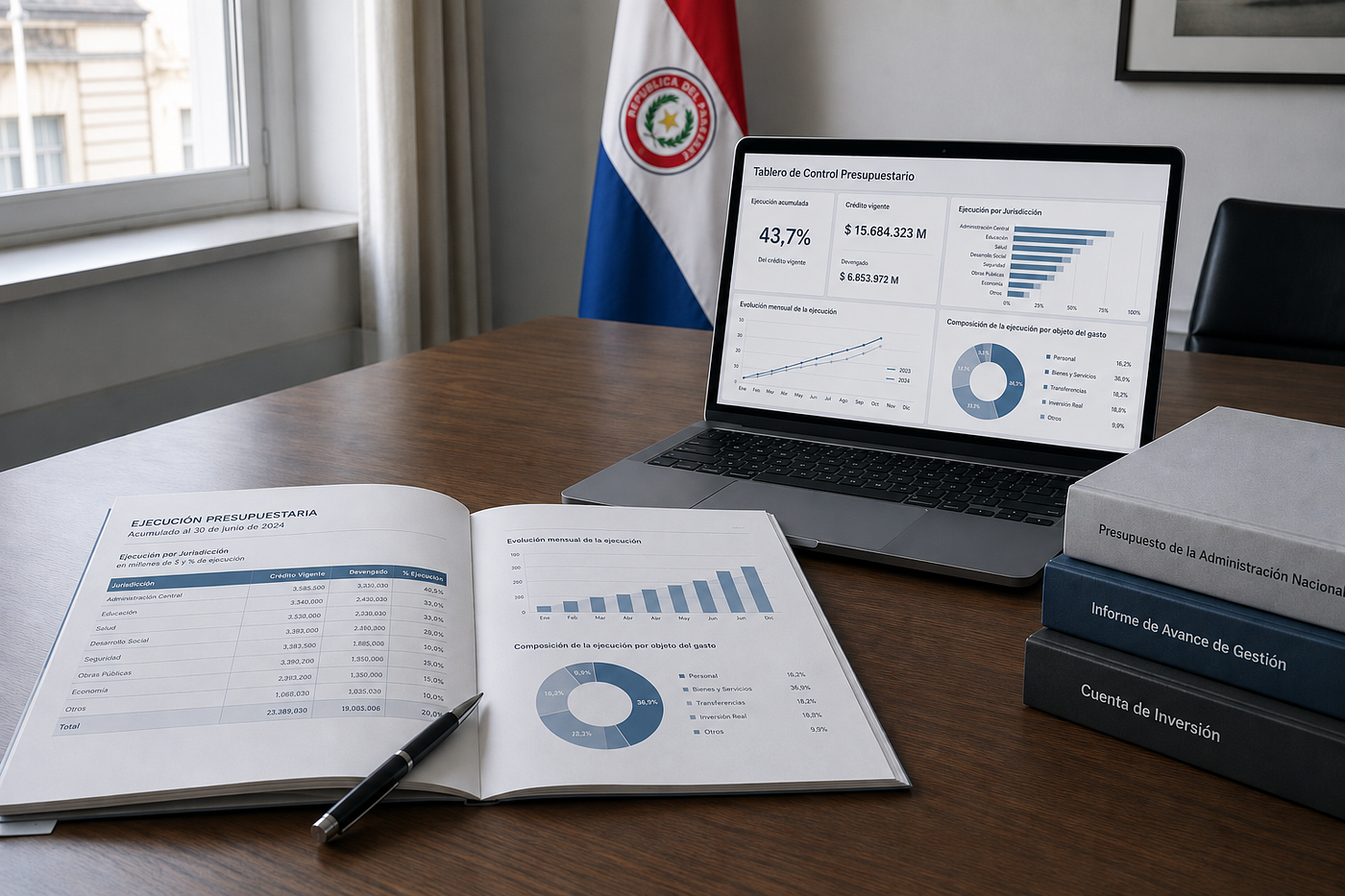
There is a phrase in Paraguay’s Law N° 1535/1999 that often goes unnoticed. Article 1°, subsection b), establishes as an objective of the State Financial Administration to “develop systems that generate timely and reliable information on public sector operations.” It is not a statement of principles. It is a design obligation.
What that phrase implies is that public information is not a byproduct of management. It is an input for decision-making. And that distinction, in institutional practice, changes everything.
When Information Fails Before It Arrives
Budget execution continuously generates data. Every stage of the process — from budget commitment to expenditure recognition and payment — leaves a record in the system. In theory, that should translate into information available to those who manage public institutions.
In practice, the gap between data and decision takes several forms:
- information exists but arrives late, after the decision has already been made
- information exists but lacks the structure needed for interpretation
- information exists but circulates among technical units and never reaches those with authority to act
- information does not exist because the record was not properly created at the right moment
Each of those forms is a design failure. Not of the officials. Of the system that processes and distributes information.
Data Is Not Information
A piece of data is a record: an amount, a date, a budget line code. Information is that data placed in context, related to other data, with a structure that allows interpretation.
Financial administration systems continuously produce data. Paraguay’s Integrated Financial Administration System (SIAF) records transactions. The SICO generates accounting entries. The SIPP links execution to the budget structure. But a system can be technically integrated and still not produce useful information for decision-making, if the data lacks the right presentation, timing, or recipient.
Law 1535 does not demand data. It demands timely and reliable information. The distinction matters.
Timeliness and Reliability as System Conditions
The two attributes the law requires have different implications.
Timeliness means information arrives when it can still influence a decision. Once a decision is made, the information that would have supported it ceases to be useful as an input: it may still serve accountability purposes, but not institutional management. Designing information systems means deciding not only what is recorded, but when and how frequently it is consolidated and distributed.
Reliability means the information reflects what actually happened, without omissions or incorrect records. This is where traceability enters: the ability to verify the path of each operation, from the triggering event to the accounting entry, without interruption. A system with low traceability produces information that cannot be audited with certainty, which reduces its value as a decision-making input.
When timeliness fails, decision-makers act on outdated information. When reliability fails, they act on a basis that does not reflect reality. Both situations produce lower-quality decisions, regardless of the technical competence of those deciding.
What the Public Access to Information Law Adds
Law N° 5282/2014 on Free Citizen Access to Public Information establishes in its Article 8° the minimum information that institutions must keep permanently available: a description of how the institution functions and its decision-making process, programs in execution with goals and applied budget, audit reports, among others.
This law governs information outward — toward citizens. But there is an underlying reading worth making: if an institution lacks internal clarity about how its decision-making process works, it will struggle to meet its transparency mandate. Internal information and public information are not separate systems. They draw from the same source.
The Design No One Documents
Behind every public decision lies an information path that no one explicitly maps. Who generates the data, at what moment, at what level of aggregation, through which channels, with what priority criteria. That path is not in the law. It is in the system design.
When that design works, information arrives on time, with the right structure, to the right actor. When it does not, the technical system may operate without interruption and still produce decisions that lack the informational foundation they should have.
State Financial Administration is not merely a set of accounting records and budget execution. It is also a system for producing information that supports institutional leadership. That is the deeper meaning of Article 1°, subsection b) of Law 1535.
The Moment When a Decision Can No Longer Wait
There are situations in public management where information arrives exactly when it can no longer change anything. Not because the system failed technically — all records are correct, all modules are running. The problem is that no one designed the information flow with an eye toward when the most consequential decisions are actually made.
That is what separates a recording system from a management system. The first accumulates data. The second transforms it into inputs for decision-making. Law 1535 aspires to the second. In practice, many institutions operate as the first.
Rubén Ayala writes on State Financial Administration, budget execution, and internal control in Paraguay. He publishes at rubenayala.com.py.
메타데이터
- post_id
- cf99f3ff1fc1
- slug
- the-role-of-information-in-public-decision-making-cf99f3ff1fc1
- url
- https://medium.com/@rubenayala.ai/the-role-of-information-in-public-decision-making-cf99f3ff1fc1
- canonical_url
- https://medium.com/@rubenayala.ai/the-role-of-information-in-public-decision-making-cf99f3ff1fc1
- author_url
- https://medium.com/@rubenayala.ai
- status
- ok
- fetched_at
- 2026-06-23 19:41:31