Focal Point Data Modelling
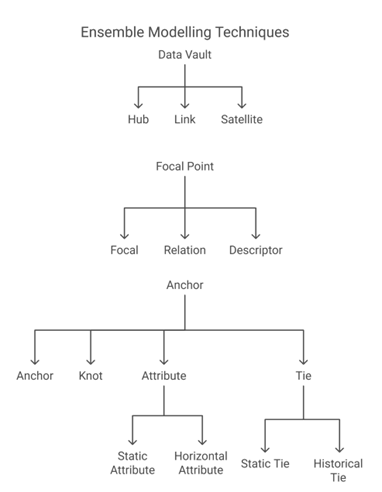
Just like Data Vault, Focal Point Data Modelling also belongs to the family of Ensemble Data Modelling.
Focal Point Data Modelling
Just like Data Vault, Focal Point Data Modelling also belongs to the family of Ensemble Data Modelling.

The modelling process in the Focal methodology is organized into five distinct stages, referred to as the Focal Forms:
· Focal Form One — Identify and define the primary business concept entities.
· Focal Form Two — Identify and define the natural business relationships between the core business concepts.
· Focal Form Three — Identify the attributes of the core business concepts, focusing on capturing terms or attributes that are categorized as descriptive characteristics of the business concepts.
· Focal Form Four — Group the attributes into Descriptor Concepts. This step is unique to Focal, as it emphasizes good definition practices. The task is to categorize attributes into one of 10 predefined Descriptor Concepts, each with a specific definition. For example, one such descriptor concept is Condition, which is a qualifying attribute related to a Focal. A Condition serves two main purposes: (1) it imposes constraints or modifications on the Entity’s characteristics or behaviour, and (2) it specifies requirements that must be met by the Entity. These Conditions are often established through agreements between relevant parties regarding specific Focal members. In practice, Conditions take the form of concrete parameters that influence business relationships or transactions. For instance, in a Contract Focal, the start date acts as a temporal Condition; in a Loan Focal, the interest rate represents a financial Condition; and in an Order Focal, the payment date serves as a temporal Condition that needs to be met.
· Focal Form Five — Atomic Context. Determine which attributes group together at the most granular level, answering a specific atomic question. This step is crucial for physical implementation, as it helps identify attribute sets that consist of a small number (usually no more than five) of related attributes.

The Focal implementation pattern.

Physical Descriptor Table Pattern

Instantiation of the Table Pattern as a Focal Customer Descriptor Table

The Focal implementation pattern follows a Physical Descriptor Table Pattern, which is instantiated as specific tables, such as a Focal Customer Descriptor Table.
Once the physical data model is implemented in Focal Point Modelling, it typically remains stable, with minimal changes thereafter unlike in Data Vault, where the physical model tends to evolve more frequently.
메타데이터
- post_id
- cf9a36cd795c
- slug
- focal-point-data-modelling-cf9a36cd795c
- url
- https://medium.com/i-am-datapedia/focal-point-data-modelling-cf9a36cd795c
- canonical_url
- https://medium.com/i-am-datapedia/focal-point-data-modelling-cf9a36cd795c
- author_url
- https://medium.com/@mustafaisonline
- status
- ok
- fetched_at
- 2026-06-12 18:14:10