This Looks Like a Multiplication Problem. It Isn’t
Can you find the remainder without multiplying or using a calculator?🧮
This Looks Like a Multiplication Problem. It Isn’t
Can you find the remainder without multiplying or using a calculator?🧮
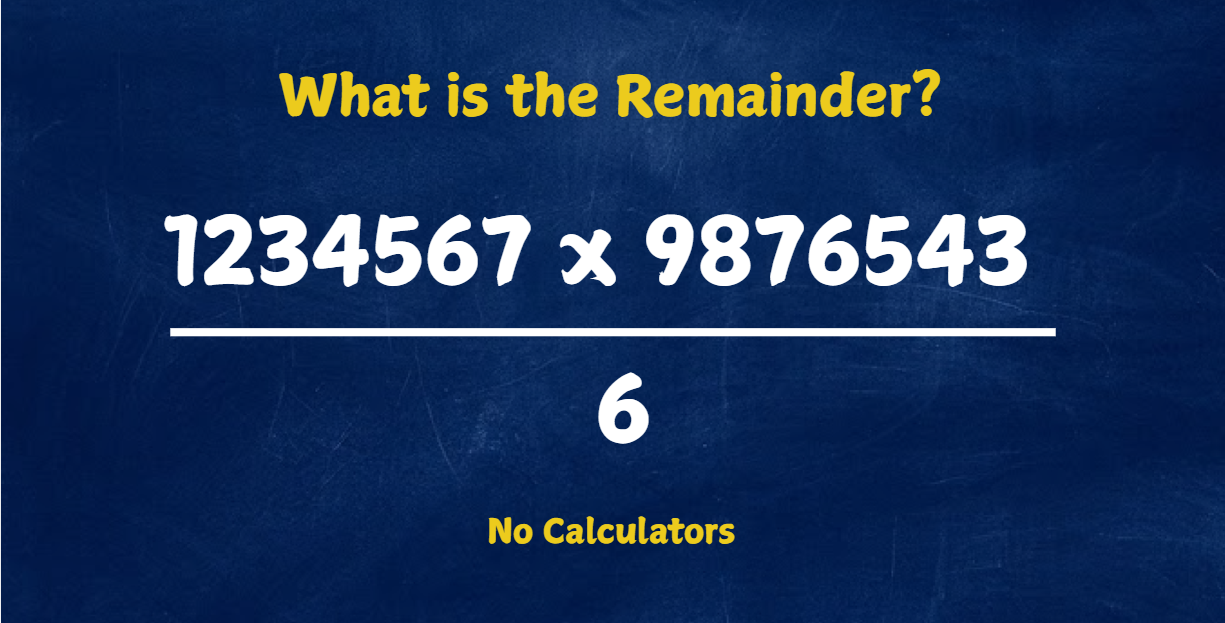
Image by the Author
A calculator would solve this problem in less than a second.
But imagine you’re sitting in an interview or a mathematics competition where two rules apply:
- No calculator.
- No multiplication.
How would you find the remainder?
Your first instinct would probably be to multiply the two numbers. Unfortunately, that option is off the table.
So, instead of computing the product, what deductions can we make about this problem?
The first clue is hidden in the number 6, the divisor.
This is a Euclidean division, so the remainder must be strictly less than the divisor. Therefore, there are only six possible remainders: 0, 1, 2, 3, 4, and 5.
This leaves us with a natural question:
What properties of the divisor can help us eliminate these possibilities?
Apart from being the smallest perfect number, every multiple of 6 satisfies two simple conditions:
- The number must be even.
- The sum of its digits must be divisible by 3.

Image by the Author
Let’s begin with the first condition.
An odd number can never be divisible by 6 because every multiple of 6 is even. Consequently, when an odd number is divided by 6, its remainder cannot be 0, 2, or 4. The only remaining possibilities are:
1, 3, 5
Now let’s examine our expression.
Both operands are odd numbers, and the product of two odd numbers is always odd.
Every odd number can be written in the form (2m + 1), where m is an integer. Therefore, (2x + 1)(2y + 1)= 4xy + 2x + 2y + 1 = 2(2xy + x + y) + 1. Since the product can be expressed as (2k + 1) for some integer k, it is always odd.
This immediately tells us that the product cannot be divisible by 6, because every multiple of 6 is even. Consequently, when we divide the product by 6, the remainder must be one of the odd values: 1, 3, or 5.
We’ve already eliminated half of the possible remainders.
Now we need a way to eliminate the remaining two.

Earlier, we established that the product is odd. From the perspective of modular arithmetic, this means the product leaves a remainder of 1 when divided by 2. In other words, we have already determined its behaviour modulo 2.
Now we need the missing piece: its behaviour modulo 3.
This is exactly where modular arithmetic becomes useful. Since 6 = 2 x 3, knowing how a number behaves modulo 2 and modulo 3 is enough to determine its remainder modulo 6. (This idea is a consequence of the Chinese Remainder Theorem)
So instead of attacking the product directly, we simply investigate whether it is divisible by 3.
Fortunately, divisibility by 3 is easy to test.
A number is divisible by 3 if the sum of its digits is divisible by 3. But we don’t have a single value to use; we have two numbers.
But from the Property of Divisibility of a Product;
The divisibility property of a product states that if a number a divides each of two numbers b and c, it also divides their product bc.
So if one factor of a product is divisible by 3, then the product itself must also be divisible by 3.
With this rule in mind, let’s see if any of the operands in the numerator is divisible by 3.
For 1234567:

Since 28 leaves a remainder of 1 when divided by 3, 1234567 is not divisible by 3.
For 9876543:

Since 42 is divisible by 3, 9876543 is divisible by 3.
Since one factor of a product is divisible by 3, the entire product is also divisible by 3.
Therefore, 1234567 x 9876543 is divisible by 3.
We can now combine everything we’ve discovered.
From parity, we know the product is odd, so the remainder upon division by 6 must be one of (1,3,5), and from divisibility by 3, we know the product must also leave a remainder that is divisible by 3.
Among the three remaining candidates, only one satisfies both conditions:
3
Therefore,

The Remainder of the operation (1234567 X 9876543) is 3
The surprising part of this problem isn’t the answer.
It’s that we never needed the product in the first place.
By focusing on the properties that survive multiplication instead of the multiplication itself, a seemingly impossible calculation became a straightforward exercise in logical elimination.
That’s one of the most beautiful lessons in mathematics:
The smartest solution isn’t always the one that does the most work. It’s the one that knows what work can be avoided.
Thank you for reading! If you like this article, please give a few claps, follow me, and don’t forget to subscribe to stay updated with my latest articles.
메타데이터
- post_id
- cfa535d43d02
- slug
- this-looks-like-a-multiplication-problem-it-isnt-cfa535d43d02
- url
- https://medium.com/think-art/this-looks-like-a-multiplication-problem-it-isnt-cfa535d43d02
- canonical_url
- https://medium.com/think-art/this-looks-like-a-multiplication-problem-it-isnt-cfa535d43d02
- author_url
- https://medium.com/@baseyjonn
- status
- ok
- fetched_at
- 2026-07-09 05:53:33