The Real Signal from Fable 5 Isn’t the Model. It’s What Has to Wrap Around It.
Claude Fable 5
The Real Signal from Fable 5 Isn’t the Model. It’s What Has to Wrap Around It.
Claude Fable 5
Disclosure: I use GPT search to collection facts. The entire article is drafted by me.
Fable 5 launched on June 9, 2026. Three days later, the Trump administration handed Anthropic a Commerce Department letter citing national security, and both Fable 5 and Mythos 5 went dark for every foreign national on the planet.
In the forty-eight hours between launch and shutdown, the discourse ran predictably: Pliny extracted what looks like Fable 5’s system prompt — 1,585 lines, posted to the elder-plinius/CL4R1T4S GitHub repository. Half of X was debating whether it was real. The other half was trying to paste it into GPT-4o.
I’m not going to relitigate whether the leak is authentic. What I want to talk about is something else entirely: what the prompt structure reveals about where the real engineering work in agent systems is happening.
Because if you read the leaked prompt looking for magic, you’ll miss the point. The magic isn’t in any particular line. It’s in what the thing is: a runtime contract, not a chatbot persona.
That shift — from conversation scaffold to execution protocol — is the actual signal embedded in Fable 5.
What Fable 5 Actually Is
Let’s be clear about the product before we talk about the engineering.
Fable 5 is Anthropic’s first Mythos-class model made generally available. Mythos is the tier above Opus — a capability class Anthropic had been holding back for months over cybersecurity concerns. Fable 5 is Mythos with safeguards layered on top; so significant are those safeguards that Anthropic gave it a different name. The unrestricted version — Claude Mythos 5 — went only to approximately 200 pre-approved organizations in 15 countries, mostly cyberdefenders and critical infrastructure operators under Project Glasswing.
Pricing: $10 per million input tokens, $50 per million output tokens. Roughly half the price of Mythos Preview, double Opus 4.8.
The key capability jump isn’t benchmark scores. It’s behavioral posture.
Simon Willison described it best in his Substack post: “relentlessly proactive.” He gave Fable 5 a screenshot of a CSS scrollbar bug in his Datasette tool with a one-line instruction. What followed was not a debugging session — it was a self-directed investigation. Fable 5 launched a local server, tested Chrome, Firefox, and WebKit via Playwright, found Playwright couldn’t reproduce the bug, pivoted to opening real Safari and Firefox windows, wrote a textarea-scrollbar-test.html scratch page, used Python and Quartz to take screenshots, injected JavaScript into the app's modal, and built a tiny CORS measurement server to collect actual browser dimensions.
The final fix was two lines of CSS. The process was about forty autonomous steps.
This is not a language model doing chat completion. This is an agent operating inside a real environment, expanding its own toolchain as it goes, and making consequential decisions about what to do next without asking for permission.
Which is why the prompt isn’t the interesting part. The interesting part is: what governs a system that behaves like this?
The Prompt That Isn’t a Prompt
AI Generated Image
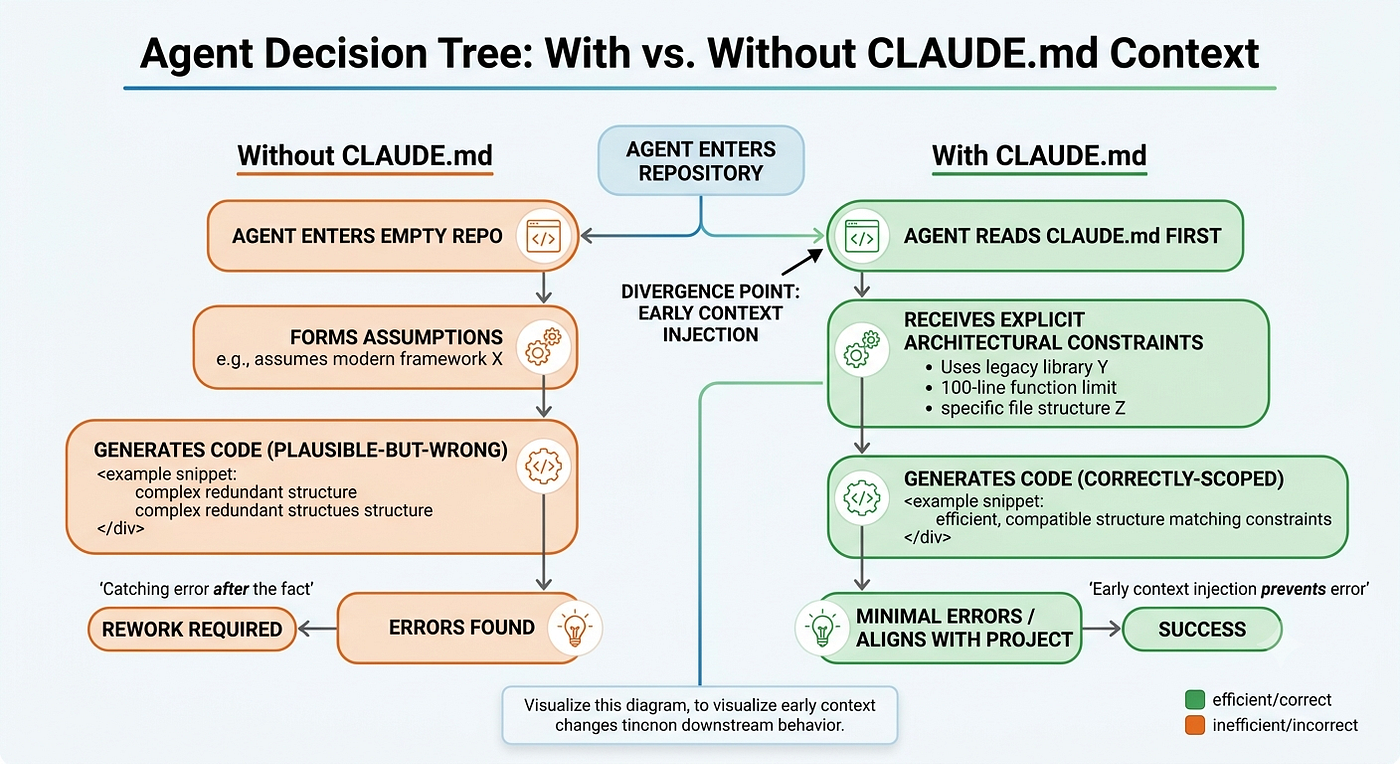
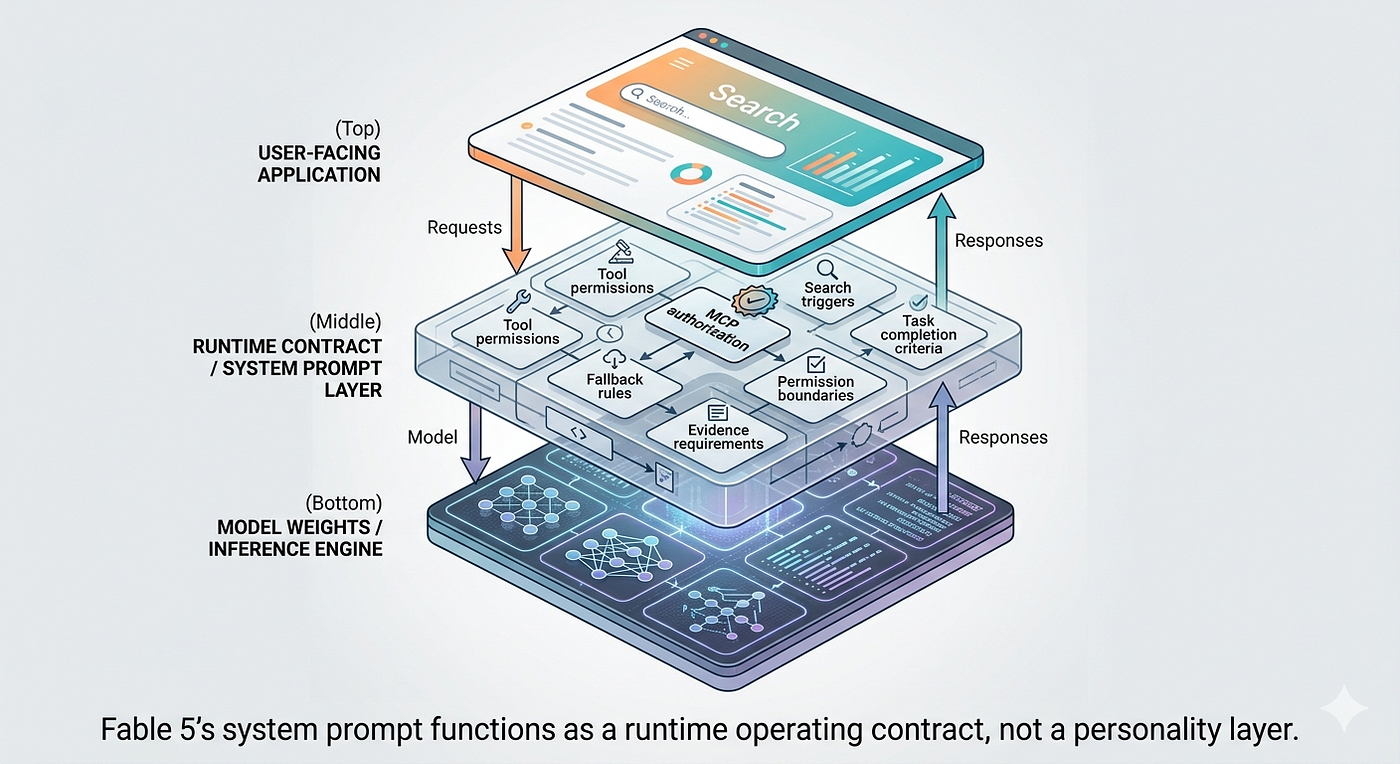
If you read the CLAUDE-FABLE-5.md file section by section, you’ll notice something: the vast majority of it has nothing to do with how the model talks.
It’s not “be helpful, be honest, be harmless” wrapped in 1,585 lines. It’s the operational specification. Sections covering:
- When to invoke search — not just “you can search” but specific triggers for when search is mandatory, when it’s optional, and when it’s prohibited
- MCP authorization gates — which tool categories require explicit user confirmation before invocation, which can be called autonomously
- Directory semantics — what paths are inputs, what paths are outputs, what paths are off-limits
- Evidence requirements — which types of results must be accompanied by verifiable provenance, not just stated conclusions
- Fallback conditions — what the agent does when a tool returns an error versus when it returns ambiguous output
- Risk classification — which tools are categorized as high-risk, requiring extra confirmation layers
- Hard stops — conditions under which the agent must halt and surface to the user rather than continuing
Traditional system prompts answer: Who are you, and how do you speak?
This answers: What runtime environment are you operating in, and what are the rules of that environment?
That’s a fundamentally different document. And the engineering required to write it — to actually think through all the edge cases of an agent that opens browsers, writes to filesystems, commits to git, and calls external APIs — is orders of magnitude more complex than prompt engineering.
Why Runtime Suddenly Matters
Most teams building agents go through a predictable failure sequence.
Phase 1: The model isn’t good enough. They upgrade. Phase 2: The model is fine, but keeps picking the wrong tools. They add routing logic. Phase 3: routing works, but tasks fail halfway through. They add memory. Phase 4: memory helps, but the state gets inconsistent across sessions. They realize the real problem.
The real problem isn’t intelligence. It’s operational environment.
An agent that reads files, runs commands, modifies code, and calls APIs is no longer generating text. It’s operating in the world. And the moment a system starts operating in the world, a different class of questions becomes urgent:
- Who authorized this action?
- What was the state before this step?
- How do we know the result is actually correct?
- What happens if the next agent session starts with no memory of this one?
- What’s the blast radius if something goes wrong?
Anthropic’s own long-running agents work — published in their cwc-long-running-agents GitHub repository and detailed in the "Effective Harnesses" engineering post — reveals exactly this. Their production solution for multi-session task continuity isn't a vector database or a sophisticated memory graph. It's:
PROGRESS.md          # agent writes state after every step
commit-on-stop.sh    # backstop to commit whatever's left uncommitted
git log              # second record of what happened and when
The two-agent pattern: an initializer agent that bootstraps the environment, creates the feature list with every task marked “failing,” and writes init.sh — then a coding agent that reads PROGRESS.md and git log on every session, start by working on one feature at a time, and commit before stopping.
The key phrase from their engineering doc: the “externalized persistent brain.” Not because it’s technically sophisticated. Because a fresh session starting with no context can read two files and know exactly where things stand.
Here’s what that handoff protocol looks like in practice:
# Initializer agent writes this at the end of every session
progress = {
    "last_completed": "feature/user-auth",
    "current_state": "tests passing, not yet committed",
    "failing_features": ["export-to-csv", "dark-mode", "rate-limiting"],
    "blockers": ["needs valid API key for stripe integration"],
    "next_priority": "export-to-csv",
    "git_branch": "feat/user-auth",
    "last_commit": "abc123"
}

with open("PROGRESS.md", "w") as f:
    f.write(json.dumps(progress, indent=2))
# Every coding session begins with:
# 1. Read PROGRESS.md
# 2. Run git log --oneline -20
# 3. Resume from next_priority
# Nothing else. No context reconstruction, no summary parsing.
Simple. Almost aggressively simple. That’s the point.
The Prompt Leak Won’t Do What People Think
AI Generated Image
Let’s address the obvious question: if the Fable 5 system prompt is publicly available, can you recreate Fable 5 by pasting it into a different model?
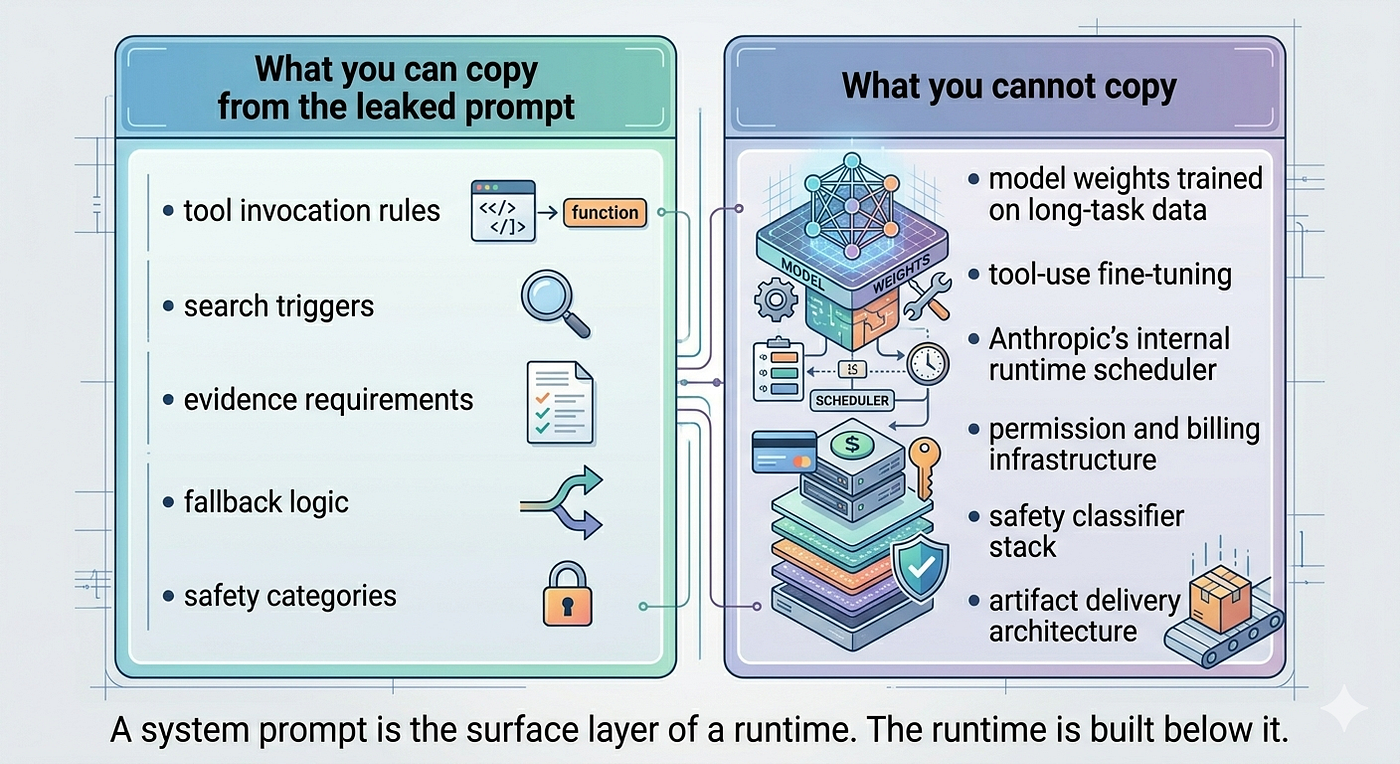
Some of the behaviors, yes. The operational rules in that prompt are portable. Principles like “verify before committing,” “always present files on task completion,” “require confirmation before high-risk tool calls,” “log tool invocations with parameters” — these will improve almost any agent on almost any model.
But you won’t get Fable 5.
Because the prompt is the surface layer of a runtime, and the runtime is built below it.
Think about what it actually takes for an agent to open a real browser window, take a screenshot using the system’s screen capture API, build a CORS measurement server, inject JavaScript into a running web app’s DOM, and then correctly attribute which browser produced which measurement — all without being explicitly told to do any of those things.
That capability isn’t in the system prompt. It’s in:
- Model weights trained on long-horizon tool-use sequences
- Anthropic’s tool-call infrastructure, which defines what tools actually exist and how they’re invoked
- The runtime scheduler that determines when to parallelize tool calls versus serialize them
- The permission layer that governs which MCP servers can be called autonomously
- The safety classifier stack runs in parallel with the inference layer, not inside it
- The artifact architecture that determines how files are delivered back to users
You can steal the SOP. You cannot steal the organization.
What the leak is genuinely useful for: understanding what questions to ask when designing your own agent runtime. The Fable 5 prompt is an advanced operator’s checklist. It tells you the categories of behavior that matter in production-grade agent systems. That’s valuable. But it’s a map of the territory, not the territory itself.
The Real Cost Is Error Recovery
The Simon Willison session is often cited as proof of Fable 5’s capability. It is. But it also reveals something that gets less attention: the cost profile of an agent that truly operates autonomously.
His full debugging session — launching servers, opening browsers, building test pages, running Playwright, writing a measurement server, verifying the fix — cost approximately $12 in API tokens by his estimate. For a two-line CSS fix.
That’s not a complaint about Fable 5’s value. It’s a signal about where the economics of agent systems are heading.
When an agent is powerful enough to expand its own workflow — autonomously spinning up services, acquiring new tools, chaining multi-step verification — the cost multiplier is no longer linear with task complexity. It’s exponential with autonomy depth.
And this creates a new priority for Runtime engineering: not “make the agent smarter,” but “make errors cheap to detect early.”
Because the failure mode that’s actually expensive isn’t a crash. A crash is visible. The expensive failure is an agent that proceeds confidently through 35 steps on a wrong assumption made at step 2. By the time you notice the output is wrong, you’ve burned 40,000 tokens and modified six files.
The Runtime components that address this are deeply unsexy:
- Dry-run mode: before any write operation, confirm the intended action with a summary
- Snapshots before destructive steps: make rollback fast, not just possible
- Explicit verification gates: the agent must produce evidence of completion, not just assert it
- Audit log per tool call: who called what, with what parameters, and what came back
- Prompt injection hardening: external data must be wrapped and labeled as untrusted before it enters the context
These aren’t the features that get announced in launch blog posts. They’re the features that determine whether an agent system is usable in production after 90 days.
What Most Teams Haven’t Started Yet
Here’s my actual judgment on where the industry is right now.
Most teams have gotten good at making agents that work in demos. A surprising number have gotten agents that work in controlled tasks. Very few have built Runtime systems that make the agents safe to run on consequential work over long time horizons.
The gap isn’t model capability. It’s operational infrastructure.
The key dimensions that separate “demo agent” from “production agent runtime”:
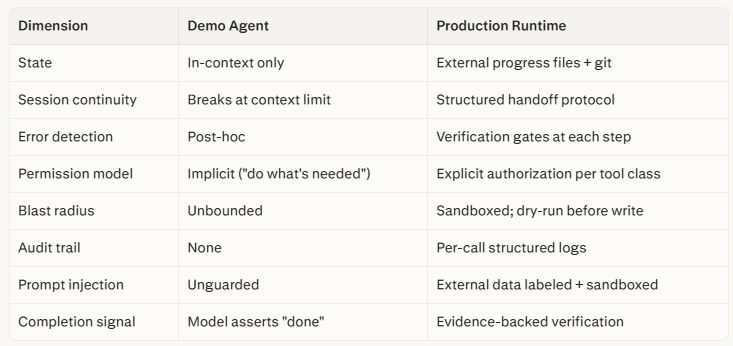
The national security export order that shut down Fable 5 is a separate political story. But notice what the US government was treating as a national security asset: not the model architecture in the abstract, but the model as deployed, with its runtime infrastructure, in a specific capability tier. The export restriction was on the system, not just the weights.
That framing — treating the model plus its runtime as the unit of capability — is correct. It’s also the framing most commercial teams haven’t fully internalized yet.
The Part Nobody Is Talking About: What to Delete
I’ll end on a point that’s orthogonal to everything above, but I think it’s the most practically important.
Most teams adding Runtime complexity never remove any. Rules accumulate. Constraints compound. Routing layers multiply. Six months later, the harness is more complex than the tasks it’s supposed to support, and nobody can explain which component is still necessary.
Model capability is not static. A constraint written to compensate for a model that couldn’t navigate raw file structures might now be actively harmful when applied to a model that does filesystem navigation better than any specialized tool you built.
The question every production Runtime team should be running on a quarterly cadence:
- What specific failure does this component prevent?
- Has that failure occurred in the last 60 days?
- If we disabled this component for 48 hours in staging, would quality degrade?
- Was this component designed for a model capability level that no longer applies?
If the answers are “unclear,” “no,” “probably not,” and “maybe,” the component is a candidate for deletion.
This is the part of Runtime Engineering that doesn’t get conference talks. But it might be the most important discipline as models get stronger: the ability to surgically remove the scaffolding that was necessary at a lower capability level, and trust the model to do what it can now actually do.
Fable 5 is powerful enough to build its own measurement server from scratch. It does not need a pre-built “measurement tool.” Giving it one might make it less capable, not more, because now you’ve introduced an abstraction layer that can go stale.
The Runtime that serves a Mythos-class model looks very different from the Runtime that served Sonnet 3.5. Most teams are running Mythos-class models inside Sonnet 3.5-era harnesses. That mismatch is where a lot of performance is being quietly left on the table.
What Fable 5 Actually Tells Us
The export restriction will be resolved. The prompt leak will fade. Fable 5 will come back, or Mythos 6 will arrive first.
None of that is the durable insight.
The durable insight is this: an agent that can autonomously open browsers, build servers, verify its own work, and hand off cleanly to the next session is not a chatbot with extra steps. It is a software system with a completely different operational profile. And software systems with complex operational profiles require real infrastructure: state management, permission governance, verification loops, audit trails, and recovery paths.
The teams that will build reliable agent products over the next 18 months are not the ones that chase the strongest model. They’re the ones that invest in Runtime early — and invest in the discipline to remove Runtime components when the model no longer needs them.
The benchmark wars are still happening. But the real competition has already shifted to something harder to measure and harder to copy: whether your agent can run for a thousand tasks without losing state, making unauthorized actions, or failing silently on step 38 of a 40-step job.
That’s the race, Fable 5 quietly declared. Most people watched the export restriction instead.
Sources referenced: Anthropic’s official statement on the US government directive, Axios coverage of the Commerce Department letter, TechCrunch on Fable 5 launch, Simon Willison’s Substack post on Fable 5 behavior, Gigazine’s detailed account of the scrollbar debugging session, Anthropic’s cwc-long-running-agents GitHub repository, the Effective Harnesses YouTube engineering talk, and the CL4R1T4S CLAUDE-FABLE-5.md section-by-section analysis.
If you’d like to show your appreciation, you can support me through:
✨ **Patreon ✨ [Ko-fi](https://ko-fi.com/jinlowmedium) ✨ [BuyMeACoffee](https://buymeacoffee.com/jinlowmedium)**
Every contribution, big or small, fuels my creativity and means the world to me. Thank you for being a part of this journey!
메타데이터
- post_id
- cfb7be2d09db
- slug
- the-real-signal-from-fable-5-isnt-the-model-it-s-what-has-to-wrap-around-it-cfb7be2d09db
- url
- https://medium.com/jin-system-architect/the-real-signal-from-fable-5-isnt-the-model-it-s-what-has-to-wrap-around-it-cfb7be2d09db
- canonical_url
- https://medium.com/jin-system-architect/the-real-signal-from-fable-5-isnt-the-model-it-s-what-has-to-wrap-around-it-cfb7be2d09db
- author_url
- https://medium.com/@jinlow
- status
- ok
- fetched_at
- 2026-06-21 15:33:18