Finding Presence by Crafting a Tenseless Language
What if there was no future and no past — one that existed just in the now?
Finding Presence by Crafting a Tenseless Language
What if there was no future and no past — one that existed just in the now?
That question haunted me during a time when I found myself shifting between unfinished projected and fragmented ambitions. I wasn’t burned out in the traditional sense — I had the time, the energy, the curiosity — but I was rarely present during my most creative moments.
My thoughts clung to things I should’ve said, projects I hadn’t started, futures I hadn’t mapped. Time, to me, was a burden I carried on both shoulders and my back.
I wanted to live more presently, not in the mindfulness-app sense of breathing deeply for 30 seconds, but in a more profound way: in an attempt to root my perception in what was in front of me, untethered from the compulsion to narrate forward or backward.
And then I started thinking about language.
Our words do more than describe what we see — they shape how we see. They hold our assumptions about time, agency, causality. Nearly every sentence we speak in English hinges on verbs: something is always doing, becoming, changing.
But what if a language refused that structure? What if it didn’t describe what was happening, but instead located everything as it already is — relationships, qualities, contexts, all suspended in a present that doesn’t move? Why did I need to be in the process of doing, becoming, changing, instead of observing how beautiful the world I made for myself was?
That question became the foundation for a verbless, tenseless language — one that imagines a culture not obsessed with doing, but with being; not moving forward, but circling inward. This wasn’t just a linguistic challenge. It became a way to reflect my own struggle — and desire — to experience life in the now.
Now that you know about the existential crisis that I was consumed byat the start of the semester, I can tell you about how I actually started making the language!
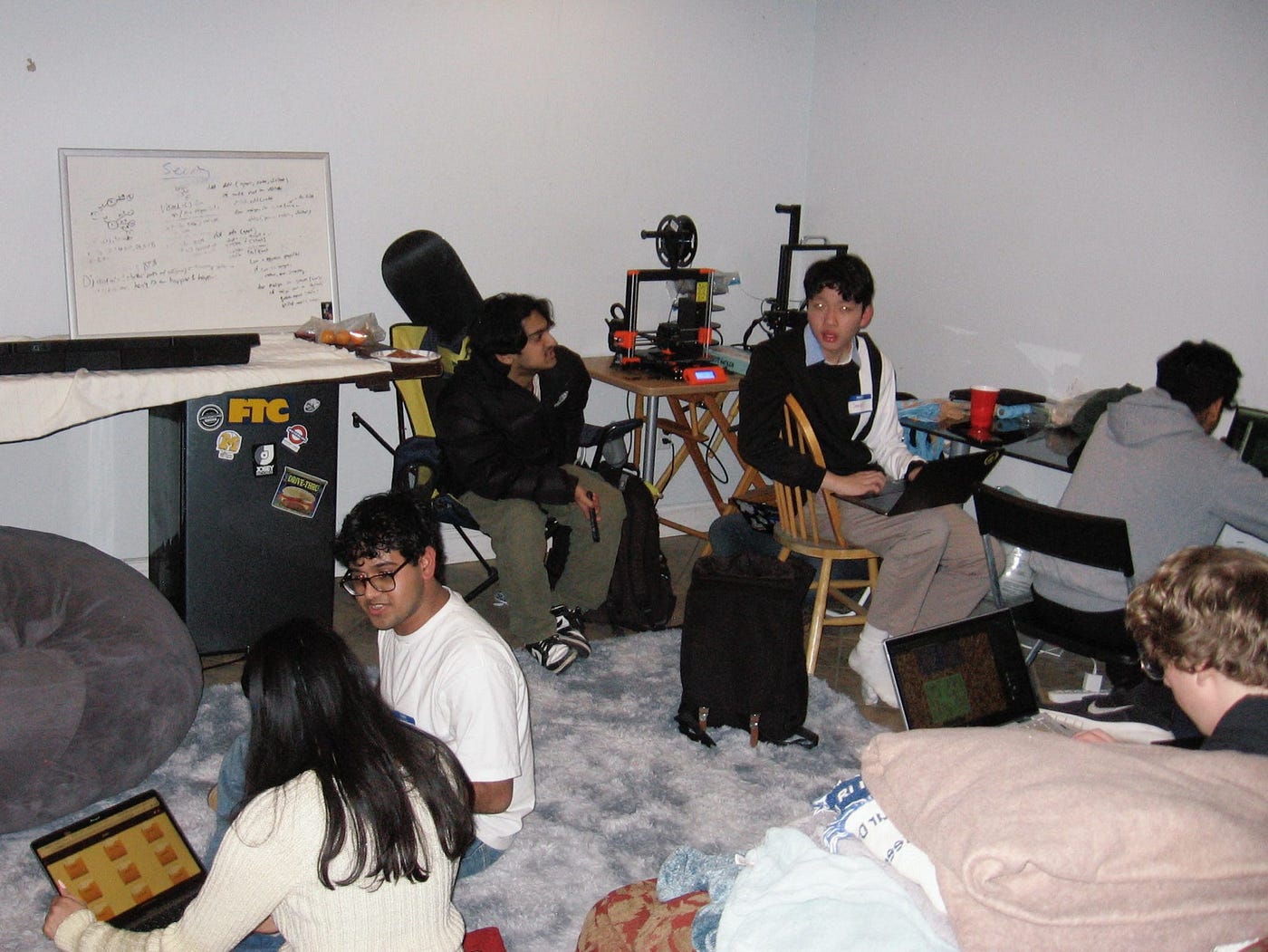
shift basement, during open house
The first real moment of ignition came at the shift open house. It was one of those environments where creativity hummed under your skin. The room was full of half-built prototypes, people showing each other their prototypes, pages torn from notebooks, sketching diagrams in the margins of each other’s ideas and people sketching each other. There was a kind of electricity in the air — not just excitement, but intention. Everyone was trying to build something they didn’t fully understand yet.
I came in with a notes page full of half-formed ideas. Some were technically ambitious, others were whimsical or strange. But one line buried near the bottom of the list caught my eye: “A language with no verbs.” I’d written it weeks ago and forgotten about it.
Reading it again in that space — with whiteboards peeking around the corner and the buzz of exciting people in the air — I felt an unexpected jolt. It wasn’t just clever. It felt honest. It felt like the thing I was supposed to do.
There was something poetic in the timing. Shift had always been a space of radical presence. It wasn’t about productivity or prestige. It was about articulating the inarticulable, capturing the weirdness of being alive together. In that moment, I realized that this language didn’t have to be theoretical — it could be real. It could be a gift to this community.
A way to share a mode of thinking and speaking that resists acceleration, resists narrative, and resists the notion that value lies in what’s next.
It felt right because I wasn’t trying to build a system — I was trying to name a feeling I hadn’t been able to express before. And what better place to start than among people doing the same? I sat down and jotted down some ideas, making an overleaf document first called ‘bullshit’ and right before I presented, renamed it to ‘cycle?’, which later ended up being the name of my language.
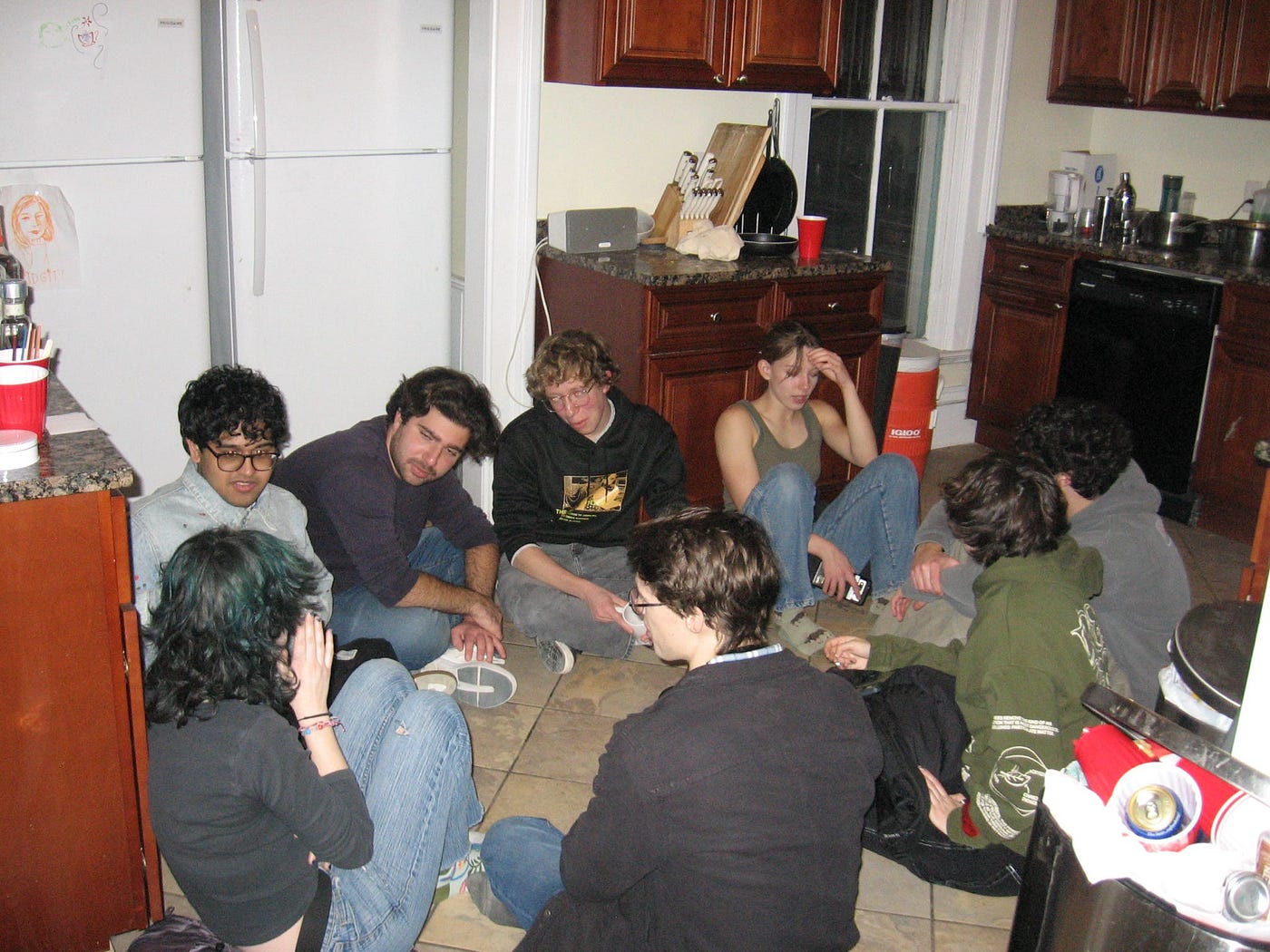
a bunch of shift members on the shift kitchen floor
After the open house, the idea didn’t just linger — it took over. And FISI, “Fuck It, Ship It,” gave it space to breathe and grow. But this wasn’t the kind of grindy, heads-down incubator you’d expect from something named that boldly.
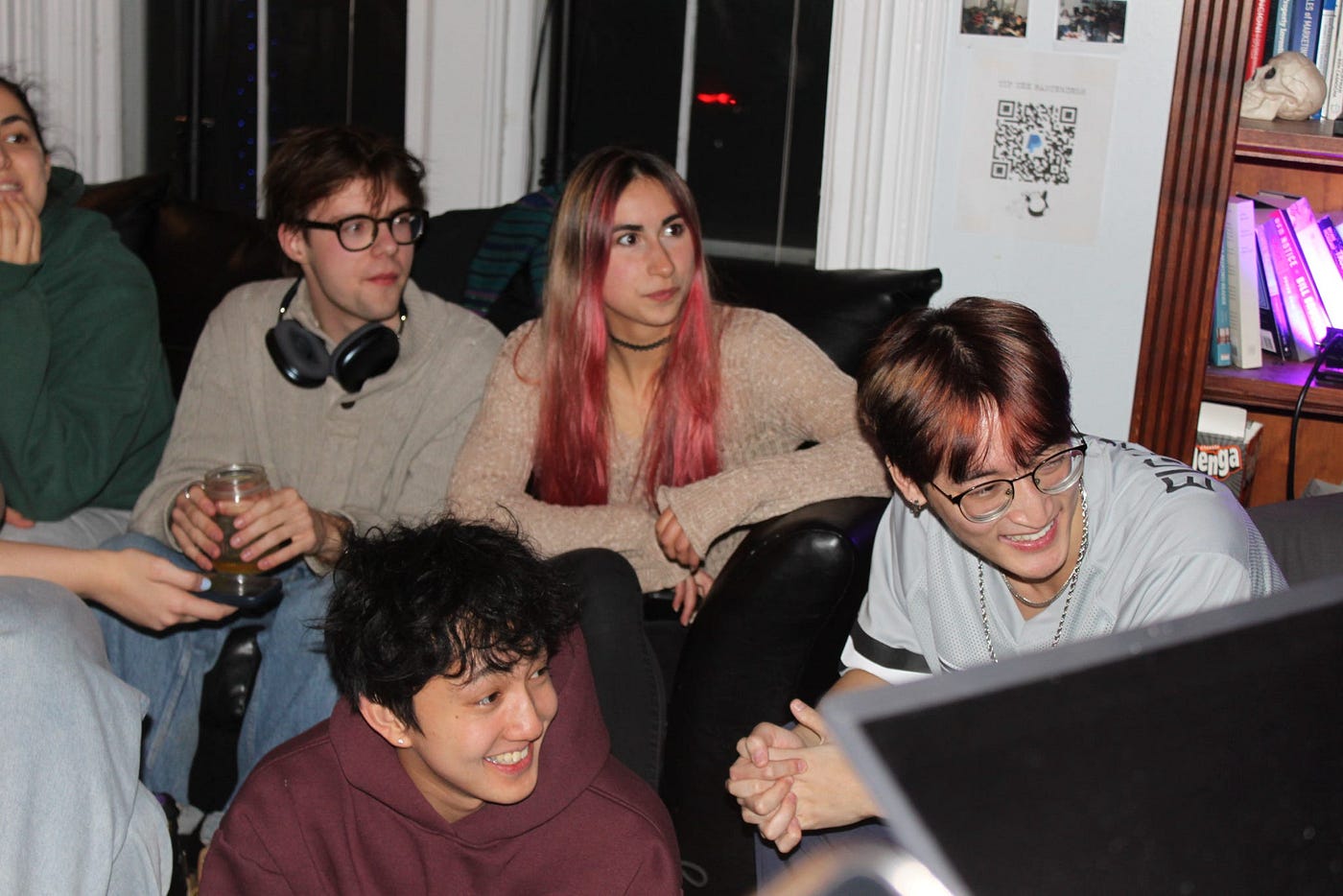
FISI felt more like a living room where creation was the default state. People sprawled across couches with laptops, gathered at long tables half-covered in snacks and sketches, or flopped on the floor mid-discussion . At any given moment, you could hear a conversation about speculative fiction, the ethics of AI, or someone loudly wondering if they should pivot their project entirely . It was chaotic, chatty, warm — like a cross between a co-working space and a sleepover.
That atmosphere, oddly enough, made it easier to go deep. There was no pressure to perform or prove anything. You could be stuck for an hour, walk into the kitchen, chat about someone else’s project over tea, and come back with your mind unlocked. I thrived in that rhythm. In the background hum of creative noise, I found the space to take my idea seriously — and technically.
The work began by stripping away everything I’d taken for granted about language.
My first goal was to identify what structure could exist without verbs. What would remain if language no longer needed to describe action, only presence? I started constructing a small vocabulary of core nouns: things like child, tree, sun, air. From there, I tested out sentence fragments built entirely from particles — a set of relational markers that could act in place of verbs.
Instead of “The bird flies above the forest,” I wrote: “Bird above forest.” Or, “In air, bird above forest.” The point wasn’t to imply motion. It was to describe location, state, and orientation without invoking time. It was about where things are, how they are, not what they’re doing.
The next layer came with modifiers. These words would convey texture, intensity, emotional tone — traits we often rely on verbs to carry. Take “The sun shines warmly.” That became “Sun bright with warmth.” Or “Air cold in night.” These were phrases that anchored description in the present, rather than implying change or progression. It started to feel like building a vocabulary of stillness.
One of the strangest and most exciting moments was realizing how compound nouns could take on the work of complex actions. “Fire-preparation” became a stand-in for “cooking,” but it didn’t describe the act — it located it. “Meal with fire-preparation” wasn’t about someone cooking — it simply meant the meal had that attribute, that context. I was no longer describing agency. I was cataloging relationships.
These linguistic moves — particles, modifiers, compound nouns — weren’t just technical substitutions. They were the philosophical heart of the project. I wasn’t building a language that moved. I was building a language that saw. This was how I was able to go beyond this gimmick of language having no verbs to having a real philosophy behind why the language was constructed the way it was.
FISI gave me the momentum to get through the hard part: deciding what this language believed about the world. Watching others around me — shifting between heads-down bursts and spontaneous conversation — reminded me that presence isn’t silence. It’s awareness. And this language was becoming just that: a system that favors observation over explanation, stillness over story, being over doing.
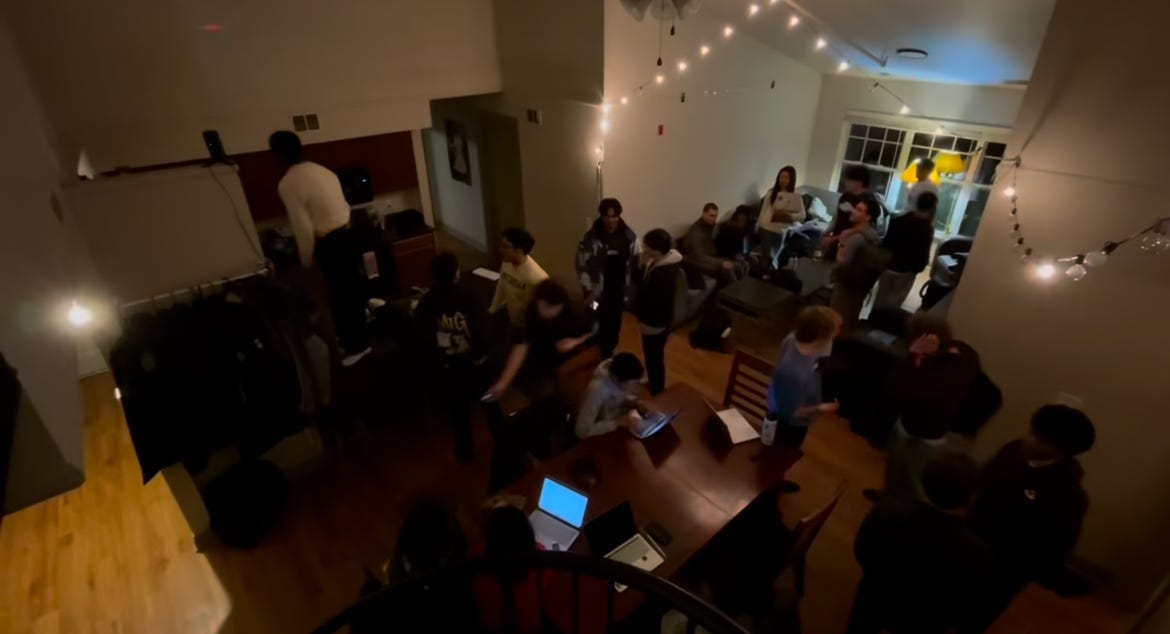
a blurry picture of the few minutes before everyone settled down for TMC
There’s something special about working when the world feels like it’s asleep. That’s what The Midnight Club offered. It wasn’t a formal event — just a bunch of us who stayed up too late, laptops open, quietly absorbed in our own worlds. They didn’t have loud music, massive chatter, just the gentle rhythm of keys tapping and water being poured into mugs. The energy wasn’t intense — it was reverent.
Those late nights became some of my favorite times to work on my projects. During the day, I was often too tempted to jump between tasks, to check in on other projects, to talk and drift. But in that space, with nothing to distract me but my own thoughts, I was finally able to get into the marrow of the work.
This was the perfect setting to begin shaping the formal logic of the language — its core structure, its syntax, its boundaries. I started with the question: how do you enforce grammar without using verbs, and without falling into ambiguity or chaos? To answer that, I turned to formal language theory, grounding the project in my theoretical linguistics education to ensure internal coherence.
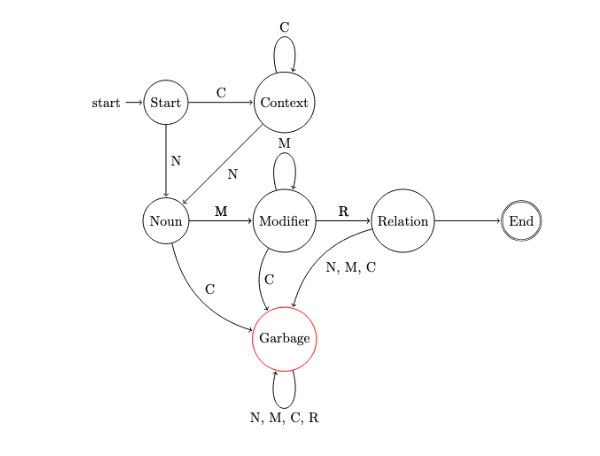
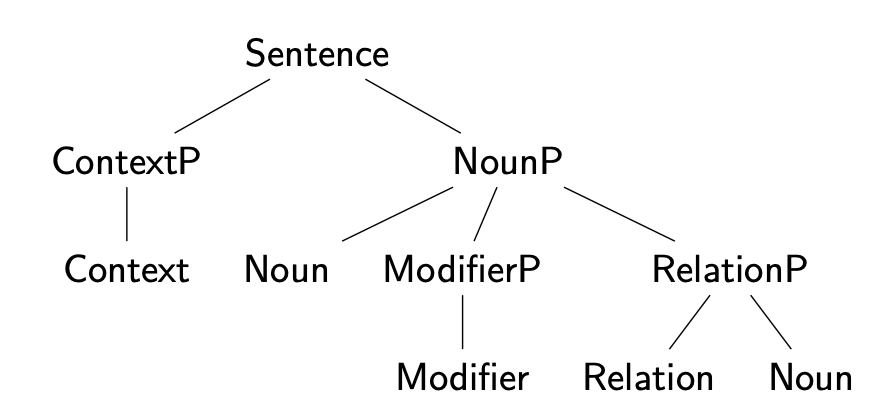
FSA on left, MG on right
The first thing I built was a finite-state automaton (FSA) — a simple, abstract machine designed to recognize whether a sentence in my language followed the valid pattern. Each state in the automaton corresponded to a syntactic role: Noun → Relation → Modifier. Optional loops allowed for nested noun phrases or stacked modifiers. For instance, “Bird song in air soft” would be accepted by the automaton — it transitioned cleanly through Noun → Noun → Relation → Noun → Modifier. But “Soft bird song in air” would be rejected; the modifier appears out of order, disrupting the expected transition.
I mapped out state diagrams by hand at first, testing permutations. Eventually, I implemented a digital version to stress-test longer and more complex phrases. I found that once this framework existed, I could begin to introduce complexity — recursive nesting, context-dependent openings (“In air, bird soft above valley”), and emphasized constructions — without losing consistency. The FSA became the silent adjudicator behind every sentence.
But I didn’t stop there. I needed more than validation — I needed generation. That’s where minimalist grammar (MG) came in. Unlike FSAs, which are excellent for verifying structure, minimalist grammars allowed me to define how phrases are built from smaller lexical units. I assigned each word or particle a set of syntactic features — [noun], [rel], [mod], etc. — and used operations like Merge and Move to generate hierarchical phrase structures.
For example, a noun phrase like “Bird extremely soft above forest” was built from base units using a strict order of operations:
-
Start with the Noun [bird]
-
Merge with ModifierP [extremely → soft]
-
Merge with RelationP [above → forest]
-
Optionally attach a ContextP [In air] at the top level
Each Merge had to satisfy the feature-checking rules, which meant not every combination was allowed. The system was surprisingly expressive despite its minimalism — just a few rules could generate an astonishing variety of valid, poetic expressions .
Working on this at midnight felt strangely aligned with the project’s core principle: presence. Every decision I made — every rule I defined — was about creating a system that described being, not doing. There was no narrative progression, no causality baked into the syntax. Just structure, context, and relation. And even though I was building a new world, every part of it had to make sense — not just to me, but to the machine inside it.
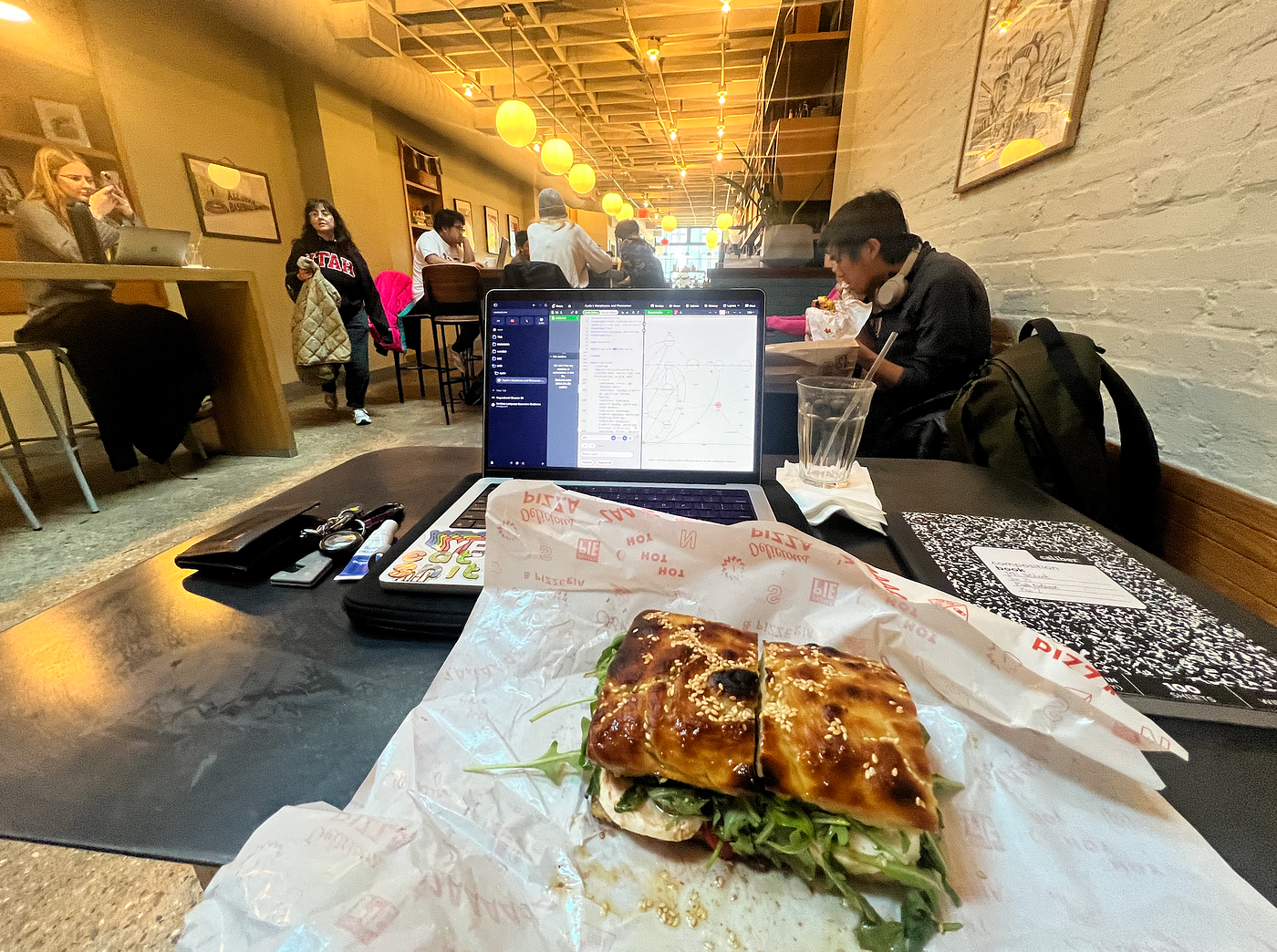
doubles, the cafe I worked at during spring break in DC
After the intensity of FISI and the late-night momentum of The Midnight Club, I found myself in a radically different space — physically and mentally. I spent the semester break living with my brother in DC.
The pace of life shifted. The noise quieted. The community dissolved into the background. In its place was stillness: long walks, solo café afternoons, quiet evenings. It was a different kind of time. Not collaborative, not chaotic — just spacious. And it turned out to be exactly what I needed.
Without the constant input of peers and project energy, I was finally able to sit with the philosophical core of the language. Up until then, most of my focus had been structural — syntax, form, logic.
But now I asked myself: What does this language actually mean to its speakers?What kind of culture produces a way of speaking with no verbs? What does it say about how they understand the world, themselves, and each other?
That question led me to sketch the contours of a fictional society. One that didn’t experience time as progression but as position — cyclical, recursive, and observational. In this world, events didn’t happen. They were located. Emotions didn’t pass through people. They emerged within them, shaped by context, not by cause. There was no before or after. Only arrangement. Only relation.
With that vision in mind, I returned to the technical side — but now with sharper intention.
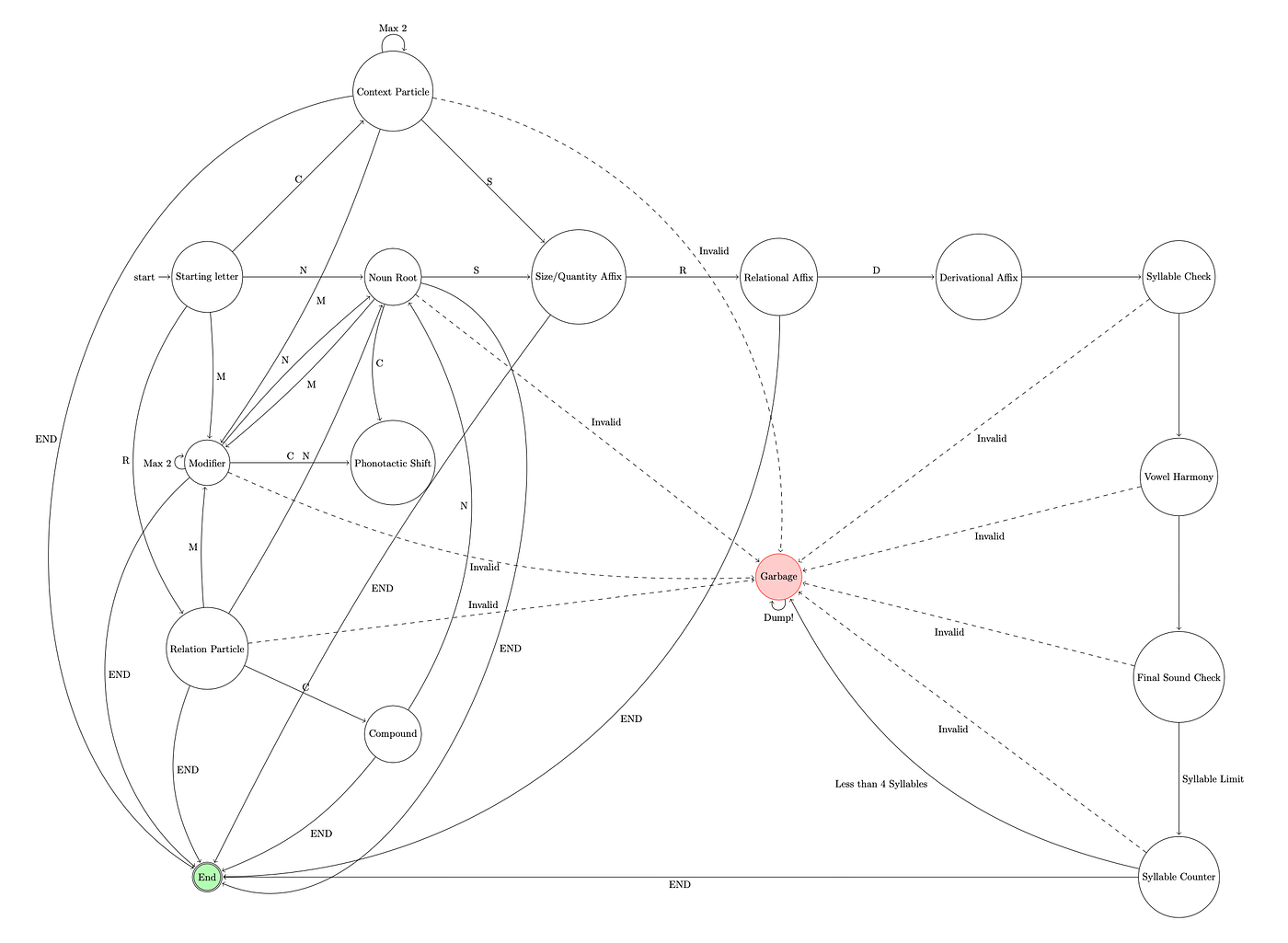
my morpheme structure FSA!
I built a full finite-state automaton (FSA) to govern how morphemes could combine to create valid words. Unlike the syntactic-level FSA that managed sentence structure, this automaton worked at the phonological and morphological level. It handled everything: from the initial consonant or vowel, through noun roots, context particles, modifiers, compounds, and a host of affixes — size, relational, derivational — before finally validating each word against a set of strict phonotactic rules.
The system was unforgiving. A word that didn’t pass through all transitions cleanly — if it skipped a required modifier, exceeded syllable limits, violated vowel harmony, or landed in the wrong morphological sequence — was dumped into a special “Garbage” state, a visual and functional endpoint that made errors explicit. It was brutal, but necessary. The FSA didn’t just produce words — it enforced linguistic integrity. It kept the language honest.
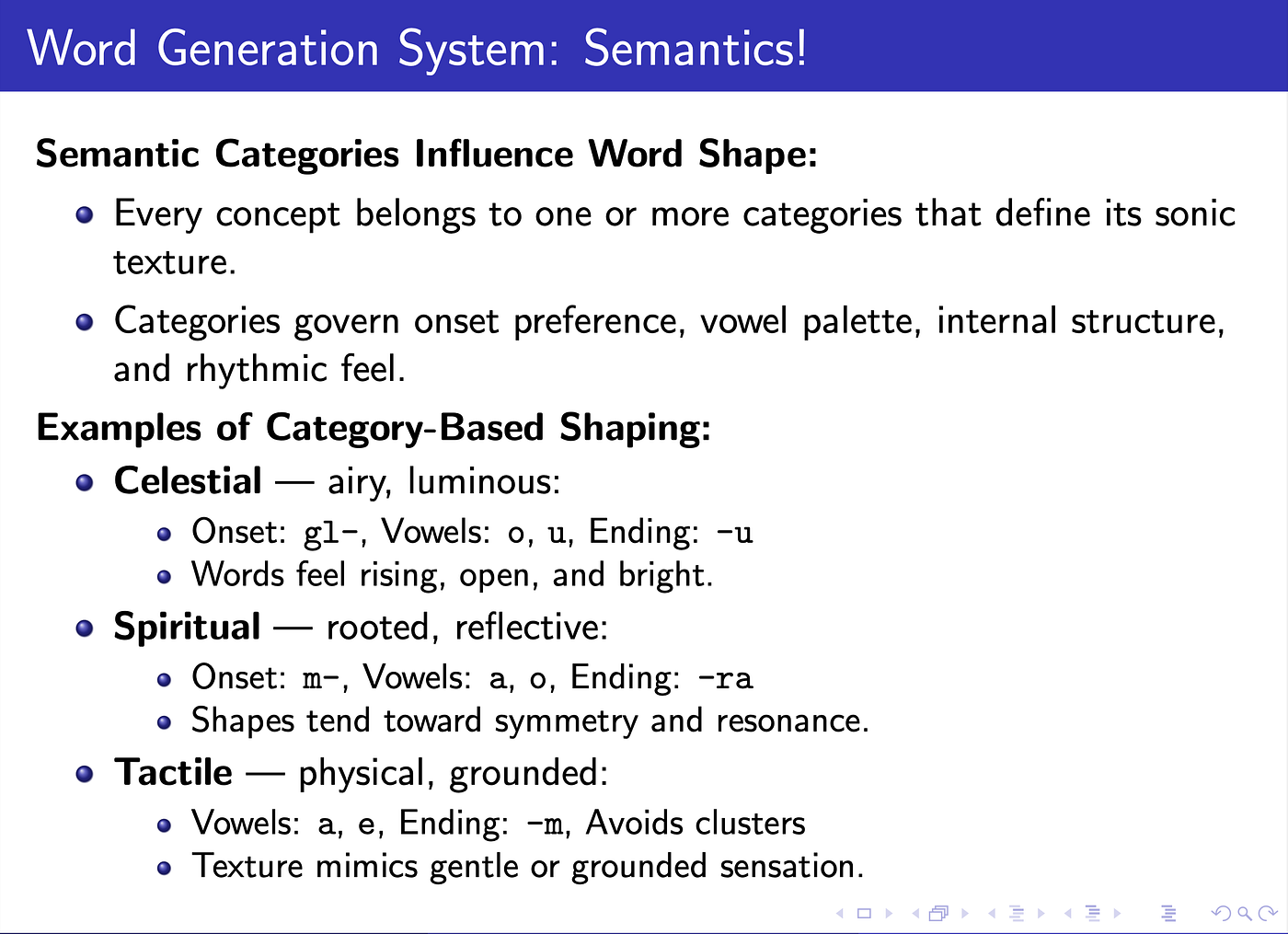
a slide I made, talking about semantic categories
But this was still only half the picture. Form without meaning isn’t language — it’s code. So in parallel, I built a semantic categorization system to guide how words were shaped sonically and conceptually. Each morpheme belonged to one or more semantic categories — celestial, tactile, emotional, spiritual, elemental, temporal. These categories dictated the phonological texture of the word: its preferred consonants, vowel palettes, possible affixes, and rhythm.
For example, words in the celestial category — sun, moon, light — used rising consonant clusters (gl-, tr-, vl-), rounded vowels like /o/ and /u/, and soft, open endings like -u. These features conveyed lift, lightness, and radiance. Tactile words (stone, hand, cloth) took the opposite approach: grounded consonants, closed syllables (-m, -t), and vowel choices like /a/ and /e/ to create a more earthy feel. Spiritual concepts emphasized symmetry and resonance — /m/, /n/, and endings like -ra or -en — to mimic a reflective internal rhythm. Emotional and temporal classes came with their own rules, including infixation patterns and contrastive vowel shifts to imply fluctuation or duration without explicitly marking tense.
The phonotactic structure followed a flexible (C)V(C) template, with optional infixes, reduplications, and size or relational affixes layered in only if valid per the FSA. Vowel harmony ensured consistency within a word, and cluster smoothing cleaned up phoneme transitions that felt jarring or unnatural. Each of these rules was embedded in the automaton — not manually enforced, but systematized.
The result was a generation engine that didn’t just create words — it created culturally coherent, sonically consistent, and semantically grounded lexical items. The words felt like they belonged to the society I was imagining: a people who didn’t tell stories in sequence, but described relationships in space and context. A society that experienced time not as a movement, but as an arrangement.
That break in DC became a deep alignment point. By its end, I had not just a lexicon, but a worldview. Alone, I had the space to unify philosophy, sound, and structure into one consistent framework. The language I had once been inventing was now inventing itself, word by word.
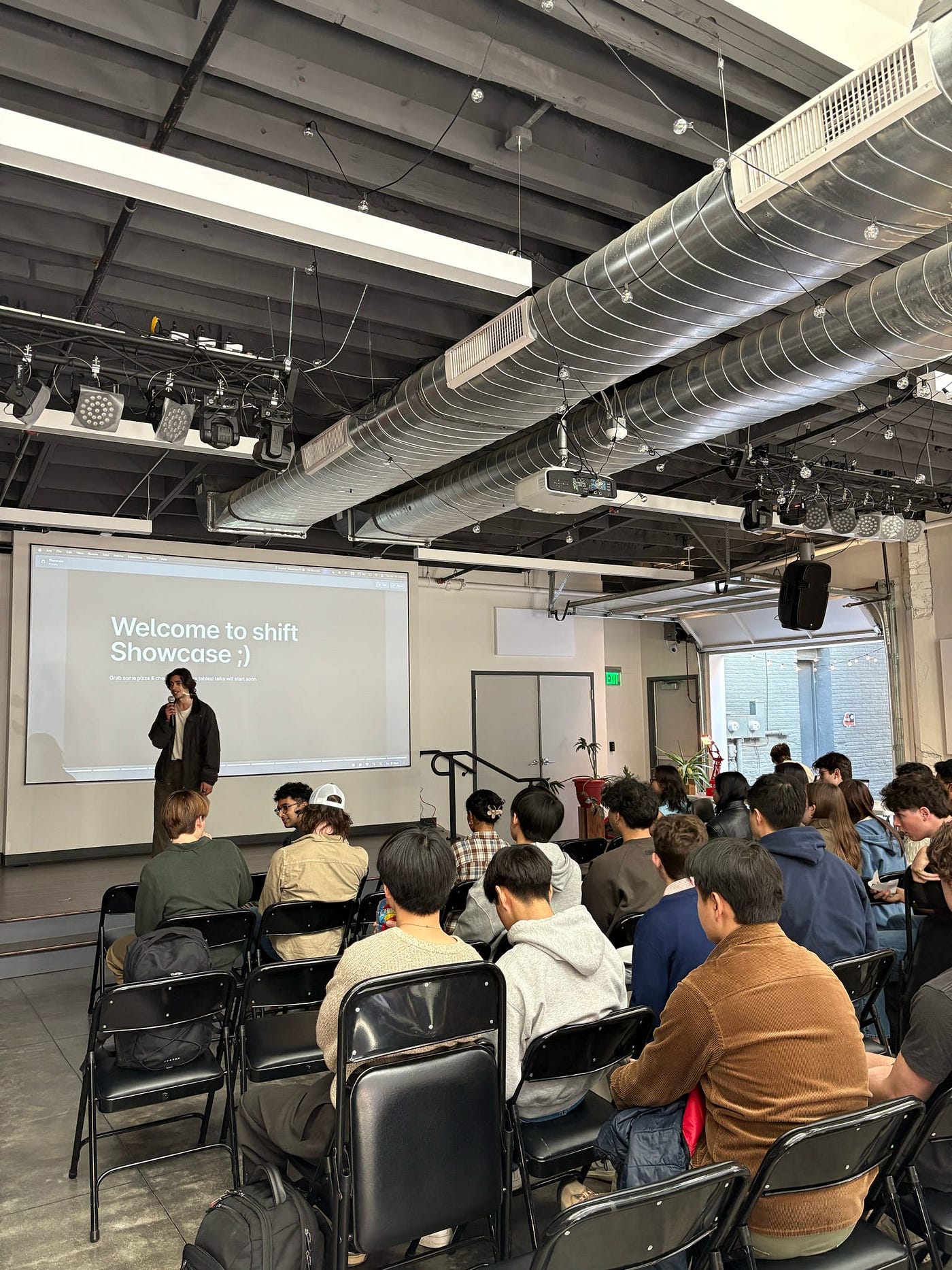
showcase!
After weeks of working in abstraction — surrounded by automata states, grammar trees, and semantic categories — it felt grounding to return to the place where the idea was born: the Shift community.
The showcase at the end of the semester was chaotic in the best way. The space buzzed with half-finished installations, tangled wires, zines fresh from printers, and tables laid out with projects that defied easy explanation. It felt less like a presentation and more like an open invitation — to witness, to question, to share.
For my part, I wanted the language to be experienced, not just displayed. So instead of a lecture or a slide deck, I built a simple interaction. On my table, I had a single monitor where people could write down any word or phrase they wanted translated into the language. I kept my laptop open, a grammar parser running in the background, ready to generate their words live, using the word itself and the combinations of the semantic categories they felt like best described their words.
Each time someone offered a word, I had to slow down and think — not just about the mechanics, but about meaning. I’d have to ask: what relationships define this concept? What qualities color it? How would a timeless society describe this — not in terms of what it does, but what it is?
My interactions were chatty, but still almost meditative. People didn’t just take the translations and walk away. They paused. They asked follow-ups. They thought about if their translation fit their word. Some even offered back their own ideas — new modifiers, alternate structures, playful rephrasings. And that’s when I knew the language had done what I hoped it would. It had invited others to see the world a little differently. It had made stillness feel active.
Even though this began as a deeply personal project, in that moment it became communal. The language stopped being mine. It became ours — a shared lens for observing without rushing, naming without narrating. A slow language for a fast world.
And on that note, my closing thoughts. But before that, enjoy my playlist I made for writing this article!
[embed]
Looking back, this wasn’t just a technical or creative exercise. It was a recalibration.
When I first began, I thought I was building a language to reflect timelessness. But what I found was a language that could create it. Each sentence I wrote in that system slowed me down. It made me ask what really mattered in the moment I was trying to describe. There was no default grammar to lean on. No verb to rush me forward. I had to notice the relationships. I had to see.
In doing so, I started to shift the way I think — not just in this fictional world, but in my real one. I became more attentive. More deliberate. Less interested in what comes next, and more invested in what is already here.
This language taught me that presence isn’t just a practice. It’s a structure. It’s something we can build into the systems we use, the words we choose, the way we communicate. Language isn’t just a tool for expression — it’s a blueprint for experience.
And maybe, in a world that’s always accelerating, we need more blueprints that teach us how to stay.
Also, before we end, thank you to shift! I have so many precious friends in the club, who have defined this semester for me, and to all of you, thank you:)
메타데이터
- post_id
- cfca3bbf39b2
- slug
- finding-presence-by-crafting-a-tenseless-language-cfca3bbf39b2
- url
- https://medium.com/shiftcreatorspace/finding-presence-by-crafting-a-tenseless-language-cfca3bbf39b2
- canonical_url
- https://medium.com/shiftcreatorspace/finding-presence-by-crafting-a-tenseless-language-cfca3bbf39b2
- author_url
- https://medium.com/@rrohan_68777
- status
- ok
- fetched_at
- 2026-06-14 11:28:49