Designing the Revolution: How the Russian Avant-Garde Entered Everyday Life
Art and the New State
Designing the Revolution: How the Russian Avant-Garde Entered Everyday Life
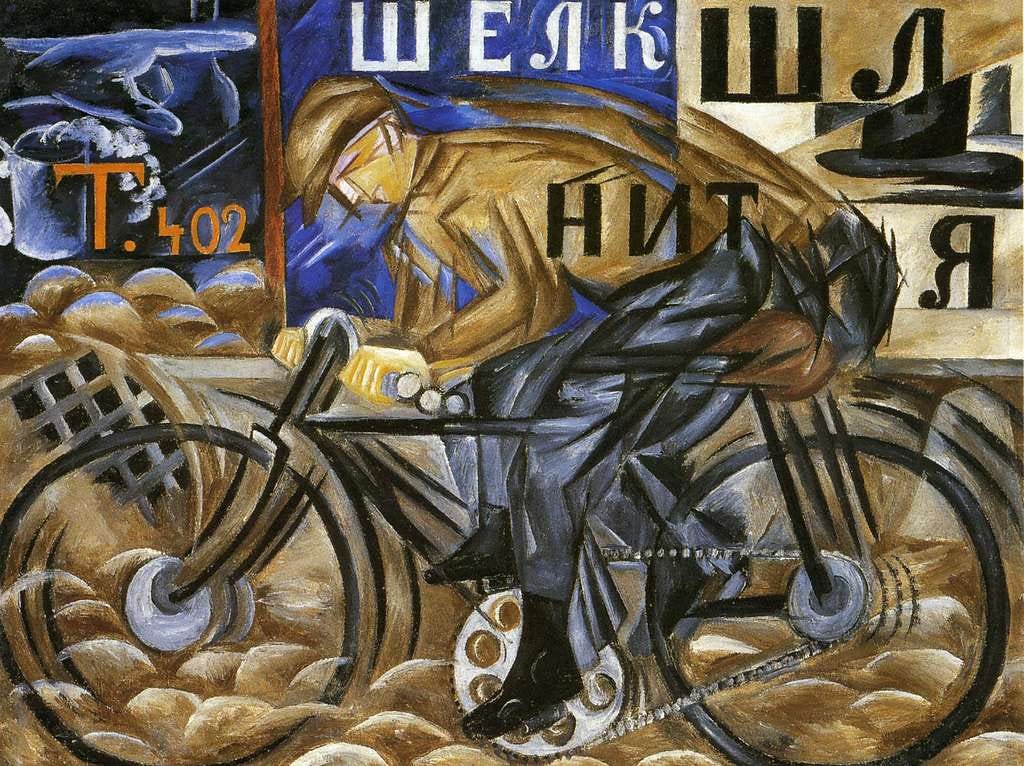
Cyclist, Natalia Goncharova, 1913. Oil on canvas, State Russian Museum, St. Petersburg. Public domain, via Wikimedia Commons.
Art and the New State
Soon after the October Revolution of 1917, the new Soviet state began seeking the support of artists and writers. This was more than a matter of decoration or official ceremony. Art could shape perception, stir emotion, communicate political ideas, and help people imagine a social order that did not yet exist.
At first, Soviet cultural leaders appealed to a broad range of artists. They approached established painters such as Boris Kustodiev, Kuzma Petrov-Vodkin, and Alexander Benois, while radical figures who had previously stood at the edges of academic culture gained new authority. Artists such as Alexander Rodchenko and Lyubov Popova became involved in art schools, workshops, and research institutions.
For the avant-garde, the revolution appeared to offer an extraordinary possibility: art would no longer be confined to galleries and private collections. It could participate directly in creating the future. Yet the relationship contained a danger from the beginning. Once the state recognized that art was powerful enough to shape public consciousness, it also had a reason to control it.
Several Languages for a New World
The Russian avant-garde was not one unified style. It was a field of competing experiments, each proposing a different way of seeing the modern world. Vassily Kandinsky explored how color and shape could express emotion without representing recognizable objects. Kazimir Malevich’s Suprematism went further: works such as Black Square rejected the visible world almost completely in pursuit of pure artistic feeling.
Vladimir Tatlin turned toward materials and construction. His counter-reliefs, followed by the unrealized Monument to the Third International, helped inspire Constructivism, which treated art as a practical force for building a new reality. Lyubov Popova’s Cubo-Futurist and abstract compositions captured movement, energy, and the fractured rhythm of modern life.
These artists did not agree on what the future should look like. What united them was the conviction that inherited forms were no longer sufficient. A transformed society required a transformed visual language.
When Art Entered Everyday Life
The poster became one of the revolution’s most immediate artistic tools. In a country where literacy remained uneven and political messages needed to travel quickly, a forceful image, a few words, and a bold composition could communicate with remarkable speed.
But the avant-garde did not stop at paintings and posters. It moved into textiles, porcelain, book covers, advertising, fashion, stage design, and typography. If the revolution was going to create a new society, then everything had to become modern and progressive, from the clothes people wore to the plates from which they ate.
Popova, Varvara Stepanova, Rodchenko, El Lissitzky, Tatlin, and others approached the artist’s role in a new way. The artist was no longer imagined only as an isolated creator producing unique objects. The artist could also be a designer of ordinary life. Geometric patterns appeared on fabric and dishes; books acquired energetic new layouts; letters and photographs became active parts of a composition rather than passive carriers of information.
Photography changed as well. Rodchenko used steep viewpoints, tilted horizons, close-ups, and dramatic perspectives to make familiar streets, buildings, and people appear newly strange. His photographs did not merely document a changing society. They trained the eye to look at that society differently.
Architecture for a Collective Future
Architecture, perhaps more than any other art form, had to respond to the revolution’s ambitions. A new state wanted buildings that reflected a modern, industrial, and collective future rather than the palaces and ornamental traditions of imperial Russia.
The Shukhov Radio Tower, built in Moscow between 1920 and 1922, embodied the period’s fascination with structural innovation and efficiency. Its open lattice form appeared light, daring, and unmistakably modern. Elsewhere, architects imagined collective housing, workers’ clubs, communal facilities, and industrial buildings designed not simply to impress but to reorganize everyday experience.
New materials and construction methods encouraged an emphasis on function, economy, and reproducibility. The purpose was not merely to give buildings a modern appearance. Architecture itself was expected to help change social habits, directing people toward communal work, education, and leisure.
From Experiment to Control
By the end of the 1920s, the atmosphere had begun to change. The early revolutionary years, with their competing groups and audacious experiments, gave way to a more centralized cultural policy. Art that had once appeared boldly revolutionary was increasingly criticized as abstract, formalist, and disconnected from ordinary people.
By the early 1930s, Socialist Realism had become the approved direction. Its images were clear, accessible, heroic, and closely aligned with the state. Architecture followed a similar movement away from avant-garde austerity. Stalinist buildings returned to monumentality, symmetry, ornament, columns, and imposing scale. Instead of suggesting an open future, they projected permanence and authority. Once an authoritarian state feels secure, it has little patience for art that remains unpredictable or disruptive. It prefers images that confirm its ideology.
A Revolution with a Long Afterlife
The Soviet avant-garde was one of the most radical artistic movements of the twentieth century because its ambitions extended far beyond the canvas. Its artists tried to reshape perception, objects, buildings, and daily routines. They believed that art could help construct an entirely new world.
The historical irony is difficult to miss. The same revolutionary state that initially welcomed avant-garde energy later abandoned it in favor of controlled, state-approved aesthetics. The artists who had helped invent the visual language of revolution became inconvenient once experimentation itself began to look like a threat.
The movement belonged to a particular and turbulent moment, but its visual language never disappeared. Its influence remains visible in graphic design, photography, typography, modern architecture, and contemporary art. The avant-garde set out to design the future; the state eventually decided that only one future could be imagined.
메타데이터
- post_id
- cfca51a1c42d
- slug
- designing-the-revolution-how-the-russian-avant-garde-entered-everyday-life-cfca51a1c42d
- url
- https://medium.com/@olgafieldspro/designing-the-revolution-how-the-russian-avant-garde-entered-everyday-life-cfca51a1c42d
- canonical_url
- https://medium.com/@olgafieldspro/designing-the-revolution-how-the-russian-avant-garde-entered-everyday-life-cfca51a1c42d
- author_url
- https://medium.com/@olgafieldspro
- status
- ok
- fetched_at
- 2026-08-17 00:23:30