I Rode in a Chinese Electric Car. Now I Get Why Everyone’s Panicking
The other day I was chatting with a friend who’s an auto industry analyst in Detroit. Great guy, knows the business inside out, former…
I Rode in a Chinese Electric Car. Now I Get Why Everyone’s Panicking
The other day I was chatting with a friend who’s an auto industry analyst in Detroit. Great guy, knows the business inside out, former engineer at one of the Big Three, now consults for startups. But when I mentioned that China sold over 11 million electric vehicles last year, he looked at me like I’d just announced the moon was made of cheese. “That can’t be right,” he said. It was right. More than right, actually — the number keeps climbing every quarter, and the trajectory shows no signs of flattening.
What really got me thinking wasn’t just the scale. It’s how they got here. This wasn’t some overnight miracle or happy accident. China made a conscious decision decades ago to own this space, and now the rest of the world is scrambling to catch up while Beijing’s already thinking three moves ahead.
Let me walk you through what’s actually happening on the ground there.
In 2024, China moved 11 million new energy vehicles off dealer lots. The US managed around 1.5 million. Europe, often praised for its green policies, hit roughly 3 million combined. China’s share of global EV sales sits somewhere around 60 percent. For context, that’s like if the entire US car market went electric and then some. More striking is the production side. China manufactures roughly 70 percent of the world’s EV batteries. This isn’t just market share — it’s control over the entire supply chain, from mining lithium in remote provinces to refining cobalt in industrial megacities to shipping finished cells to assembly plants on three continents.
The penetration rate within China itself is staggering. More than one in three new cars sold there today is either fully electric or a plug-in hybrid. In major cities like Shanghai and Shenzhen, the ratio skews even higher. Shenzhen, for instance, has already fully electrified its entire bus fleet — over 16,000 vehicles — and replaced 22,000 taxis with electric models. You want to see the future? Take a bus in Shenzhen. It’s quiet, smooth, and costs a fraction to operate.
Here’s what I keep coming back to: China built the infrastructure before people even knew they wanted it.
Why are Chinese consumers actually buying in? Here’s something Western automakers keep getting wrong — they assume price is the only factor. It’s not. Or rather, it’s never just price.
Yes, Chinese EVs are cheap by global standards. A BYD Seagull starts at just 73,800 yuan — that’s about $10,200. The Wuling Mini EV, a tiny city car that looks like a happy meal box with wheels, goes for as low as 32,800 yuan ($4,500). These aren’t stripped-down penalty boxes either. They’re real cars with real features, decent build quality, and enough range for daily commutes. The game has changed.
But price alone doesn’t explain the shift. Look at Shanghai or Beijing, where getting a gasoline car license means entering a lottery with five-year wait times. An EV license? Virtually guaranteed, no drama. This isn’t a perk — it’s survival. People need to get to work, to school, to grandma’s house on the weekends. The EV path is just the path of least resistance. When the government makes the practical choice the green choice, adoption accelerates fast.
Then there’s the tech angle. Chinese consumers have developed a taste for cars that basically function as smartphones on wheels. Over-the-air updates that add new features monthly, massive touchscreens that make Tesla’s look quaint, voice assistants that actually understand Mandarin dialects, and driver assistance that handles highway driving competently. These aren’t selling points in China, they’re baseline expectations.
Li Auto’s L-series SUVs offer ranges exceeding 1,100 kilometers on a full charge. That’s roughly the distance from New York to Miami without stopping. NIO’s vehicles can swap batteries in three minutes flat at one of their 2,500-plus swap stations scattered across the country. Think about that for a second. You pull in, the machine removes your depleted pack, slides in a fresh one, and you’re gone. Faster than pumping gas. The infrastructure question — what about charging? — gets answered differently when you think about battery swapping as an option.
The charging network itself is equally impressive. China has more than 3 million public charging points. Combined. The rest of the world doesn’t come close. Walk through any Chinese city and you’ll spot charging stations like phone charging kiosks in a mall. It’s saturated.
The brands you need to know about? Forget what you think you know about “Chinese cars.” The playing field has shifted dramatically, and if you’re not paying attention, you will be surprised.
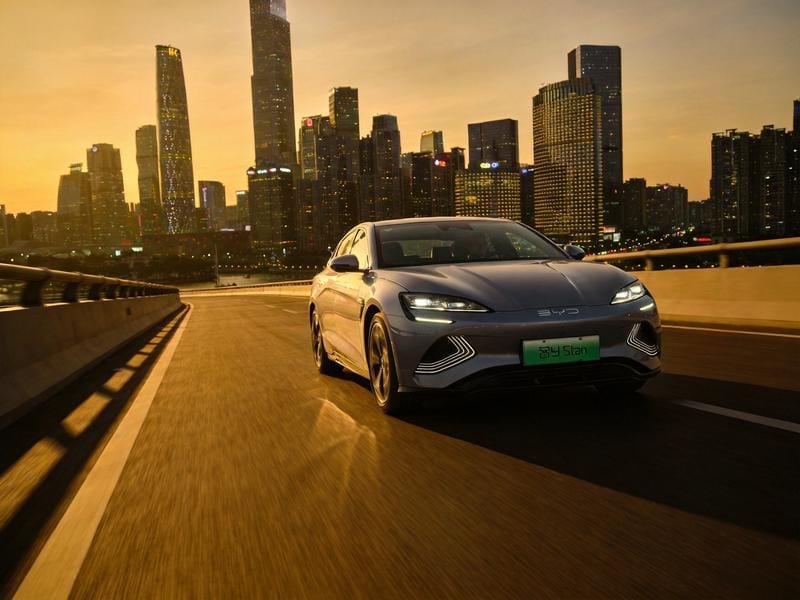
BYD is the obvious one. They started as a battery company, pivoted to cars, and now sell everything from budget compacts to luxury hybrids. Their Seal sedan competes directly with the Tesla Model 3 on specs and undercut it on price. Their Yangwang brand targets the ultra-premium segment with a luxury SUV that costs more than most houses in middle America. They’re not trying to be the cheap option anymore — they’re trying to be the best option, or at least one of them.
NIO takes a different approach. Their focus on battery swapping addresses a real anxiety point: what if you’re running low and there’s no charger nearby? Drive into a station, swap the depleted pack for a fresh one, and you’re gone in the time it takes to grab a coffee. It’s elegant in theory and increasingly practical in execution. They’ve built over 2,500 stations across China, with expansion into Europe quietly underway.
Xpeng has bet heavily on autonomy. Their assisted driving features handle highway driving and parking with genuine competence. The system doesn’t just lane keep — it navigates interchanges, suggests lane changes, and handles complex merge situations. Zeekr, the premium arm of Geely (which also owns Volvo and Polestar), combines Scandinavian design sensibilities with Chinese manufacturing muscle. Clean lines, premium materials, competitive pricing. And then there’s AITO, the brand born from Huawei’s partnership with Seres, offering cars where the software experience feels like using a flagship phone because, well, it basically is one.
None of these brands existed fifteen years ago. Now they’re exporting to Europe, Southeast Asia, Australia, and beyond. The trajectory is hard to ignore. Nobody took Chinese cars seriously in 2010. Nobody can ignore them in 2025.
If EVs are the story, batteries are the plot — and this is where things get really interesting for anyone who cares about geopolitics and industrial policy.
Contemporary Amperex Technology, CATL if you want to sound like you know things, supplies roughly 37 percent of all EV batteries globally. Their customer list reads like a who’s who of the automotive industry: Tesla, BMW, Mercedes, Volkswagen. They ship cells to factories on four continents. Their factories run around the clock.
China doesn’t just dominate cell production though. The country controls over 70 percent of the entire battery supply chain, from raw material processing to cell manufacturing to recycling infrastructure. This wasn’t accidental. Years of strategic investment in lithium mines (mostly in Australia and South America, but processed in China), cobalt refineries, and gigafactories created a moat that competitors in the US and Europe are still trying to scale.
CATL has also pioneered new chemistries. Their third-generation cell-to-pack technology eliminates the module stage, packing more energy density into the same volume. Fewer steps, lower costs, better performance. That’s the kind of innovation that comes from building at scale and learning from millions of iterations.
I rode in a NIO ES8 last month. The silence hit me first — the kind of silence you associate with expensive luxury cars. Then the screen size. Then the way it accelerated. It felt like stepping into the future, except the future was already here, just not for us.
Now for the rough edges. I want to be fair here. This revolution isn’t without its scars, and anyone telling you otherwise is selling something.
Winter remains a genuine problem. Battery chemistry doesn’t love cold weather. In northern Chinese cities where temperatures drop below freezing for months, drivers report losing 20 to 40 percent of their stated range when conditions get harsh. That’s not a dealbreaker for city commuting — you’re probably fine — but it changes the calculus for longer trips. Your 500-kilometer range becomes 300 kilometers in January. Whether manufacturers are doing enough to address this through thermal management systems and better cold-weather chemistry is another question. I think not, but the data is still coming in.
The market has also been brutal for smaller players. At one point, China had over 400 EV startups. Most are gone now, either bankrupt or barely surviving on government life support. Buying from an extinct brand means headaches: service centers close, parts become scarce, and the app that controlled your car’s features stops working. We’ve seen this before in other industries, but the stakes are higher when it’s your primary vehicle.
Which brings me to another issue: depreciation. A three-year-old EV in China can lose 50 to 60 percent of its original value. Compare that to gasoline cars, which hold value much better in the Chinese market. The math on total cost of ownership gets murky fast. Buy new, lose money on resale. Buy used, take the battery degradation risk. It’s a genuine problem that hasn’t been solved yet.
And then there’s the geopolitical mess that nobody in Detroit seems to want to talk about honestly. The EU has imposed tariffs around 45 percent on Chinese EVs. The US went further, with duties hitting 100 percent. These aren’t subtle signals. Western governments are worried — about trade deficits, about losing technological leadership, about what it means when a single country dominates a critical industry. Whether tariffs are the right response is debatable. That there’s a problem requiring a response is not.
Here’s the uncomfortable part for anyone who works in the auto industry outside China.
China didn’t win the EV race by stealing technology or engaging in unfair practices — at least, not primarily. They won by moving fast, investing heavily, and building at a scale that other regions couldn’t match in the same timeframe. Their charging infrastructure alone took years of coordinated government effort and private capital that Western countries are still struggling to replicate. Beijing has poured over 200 billion yuan (roughly $28 billion) into the sector. Subsidies reached up to 60,000 yuan per vehicle in earlier phases, which sounds like a lot until you realize the scale they’re operating at created learning curves and economies of scale that drove costs down for everyone.
The US and Europe are now playing catch-up in a game where the leader has every structural advantage: established supply chains, experienced workforce, brand recognition in emerging markets, and the confidence that comes from actually doing something difficult at scale. Starting from behind is hard. Starting from behind against someone who knows you’re trying to catch up? Harder.
The tariff walls might slow China down, but they won’t stop it. They’ll just push Chinese manufacturers to build factories in Mexico, Hungary, Thailand. The cars will still come — they’ll just wear different badges. We’ve seen this pattern in solar panels, in smartphones, in consumer electronics. The industrial logic eventually wins.
Whether that’s a crisis or an opportunity depends on your perspective. Chinese EVs are bringing down the cost of the transition to sustainable transport globally. That’s not nothing. The world needed cheap EVs, and China made them cheap. Whether we wanted to admit that’s where the industry was heading is a different question.
The revolution is happening. China got there first. Now the rest of the world has to decide: fight it, join it, or get left behind.
This piece draws on reporting from across the EV industry. For a deeper dive into the data and original analysis, check out the 原文.
메타데이터
- post_id
- cfd3b986d2b2
- slug
- i-rode-in-a-chinese-electric-car-now-i-get-why-everyones-panicking-cfd3b986d2b2
- url
- https://medium.com/@563704148/i-rode-in-a-chinese-electric-car-now-i-get-why-everyones-panicking-cfd3b986d2b2
- canonical_url
- https://medium.com/@563704148/i-rode-in-a-chinese-electric-car-now-i-get-why-everyones-panicking-cfd3b986d2b2
- author_url
- https://medium.com/@563704148
- status
- ok
- fetched_at
- 2026-06-26 03:39:16