Synaptics in 2025: Delivering on Strategy or Chasing Momentum?
Synaptics, long known for its leadership in human interface technologies, has undergone a remarkable transformation. Over the last several…
Synaptics in 2025: Delivering on Strategy or Chasing Momentum?
Synaptics, long known for its leadership in human interface technologies, has undergone a remarkable transformation. Over the last several years, the company’s focus has pivoted sharply toward Core IoT, AI at the edge, and wireless connectivity. Judging by the company’s Q3 fiscal 2025 results and its most recent technology launches, Synaptics is showing strong execution against this long-term strategy, especially in leveraging the explosive growth of the IoT space. However, scaling those wins and defending against rising competition still faces challenges.
Core IoT Momentum Is Real — and Growing
At the center of Synaptics’ turnaround is its Core IoT business, which posted a 43% year-over-year growth in Q3 FY25, contributing $68 million and accounting for 25% of total sales. This performance is not just an anomaly; it’s part of a consistent upward trend with five consecutive quarters of sequential growth. This diversification represents a meaningful strategic evolution for a company that was once heavily reliant on legacy PC (touchpads) and mobile touch businesses.
This surge was driven by demand for wireless connectivity and edge processor solutions, underscoring Synaptics’ ability to build traction where the market is headed, not where it’s been. Synaptics is no longer just competing for socket wins in saturated device categories; it’s carving out relevance in rapidly expanding verticals like smart homes, industrial automation, and AI-powered embedded devices.
Astra: A Bet on AI at the Edge
One of the clearest illustrations of Synaptics’ strategic ambition is the Astra platform — its AI-native processor suite targeting edge devices. The company recently expanded this initiative by launching the SR Series High Performance Adaptive MCUs introduced at Embedded World in Germany. These chips feature dynamic power management depending on inference load, allowing them to deliver AI capabilities with minimal power and footprint.
This decision is smart, strategic move. Unlike cloud-based AI, Edge AI demands low-latency processing with limited energy budgets. Astra positions Synaptics squarely at the intersection of two major megatrends: decentralized compute and intelligent IoT devices, focusing on ultra-compact, low-power designs.
According to company leadership, Astra is already gaining traction across consumer, industrial, and automotive segments. Even more promising is that Synaptics’ ODM partners are now actively building out real-world use cases and engaging OEMs to bring Astra-enabled solutions to market. While early, this ecosystem-building effort is essential for long-term defensibility and scale.
Veros Wireless: Gaining Ground with Wi-Fi 7
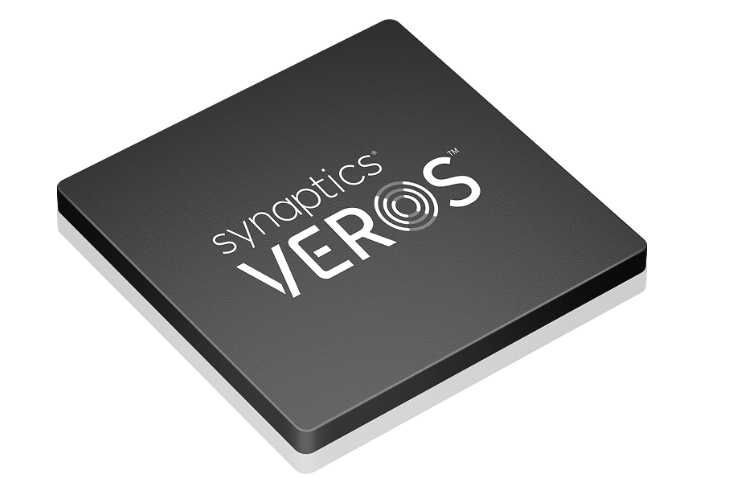
Another strategic pillar that appears to be gaining momentum is Synaptics’ Veros wireless connectivity portfolio. The company recently launched its first Wi-Fi 7 solution for IoT applications, which could open a substantial new addressable market.
Unlike standard consumer Wi-Fi 7 solutions, Synaptics’ design targets embedded and edge IoT applications with an emphasis on power efficiency, small die size, and ultra-reliable performance. According to SVP Venkat Kodavati, their chip consumes up to 50% less power. It substantially reduces system cost compared to earlier high-performance solutions, delivering double the throughput and improved load balancing.
The point here isn’t that Synpatics engaging in spec war — it’s a positioning strategy. By designing purpose-built chips for video-rich, real-time applications like AR/VR, UHD streaming, and automotive infotainment, Synaptics differentiates itself from traditional connectivity players who simply retrofit Wi-Fi 7 into existing frameworks.
If adopting high-bandwidth IoT applications continues its current trajectory, Synaptics could be well-positioned as a premium provider in an increasingly commoditized connectivity landscape.
Market Penetration vs. Ecosystem Complexity
Despite these successes, Synaptics still faces a steep hill to climb, particularly in scale. While Astra and Wi-Fi 7 open new SAMs, the challenge is penetrating beyond flagship design wins and into the long tail of volume production.
Historically, Synaptics has succeeded by selling to a narrow set of top-tier OEMs. However, IoT markets — exceptionally broad-based industrial and embedded systems — require a different go-to-market muscle. Selling into fragmented ecosystems, managing channel partners, and supporting diverse use cases need operational infrastructure, which Synaptics is only beginning to invest in.
During its Q3 earnings call, Synaptics acknowledged this, noting it is still in the “early innings” of its go-to-market evolution. While hiring more sales and business development talent and investing in ecosystem partnerships with ODMs, the company will need to scale these efforts quickly to maintain its lead before competitors catch up.
Execution Remains Solid Amid Macro Headwinds
From a financial standpoint, Synaptics is showing signs of maturity and resilience. Revenues grew 12% year-over-year to $266.6 million in Q3, and non-GAAP EPS hit $0.90, a 70% increase year-over-year. Even more encouraging is its non-GAAP gross margin, which held steady at 53.5%, demonstrating pricing power and solid execution despite ongoing macroeconomic volatility.
While GAAP results continue to show net losses, primarily due to acquisition-related costs and share-based compensation, Synaptics is managing its operations with discipline. The company generated over $74 million in cash flow from operations and repurchased $37.9 million of shares, indicating financial health and shareholder confidence.
That said, Synaptics isn’t immune to external risks. Tariff (there’s that word again) uncertainties and supply chain constraints remain potential headwinds. While the company reported minimal direct impact from tariffs, indirect effects on demand and supply chain dynamics could emerge with little notice. As with most semiconductor firms, agility and forecasting accuracy will be key.
Competitive Landscape and Innovation Pressure
Synaptics’ move into Wi-Fi 7 and Edge AI comes with its competitive pressures. Larger connectivity players may enter the IoT-specific Wi-Fi 7 space, and silicon incumbents like Qualcomm and MediaTek are aggressively investing in edge AI capabilities.
Synaptics’ differentiation lies in its tailored, low-power designs and ability to serve niche but high-growth segments. However, this edge could erode without continued innovation. To maintain and extend its lead, the company must consistently deliver best-in-class performance, energy efficiency, and developer support.
Additionally, customers in the IoT space — particularly in industrial and enterprise verticals — value long-term platform stability, security certifications, and software toolchains. Synaptics must deepen its ecosystem investments, possibly including strategic partnerships or acquisitions, to build a moat around its IP.
Final Thoughts: A Strategically Unique Player with Execution Momentum
In my view, the short answer is yes: Synaptics is executing effectively against its long-term strategic plan. The pivot toward Core IoT shows clear returns, the Astra AI-native platform is gaining traction across multiple verticals, and the company’s entrance into the Wi-Fi 7 space is timely, well-aligned, and technologically differentiated. The financials — 12% year-over-year revenue growth, a 70% increase in non-GAAP EPS, and strong cash flow — provide real-world validation that the strategy is working.
But what truly sets Synaptics apart isn’t just its technology. It’s the company’s hybrid identity — not a pure semiconductor firm and a component vendor. This attribute about Synaptics is often misunderstood or underappreciated.
Synaptics occupies a unique position in the marketplace: it often wins designs not only because of chip specs, but because of its deep design-in expertise, its ability to deliver firmware and software modifications, and its long history of working side-by-side with OEMs to build tightly integrated solutions. This capability is a major strategic asset in an era where differentiation goes beyond silicon into system-level experience.
This holistic design approach is fundamental in IoT and edge AI markets, where requirements are fragmented, highly customized, and not well-served by one-size-fits-all components. Synaptics’ willingness — and proven ability — to tailor solutions at the firmware and software level gives it a practical edge against competitors who focus purely on silicon performance.
As the company scales, the challenge now shifts toward broadening its customer base, building out its go-to-market infrastructure, and reinforcing its partner ecosystem. IoT and Edge AI markets are notoriously diffuse, and success at scale requires more than just great products. It requires repeatable, well-supported design wins across a range of use cases and geographies.
However, with its differentiated technology, growing market traction, and embedded customer relationships, Synaptics is better positioned than many might assume. It’s not chasing broad volume at all costs; it’s building intelligently, with customization and strategic alignment as core principles.
In a world where many competitors race to the bottom on cost or to the top on performance, Synaptics is playing a different ballgame — winning through integration, precision, and adaptability. If it continues to build on that foundation, the next chapter of its growth may well outpace expectations.
Mark Vena is the CEO and Principal Analyst at ***SmartTech Research based in Las Vegas, Nevada. As a technology industry veteran for over 25 years, Mark covers many consumer tech topics, including PCs, smartphones, smart home, connected health, security, PC and console gaming, and streaming entertainment solutions. Mark has held senior marketing and business leadership positions at Compaq, Dell, Alienware, Synaptics, Sling Media and Neato Robotics. Mark has appeared on CNBC, NBC News, ABC News, Business Today, The Discovery Channel and other media outlets. Mark’s analysis and commentary have appeared on [Forbes.com](http://forbes.com/)** and other well-known business news and research sites. His comments about the consumer tech space have repeatedly appeared in The Wall Street Journal, The New York Times, USA Today, TechNewsWorld and other news publications.*
SmartTech Research, like all research and tech industry analyst firms, provides or has provided paid services to technology companies. These services include research, analysis, advising, consulting, benchmarking, acquisition or speaking sponsorships. Companies mentioned in this article may have utilized these services.
Subscribe to my SmartTechCheck podcast on YouTube and to my SmartTechCheck newsletter for FREE on ***LinkedIn or [Medium](https://markvena.medium.com/)** for updates on the most important, disruptive tech topics that should be on your radar screen.*
메타데이터
- post_id
- cfd7b3bee8ea
- slug
- synaptics-in-2025-delivering-on-strategy-or-chasing-momentum-cfd7b3bee8ea
- url
- https://medium.com/@markvena/synaptics-in-2025-delivering-on-strategy-or-chasing-momentum-cfd7b3bee8ea
- canonical_url
- https://medium.com/@markvena/synaptics-in-2025-delivering-on-strategy-or-chasing-momentum-cfd7b3bee8ea
- author_url
- https://medium.com/@markvena
- status
- ok
- fetched_at
- 2026-07-19 23:03:27