What Researchers Need to Know About OpenAI’s New o1 Model
OpenAI’s new o1 model is a huge advancement in it’s language model capabilities, particularly for complex reasoning tasks. But there are…
What Researchers Need to Know About OpenAI’s New o1 Model
Previously given working names like “Strawberry” and “Q-Star”, o1-preview is now available for GPT Plus users
OpenAI’s new **o1 model is a huge advancement in it’s language model capabilities, particularly for complex reasoning tasks. But there are some key aspects of o1** that researchers should consider when evaluating its potential for their work.
Core Advancements in o1
Chain-of-Thought Reasoning
o1 uses Chain-of-Thought (CoT) reasoning. This primarily allows it to break down more complex problems into smaller steps which it can address one at a time before returning an output. This makes it particularly valuable for larger complex tasks.
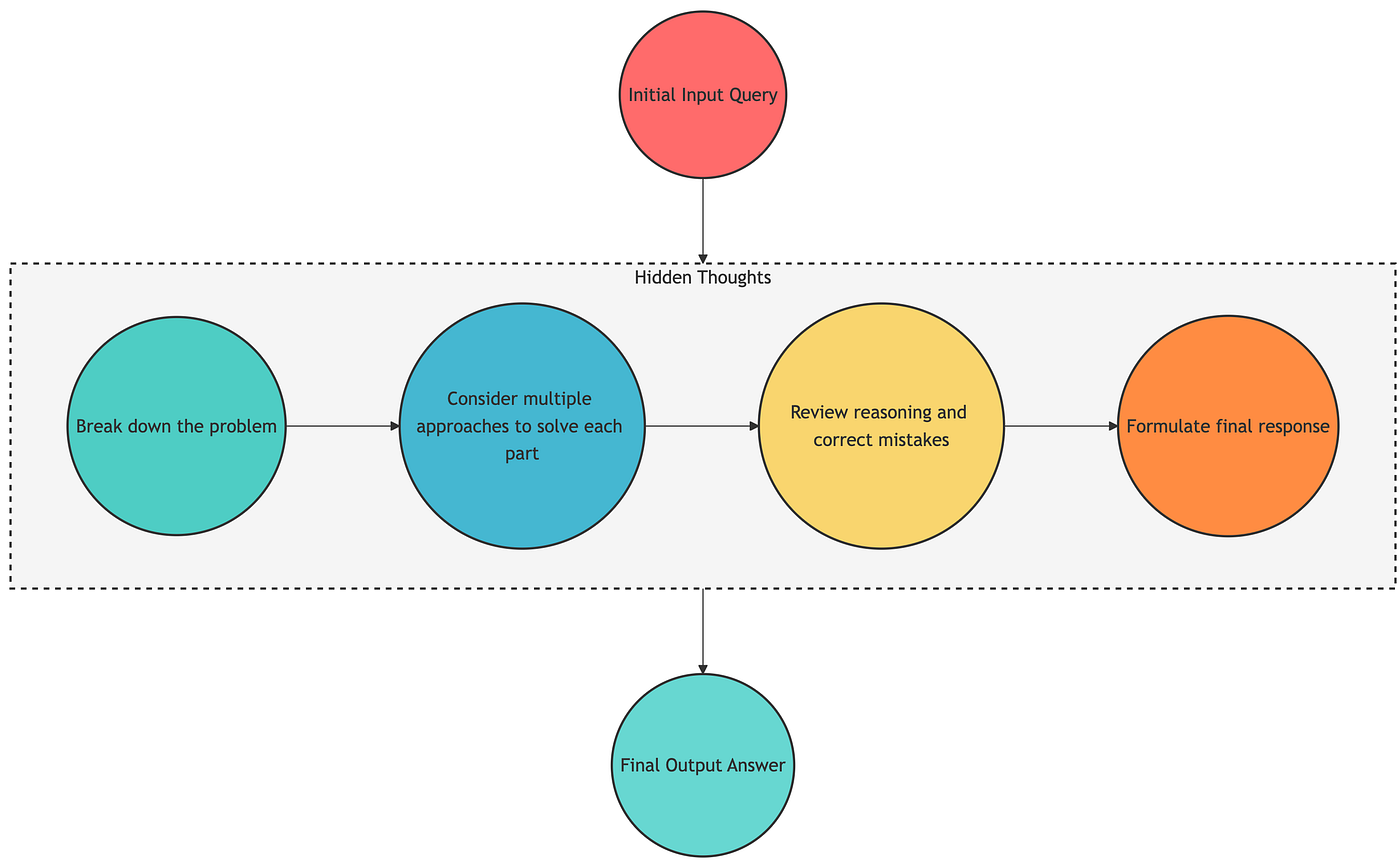
Internal Reasoning with Chain of Thought in Language Models: From Query to Answer
While most language models have a straightforward text Input -> text Output process for answering queries, o1 follows a multi-step process before returning a final answer.
Chain of Thought Prompting was also a popular prompt engineering strategy to improve results with older GPT models like GPT 3.5, 4 and 4o. To learn about how people did this manually before, check out the article below:
Understanding Chain of Thought in o1
Unlike manual CoT prompting used with earlier models, o1’s internal reasoning is an integrated feature. This means:
- Automatic Step-by-Step Processing: O1 naturally breaks down complex queries into logical steps without explicit prompting.
- Enhanced Problem-Solving: The model can handle more nuanced, multi-step research questions.
- Improved Accuracy: By processing information systematically, o1 is less likely to make logical leaps or assumptions.
Using CoT for Research
Researchers can optimize their use of o1’s CoT capabilities by:
Framing Complex Queries: Structure your research questions to make use of step-by-step analysis. For example:
- “Analyze the potential impact of gene XYZ on cellular metabolism, considering its interactions with pathways A, B, and C.”
Requesting Explanations: Ask o1 to explain its reasoning process. This can provide insights into the model’s problem-solving approach and help identify potential biases or gaps in logic.
- “Explain your reasoning for each step in solving this differential equation.”
Iterative Refinement: Use o1’s outputs as a starting point for further inquiry. Each step in the chain of thought can be a potential branch for deeper investigation.
Comparative Analysis: Leverage CoT for comparing different hypotheses or methodologies.
- “Compare and contrast methods X and Y for protein folding prediction, considering efficiency, accuracy, and scalability.”
CoT and Context Windows
While o1’s exact context window size isn’t publicly disclosed, it’s important for researchers to understand how context affects CoT reasoning:
- Extended Reasoning Capacity: O1’s CoT capabilities likely allow for more extended chains of reasoning within a single context window compared to previous models.
- Strategic Information Presentation: When dealing with complex topics, present information in a logical, sequential manner to maximize the effectiveness of CoT reasoning.
- Chunking Complex Problems: For extremely complex research questions, consider breaking them into related sub-queries to ensure thorough processing within the context window.
Performance Metrics In Math, Coding and Science
o1 shows major improvements over GPT-4o across key areas important for research. Here’s how they compare:
o1 and o1-preview make improvements across topics in advanced math, programming and PhD level questions compared to the previous best in class model, gpt4o
Math Skills
o1 is much better at solving complex math problems. AIME 2024 (advanced math test):
- o1: 83.3% correct
- GPT-4o: 13.4% correct
Coding Ability
o1 can write better code and solve harder programming tasks. Codeforces (competitive programming):
- o1: 89th percentile
- GPT-4o: 11th percentile
Scientific Knowledge
o1 outperforms both GPT-4o and human experts on tough science questions. GPQA Diamond (PhD-level science questions):
- o1: 78% correct
- GPT-4o: 56.1% correct
- Expert humans: 69.7% correct
Other Key Improvements
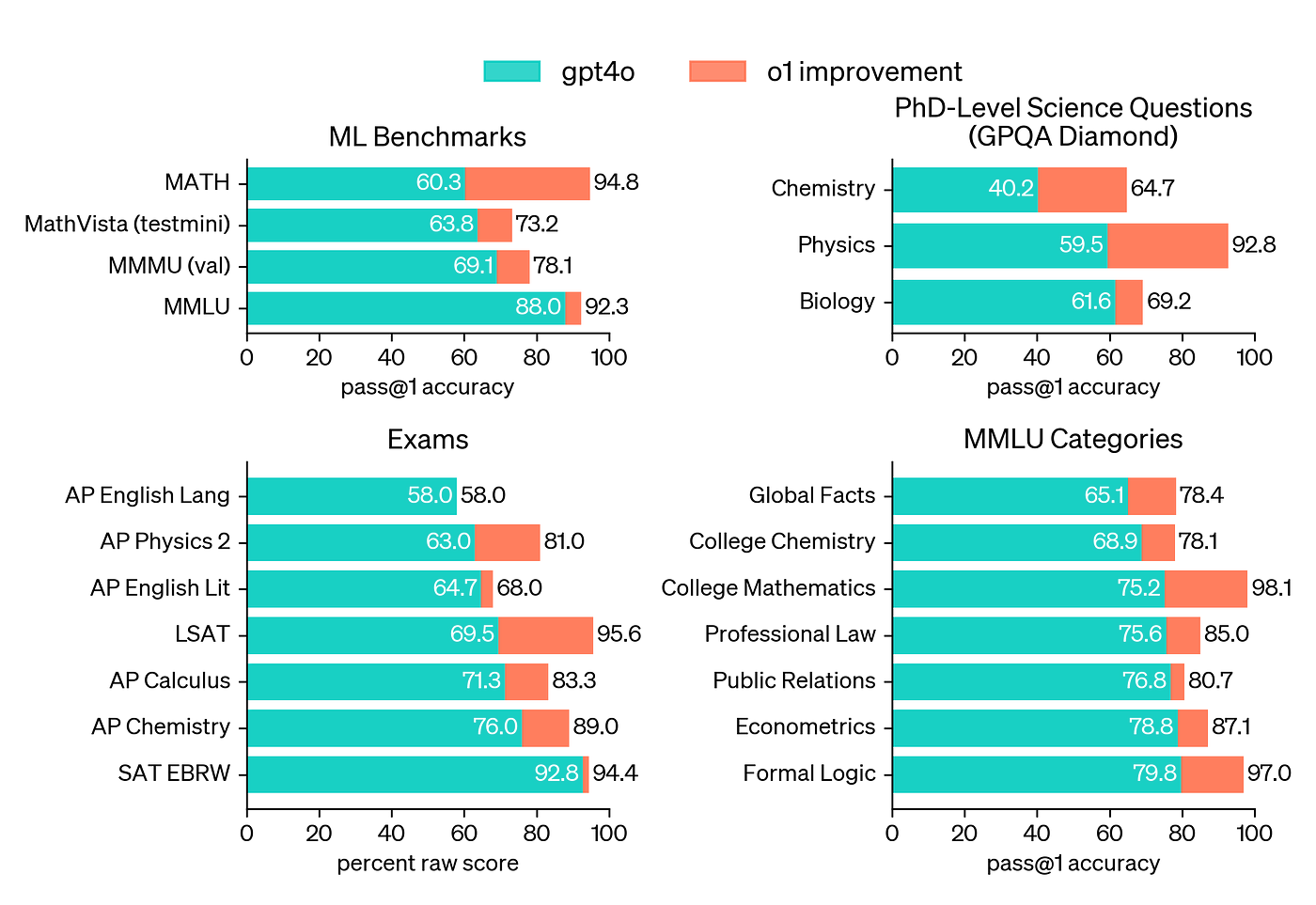
Performance Comparison: o1 vs GPT-4o Across Various Benchmarks and Disciplines
o1 consistently outperforms its predecessor across a broad range of categories. From machine learning benchmarks to PhD-level science questions, standardized exams, and specialized knowledge categories.
What This Means for Researchers
o1 is a highly useful language model with impressive benchmark scores, but when should you use it over older models? Short answer: for complex multi step problems go with o1, for everything else go with gpt-4o or Claude Sonnet 3.5.
- Deeper Knowledge: o1 can reason through more complex ideas in many subjects, helping with diverse research.
- Time vs. Quality Trade-off: o1 is slower and more expensive (if you’re using the API) but gives much better answers.
Model Variants
- o1-preview: Full model with broader knowledge base
- o1-mini: Faster, more cost-effective, specialized for coding tasks
Researchers should choose based on their specific needs (breadth vs. speed)
Trade-offs: Price and Speed
- Time: o1 is approximately 30 times slower than GPT-4o, o1-mini is 16 times slower than GPT-4o mini
- Cost (API usage): o1-preview: $15 per million input tokens, $60 per million output tokens vs. GPT-4o comparison: $5 per million input tokens, $15 per million output tokens
Current Limitations
- Lacks web browsing and file/image processing capabilities
- More limited general world knowledge compared to GPT-4o
- API restrictions: No function calling, streaming, or system message support
Safety and Ethical Considerations
- Improved performance on jailbreaking tests (o1-preview: 84/100, GPT-4o: 22/100)
- Researchers should still implement additional safeguards for sensitive applications
Availability
- Currently limited to ChatGPT Plus and Team users
- API access restricted to high-tier users
- Plans for broader access in the future
Experimenting with o1’s Capabilities
I’ll cap this off with some examples of more complex problems that older models would struggle with.
Mathematical Proof: Let’s see how o1 provides a detailed proof of √2’s irrationality using contradiction and explains each step’s significance.

“Prove the irrationality of the square root of 2 using a proof by contradiction. Explain each step of the proof and why it’s”
Scientific Experiment Design: o1 can also design comprehensive experiments, covering experimental setup, controls, and data collection. Try out a prompt like the one below to see how it demonstrates its capacity for multidisciplinary scientific thinking.

“Design a hypothetical experiment to test the effects of microgravity on plant growth and photosynthesis on the International Space Station. Include the experimental setup, control measures, data collection methods, and potential challenges. Then, outline how you would analyze the results and discuss their potential implications for long-term space missions and agriculture in space.”
Pushing o1’s Limits
Try experimenting with much longer, more complex queries than you’d normally attempt with GPT-4o. o1’s advanced reasoning can tackle intricate, multi-faceted problems that often stumped older models.
Word of caution: You’ll likely hit usage limits much faster due to o1’s intensive processing. Keep this in mind, especially if you’re on a usage-restricted plan or using the API.
메타데이터
- post_id
- cfda50f18d1a
- slug
- what-researchers-need-to-know-about-openais-new-o1-model-cfda50f18d1a
- url
- https://medium.com/@wadan/what-researchers-need-to-know-about-openais-new-o1-model-cfda50f18d1a
- canonical_url
- https://medium.com/@wadan/what-researchers-need-to-know-about-openais-new-o1-model-cfda50f18d1a
- author_url
- https://medium.com/@wadan
- status
- ok
- fetched_at
- 2026-06-20 20:29:01






