Science and Society
Is there a connection?
Science and Society
Is there a connection?

Will they understand us? Collage by author, with the help of Copilot
There are two opposing views of science and (especially) mathematics.
View 1: Both mental disciplines are independent of social influences. Therefore, they could be useful for communicating with extraterrestrial intelligence. Carl Sagan proposed different messages to be sent to alien civilisations, starting with prime numbers, followed by various universal principles and facts of mathematics and science, such as the Pythagorean theorem, which should be universally understandable.
View 2 asserts the reverse: Science, and even mathematics, depend on the Zeitgeist, the prevailing social, political, and mythological views of the times. Erwin Schrödinger, in 1932, asked: “Is Science a Fashion of the Times?”. Together with science-historians Max Jammer and Paul Forman he answered his own question affirmatively:
Interest in a certain subject must necessarily be influenced by the environment or what may be called the cultural milieu or the spirit of the age in which one lives.
But we do not see it:
When we live in the midst of a cultural epoch it is difficult to perceive the characteristics that are common to various branches of human activity within that epoch.
Hence
The current view: you may call it the scientific fashion of the day.
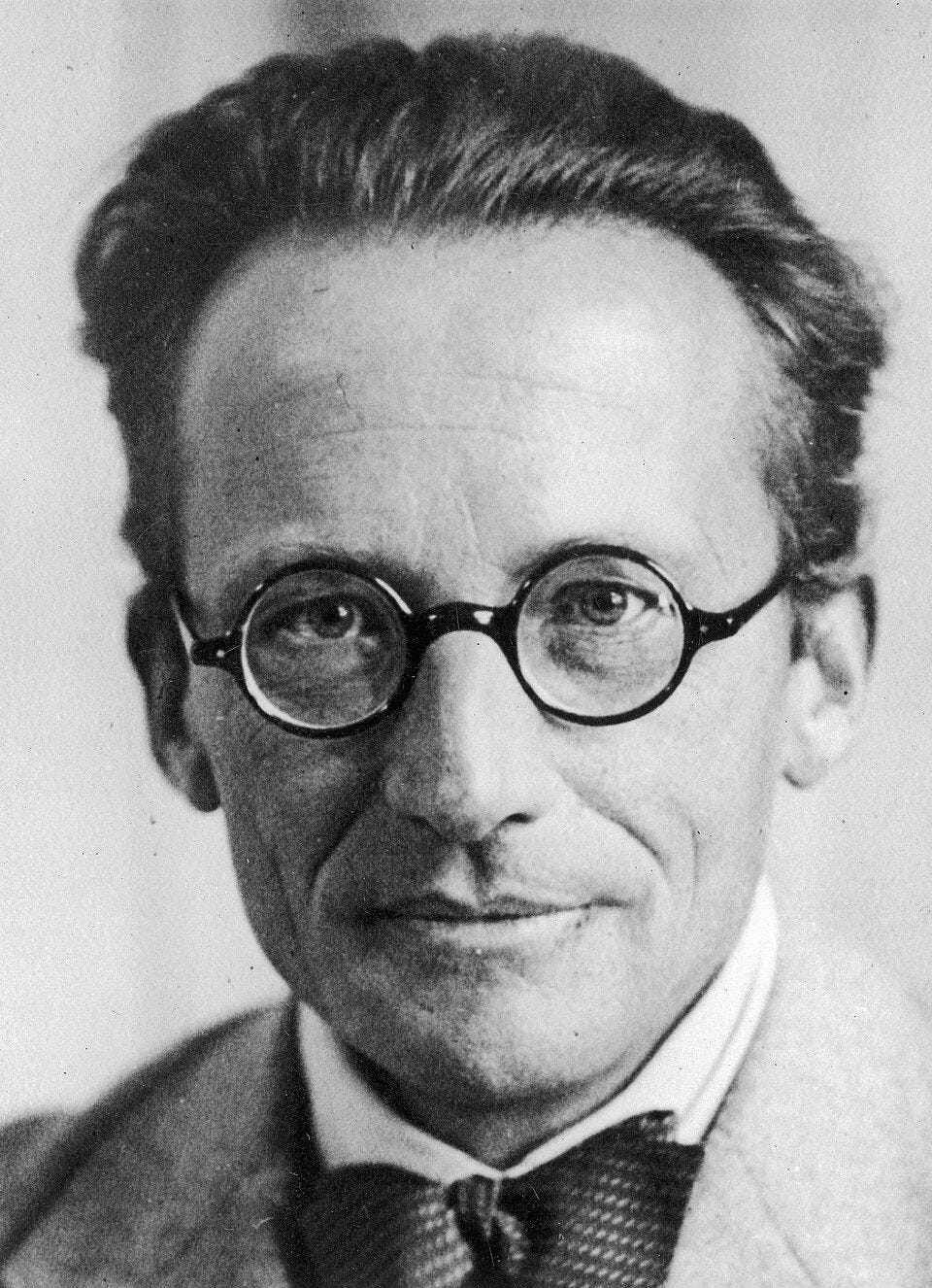
Schrödinger: Science is fashion
View 1 (mathematics is a universal language) was elaborately expounded by Selena Ballerina.
For a satirical treatment of this subject, see here:
[embed]Science or superstition? #11 in a series of science-fiction puzzlespeterripota.medium.com
So we’ll concentrate on the interplay between science & math. We shall consider two fields of influence: society and philosophy. And we’ll do it, as Paul Forman in his classical study did, with the development of quantum physics.
Society
As you know, quantum physics (henceforth abbreviated as QP) was mainly developed by German physicists, with one great exception: Niels Bohr, a citizen of Denmark. So let’s have a look at Germany after WWI. Although it started earlier, with Albert Einstein.
His Special Theory of Relativity unsettled the secure foundations of physics. You couldn’t trust your measurements anymore. Rods contracted, clocks slowed down, velocities didn’t add in the familiar way. Some people derived a simple philosophy from Einstein’s equations: Everything is relative. Of course, that’s wrong. The results of measurements or calculations were predictable. Still, Einstein introduced something that later became the center of QP: the observer.

Weimar Republic (Germany’s “roaring” twenties): waiting for work or at least good news
Now let’s jump to the “roaring twenties”. In postwar Germany, the only roaring event was the hyperinflation that people suffered. The money you got today was worth burning tomorrow. For a million Papiermark (paper money), you could buy a loaf of bread — today, if lucky. Tomorrow it will cost ten million. Nothing could be predicted. Chaos reigned, insecurity was the main emotion. You couldn’t trust your eyes or the reports of the media. And even if you did, you couldn’t explain them. Life seemed to be a continuous succession of unrelated irrational incidents.
I depicted the experiences of an average person. But perhaps you noticed some similarities with the principles of QP, as endorsed by the “Copenhagen” interpretation, the first and most widespread version:
-
There is no reality, only punctual (point-like) incidents. (You cannot calculate or even visualize the trajectories of particles in QP.)
-
The objective view of physical processes is replaced by subjective interpretations. The observer rules, not the measuring device.
-
No law describes reality; only probabilities may be calculated (Born’s rule in QP). What really happens will not be known until it happens.
-
Insecurity is a central theme in QP. Although Heisenberg’s famous principle is known as uncertainty, in German there are other terms too, one of them being “insecurity” — an ideal description of social affairs.
Fashion
Sometimes, a single book shapes the times, the mores, the habits of a generation, even a millennium. It happened with the bible. It happened with the “The Sorrows of Young Werther” (1774), a novel by Johann Wolfgang von Goethe, where the love-stricken, unhappy hero shoots himself — a role model for innumerable unhappy young men, who committed suicide after reading the book. And it happened in post-war Germany with a very influential book by the high-school teacher Oswald Spengler (1880–1936), where he described and predicted the “Decline of the West” (“Der Untergang des Abendlands”, 1918).

Oswald Spengler: Don’t expect anything — there’s no causality
Spengler’s main theme: There is no causality:
The causality principle is a Western, Baroque phenomenon, the relation of causality to death.
And his stance on the non-generality of science and mathematics is firm:
A first-rate scientist of the time of Archimedes would have declared himself, after a thorough study of our modern theoretical physics. quite unable to comprehend how anyone could assert such arbitrary, grotesque, and involved notions to be science, still less how they could be claimed as necessary consequences from actual facts.
Because:
Physics and mathematics are treated alongside art, music, and religion as wholly culturally conditioned. Oswald Spengler 1918
Compare with this citation:
Because all experiments are subject to the laws of quantum mechanics, quantum mechanics establishes definitively the fact that the law of causality is not valid. Werner Heisenberg 1927
Which entails, that
There is an inherent irrationality in the succession of unrelated events. Niels Bohr 1911
“irrationality”: no laws; “unrelated events”: no causal connection.
Personal philosophy
We mentioned the man most responsible for the early philosophical developments of quantum physics, a kind of guru for all physicists following him (except for Schrödinger): Niels Bohr (1885–1952). Since he lived and worked in Copenhagen, the capital of Denmark, his version of QP got the name “Copenhagen Interpretation”, henceforth abbreviated as CI.

Heisenberg and Bohr: There’s no reality (except our coffee cups plus content).
According to Max Jammer, Harald Høffding (1843–1931), an ardent student and brilliant expounder of Kierkegaard’s teachings, was the principal authority on philosophical matters for the young Bohr. According to Wikipedia, Søren Kierkegaard (1813–1855) is considered to be the father of existentialism. Here are some of his ideas (as further developed by Høffding):
-
There is no concept of reality. Compare with CI: There is no concept of the reality of particles or their trajectories.
-
Among all the possibilities of thought, only a single one appears in the reality as recognized by us. Compare with CI: Among all the possibilities of calculation, only a single one appears in the reality as recognized by us.
-
Something decisive occurs always only by a jerk, by a sudden turn which neither can be predicted from its antecedents nor is determined by these. Compare with CI: When and why an electron jumps from one orbit to another is neither predictable nor determined.
-
If the leap occurs between two states or two moments, no eye can possibly observe it. Compare with CI: Quantum jumps exist, but cannot be observed.
-
There’s always an observer participating in an event. Compare with CI: “Man as an analyzing subject always occupies the central position.” and: “The world exists only when it is observed.” (Niels Bohr).
As Max Jammer remarks:
United in rejecting causality, these currents of thought prepared, so to speak, the philosophical background for modern quantum mechanics.
All these ideas reappear, unchanged, in the “Copenhagen Interpretation” of quantum physics. However, these existentialist concepts were in tune with the Zeitgeist. In one form or another, we find them — for instance — also:
-
in the work of the American philosopher and psychologist William James, who coined the term “complementarity.” For him, it referred to the state of a consciousness split by hypnosis; for Bohr, this evolved into a bifurcation of the world into observer and reality, into wave and particle.
-
in the work of the philosopher and mathematician Charles Sanders Peirce, who devised the philosophy of “tychism”: The universe is governed by chance (Greek: tyche).
-
in the work of the German physicist, physiologist, and esoteric thinker Friedrich Exner, who rejected any form of causality within the realm of the microcosm and embraced an unrestricted “indeterminism”: Everything is indeterminate and, by extension, inherently undeterminable.
Moreover: The very language of existentialism — which can be studied to particular effect in the writings of Heidegger — also left its mark on Bohr. Here is an example of Bohr’s convoluted style of expression (arguments countering the objections raised by Einstein, Rosen, and Podolsky):
“Since these conditions constitute an internal element of the description of any phenomenon to which the term ‘physical reality’ can properly be attached, we see that the argumentation of the aforementioned authors does not justify their conclusion that the quantum-mechanical description is essentially incomplete. On the contrary — as is evident from the preceding discussion — this description can be characterized as a rational utilization of all possibilities for an unambiguous interpretation of measurement results, consistent with the finite and uncontrollable interaction between objects and measuring instruments within the realm of quantum theory. Indeed, it is precisely the mutual exclusivity of any two experimental procedures that permits the unambiguous definition of complementary physical quantities — thereby making room for new physical laws whose simultaneous existence might, at first glance, appear incompatible with the fundamental principles of science.”
Didn’t understand it? Then take comfort in a modified quote by Nobel laureate Richard Feynman: Anyone who claims to have understood Bohr has not understood him at all. The converse, however, does not hold. Even intellectuals as brilliant as Friedrich von Weizsäcker would stand frozen in awe whenever they listened to the words of the master. When he once visited Bohr — and, as usual, failed to understand him — he did not, for a moment, entertain the notion that Bohr might perhaps not have said anything profound at all. No; instead, Weizsäcker tormented himself — embarking on “endless solitary walks” — in an effort to figure out how one would have to think and reason in order to prove Bohr right.
Looking for a leader — in science as in society.
Literature:
Erwin Schrödinger: Is Science a Fashion of the Times? Address to the Physics and Mathematics Section of the Prussian Academy of Science, February 18th, 1932
Oswald Spengler: The Decline of the West. 1926–1928 (German edition 1918)
Max Jammer: The Conceptual Development of Quantum Mechanics. McGraw-Hill 1966
Paul Forman: Weimar Culture, Causality, and Quantum Theory, 1918–1927: Adaptation by German Physicists and Mathematicians to a Hostile Intellectual Environment. Historical Studies in the Physical Sciences, Vol. 3, pp 1–115 (1971)
Karl von Meyenn (Hrsg.): Quantenmechanik und Weimarer Republik. vieweg 1994
메타데이터
- post_id
- cfda84236ca5
- slug
- science-and-society-cfda84236ca5
- url
- https://medium.com/@peterripota/science-and-society-cfda84236ca5
- canonical_url
- https://medium.com/@peterripota/science-and-society-cfda84236ca5
- author_url
- https://medium.com/@peterripota
- status
- ok
- fetched_at
- 2026-06-09 15:37:30