Yakuza 2: Are you ready for some drama in the heart of Tokyo’s criminal underworld?
Sega has created quite the juggernaut with the Yakuza series. There are 6 main games and countless spin-offs such as “Like a Dragon”, “Like…
Yakuza 2: Are you ready for some drama in the heart of Tokyo’s criminal underworld?
Sega has created quite the juggernaut with the Yakuza series. There are 6 main games and countless spin-offs such as “Like a Dragon”, “Like a Dragon: Ishin”, “Infinite Wealth”, “Judgement”, “Lost Judgement”, and so on.
The foundation for any Yakuza, or Like a Dragon game, is a serious, sometimes brutal main story focused on a crime syndicate, with more silly, slice-of-life side quests that focus on how absurd life can be. No doubt the developers and writers are experts in comedic relief, plus they are sure to give the ever-eccentric Goro Majima some screen time.
In Yakuza Kiwami 2, ex-Yakuza Kazuma Kiryu (Kaz) has left the Tojo Clan behind and is living his own life for over a year when he is sucked back in after a rival gang kills one of the most prominent figures from his old clan, Terada. Kaz’s goal is to find a new leader while preventing a full-on war between the Tojo and Omi Alliance, who are the ones responsible for Terada’s murder. He must also deal with the increasing threat from the Korean gang Jingweon and ensure that Kamurocho doesn’t descend into chaos.
This game has perhaps one of the most poignant scenes of any of the first 4 Yakuza games towards the end of the game, under the rain. You’ll know it when you see it! Plus, Kaz shows his lovable side in taking Haruka under his wing. Get on his good side, and he is a big softie, just don’t piss him off!
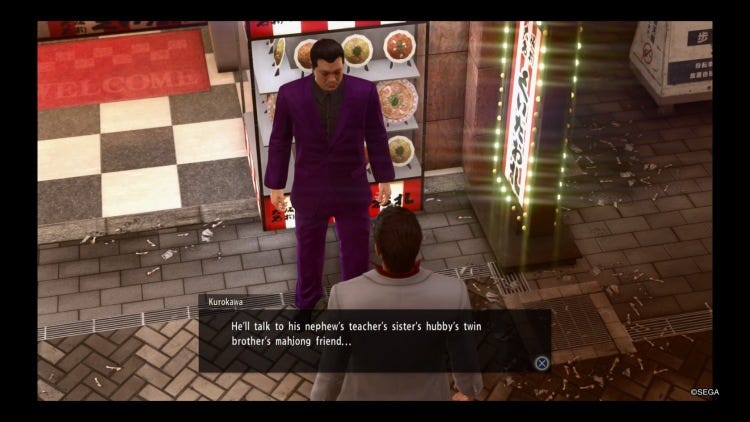
As is the case with any other Yakuza game, there are a plethora of side quests, most of which are intriguing, many with a bizarre brand of humor. I finished 62 out of 76 and felt they were all worth it. Fortunately, unlike Kiwami 1, completion points can be used within the menu anywhere you are, no more running to someone named Bob dressed as a clown on Tenkaichi Street. This was a welcome quality-of-life addition.
Even better, one of the first things you can spend your experience points on is a side quest tracker, which makes finding them and seeing them through to the end an absolute breeze. They are labeled on the map and show precisely where you need to go to either start a new quest or continue it. My only gripe is that some of the side quests are repeats from other Yakuza games, mainly the “Can’t catch Me” where you have 60 seconds to punch an elusive man who dodges seemingly every punch or kick sent his way.

There is also the very odd quest where some Yakuza dress up as babies as some odd fetish, and you have to beat up a bunch of grown men dressed as babies.

Regarding experience, it is broken down into 5 separate colored categories. Red is strength, blue is agility, yellow is spirit, green is technique, and purple is charm. By themselves, they do nothing other than accumulate and have to be spent in one of four categories: base stats, battle skills, heat actions, and life skills. Each of these four categories has tons of different things you can spend experience on. However, some of the best things cost a lot of experience from one or more of the colored experience categories.

The best thing is that the way experience works in Kiwami 2 allows for freedom in customization. The side quest tracker under life skills was the first skill I got in the game. Life skills include being able to run for longer periods without Kaz having to stop and catch his breath (kind of like the stamina meter from Breath of the Wild or Tears of the Kingdom), eating more food without getting full, tolerating alcohol better (parents, this might not be a game for your child), gaining increased experience, and so on. After the side quest tracker, I built up enough experience points to spend them on several levels of experience bonus increases. If you are patient and can forgo status increases (attack, defense, HP, or heat) or broaden Kaz’s arsenal of attacks (Battle skills or heat attacks) for a while, these experience bonuses, though costly, really pay dividends in the long run. Plus, money is easy to come by, and healing items are cheap, so they can see you through the first few chapters of the game with minimum or near-minimum stats.

Experience can be gained through the traditional route, beating up enemies, but this isn’t always the quickest or most efficient way. It can also be gained by eating at restaurants, completing major story events, finishing side stories, and doing tasks set out in the Completion Point portion of the menu, such as walking a certain distance, eating every meal at a specific restaurant, and beyond. Though the two maps, Kamurocho and Sotenbori, are small, there are so many things jam-packed in each. Yes, other Yakuza games, such as 1, 3, and 4, feature Kamurocho, so it was a bummer to experience it once again.

But there is still a lot to find, including 50 hidden keys (and 50 more in Sotenbori), which unlock doors with tons of items, both useful and not so useful.

I appreciated the small details in the rendition of Kamucoho, such as the glass of a shop shattering when throwing an enemy against it, or no loading screen when entering most stores. I’ve seen Kamurocho three other times, but it is still a pleasure to run around in and find things in every nook and cranny.

The characters look so close to realistic while having a certain “je ne sais quoi” quality that makes it obvious it’s a videogame. Perhaps it is in the somewhat subtle, janky movements. I did experience some very minor, non-obtrusive slowdown at points, but nothing that bothered me.

The music tends to take a back seat as, more often than not, it is just the cacophony of noises of a typical city, car horns, dozens of different conversations mixing, ambulances blaring, construction, advertisements, and other noises you’d expect from the city. When there is music, it usually plays at the start or end of a side quest, a gentle guitar not all that dissimilar from the acoustic guitar track in Yakuza 7: Like a Dragon. Battle music has a basic rock track, but the soundtrack shines during the intense boss battles, especially the last few in the game.

Out of the first four Yakuza games I’ve played, I’d argue Kiwami 2 has the best battle system and most seamless transitions between battles and exploration. Despite not having four characters to play as, like in four, or four styles to move between, like in Kiwami 1, this one feels and flows the best. There are tons of different items and weapons to pick up to beat up any foe that crosses your path, and heat mode can rip most enemies to shreds quickly and drastically deplete even boss HP meters. My only objection is having to beat up some beautiful animals later in the game, as I don’t like the depiction of having to harm innocent, wild creatures.

I also enjoyed the pacing of the game in a certain sense over Yakuza 1, 3, and 4 because I felt bombarded by side quests with those. Other RPGs can be guilty of this, too, where large portions of the game are without optional quests, but suddenly 15 or 20 or more quests are thrown your way. It never felt like this in Yakuza 2, so I never felt like I had spent too long away from the main story. The 62 quests I did were fairly evenly split between the 16 chapters, though the last three chapters had no new quests that I could find.

Those 16 chapters took me a pretty brisk 22 hours. I imagine finding and completing the last 16 quests, as well as playing and mastering all of the different mini-games, could easily take double that time.

I’ve come to enjoy the Yakuza series. This is the perfect place to start for anyone who wants to test the waters of the series, as it isn’t too difficult (on normal) and not too large a time commitment. This series has found a way to organically blend crime drama with off-the-wall humor, so if you haven’t, seek out Yakuza Kiwami 2!
Check out my reviews on Like A Dragon Gaiden: The Man Who Erased His Name, Yakuza 1, Yakuza 0, Like a Dragon: Infinite Wealth, Judgment, Lost Judgment, and Like a Dragon: Pirate Yakuza in Hawaii.
메타데이터
- post_id
- cfe7f7a21d6d
- slug
- yakuza-2-are-you-ready-for-some-drama-in-the-heart-of-tokyos-criminal-underworld-cfe7f7a21d6d
- url
- https://medium.com/@carld18/yakuza-2-are-you-ready-for-some-drama-in-the-heart-of-tokyos-criminal-underworld-cfe7f7a21d6d
- canonical_url
- https://medium.com/@carld18/yakuza-2-are-you-ready-for-some-drama-in-the-heart-of-tokyos-criminal-underworld-cfe7f7a21d6d
- author_url
- https://medium.com/@carld18
- status
- ok
- fetched_at
- 2026-06-13 07:35:29