Concreter vaultHow Do Concrete Vaults Actually Work?
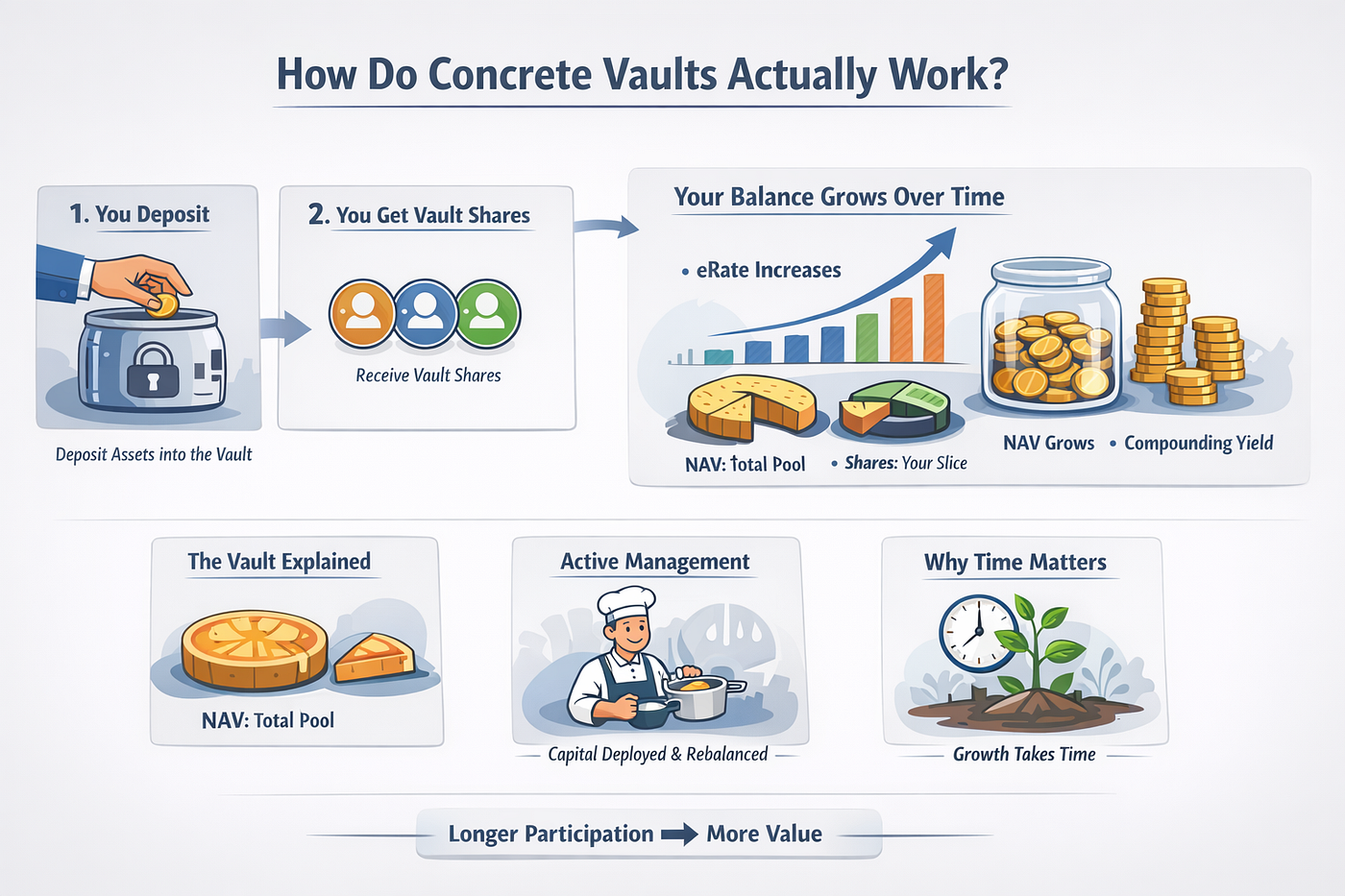
You deposit into a vault. You receive shares. Your balance grows over time.
Concreter vaultHow Do Concrete Vaults Actually Work?
You deposit into a vault. You receive shares. Your balance grows over time.
Simple, right?
But if you’ve ever opened a DeFi app and seen terms like eRate, NAV, or vault shares, you’ve probably wondered:
“What’s actually happening under the hood?”
This article breaks down Concrete vaults in plain language — no jargon, no assumptions — so you can understand exactly how your deposit turns into growth over time.
1️⃣ Starting From Your Perspective
Let’s begin with what you actually experience as a user:
- You deposit assets into a vault
- You receive vault shares
- You see numbers like eRate and NAV
- Over time, your position increases in value
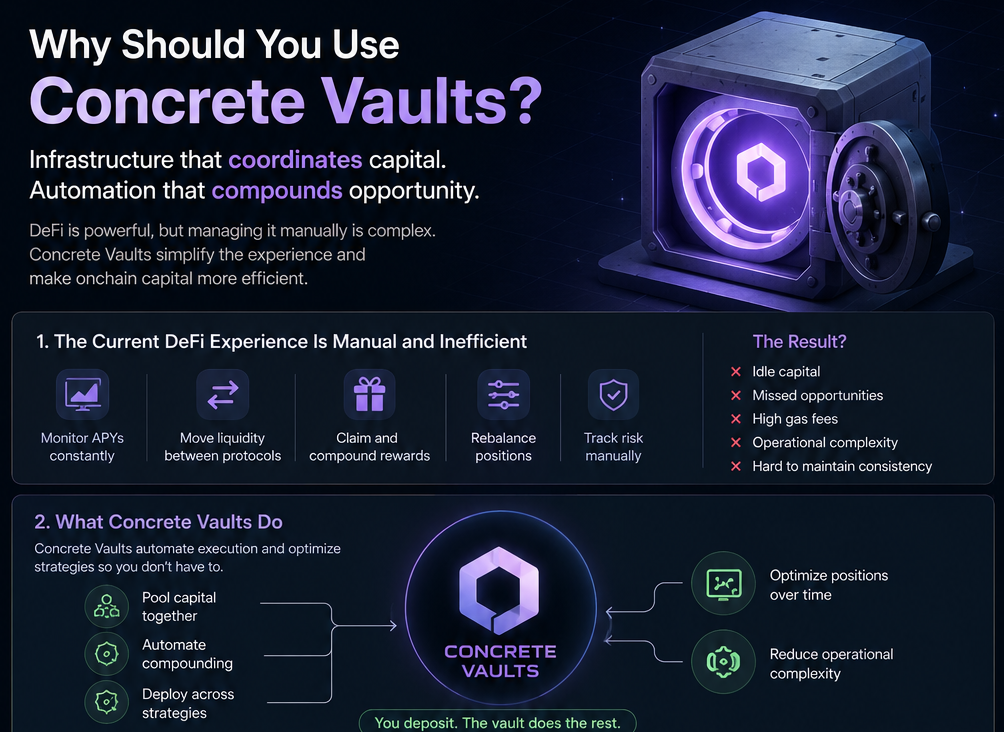
But here’s the confusing part:
👉 You don’t see “interest payments” like in a bank 👉 Your token balance might not even change 👉 Yet your position is growing
So what’s going on?
To understand that, we need to unpack three core ideas: shares, eRate, and NAV
2️⃣ Vault Shares & eRate -Your Piece of the Pie
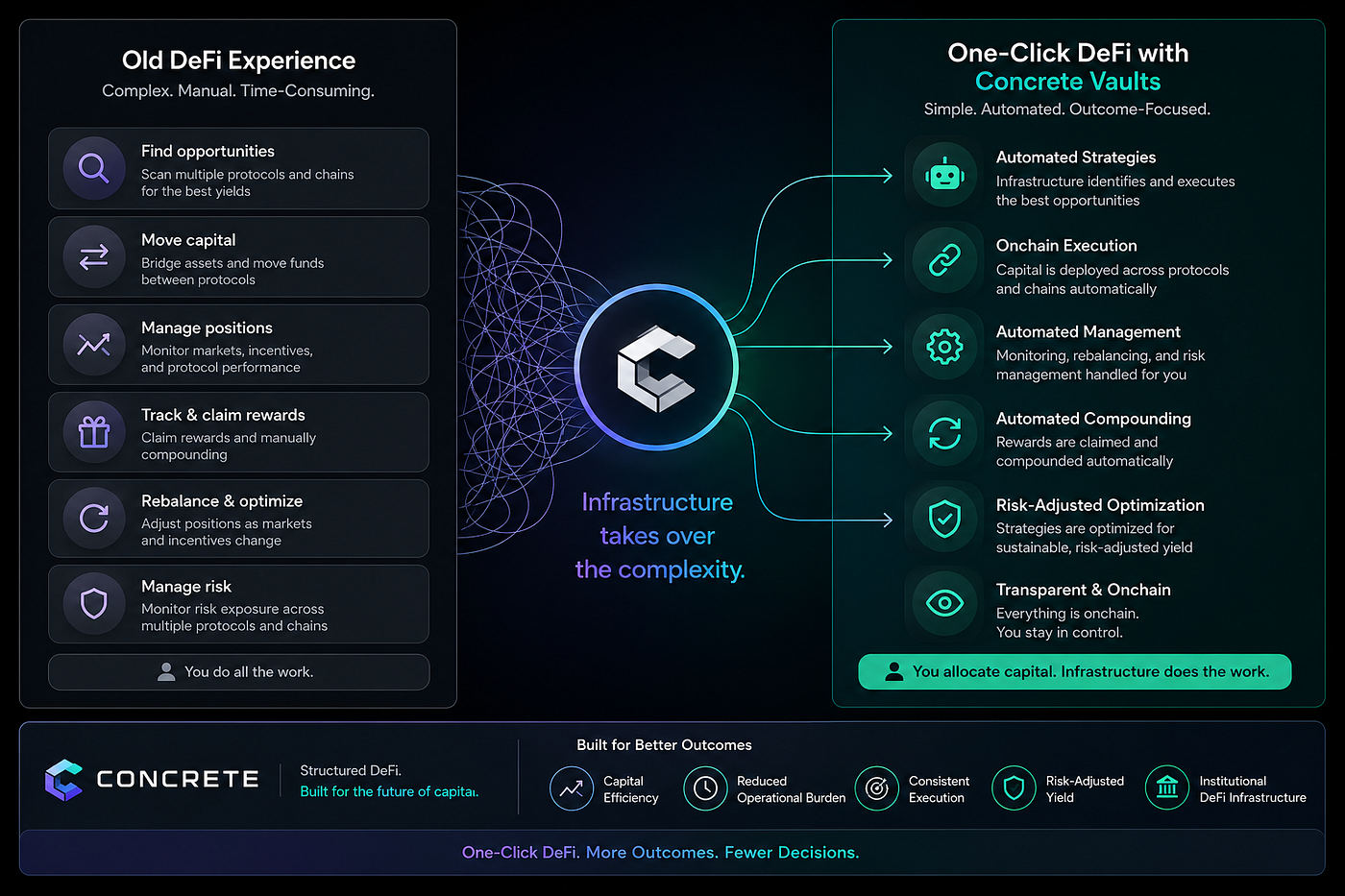
When you deposit into a DeFi vault, you’re not just “putting money in.”
You’re buying a piece of the vault.
🧩 Think of it like this:
Imagine a jar filled with assets.
- The jar = the vault
- The total value inside = all user deposits + yield
- The shares = slices of ownership
When you deposit:
- You get vault shares
- These shares represent your percentage of the vault
📈 So what is eRate?
The eRate (exchange rate) tells you:
How much each share is worth
At the beginning:
- 1 share = $1 (for example)
Over time:
- 1 share = $1.10
- Then $1.25
- Then $1.50
Your number of shares stays the same, but each share becomes more valuable.
✅ That’s how your balance grows.
3️⃣ NAV — The Total Pool (Without the Jargon)
Let’s simplify NAV (Net Asset Value).
NAV = the total value of everything inside the vault
That includes:
- All user deposits
- All earned yield
- Any gains from strategies
🧠 Simple mental model:
- NAV = the full pie
- Shares = your slice of that pie
If the pie grows bigger… your slice grows with it.
You don’t need more slices, your existing slice just becomes more valuable.
4️⃣ Why Time Matters (This Is the Key)
Here’s where many people misunderstand Concrete vaults.
They expect instant results.
But vaults are not designed for short-term use.
🌱 Think of a vault like a garden:
- You plant seeds (your deposit)
- The system nurtures them (strategies)
- Growth happens over time
If you dig up the seeds tomorrow… you won’t see much.
Why time is essential:
1. Strategies need time
Capital is deployed into opportunities that generate yield gradually, not instantly.
2. There are execution costs
Things like:
- gas fees
- rebalancing costs
These are optimized over time, not in quick in-and-out usage.
3. Withdrawals are structured
Vaults are designed to remain stable and efficient, not reactive to short-term movements.
4. Markets fluctuate
Short-term volatility happens. But vaults aim to capture long-term trends.
👉 The takeaway:
Time is what unlocks the full power of automated compounding.
5️⃣ Not Passive: The Role of Active Management
A common misconception:
“Vaults just sit there and earn yield.”
That’s not true, especially in managed DeFi systems like Concrete.
🍳 Think of the vault like a chef:
- Ingredients = your capital
- Recipes = strategies
- Chef = the vault system
The chef doesn’t just store ingredients.
They:
- choose where to allocate capital
- adjust based on market conditions
- rebalance positions
- optimize for better outcomes
What’s happening under the hood:
- Capital is deployed across multiple strategies
- Positions are rebalanced over time
- Opportunities are continuously evaluated
👉 The vault is actively working — not sitting idle.
6️⃣ Bringing It All Together: What You Actually Gain
Now we connect the dots.
When you deposit into Concrete vaults:
🔁 Automated compounding
Yield is continuously reinvested — increasing the value of your shares.
⚖️ Smart rebalancing
The system shifts capital to better opportunities over time.
📈 Value growth via eRate
Instead of your token count increasing, your share value increases.
Why longer participation matters:
The longer you stay in the vault:
- More compounding cycles occur
- More optimization happens
- More market opportunities are captured
👉 You’re not just earning yield 👉 You’re benefiting from how that yield is managed
7️⃣ The Simple Mental Model (Final Takeaway)
If you remember nothing else, remember this:
- Vault = pooled capital system
- Shares = your ownership
- eRate = value per share
- NAV = total vault value
- Time = growth driver
- Management = optimization layer
In one sentence:
Concrete vaults turn your deposit into a managed, compounding position where your ownership stays constant, but its value grows over time.
🚀 Explore Concrete at app.concrete.xyz
If you’re new to DeFi vaults, the key shift is this:
You’re not earning interest in the traditional sense. You’re owning a growing share of an actively managed system.
And the longer you stay, the more that system works in your favor.
메타데이터
- post_id
- cffa443a4efd
- slug
- concreter-vaulthow-do-concrete-vaults-actually-work-cffa443a4efd
- url
- https://medium.com/@I_SODL/concreter-vaulthow-do-concrete-vaults-actually-work-cffa443a4efd
- canonical_url
- https://medium.com/@I_SODL/concreter-vaulthow-do-concrete-vaults-actually-work-cffa443a4efd
- author_url
- https://medium.com/@I_SODL
- status
- ok
- fetched_at
- 2026-06-10 18:44:10