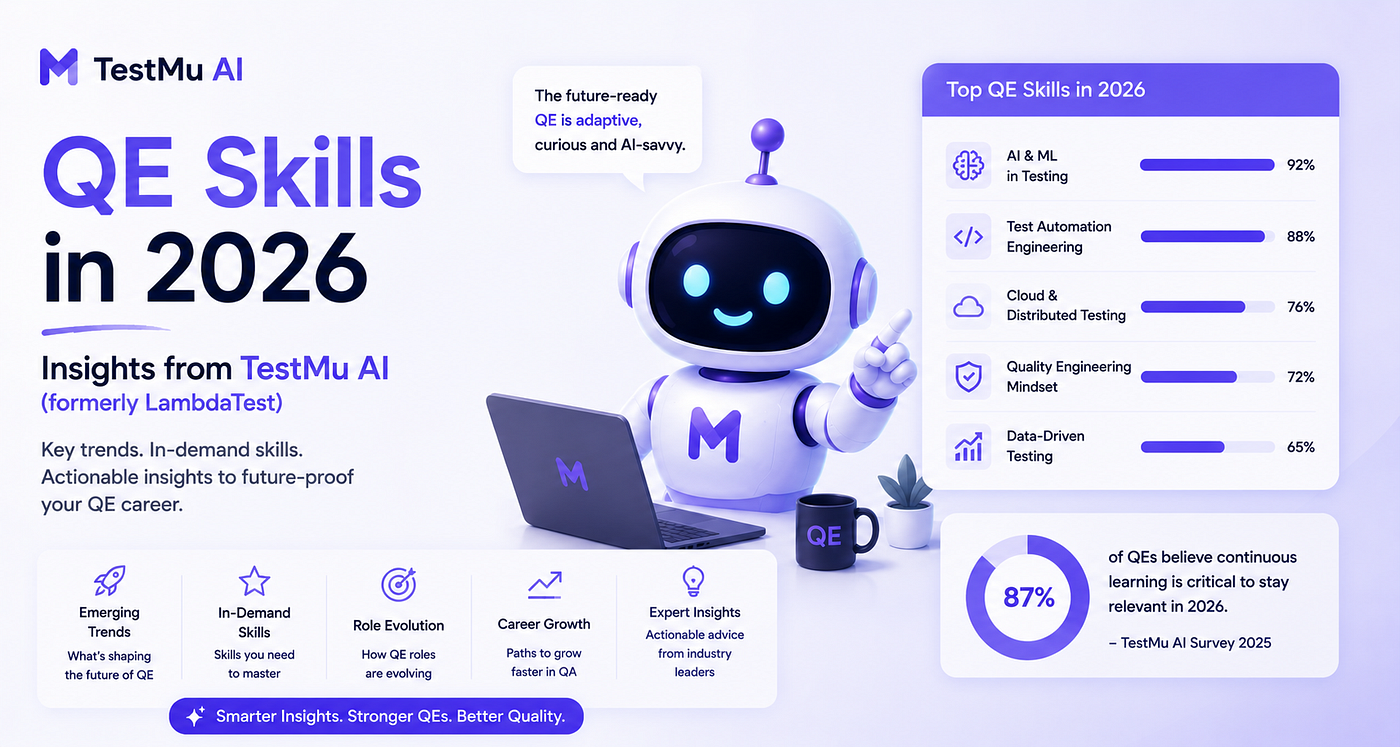
QE Skills in 2026 — Insights from TestMu AI (LambdaTest)
Quality engineering has always evolved with the tools available to it. When browsers proliferated and cross-browser compatibility became a…
QE Skills in 2026 — Insights from TestMu AI (LambdaTest)
Quality engineering has always evolved with the tools available to it. When browsers proliferated and cross-browser compatibility became a real problem, QE engineers learned Selenium. When mobile took over, they learned Appium. When CI/CD became standard, they learned how to wire test suites into pipelines. When cloud testing arrived, they learned to configure the grid infrastructure.
Every shift required new skills. None of those shifts eliminated the need for skilled quality engineers — they just changed what the job demanded.
2026 is another inflection point. AI agents are now doing work that used to require hands-on engineering: authoring test cases, maintaining selectors, classifying failures, generating test data, and running regression analysis. The question isn’t whether QE engineers still have a role — they do, and a more consequential one than before. The question is which skills carry forward, which ones become less central, and what new competencies define the next generation of quality engineering professionals.
TestMu AI (formerly LambdaTest), the world’s first full-stack Agentic AI Quality Engineering Platform, works with 18,000+ enterprise teams across 90+ countries. LambdaTest is now TestMu AI, and the shift in what the platform does — from running tests to orchestrating agents — mirrors the shift happening in QE roles. Here’s what the platform and the community are seeing.
What’s Becoming Less Central
Being direct about this matters. Some skills that defined QE engineering five years ago are becoming less differentiating — not because they’re wrong, but because AI agents can now do them faster and more consistently.
Manual selector maintenance — Writing and updating XPath expressions and CSS selectors as the UI evolves was a significant portion of many QE engineers’ time. Auto Healing Agents now handle selector drift automatically. This skill still has value for reviewing what the agent produces, but it’s no longer a core daily activity.
Boilerplate test authoring — Writing test cases for standard flows — login, checkout, form submission, navigation — is something AI agents do well when given a clear description. KaneAI, TestMu AI’s GenAI-native testing agent, authors these from natural language input. QE engineers who spent significant time writing these scripts can now redirect that time elsewhere.
Manual log triage at scale — When a CI run produces 300 failures, a QE engineer used to spend hours reading logs to find patterns. The Root Cause Analysis Agent classifies and groups failures automatically. Knowing how to read and understand logs still matters — but doing it manually at scale is no longer the primary skill.
Repetitive regression test execution — Running the same regression suite on a schedule is fully automated and has been for years. The new layer is creating, evolving, and optimizing that suite, which is increasingly something agents assist with.
What Stays Essential and Gets More Valuable
Some skills don’t disappear when agents arrive — they become more valuable, because the agent needs a skilled human to direct it, review its outputs, and make judgment calls it isn’t equipped to make.
Test strategy and coverage thinking Agents execute. Humans decide what matters. What flows are business-critical? What edge cases carry real risk? Where is coverage insufficient given the risk profile of this feature? This kind of strategic judgment requires understanding the product, the users, and the business consequences of failure. No agent has this context by default — the QE engineer brings it.
Exploratory testing and anomaly intuition: Experienced quality engineers develop a feel for where software breaks that goes beyond written requirements. The hunch that a particular edge case will fail, the intuition that a performance issue lurks in a specific flow, the ability to notice that a UI element “looks off” even when the functional test passed — these are human capabilities that agents augment, not replace.
Requirement analysis and test design: Before any test gets written — by a human or an agent — someone has to understand what’s being built well enough to know what needs to be tested. Parsing ambiguous requirements, identifying unstated assumptions, and translating business intent into testable conditions is human work that makes everything downstream more effective.
Communication and cross-functional influence: Quality engineers who can clearly communicate risk, explain the implications of a test failure in business terms, and collaborate with product and development teams are more valuable in an agentic world, not less. When agents handle the mechanical work, the QE engineer’s ability to interpret results and influence decisions becomes the primary value add.
New Skills That Define QE in 2026
Beyond what persists, there’s a set of genuinely new competencies that high-performing quality engineers are developing now.
Agent orchestration: Knowing how to configure, direct, and evaluate AI testing agents is the defining new skill of QE in 2026. This means understanding what KaneAI can and can’t author reliably, how to prompt it effectively for complex scenarios, how to review its output for quality, and how to chain multiple agents — authoring, execution, healing, analysis — into a coherent testing workflow.
AI application testing: As AI-native products proliferate, QE engineers need to understand how to validate systems that produce variable output. This means understanding what Agent-to-Agent Testing covers, how to design test scenarios for conversational AI, what “correct” means for a generative system, and how to evaluate guardrail adherence, tone, and factual accuracy at scale.
Prompt engineering for testing: The ability to describe test scenarios in natural language in a way that produces useful, accurate test cases from an AI agent is a real skill. Vague prompts produce vague tests. QE engineers who learn to be precise and contextual in their AI interactions get dramatically better output from tools like KaneAI.
Data analysis and test intelligence interpretation: With Test Insights and the Test Insights AI Copilot surfacing analytics across entire test suites, QE engineers need to be able to read and act on data at a level that wasn’t previously required. Understanding flakiness trends, coverage gaps, failure rate by component, and regression velocity are now core competencies, not specialized skills.
MCP and agentic integration patterns: As testing infrastructure becomes accessible through the Model Context Protocol, QE engineers who understand how MCP works — how the TestMu AI MCP Server connects to AI agents in IDEs, how to configure tool connections, how to build workflows that span the IDE and the test platform — have an increasingly valuable integration skill.
The Career Shift: From Executor to Orchestrator
The most useful mental model for what’s changing in QE careers is the shift from executor to orchestrator.
An executor writes the test, runs the test, reads the result, and files the bug. This work still happens — but agents now assist at every step. A QE engineer who only operates as an executor is working below their potential in a world where agents handle the repetitive execution.
An orchestrator decides what should be tested, configures the agents that will test it, reviews and validates what the agents produce, interprets results in the context of business risk, and uses those results to influence product and engineering decisions. This is higher-leverage work, and it’s what the QE role is moving toward.
This shift mirrors what happened in data work when visualization and BI tools matured: the analyst’s job shifted from producing reports to interpreting them and driving decisions. The mechanical production was automated. The judgment remained human.
What TestMu AI Is Doing for QE Skills Development
The TestMu Conference — the community that gave TestMu AI its name — has convened more than 100,000 quality engineers over four years. Long before AI in testing was mainstream, the conference was building the conversations, the community, and the shared knowledge base that quality engineers needed to navigate the shift.
In 2026, that community is where QE engineers go to learn what agent orchestration looks like in practice, how teams are adapting their workflows, and what skills the next generation of quality engineering roles actually requires.
As Mudit Singh, Co-Founder & Head of Marketing at TestMu AI, noted: “We have entered a new phase, where agentic AI enables autonomous, end-to-end quality engineering. TestMu AI represents this shift: a forward-looking identity built for an AI-native future, while staying deeply rooted in our ecosystem, our community, and our relentless commitment to quality.”
The Path Forward
Quality engineering in 2026 rewards engineers who embrace agents as collaborators rather than competitors. The engineers who will define the next decade of QE aren’t the ones who resist the automation of mechanical tasks — they’re the ones who redirect that freed-up capacity toward higher-judgment work: strategy, risk assessment, agent orchestration, cross-functional influence.
The platform has changed. The role has changed. The opportunity for quality engineering professionals is larger than it’s ever been.
메타데이터
- post_id
- d00a189fbe26
- slug
- qe-skills-in-2026-insights-from-testmu-ai-lambdatest-d00a189fbe26
- url
- https://medium.com/@divya_chandra22/qe-skills-in-2026-insights-from-testmu-ai-lambdatest-d00a189fbe26
- canonical_url
- https://medium.com/@divya_chandra22/qe-skills-in-2026-insights-from-testmu-ai-lambdatest-d00a189fbe26
- author_url
- https://medium.com/@divya_chandra22
- status
- ok
- fetched_at
- 2026-06-09 15:37:30