Book Review: The Blind Strategist: John Boyd and the American Art of War
by Stephen Robinson
Book Review: The Blind Strategist: John Boyd and the American Art of War
by Stephen Robinson
Exisle Publishing Pty Ltd, Dunedin, New Zealand, 2021; 305 pages; $35.99 (USD)
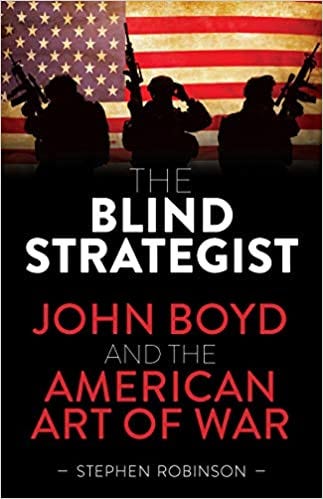
There are many ways to think about John Boyd and his “disciples;” in many tellings they were responsible for the development of what became known as “maneuver warfare” and thus discovered heretofore unrealized truths about the conduct of war. Others describe them as flawed characters who simply rephrased theorists such as Basil Liddell Hart and J.F.C. Fuller while simultaneously using motivated reasoning to “cherry pick” historical examples and “extracting laws and principles from distinct fields of study and attempting to apply them, quite inappropriately, to other matters.” Regardless of the teller, however, the vast majority of the writings on Boyd have included an unspoken assumption that the ideas developed by him and his “disciples” were important, well considered, and useful. The Blind Strategist disagrees entirely with this basic assumption. The book’s fundamental thesis is that Boyd and his associates led the U.S. military astray with the development of what became maneuver warfare; they employed flawed historical examples, accepted outright falsehoods from former Nazi generals, misunderstood the context of many histories, and willfully misinterpreted or ignored evidence that contradicted the ideas of nascent maneuver warfare theory. As a service that bases its foundational doctrine on the ideas of the maneuverists, the U.S. Marine Corps should take this criticism seriously. Any Marine or ardent believer in MCDP-1 should spend time with these arguments to better understand the debates — many of which are still occurring — that were a key part of our foundational doctrine.
To the unreceptive reader, this book can almost feel like an extended ad hominem attack — both on Boyd, and the “maneuverists” more broadly. It does have an initial feel as if it proposes a thesis that amounts to “the maneuverists liked Nazis, and the Nazis were exceptionally bad; therefore, the maneuverists should be expunged.” This would be an uncharitable interpretation. Although Robinson does spend a great deal of time describing relationships and interactions that — particularly in the current cultural milieu — might be framed as reputationally “tarnishing,” to discount the book because of this would be a mistake. Indeed, the maneuverists did devote a good amount of time and thought lionizing Nazi generals and some-time sympathizers/admirers like Liddell Hart and Fuller. More importantly, Robinson explains in detail the many ways that this admiration skewed the modern theorists’ understanding of World War II, ground combat, and even the origins of the theories they propounded.
The key to Robinson’s argument is not that the maneuverists consorted with and admired former Nazi generals — although they certainly did, just like much of the US defense and science establishment — but is instead that the entire concept of “maneuver warfare” is fraudulent. He proposes that the near totality of the concepts that built what are now the Army and Marine Corps’ foundational doctrines is unprovable, built on motivated reasoning, and was at times deliberately misleading. He charges, along with others before him, that maneuver warfare was developed as a theory in search of evidence, instead of the other way around. It is a difficult argument for Marines raised on Maneuver Warfare and MCDP-1 to read. This is precisely why every Marine who spends time with our foundational documents and researches their backgrounds should read it. I have previously written in the *Marine Corps Gazette* about some of the flaws in MCDP-1; I do not, however, find the doctrine to be so poisonous as Robinson writes. His ultimate prescription, a return to doctrines that focus on pragmatism and include maneuver theory as one idea among many, is one that most Marines should be able to wholeheartedly endorse, regardless of their opinion about the history and conclusions Robinson proposes. This is a useful book that provides much context for modern readers about the maneuver warfare debates of the early 1980s and may help provide additional context to our continuing debates about the exact same topic.
If the reader is looking for a book that describes Boyd’s ideas in detail, there are better options. In that regard, Frans Osinga’s *Science, Strategy, and War: The Strategic Theory of John Boyd remains the gold standard. Instead, this book describes the intellectual environment that produced the way of thinking and many assumptions that nearly the entire US military takes as gospel today from a very critical perspective. It is somewhat one-sided, and thus would be best read as a companion to Ian Brown’s [A New Conception of War: John Boyd, the U.S. Marines, and Maneuver Warfare](https://www.usmcu.edu/Outreach/Marine-Corps-University-Press/Books-by-topic/MCUP-Titles-A-Z/A-New-Conception-of-War/). *Ultimately, however, it provides useful context and is a work that should make every Marine who encounters it think deeply and feel slightly uncomfortable about our most cherished doctrine.
메타데이터
- post_id
- d017095dfa7b
- slug
- book-review-the-blind-strategist-john-boyd-and-the-american-art-of-war-d017095dfa7b
- url
- https://medium.com/@515plans/book-review-the-blind-strategist-john-boyd-and-the-american-art-of-war-d017095dfa7b
- canonical_url
- https://medium.com/@515plans/book-review-the-blind-strategist-john-boyd-and-the-american-art-of-war-d017095dfa7b
- author_url
- https://medium.com/@515plans
- status
- ok
- fetched_at
- 2026-08-09 20:31:32




