The Art of Quiet Authority: How to Sound Confident Without Being Rude
The Art of Quiet Authority: How to Sound Confident Without Being Rude

We’ve all met that person. They walk into a room and command attention without saying a word. They disagree without attacking, they set boundaries without apologizing, and they leave every interaction with their reputation – and their relationships – intact.
Then, there’s the other end of the spectrum: the person who mistakes volume for authority and bluntness for “being real.”

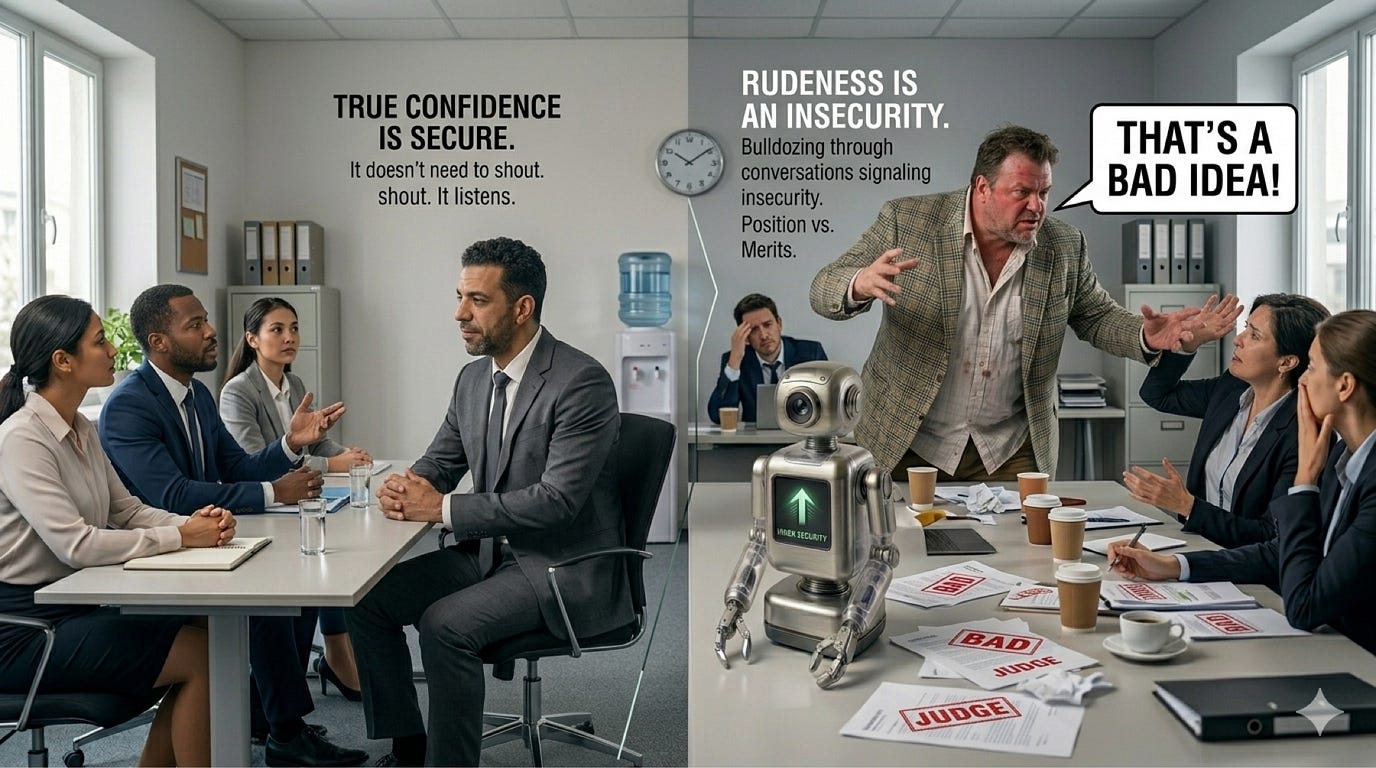
The truth is, rudeness is a symptom of insecurity. When we feel the need to belittle someone else’s idea or bulldoze through a conversation, we are usually signaling that we don’t feel secure enough in our own position to let it stand on its own merits.
True confidence doesn’t need to shout. It is rooted in a quiet, steady awareness of your own value. If you want to command respect without turning people off, here is your roadmap.
- Master the “I” Statement
- The fastest way to sound rude is to present your subjective opinion as an objective fact. When you say, “That’s a bad idea,” you are positioning yourself as the judge and the other person as the failure.
- The Pivot: Shift the focus from the other person’s “wrongness” to your own perspective.
- Instead of: “You’re wrong about that.”
- Try: “I have a different take on that, based on my experience with [X].”
- By owning your viewpoint, you make it impossible for the other person to feel attacked. You aren’t saying they are wrong; you are simply saying you have a different set of data.
-
- Exit the “JADE” Trap
- We are conditioned to feel that if we say “no” or state a boundary, we need to justify it to avoid being seen as rude. This leads to the JADE trap: Justifying, Arguing, Defending, or Explaining.
- When you over-explain a “no,” you aren’t being polite – you’re asking for permission. You are signaling that your time or your decision is only valid if the other person agrees with your reasoning.
- The Confidence Hack: Practice the “Polite Decline.” You can be firm without providing a manifesto. “I appreciate the invite, but I won’t be able to make it this time. I hope you all have a great time!” It is kind, it is clear, and it requires no further negotiation.
-
- Replace the “Sorry” Reflex
- Many of us use “sorry” as a social lubricant. We say “sorry” for asking a question, “sorry” for taking up space, or “sorry” for being five minutes late. While being polite is important, constant apologizing positions you in a submissive role before you’ve even opened your mouth.
- The Pivot: Turn apologies into gratitude.
- Instead of: “Sorry for the late reply.”
- Try: “Thanks for your patience while I looked into this for you.”
- One version focuses on your failure; the other focuses on the other person’s kindness. The latter is far more confident.
-
- The Power of the Pause
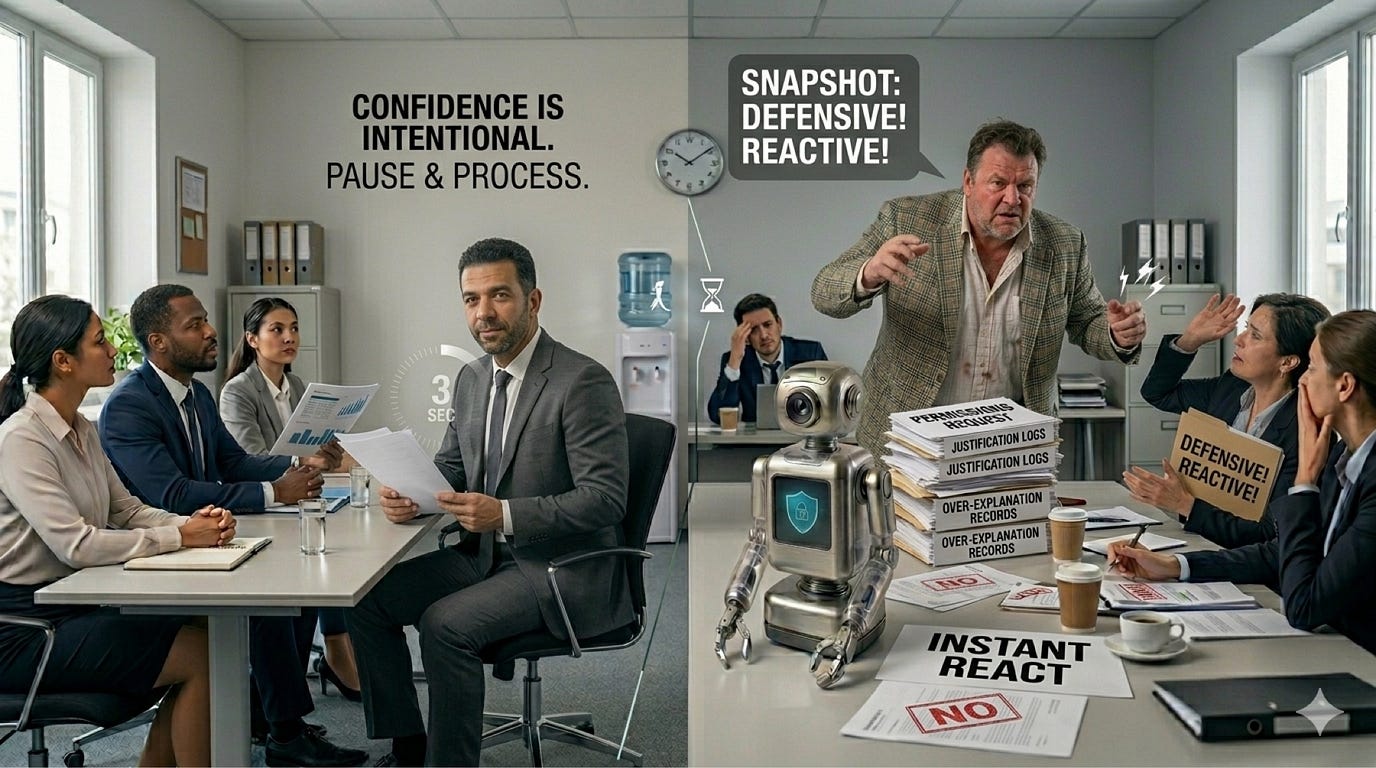
- Rudeness is almost always reactive. It happens when we feel cornered, defensive, or impatient, and we snap back instantly.
- Confidence is intentional. When you are asked a tough question or challenged, take a three-second pause.
- That silence can feel like an eternity, but to the observer, it makes you look like the most grounded person in the room. It signals that you are not easily rattled and that you have the mental space to process information before reacting. Silence is not weakness; it is a tool for control.
-
- Validate, Then Navigate
- You can hold your ground while still acknowledging the person in front of you. This is the hallmark of a high-EQ communicator. When you disagree, start by validating that you have heard them.
- “I can see why you’d see it that way, given the constraints we’re working under.”
- “That’s an interesting angle, and I appreciate the thought you put into that.”
- Once you’ve “met” them where they are, you can pivot to your own point. This ensures that the other person feels respected, which makes them far more likely to listen to your counterpoint with an open mind.
- The Takeaway
- Confidence is knowing what you bring to the table. Rudeness is trying to flip the table because you aren’t sure if you belong there.
- When you remove the need to prove yourself, you stop feeling the need to dominate. You start speaking with a calm, deliberate clarity that people naturally gravitate toward. You don’t have to be the loudest person in the room to lead it – you just have to be the one most comfortable in your own skin.
메타데이터
- post_id
- d023e8205af8
- slug
- the-art-of-quiet-authority-how-to-sound-confident-without-being-rude-d023e8205af8
- url
- https://medium.com/@spacemy211/the-art-of-quiet-authority-how-to-sound-confident-without-being-rude-d023e8205af8
- canonical_url
- https://medium.com/@spacemy211/the-art-of-quiet-authority-how-to-sound-confident-without-being-rude-d023e8205af8
- author_url
- https://medium.com/@spacemy211
- status
- ok
- fetched_at
- 2026-06-09 15:37:30


