Your Frontend Is Tightly Coupled to the Backend — And That’s a Scalability Risk
When frontend architecture depends too heavily on backend structure, every backend change becomes a frontend crisis.
Your Frontend Is Tightly Coupled to the Backend — And That’s a Scalability Risk
When frontend architecture depends too heavily on backend structure, every backend change becomes a frontend crisis.
One of the most common scalability problems in frontend systems is hidden coupling with the backend.
At first, everything feels fast.
Backend sends data. Frontend displays it.
Simple.
But as the product grows, frontend teams slowly become dependent on:
- backend response shapes
- backend naming conventions
- backend workflows
- backend release timing
- backend business logic
Now the frontend is no longer an independent system.
It becomes a rendering layer for backend decisions.
And that creates serious scalability problems.
The Coupling Usually Starts Small
A backend API returns:
{
  "first_name": "Dipak",
  "last_name": "Ahirav",
  "is_active": true
}
Frontend directly binds everything:
user.first_nameSeems harmless.
But months later backend changes:
{
  "givenName": "Dipak",
  "surname": "Ahirav",
  "status": "ACTIVE"
}
Now suddenly:
- UI breaks
- forms break
- filters break
- validation breaks
- tests fail
Why?
Because frontend architecture was tightly coupled to backend contracts.
The Real Problem
Frontend Stops Owning Its Own Domain
When frontend directly depends on backend structures:
- backend controls UI evolution
- backend changes ripple everywhere
- frontend flexibility disappears
The frontend becomes fragile.
Common Tight-Coupling Mistakes
❌ 1. Directly Using API Models Everywhere
export interface UserResponse {
  first_name: string;
  last_name: string;
}
Used across:
- components
- forms
- tables
- filters
- state management
Now API structure becomes application architecture.
Very dangerous.
❌ 2. Backend Naming Leaks Into UI
Frontend code becomes filled with:
- snake_case
- database terms
- legacy backend fields
Example:
customer_account_mstr_idNow frontend readability collapses.
❌ 3. Backend-Driven UI Logic
Example:
if (response.type_code === 'X12') {
   showPremiumFeature();
}
Business intelligence becomes scattered across API conditions.
Over time this becomes impossible to maintain.
Better Architecture
✅ Frontend Should Own Its Internal Model
Create frontend domain models:
export interface User {
  firstName: string;
  lastName: string;
  isActive: boolean;
}
Then transform API responses:
function mapUser(response: UserResponse): User {
  return {
    firstName: response.first_name,
    lastName: response.last_name,
    isActive: response.is_active
  };
}
Now backend changes affect:
- only mapping layer
— not the entire frontend.
Why This Architecture Scales Better
Now frontend becomes:
- independent
- adaptable
- maintainable
- easier to refactor
Teams can:
- redesign UI
- rename fields
- evolve state
- optimize workflows
without waiting for backend changes.
Real-World Enterprise Problem
Large enterprise systems often have:
- multiple backend teams
- legacy APIs
- inconsistent naming
- evolving contracts
Without frontend abstraction layers: every API change creates deployment risk.
This slows:
- releases
- testing
- feature development
- onboarding
The frontend becomes operationally fragile.
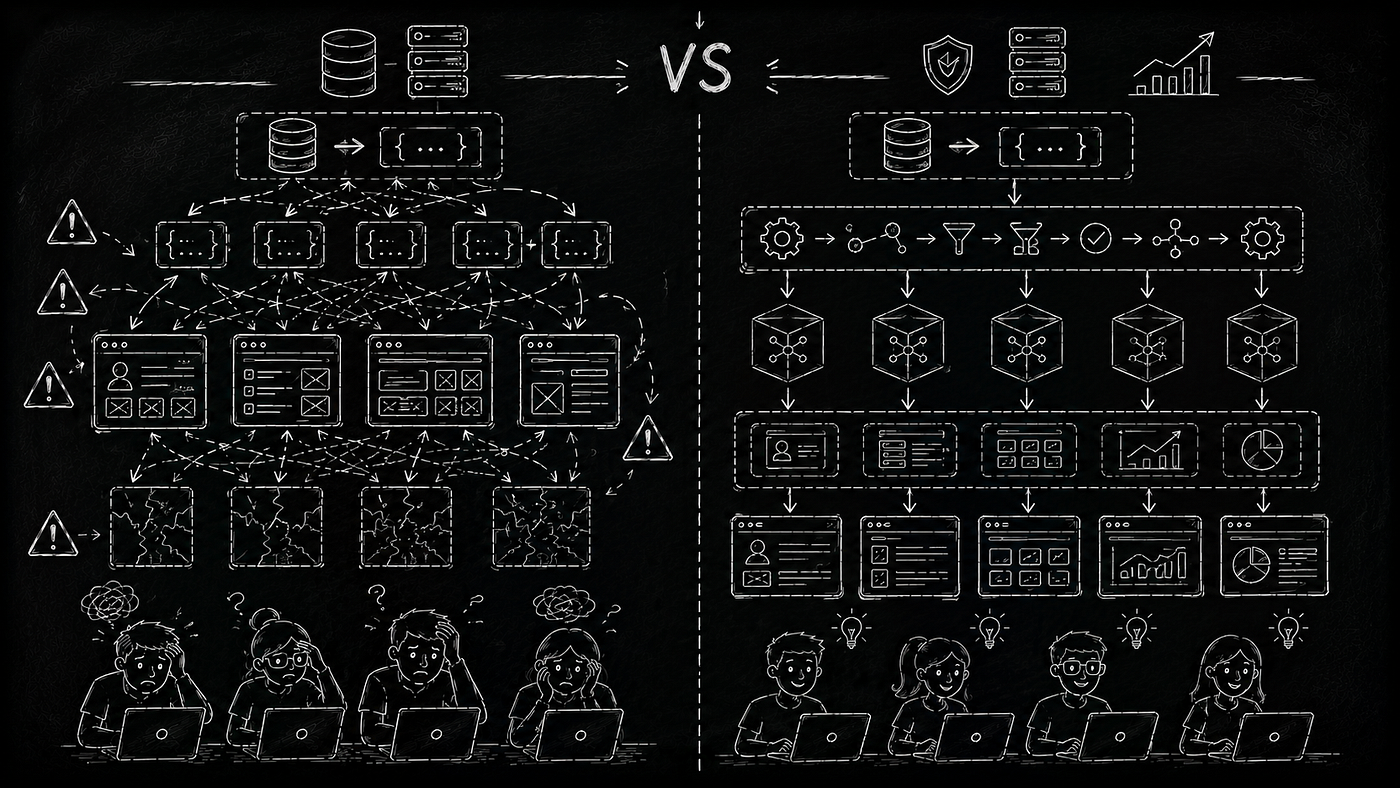
Bad Architecture vs Better Architecture
❌ Tight Coupling
Backend API
      ↓
Components
      ↓
Forms
      ↓
State
      ↓
Entire UI
One backend change impacts everything.
✅ Layered Frontend Architecture
Backend API
      ↓
Mapper Layer
      ↓
Frontend Domain Models
      ↓
UI Components
Now coupling is controlled and isolated.
Important Engineering Principle
APIs Are External Contracts
External contracts should never directly define internal architecture.
This principle exists in:
- frontend systems
- microservices
- distributed systems
- event-driven architectures
Senior engineers always isolate external dependencies.
Practical Example
❌ Bad
this.user.first_namespread across 200 components.
✅ Better
this.user.firstNamewith centralized transformation logic.
Now migrations become manageable.
Senior-Level Insight
Strong frontend architecture behaves like an independent application layer — not a passive API renderer.
The frontend should:
- own presentation logic
- own UI models
- own interaction flows
- own state abstraction
Backend and frontend should collaborate, not tightly control each other.
Final Takeaway
The more directly your frontend depends on backend structures, the harder your system becomes to evolve.
Scalable frontend systems isolate:
- API contracts
- backend naming
- transport structures
- external dependencies
Because architecture becomes scalable only when boundaries are respected.
Connect with Me
If you enjoyed this post and would like to stay updated with more content like this, feel free to connect with me on social media:
- Twitter : Follow me on Twitter for quick tips and updates.
- LinkedIn : Connect with me on LinkedIn
- YouTube : Subscribe to my YouTube Channel for video tutorials and live coding sessions.
- Dev.to : Follow me on Dev.to where I share more technical articles and insights.
- WhatsApp : Join my WhatsApp group to get instant notifications and chat about the latest in tech
Email: Email me on dipaksahirav@gmail.com for any questions, collaborations, or just to say hi!
I appreciate your support and look forward to connecting with you!
메타데이터
- post_id
- d03b4f714df1
- slug
- your-frontend-is-tightly-coupled-to-the-backend-and-thats-a-scalability-risk-d03b4f714df1
- url
- https://medium.com/angular-engineering/your-frontend-is-tightly-coupled-to-the-backend-and-thats-a-scalability-risk-d03b4f714df1
- canonical_url
- https://medium.com/angular-engineering/your-frontend-is-tightly-coupled-to-the-backend-and-thats-a-scalability-risk-d03b4f714df1
- author_url
- https://medium.com/@dipaksahirav
- status
- ok
- fetched_at
- 2026-06-09 14:34:10