Two Simple Exact Match Campaigns Every Amazon Seller Should Build
Exact match campaigns are often treated as the “serious” part of Amazon PPC.
Two Simple Exact Match Campaigns Every Amazon Seller Should Build
Exact match campaigns are often treated as the “serious” part of Amazon PPC.
Sellers run auto campaigns to explore, broad campaigns to discover variations, phrase campaigns to expand, and then exact match campaigns to finally take control.
That logic is right — but only if you use exact match at the right time.
Exact match is not where you should dump hundreds of untested keywords. It is where proven search terms go when they deserve cleaner bids, dedicated budget, and tighter performance tracking.
In other words, exact match is not your discovery engine. It is your control engine.
Why exact match works best after discovery
Amazon PPC works like a funnel.
Auto campaigns help Amazon test search terms and product placements based on your listing. Broad campaigns explore related language and variations. Phrase campaigns give you controlled expansion around keyword families.
Exact match sits at the bottom of that funnel.
By the time a keyword moves into exact match, it should already have some proof. That proof could come from search term reports, auto campaign conversions, phrase match performance, or strong keyword research.
The goal is not to target every possible keyword exactly. The goal is to isolate the keywords that matter most.
Campaign 1: Core exact match keywords
The first low-effort campaign every seller should build is a core exact match campaign.
This campaign is for high-value keywords that directly describe your product and have enough demand to matter. These are not random long-tail terms. They are the search terms most closely connected to your product’s buyer intent.
For example, if a keyword consistently gets clicks and orders in an auto campaign, it should not stay hidden inside a messy discovery campaign forever. Moving it into exact match lets you control the bid, protect the budget, and understand whether the term can support ranking or profitability.
A mature core exact campaign should usually be small. Think 10 to 50 tightly related keywords, not hundreds.
This makes optimization easier. You can see which terms deserve more budget, which bids need adjustment, and which keywords are spending without enough return.
Campaign 2: Long-tail exact match keywords
The second campaign is for long-tail exact keywords.
These terms usually have lower search volume, but they can be valuable because they are more specific and often less competitive. A shopper using a long-tail search may know exactly what they want.
Long-tail exact campaigns are useful for sellers who want cleaner traffic without competing only on expensive head terms.
The bid logic should be different from your core exact campaign. Core keywords may justify stronger bids because they influence visibility, sales volume, or keyword ranking. Long-tail keywords often need more conservative bids because the volume is smaller and the upside is more limited.
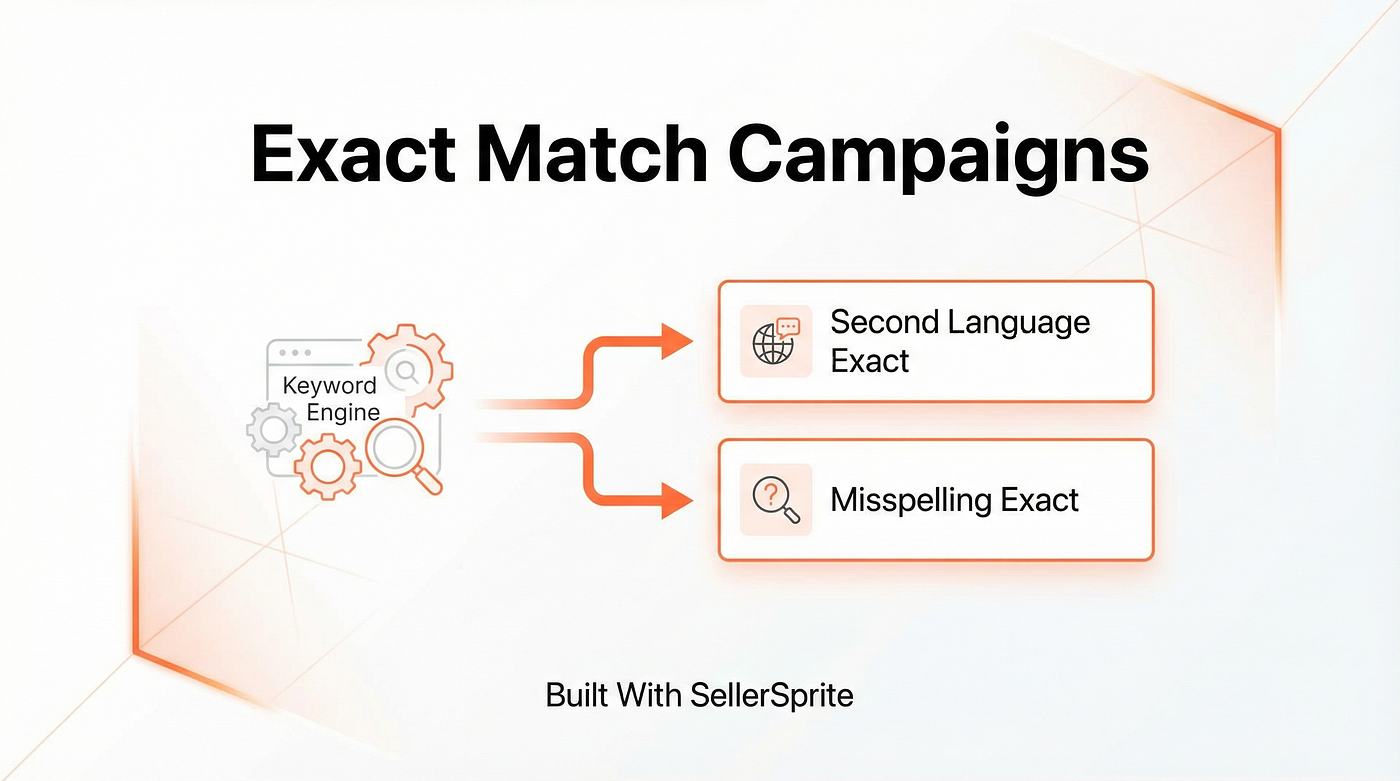
Use SellerSprite as your keyword engine
The hard part is not creating the campaign.
The hard part is deciding which keywords deserve exact match.
SellerSprite **Amazon keyword analysis tools** can help sellers filter potential exact match candidates using search volume, competition level, conversion intent, and CPC logic. Instead of chasing the biggest keyword, sellers can build a shortlist of terms that are commercially meaningful and realistic for their margin.
A good workflow looks like this:
Start with search term data from auto, broad, and phrase campaigns. Use SellerSprite to check demand, competition, and relevance. Remove keywords that are too broad, too expensive, or unlikely to convert. Then export the strongest candidates into focused exact match campaigns.
Optimize on a weekly rhythm
Exact match does not mean you can stop optimizing.
Review performance every seven days instead of reacting emotionally after a few clicks. Raise bids on keywords that convert and need more impression share. Lower bids on keywords that spend without sales. Add negatives when discovery campaigns overlap too much or create wasted traffic.
The goal is not simply to lower ACoS.
The goal is to protect your winners and buy profitable position.
Final thought
Exact match campaigns are powerful because they create focus.
Use one campaign for proven core terms and another for long-tail exact opportunities. Keep both campaigns small, readable, and connected to real data.
Auto, broad, and phrase campaigns help you discover.
Exact match helps you control.
That is how Amazon sellers turn keyword research into a PPC system that can scale with discipline.
Continue Your Learning Journey
Visit the full course directory to read every chapter of the SellerSprite Amazon FBA Beginner to Master Course. 👉 **Open Amazon Beginner to Master Course Directory →**
메타데이터
- post_id
- d041c0da8aef
- slug
- two-simple-exact-match-campaigns-every-amazon-seller-should-build-d041c0da8aef
- url
- https://medium.com/@yyfun001/two-simple-exact-match-campaigns-every-amazon-seller-should-build-d041c0da8aef
- canonical_url
- https://medium.com/@yyfun001/two-simple-exact-match-campaigns-every-amazon-seller-should-build-d041c0da8aef
- author_url
- https://medium.com/@yyfun001
- status
- ok
- fetched_at
- 2026-07-11 16:08:17