Data Analytics Course in Telugu for Future Data Analysts
Data has become an important part of how modern organizations understand customers, measure performance, and plan future strategies. As…
Data Analytics Course in Telugu for Future Data Analysts
Data Analytics Course in Telugu
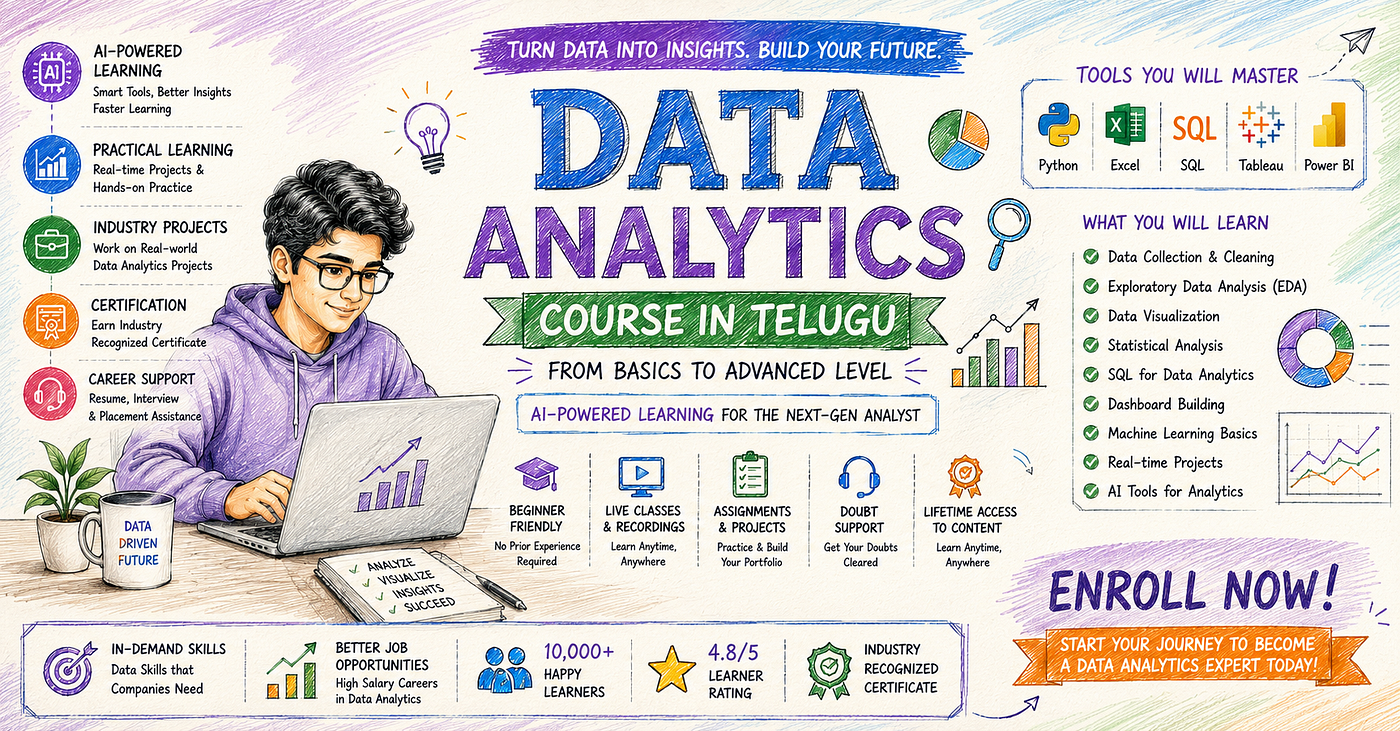
Data has become an important part of how modern organizations understand customers, measure performance, and plan future strategies. As businesses continue to adopt data-driven decision-making, the need for professionals who can examine information and communicate useful findings is creating opportunities for aspiring analysts. A **Data Analytics Course in Telugu** can offer future data analysts a structured way to develop foundational and practical skills while learning complex concepts through a familiar language. With consistent practice and exposure to real-world analytical tasks, beginners can gradually prepare themselves for the expectations of the data analytics field.
Build a Clear Understanding of the Analyst Role
A data analyst does more than work with spreadsheets or create charts. Analysts help organizations understand what their data is saying and use those findings to support informed decisions.
The role may involve examining business questions, collecting relevant information, cleaning datasets, identifying trends, preparing reports, and communicating conclusions. Understanding these responsibilities early can help learners develop the right mindset for their career journey.
Rather than focusing entirely on software, aspiring analysts should learn how technology, business requirements, and analytical thinking work together.
Begin with Essential Data Fundamentals
A strong foundation makes advanced analytical concepts easier to understand. Beginners can start by learning how data is represented, organized, stored, and interpreted.
Basic concepts such as numerical and categorical information, variables, datasets, records, and data quality provide useful groundwork. Learners can also become familiar with basic statistical ideas that are frequently used when examining business information.
This foundation allows students to understand what their analytical tools are actually processing instead of simply following technical instructions.
Develop Skills for Handling Business Data
Future analysts will likely encounter information from different sources and in different formats. Learning how to inspect and organize datasets is therefore an important part of professional preparation.
Students can practice examining columns, identifying relevant fields, recognizing inconsistencies, and preparing data for analysis. They can also learn why duplicate records, missing values, and inconsistent categories can affect analytical results.
Developing careful data-handling habits early can help learners become more accurate and systematic in their future work.
Learn SQL for Database Analysis
Many organizations store operational and customer information in databases, making SQL an important skill for aspiring analysts. SQL allows professionals to retrieve specific information and generate summaries from structured data.
Learners can gradually become comfortable with queries that filter records, combine tables, group information, and calculate metrics. These skills can then be applied to practical business questions.
For example, a future analyst might use database information to examine customer purchasing patterns or compare revenue across different product categories.
Explore Python as an Analytical Tool
Python can support several stages of the analytical process, including data preparation, calculations, visualization, and automation. Learning Python can therefore expand the range of tasks an aspiring analyst can handle.
Beginners can start with basic programming concepts and gradually move toward libraries designed for working with datasets. Practical exercises can involve loading information, cleaning records, calculating values, and examining trends.
A Data Analytics Course in Telugu can make this progression easier for learners who are new to programming by providing explanations in a familiar language while gradually introducing professional terminology.
Create Meaningful Data Visualizations
Future analysts need to communicate findings as well as discover them. Visualization tools can help transform large amounts of information into understandable reports.
Learners can explore how different chart types are suitable for different analytical purposes. A line chart may help show a trend over time, while a bar chart can make category comparisons easier.
As students gain experience, they can move toward dashboards that combine multiple metrics and allow users to explore information interactively.
Develop Analytical Problem-Solving Skills
Technical knowledge becomes more valuable when it can be applied to a meaningful problem. Analysts frequently receive broad business questions that require investigation rather than simple calculations.
For example, if customer sales decrease, an analyst may need to determine whether the change is related to customer segments, product demand, pricing, seasonality, or other factors.
Learning to break a broad question into smaller analytical tasks can help aspiring professionals develop stronger reasoning abilities.
Practice Through Realistic Projects
Projects can help future analysts understand what an analytical workflow feels like in practice. A project may begin with a business question and continue through data preparation, exploration, analysis, visualization, and reporting.
Students can work on scenarios involving retail sales, customer behavior, employee information, marketing performance, or online business activity.
Completing different types of projects can expose learners to varied datasets and encourage them to adapt their analytical approach according to the problem.
Learn to Explain Insights Clearly
A useful finding has little impact if stakeholders cannot understand it. Future analysts should therefore develop the ability to communicate analytical results in straightforward language.
A good explanation can describe what was examined, what patterns were identified, why those findings matter, and what action may be considered.
Students can practice writing short analytical summaries or presenting dashboards to develop this communication ability. These activities can help bridge the gap between technical analysis and business decision-making.
Develop a Professional Learning Mindset
The analytics field continues to evolve, so future analysts need to remain open to learning new technologies and methods. Instead of trying to master every available tool at once, learners can focus on developing strong fundamentals.
Understanding data structures, analytical reasoning, SQL, visualization, and basic programming provides a foundation that can support future specialization.
Continuous practice also helps learners become more comfortable with unfamiliar datasets and analytical challenges.
Prepare a Portfolio for Future Opportunities
A portfolio can help aspiring analysts demonstrate practical capabilities. Instead of only listing tools on a resume, learners can showcase projects that explain how they approached specific analytical problems.
Each project can describe the objective, dataset, preparation process, analysis, visualizations, and conclusions. This gives potential employers a clearer view of the candidate’s practical abilities.
A Data Analytics Course in Telugu with project-based learning can help students create meaningful work samples while developing their technical skills.
Connect Training with Career Preparation
Future data analysts can benefit from understanding workplace expectations while they are learning. Training can include practical assignments, case studies, project presentations, and analytical problem-solving exercises.
These activities can help learners become more comfortable discussing their work and explaining why they selected particular methods.
Developing both technical and professional skills can create a more balanced foundation for pursuing entry-level opportunities.
Conclusion
Becoming a data analyst requires a combination of technical knowledge, analytical thinking, business understanding, and communication skills. Starting with strong fundamentals and gradually progressing toward practical projects can make the learning journey more manageable for beginners.
A Data Analytics Course in Telugu can provide future data analysts with an accessible pathway to develop these capabilities through structured learning and hands-on practice. By building skills in data preparation, SQL, Python, visualization, problem-solving, and reporting, learners can establish a strong foundation for continued growth in the data analytics profession.
메타데이터
- post_id
- d06d3de5c2e1
- slug
- data-analytics-course-in-telugu-for-future-data-analysts-d06d3de5c2e1
- url
- https://medium.com/@trinayansriprasan/data-analytics-course-in-telugu-for-future-data-analysts-d06d3de5c2e1
- canonical_url
- https://medium.com/@trinayansriprasan/data-analytics-course-in-telugu-for-future-data-analysts-d06d3de5c2e1
- author_url
- https://medium.com/@trinayansriprasan
- status
- ok
- fetched_at
- 2026-08-17 22:54:14