Dissecting the Tiers of Play Part 1 (Local Heroes)
‘Keeping things realistic’ was a common concern of mine when I first started playing D&D, particularly when my players progressed into the…
Dissecting the Tiers of Play Part 1 (Local Heroes)
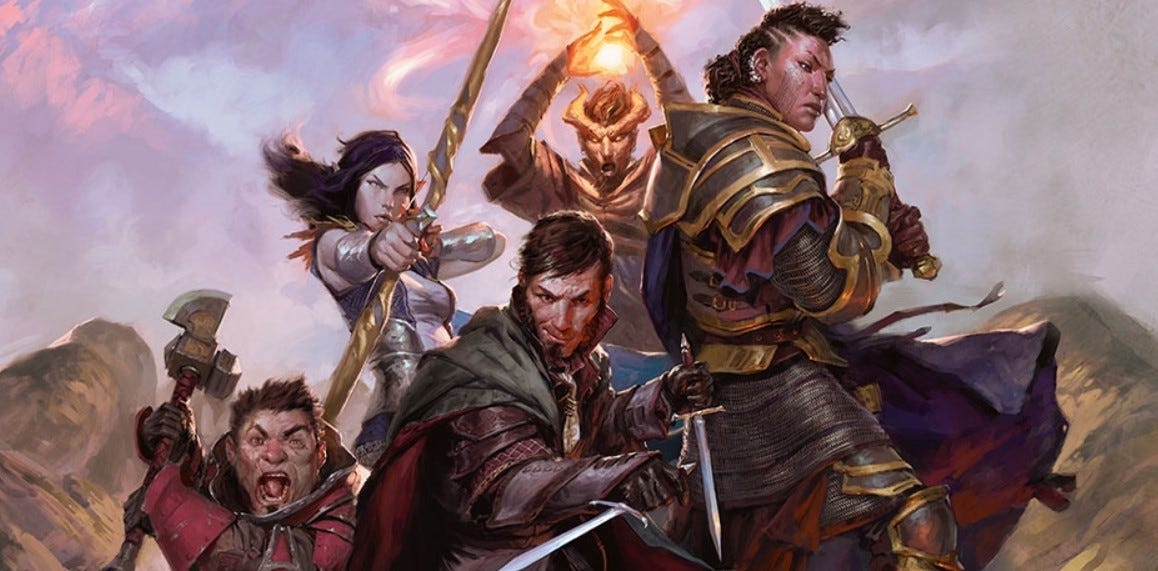
‘Local Heroes’ adventures are for parties just starting to establish themselves. They are the origin stories of D&D.
‘Keeping things realistic’ was a common concern of mine when I first started playing D&D, particularly when my players progressed into the second tier of play. I wondered about things like rules for instant death from falling, being submerged in acid or lava, or how the narrative could possibly account for a character being in the middle of a Fireball.
How, exactly, could player characters survive all this without it seeming just a little ridiculous?
A video by the Dungeon Dudes about the tiers of play actually settled this issue for me. They mentioned that, at the uppermost tiers of play, characters are less like ordinary humans and more like DC and Marvel Comics superheroes.
Take your standard, non-magical Champion Fighter and what you have is essentially a peerless athlete who can run, climb, jump, swim and punch for days, trained in a plethora of weaponry to the point of mastery, who hits like a freight train, consistently and often, and who can take a pummelling — including falling from buildings and being thrown through stone walls — just to jump right back into the fight.
What you have is Captain America.
Equip them with Winged Boots and a Dwarven Thrower and you’ve got Thor.
Since this lens helped to put things in perspective for me, I decided to dissect the tiers of play so that we can see what’s really going on in these four stages of a player character’s journey.
Unfortunately, the 2024 Dungeon Master’s Guide is woefully bereft of mention of the tiers of play, and the 2024 Player Handbook mentions them only briefly, so I’ll mostly be drawing my references from the 2014 DMG instead.
The first post on this subject is dedicated to Tier 1, levels 1 to 4, also known as the ‘Local Heroes’ tier.
To start, the DMG mentions that ‘even 1st-level characters are heroes’. This is an important quote because it means even if 1st-level characters feel weak to us as players, they are still a cut above the average person.
A party in this bracket is probably going to be spending its time fighting bandits, goblins, orcs, gnolls, etc. The mooks of the D&D worlds. Monsters that threaten ‘local farmsteads and villages’ according to the 2024 PHB. This means the action of a Tier 1 campaign will likely take place in a town or village like Phandalin, a city district like the Dock Ward of Waterdeep, or maybe the first couple of settlements in a place like Barovia.
A big creature like an ogre is going to cause the group some consternation, while a stronger or tougher creature like a troll or a hill giant will be extremely dangerous. They’re also unlikely to be fighting anything with Legendary Actions or Resistances, though attempts have been made to introduce such creatures at lower levels, possibly to act as ‘final boss’ or recurring nemesis encounters (see the Book of Many Things’ Ambitious Assassin or Fate Hag).
Crowd control remains an issue, because high-damage AOE spells like Fireball, Lightning Bolt and other game changers are not available. Martial classes don’t yet have multiple attacks. The highest modifier any character is likely to have to hit is +7, same as the highest save proficiency. The highest spell save DC reasonably possible is 15, but this is unlikely. Magic items are also not especially plentiful or powerful at this tier.
Major damage from things like falling, powerful spells or dangerous traps will be difficult for players to manage. Paladins will have a maximum 20hp in their ‘Lay on Hands’ pool and Cure Wounds will restore 25hp at absolute maximum (assuming a Life Cleric upcasting to Level 2, Wisdom 20, max on the dice). Players will have 4 hit dice maximum.
What does this mean for how we run the game?
Tier 1 games are best centred around close, intimate action rather than expansive conflicts. Mundane perils are still potentially lethal at this stage, so navigating a steep drop, a rickety rope bridge or even a single trap can still seem challenging. Players don’t have spells that let them just skip huge parts of dungeons and they don’t have the hit points to just soak damage.
They can’t fly, can’t swim very well and will struggle with difficult terrain, so cluttered or three-dimensional combats will be extremely difficult to navigate.
Note, however, that player characters are still the ones to get things done. They’re just not going to be getting involved in national politics (or interplanetary warfare) right at this minute.
Instead, Tier 1 heroes will likely spend their time on local issues. If a village’s trade route is threatened by a bandit crew, if a beleaguered sheriff is having trouble with ‘that new thieves’ guild’, if a monster is making off with all the goats, they are the ones to call. These ‘humble’ origins presage what could be a storied adventuring career, because they demonstrate the characters’ desire to have an impact on the world around them and their effectiveness against the problems that stand in their way.
As such, ideal ‘final boss’ encounters for this tier tend to be the leaders of local gangs or their toughest enforcers (e.g. gladiator, half-dragon), a somewhat rare and dreaded monster (e.g. troll, hill giant), or low-level extra-planar intruders (e.g. night hag, salamander). CR5 monsters are probably the pinnacle at this tier, unless you have more than four players at the table.
These also tend to be more impressive if everything has been building up to these encounters. Maybe an elemental cult has summoned the salamander to run amok in the city district and lost control of it, or maybe the troll has moved into the area, scaring the lesser monsters closer to the village.
Dungeons in this tier should usually be pretty simple. In fact, the Five-Room Dungeon approach seems especially well-suited to this tier because it maximises content while minimising length, and allows for a good mix of encounters. The Green Hag dungeon in Baldur’s Gate 3 is an excellent example (Riverside Teahouse (roleplay) > Entrance Gallery (exploration) > Overgrown Tunnel (combat) > The Descent (trapped exploration) > Ancient Abode (final combat)).
Sadly, dragons don’t make great antagonists for this tier, because even the weakest young dragon is probably still a little much for Tier 1 heroes to handle. A single use of a Young White Dragon’s breath weapon could easily wipe out an entire Level 4 party.
This means that the characters are unlikely to be facing any supremely powerful, stand-alone enemies like major devils, high-level spellcasters or anything above a juvenile dragon. Instead, small groups led by a personality-heavy mastermind of some kind are preferable, with a big-hitting monster or NPC to serve as a major obstacle or additional complication in reserve.
Rewards are also not likely to be major, with maybe a small business or dwelling in a village or neighbourhood, a single rare magic item and the gratitude of the NPCs involved up for grabs. These things will need to be emotionally meaningful where they are not mechanically powerful.
Tier 1 adventures can still be powerful though. If the characters are connected to the story in a personal way, if there are opportunities to advance themselves both emotionally and in terms of status, if the NPCs are sympathetic and relatable to them, and if their adversaries leave a mark on them and their lives, the end of even a low-level campaign can feel extremely satisfying. Perhaps more so than high-level campaigns because the stakes feel solid and significant.
Waterdeep: Dragon Heist and Lost Mine of Phandelver are excellent examples of these kinds of campaigns from Wizards’ own library of adventures. They show what a Tier 1 campaign can be and what elements make them interesting.
They also make good seeds for longer adventures too. Issues raised in a Tier 1 adventure can easily be expanded out into Tier 2. Perhaps the villain of the Tier 1 campaign was in the employ or thrall of a more powerful creature, or perhaps an NPC the characters helped knows someone else who might benefit from their assistance.
But that’s something to discuss when we talk about Tier 2 adventures.
메타데이터
- post_id
- d08ea414dca6
- slug
- dissecting-the-tiers-of-play-part-1-local-heroes-d08ea414dca6
- url
- https://medium.com/@FateAndFlannel/dissecting-the-tiers-of-play-part-1-local-heroes-d08ea414dca6
- canonical_url
- https://medium.com/@FateAndFlannel/dissecting-the-tiers-of-play-part-1-local-heroes-d08ea414dca6
- author_url
- https://medium.com/@FateAndFlannel
- status
- ok
- fetched_at
- 2026-07-09 00:50:33