Sunlight, UV, and Cancer: Why the Mainstream Story Is Incomplete
The sun is not isolated UV. It is a full-spectrum biological signal.
Sunlight, UV, and Cancer: Why the Mainstream Story Is Incomplete
The sun is not isolated UV. It is a full-spectrum biological signal.
By Kendall Toerner — Founder of Unlearn Health
Originally published on Unlearn Health: https://unlearnhealth.com/content/sunlight-uv-and-cancer-why-the-mainstream-story-is-incomplete
Modern health advice often treats sunlight as a hazard with a simple story: UV damages DNA, DNA damage can lead to cancer, therefore sunlight should be minimized.
That story contains a truth, but it is not the whole truth.
Yes, ultraviolet light can create molecular stress. Yes, sunburn is harmful. Yes, repeated burning is not a health practice. But the leap from “UV can damage DNA” to “sunlight is dangerous” is where the mainstream model becomes incomplete.
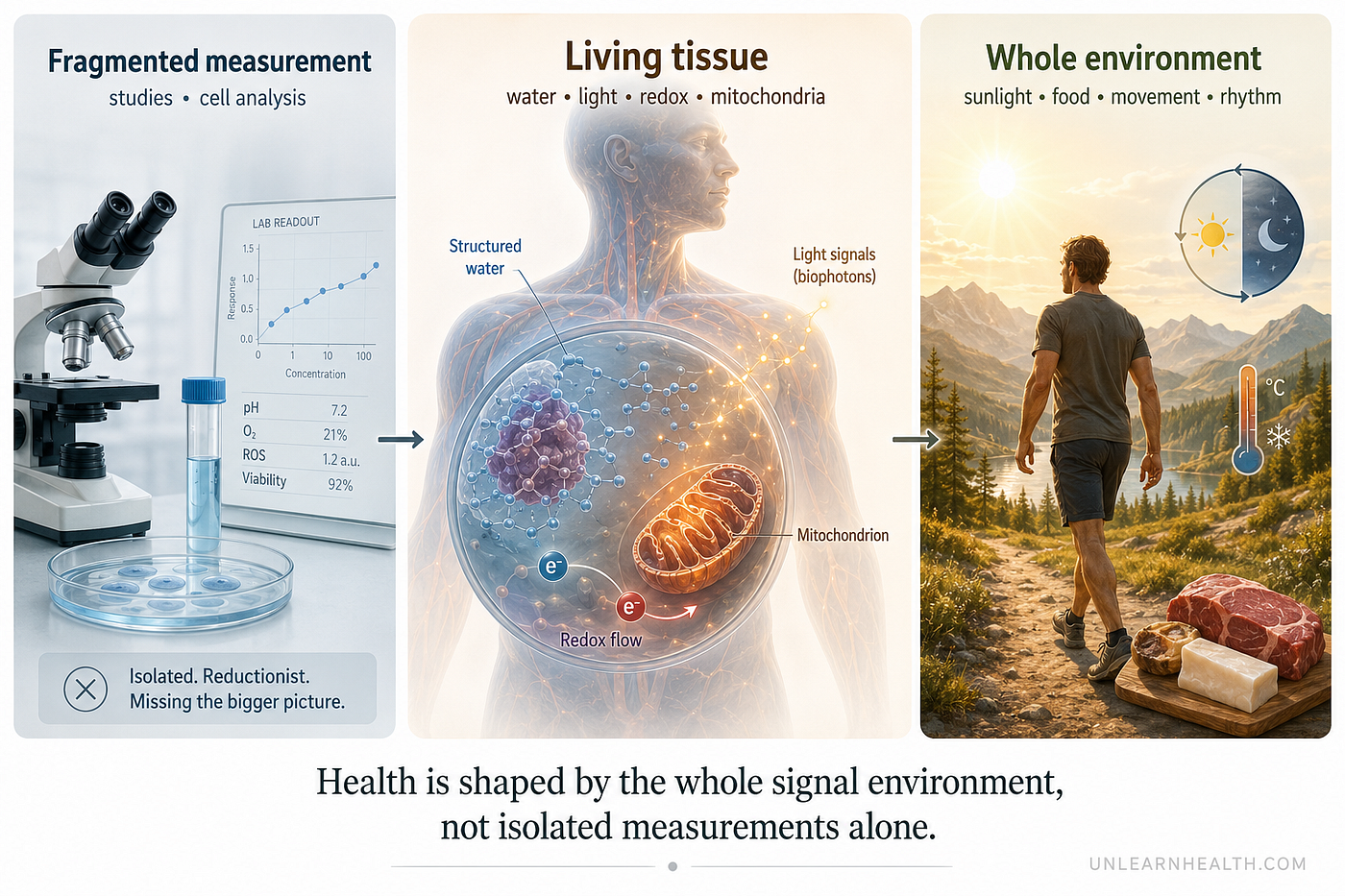
Human biology did not evolve under isolated UV lamps. It evolved under the full solar spectrum: morning light, UVA, UVB, visible light, red light, infrared, heat, brightness, seasonal variation, and darkness at night. The body does not receive sunlight as a single damaging input. It receives sunlight as environmental information.
That distinction changes everything.
For the full implementation protocols and experiments, see the Unlearn Health Protocols Library.

The main error: confusing UV with sunlight
The anti-sun narrative usually begins with one real mechanism. UV photons can interact with DNA and increase repair demand. In a narrow laboratory frame, that is true.
But biology is not a flat chemical surface.
Skin is living tissue embedded in circadian rhythm, mitochondrial signaling, melanin, antioxidant systems, immune surveillance, apoptosis, nitric oxide biology, tissue architecture, hormones, sleep, and repair. A molecular event is not the same thing as a disease outcome.
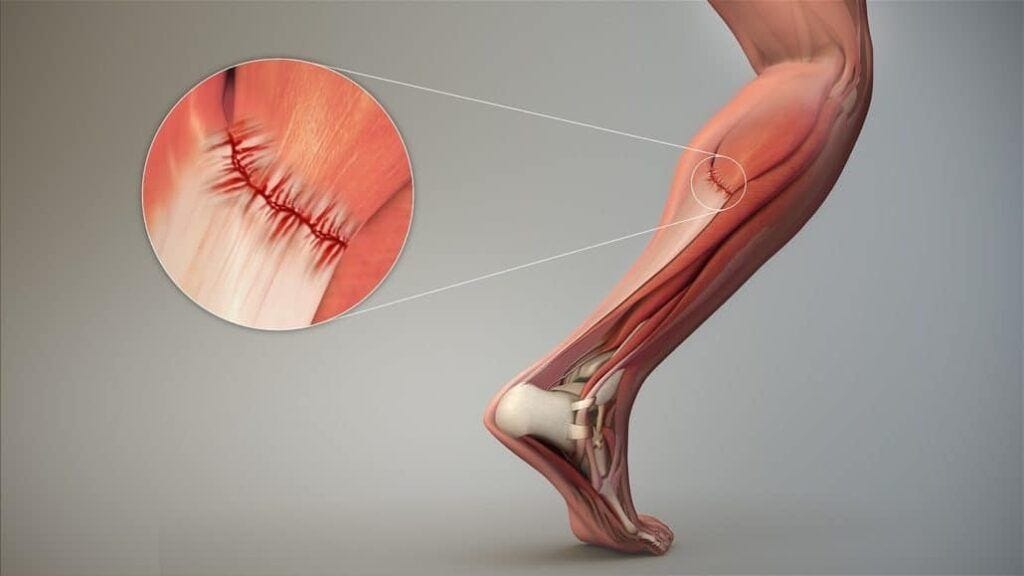
This is the same reason nobody says exercise is bad simply because it damages muscle fibers. Nobody says oxygen is bad simply because it can create oxidative stress. Nobody says fasting is bad simply because it creates metabolic stress.
Living systems are not designed to avoid all stress. They are designed to encounter the right stressors, in the right pattern, with the right repair cycle.
Sunlight has been judged inside the wrong frame: UV without infrared, damage without repair, exposure without rhythm, skin without the organism, and radiation without ecology.
The better question is not, “Can UV create damage?”
The better question is: What happens when a living, adapted organism receives full-spectrum sunlight gradually, rhythmically, and in the environmental context it evolved to expect?
DNA damage is not cancer
“DNA damage” is often used as if it automatically means cancer. But the body experiences molecular injury constantly.
Normal metabolism creates reactive oxygen species. Immune defense creates inflammatory chemistry. Exercise creates tissue microdamage. Heat, cold, fasting, movement, infection, and even oxygen create repair demands.
Cancer is not simply “DNA was touched.”
Cancer requires failed repair, failed apoptosis, failed immune surveillance, mitochondrial instability, tissue dysfunction, inflammatory permission, and time. A damaged cell has to avoid multiple layers of biological control before it becomes a serious problem.
This is where the sunlight story becomes far more interesting.
DNA repair is tied to circadian timing. Melatonin is tied to darkness. Mitochondrial redox is tied to light exposure. Immune surveillance is tied to sleep, rhythm, and environmental coherence. The same UV exposure does not land in the same biological context if the person is sleeping poorly, living under artificial light at night, missing morning light, avoiding daytime brightness, eating out of season, and then suddenly burning on vacation.
That is not ancestral sunlight exposure.
That is solar whiplash.
The modern person is not naturally sun-exposed
A person who works indoors all week, sits under dim artificial light during the day, stares into blue-heavy light at night, sleeps poorly, avoids morning sun, and then gets intense weekend UV is not living in a natural solar environment.
They are living in a light mismatch.
The modern pattern removes the signals that build adaptation, then blames the sun when an unadapted body cannot handle sudden intensity.
A useful comparison is a seedling. Gardeners do not grow a seedling indoors under weak light and then throw it into full summer sun all day. They harden it off gradually. The problem is not that the sun is bad. The problem is that the organism was not prepared for the signal.
Humans are similar.
The body expects a sequence. Morning light comes first. Daytime brightness anchors circadian rhythm. Infrared and red light arrive with natural sunlight. UV exposure rises gradually with season and time of day. Skin adapts. Melanin increases. Behavior adjusts. Darkness follows. Repair happens at night.
Modern life breaks the sequence, then treats the sun as the villain.
Sunburn is not the goal
The pro-sunlight argument should never be confused with a pro-burning argument.
Sunburn is a sign that current exposure exceeded current capacity. It is not proof that sunlight is inherently bad. It is proof that dose, timing, adaptation, pigmentation, skin type, season, latitude, and biological state matter.
Food can make you vomit if you eat too much. That does not mean food is toxic. Exercise can injure you if you overload tissue too quickly. That does not mean movement is bad.
Sunlight is similar. The body needs skillful exposure, not reckless exposure and not total avoidance.
The mainstream model often gives people only two choices: fear the sun or burn in it.
The better choice is adaptation.
Sunlight is more than vitamin D
Another major mistake is reducing sunlight to vitamin D.
Vitamin D matters, but sunlight is not a vitamin D delivery system. It is a whole-body environmental signal.
Sunlight enters the eye and anchors circadian timing. UVA interacts with nitric oxide pathways in the skin and blood vessels. Red and near-infrared light interact with mitochondrial signaling and tissue repair pathways. Bright outdoor light strengthens the day-night contrast that supports melatonin at night. UVB helps produce vitamin D. Seasonal light informs seasonal biology.
A vitamin D capsule cannot reproduce that.
This is like saying food is only calories or exercise is only muscle contraction. Technically true in one narrow sense, but biologically incomplete.
Sunlight is spectrum, timing, heat, brightness, skin, eyes, mitochondria, blood flow, sleep, and repair.
The carcinogen label is too crude
Calling sunlight a carcinogen may make sense inside a narrow hazard-classification system. But hazard classification does not equal whole-body health strategy.
Oxygen can oxidize. Iron can create oxidative stress. Exercise can damage tissue. Immune activation can inflame. Many essential biological inputs become harmful in excess, in isolation, or in the wrong context.
The question is not whether sunlight can participate in damage under some conditions.
The question is what happens when humans avoid sunlight for years.
What happens to circadian rhythm? What happens to sleep? What happens to nitric oxide biology? What happens to blood pressure, mood, mitochondrial signaling, immune rhythm, vitamin D physiology, and seasonal regulation?
A label does not answer those questions.
The mainstream conversation often focuses intensely on skin risk while underweighting systemic biology. But sunlight is not only a skin issue. It is a whole-organism environmental input.
Artificial light is not neutral
Indoor living is often treated as the safe default. That assumption deserves more scrutiny.
Artificial light is not simply “less sunlight.” It is a different signal environment.
Most indoor life gives the body weak daytime light, too much light at night, low infrared exposure, poor UV exposure, poor outdoor brightness, and flattened seasonal rhythm. This creates a world where the body receives summer-like artificial cues at night while missing the solar signals that normally organize repair during the day.
That is not neutral.
From a biophysical perspective, the modern problem is not merely “too much sun.” It is too little real light during the day, too much artificial light at night, and too many sudden exposures to strong sun without gradual adaptation.
The body is not confused by the sun. It is confused by the mismatch.
The sun is not just a risk. It is a regulator.
The deeper model is simple: sunlight is a regulatory force.
It helps set biological time. It shapes skin adaptation. It supports nitric oxide signaling. It influences mood and activity. It interacts with mitochondrial biology. It helps create contrast between day and night. It participates in vitamin D production. It trains the body to respond to season, heat, brightness, and environmental rhythm.
That does not mean more is always better.
It means sunlight belongs in the category of essential environmental inputs that require intelligence, timing, and adaptation.
Water is essential, but you can drown. Food is essential, but overeating harms. Movement is essential, but overload injures. Heat and cold can strengthen or damage depending on dose and context.
Sunlight works the same way.
The goal is not maximum exposure. The goal is biological coherence.
A better sunlight model
A more complete model would stop asking whether the sun is “good” or “bad” and start asking better questions:
How adapted is the person?
Are they getting morning light?
Are they sleeping in real darkness?
Are they avoiding artificial light at night?
Are they building exposure gradually?
Are they burning?
Are they receiving full-spectrum outdoor light or isolated artificial light?
Is the skin responding with adaptation or injury?
Is the body receiving sunlight as part of a daily rhythm or as an occasional shock?
These questions are more useful than blanket avoidance.
The safest person is not necessarily the person who avoids UV forever. The safer person may be the person whose biology is adapted, whose circadian rhythm is strong, whose sleep is protected, whose melatonin rhythm is intact, whose exposure is gradual, and whose relationship with the sun is built on rhythm rather than fear.
The mainstream story is incomplete
The mainstream story is not entirely wrong. UV can damage DNA. Burning should be avoided. Some exposure patterns increase risk. Skin type matters. Dose matters.
But the mainstream story becomes incomplete when it treats sunlight as isolated UV, treats DNA damage as destiny, treats indoor living as neutral, treats vitamin D as the whole benefit, and treats avoidance as the safest long-term strategy.
The sun is not merely a carcinogenic hazard in the sky. It is the original environmental signal around which human biology organized itself.
The real danger is not sunlight itself. The real danger is losing the biological context that makes sunlight usable: morning light, gradual exposure, outdoor brightness, full-spectrum rhythm, darkness at night, mitochondrial repair, melatonin, and seasonal adaptation.
Sunlight is not the enemy.
Mismatch is the enemy.
Burning is the enemy.
Artificial light at the wrong time is the enemy.
A body cut off from the environment it evolved inside is the enemy.
The future of health will require a more intelligent sunlight model. Not reckless sun worship. Not institutional sun fear. Something more mature: a biology-first understanding of sunlight as information, stress, rhythm, repair, and regulation.
That is the story the mainstream model still has not fully told.
This article is not an argument for burning, reckless exposure, or ignoring individual skin cancer risk. It is an argument for a more complete model of sunlight biology: one that distinguishes full-spectrum, gradually adapted sunlight exposure from isolated UV damage, sunburn, and modern light mismatch.
Unlearn Health
Kendall Toerner is the founder of Unlearn Health, a research project exploring how environmental signals — light, energy, and circadian timing — optimize or destroy human biology.
More articles: https://unlearnhealth.com Protocols and experiments: https://unlearnhealth.substack.com
References
[1] World Health Organization. Radiation: Ultraviolet (UV) radiation and skin cancer. https://www.who.int/news-room/questions-and-answers/item/radiation-ultraviolet-(uv)-radiation-and-skin-cancer
[2] Lucas RM, McMichael AJ, Armstrong BK, Smith WT. Estimating the global disease burden due to ultraviolet radiation exposure. International Journal of Epidemiology. 2008. https://pubmed.ncbi.nlm.nih.gov/18276627/
[3] Juzeniene A, Moan J. Beneficial effects of UV radiation other than via vitamin D production. Dermato-Endocrinology. 2012. https://pubmed.ncbi.nlm.nih.gov/22928066/
[4] Weller RB. Sunlight has cardiovascular benefits independently of vitamin D. Blood Purification. 2016. https://pubmed.ncbi.nlm.nih.gov/27195028/
[5] Opländer C, Volkmar CM, Paunel-Görgülü A, Paunel-Görgülü A, et al. Whole body UVA irradiation lowers systemic blood pressure by release of nitric oxide from intracutaneous photolabile nitric oxide derivates. Circulation Research. 2009. https://pubmed.ncbi.nlm.nih.gov/19661440/
[6] Diffey BL. Solar ultraviolet radiation effects on biological systems. Physics in Medicine and Biology. 1991. https://pubmed.ncbi.nlm.nih.gov/1962191/
[7] Sancar A. Mechanisms of DNA repair by photolyase and excision nuclease. Nobel Lecture / DNA repair overview. https://pubmed.ncbi.nlm.nih.gov/26534211/
[8] Reiter RJ, Tan DX, Korkmaz A, Rosales-Corral SA. Melatonin and stable circadian rhythms optimize maternal, placental and fetal physiology. Human Reproduction Update. 2014. https://pubmed.ncbi.nlm.nih.gov/24012774/
[9] Erren TC, Reiter RJ. Light hygiene: Time to make preventive use of insights. Medical Hypotheses. 2009. https://pubmed.ncbi.nlm.nih.gov/19110343/
[10] Institute of Medicine. Dietary Reference Intakes for Calcium and Vitamin D. National Academies Press. 2011. https://www.ncbi.nlm.nih.gov/books/NBK56070/
[11] Alfredsson L, Armstrong BK, Butterfield DA, et al. Insufficient sun exposure has become a real public health problem. International Journal of Environmental Research and Public Health. 2020. https://pubmed.ncbi.nlm.nih.gov/31968633/
[12] Holick MF. Vitamin D Deficiency. New England Journal of Medicine. 2007. https://pubmed.ncbi.nlm.nih.gov/17634462/
Originally published at https://unlearnhealth.com.
메타데이터
- post_id
- d093cfe26f9b
- slug
- sunlight-uv-and-cancer-why-the-mainstream-story-is-incomplete-d093cfe26f9b
- url
- https://medium.com/@unlearnhealth/sunlight-uv-and-cancer-why-the-mainstream-story-is-incomplete-d093cfe26f9b
- canonical_url
- https://medium.com/@unlearnhealth/sunlight-uv-and-cancer-why-the-mainstream-story-is-incomplete-d093cfe26f9b
- author_url
- https://medium.com/@unlearnhealth
- status
- ok
- fetched_at
- 2026-06-09 15:37:30